
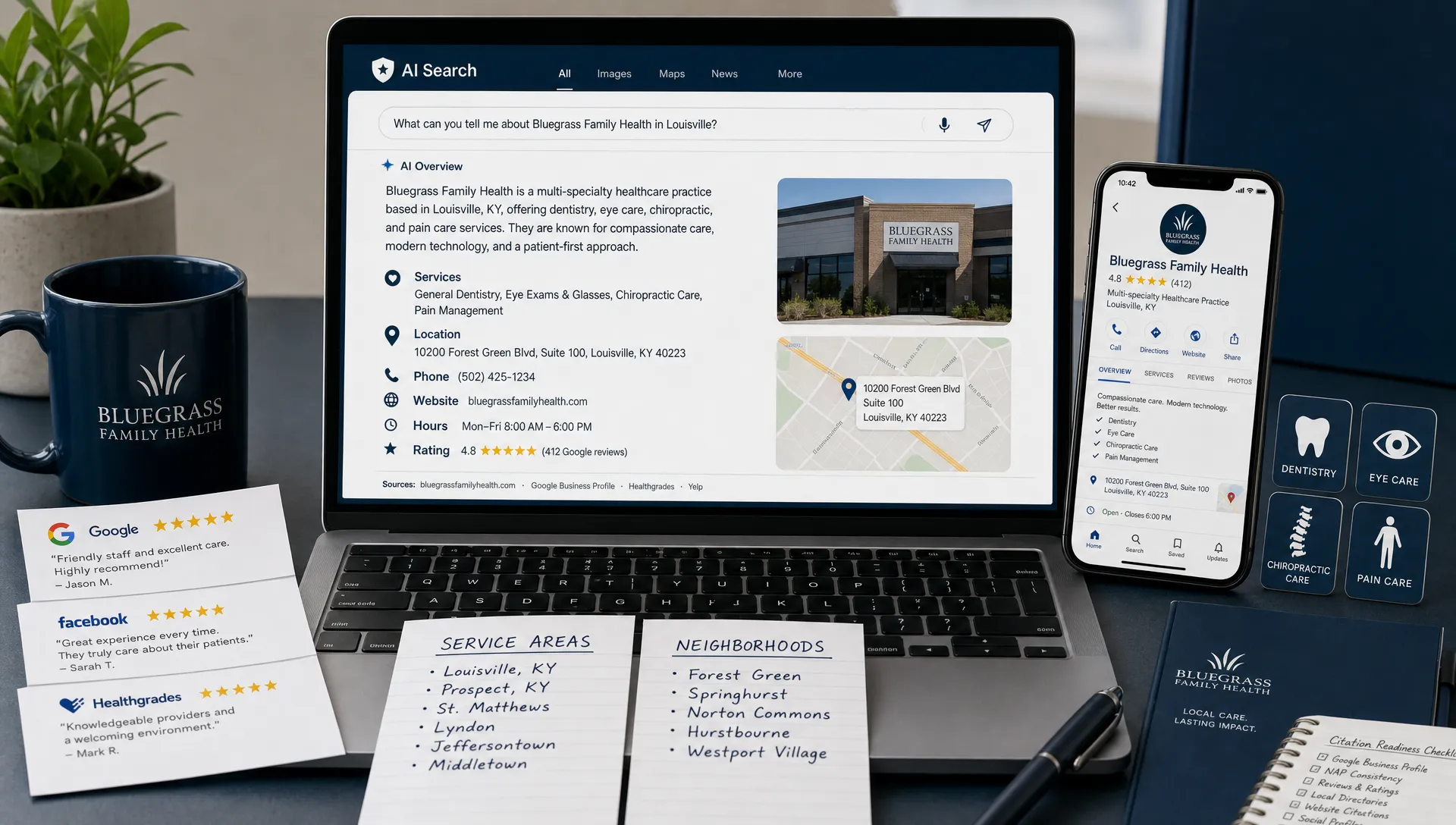
Patients are changing how they search. A Louisville patient with tooth pain, dry eye symptoms, chronic back pain or a possible sports injury may still use Google, but they may also ask an AI assistant for a short list of providers, compare options through AI-generated summaries or rely on Google AI Overviews before visiting a practice website.
That shift does not make traditional SEO obsolete. It raises the bar. AI search optimization is about making your practice clear, credible, locally relevant and easy to cite across the sources that search engines and AI systems can interpret.
If you are comparing healthcare AI SEO services in Louisville, KY, the real question is not whether an agency can mention ChatGPT in a proposal. The question is whether your practice can become the trusted answer when a patient asks, “Who is the best provider near me for this problem?”
What AI search optimization means for healthcare practices
AI search optimization, often called generative engine optimization or GEO, is the process of improving how your practice appears in AI-generated answers, conversational search tools and AI-enhanced search results.
For a healthcare practice, that usually means three things:
- Your practice must be easy for AI systems to understand, including who you treat, what services you provide, where you are located and what makes you qualified.
- Your information must be consistent across your website, Google Business Profile, directories, reviews and authoritative third-party mentions.
- Your content must answer real patient questions with enough specificity, accuracy and local context to be useful.
Traditional SEO focused heavily on rankings, links and keywords. Those still matter, but AI search adds another layer: citationworthiness. AI systems are more likely to surface sources that are clear, comprehensive and trustworthy. For healthcare, that means the quality of your information matters as much as its visibility.
Google’s own Search Essentials emphasize helpful, reliable, people-first content. That guidance is especially relevant for medical and healthcare-related topics, where vague claims or thin service pages can weaken trust.
Why Louisville practices should pay attention now
Louisville healthcare markets are competitive. A patient searching for a dentist in St. Matthews, an optometrist near Middletown, a chiropractor in Jeffersontown or a pain management clinic near downtown has options. AI search compresses those options into fewer answers.
In classic search, a patient might scan ten blue links, map results and ads. In AI search, they may see a summarized answer naming a few practices or recommending what to look for. If your practice is not clearly represented in the sources AI systems use, you may be invisible during the research phase even if your website still ranks somewhere on page one.
This matters most for high-intent searches, such as:
- “Best dentist in Louisville for dental implants”
- “Orthodontist near me that treats adults”
- “Dry eye clinic Louisville KY”
- “Chiropractor for sciatica in Louisville”
- “Pain management doctor near me”
- “Physical therapy for sports injury Louisville”
These searches are not casual. They often come from patients who are comparing providers and getting close to booking. AI search optimization helps your practice participate in that decision moment.
How AI systems evaluate local healthcare practices
No agency can guarantee that ChatGPT, Google AI Overviews, Perplexity or Copilot will cite a specific practice for a specific prompt. AI systems change often and use different retrieval methods. Still, the same foundations tend to improve your odds across search experiences.
| Signal | Why it matters for AI search | Example for a Louisville practice |
|---|---|---|
| Clear entity information | AI systems need to understand exactly who the practice is | Consistent practice name, address, phone, providers and specialties |
| Local relevance | Patients usually need care within a practical driving area | Pages that reference Louisville neighborhoods and nearby service areas naturally |
| Topical depth | Thin pages rarely answer enough patient questions | A dental implant page that explains candidacy, process, recovery and FAQs |
| Trust signals | Healthcare content needs credibility | Provider bios, credentials, reviews, policies and medically reviewed content |
| Structured data | Schema helps search engines interpret key details | LocalBusiness, Physician, Dentist, FAQ and review markup where appropriate |
| Consistent reputation | Reviews influence patient trust and local visibility | Recent, authentic reviews that mention services and patient experience |
Google Business Profile is still a major local visibility asset. Google’s Business Profile guidelines make it clear that businesses should represent themselves accurately, which includes correct names, categories, addresses, hours and service details. AI search does not remove that requirement. It makes accuracy more important because inconsistent data can spread across multiple systems.
The healthcare content problem AI exposes
Many practice websites were built around short service pages: one page for implants, one for braces, one for dry eye, one for chiropractic adjustments. Those pages often repeat the same claims as every competitor, such as “personalized care,” “experienced team” and “state-of-the-art technology.”
AI search is not impressed by generic copy. More importantly, patients are not either.
A better healthcare content strategy answers the questions patients actually ask before they schedule. For example, an oral surgery practice should not only say it offers wisdom teeth removal. It should explain when removal is recommended, what the consultation includes, what recovery typically involves and when a patient should call the office. An optometry clinic should not simply list dry eye treatment. It should explain symptoms, possible causes, diagnostic approach and when dry eye needs medical attention.
For SEO and AI search, the strongest content usually has four qualities:
- It is specific to the service, condition or patient need.
- It reflects the practice’s real clinical process without making exaggerated claims.
- It includes local context where helpful, such as service areas and appointment access.
- It is reviewed for accuracy by the appropriate clinical team.
Healthcare is a trust category. If your practice uses AI tools to draft content, the final version should still be checked by someone qualified inside the practice. AI can help with structure and efficiency, but it should not invent treatment details, outcomes, credentials or guarantees.
Local SEO is the foundation of AI visibility
AI search optimization works best when local SEO is already strong. If your practice has weak local signals, inconsistent listings, thin content and few reviews, AI optimization has little to build on.
A Louisville healthcare practice should first make sure the local foundation is sound:
- The Google Business Profile is complete, accurate and aligned with the website.
- Core service pages clearly describe treatments, providers, locations and appointment paths.
- NAP information (name, address and phone) is consistent across major directories.
- Reviews are recent, legitimate and responded to professionally.
- The website loads quickly, works well on mobile and makes calling or booking simple.
For practices still building that foundation, Louisville Web Lab’s healthcare SEO services and guides for Louisville practices are a useful starting point because they connect local SEO, content and patient acquisition rather than treating rankings as the only goal.
What to optimize on your website for AI search
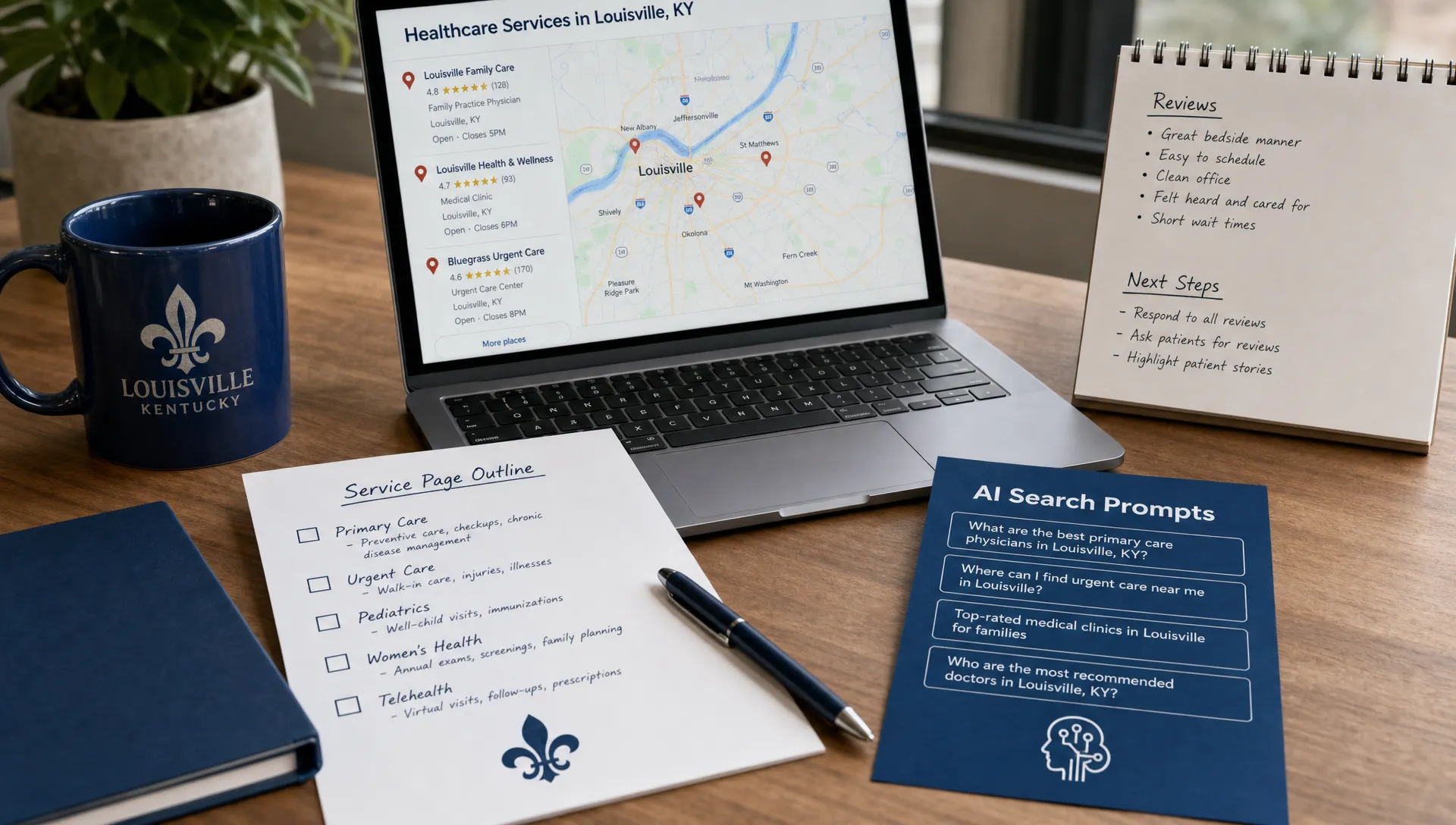
Your website is still the source you control most. AI search systems may use many sources, but a clear, authoritative website gives them better material to interpret and cite.
Service pages that answer complete patient questions
Each priority service should have a page that goes beyond a definition. A strong page for dental implants, adult orthodontics, dry eye care, chiropractic care, pain injections or physical therapy should explain who the service is for, what happens during the first visit, common concerns, expected next steps and why local patients choose your practice.
This does not mean writing a textbook. It means giving patients enough information to feel informed and confident taking the next step.
Provider pages that establish expertise
AI search needs to understand who delivers the care. Provider pages should include credentials, specialties, education, professional background and patient-friendly context about the types of cases each provider commonly treats. For specialists, this can be especially valuable.
A periodontist, ophthalmologist, pain physician or orthopedic provider should not be hidden behind a generic “our team” page with only a photo and first name. Patients often search by provider expertise, and AI systems may use that information when forming recommendations.
FAQ sections based on real patient concerns
FAQ content can help AI systems match your site to conversational searches. The best FAQs are not filler. They come from phone calls, consultation questions, front desk conversations and treatment coordinator notes.
For example, a pediatric dentist may answer questions about first visits, dental anxiety and sedation options. A dry eye clinic may address symptoms, evaluation and treatment timelines. A chiropractic office may explain when imaging or referral may be needed.
Schema markup that supports clarity
Structured data can help search engines understand your practice, locations, services, providers and FAQs. It does not guarantee AI citations, but it reduces ambiguity.
Healthcare practices should use schema carefully and accurately. Do not mark up fake reviews, misleading ratings or services you do not actually provide. Schema should describe reality, not decorate a page for rankings.
Reputation signals matter more in AI search
Patients have always used reviews to choose providers. AI search may intensify that behavior by summarizing sentiment across reviews, directories and other mentions.
A review profile with consistent themes can help both humans and search systems understand what your practice is known for. For example, reviews that naturally mention “explained my implant options,” “helped with my dry eye symptoms,” “easy scheduling” or “great with kids” provide context that generic star ratings cannot.
Healthcare practices should never pressure patients or offer incentives for reviews. They should create a compliant, consistent process for asking satisfied patients to share honest feedback. Staff responses should be professional and privacy-conscious. The HHS HIPAA Privacy Rule overview is a good reminder that patient information must be handled carefully, including in public-facing communication.
AI search optimization is not only a content project
Some practices hear “AI SEO” and assume it means publishing more blog posts. Content helps, but AI search visibility depends on the entire patient acquisition system.
If an AI answer sends a patient to your website, the page still has to convert. That means the site needs clear calls to action, fast mobile performance, visible phone numbers, online booking where available, trust-building design and service pages that guide the patient toward the right next step.
It also means tracking matters. A practice should not judge AI search optimization only by impressions or rankings. Useful measurements include organic appointment requests, calls from local search, form submissions, service-page engagement, Google Business Profile actions and consultation quality. Louisville Web Lab explains this broader view in its guide to how a Louisville SEO company should measure success.
A practical AI search optimization plan for Louisville practices
A good AI search plan should be specific enough to execute, but flexible enough to adapt as search tools change. For most healthcare practices, the work falls into six areas.
| Phase | What to do | Why it matters |
|---|---|---|
| Audit | Review current rankings, AI visibility, GBP data, reviews and website content | Finds gaps before adding new content |
| Entity cleanup | Standardize practice, provider, location and service information | Helps AI systems understand the practice accurately |
| Content expansion | Improve priority service pages and add patient-focused FAQs | Makes the website more useful and citation-ready |
| Local authority | Strengthen listings, reviews, local mentions and relevant backlinks | Reinforces Louisville relevance and trust |
| Conversion improvement | Improve calls to action, landing pages, mobile UX and tracking | Turns visibility into booked appointments |
| Measurement | Track calls, forms, appointments and source quality | Connects AI search work to practice growth |
The key is sequencing. A practice with inaccurate listings should not start by publishing ten AI-generated blog posts. A practice with strong rankings but low conversion may need landing page and call tracking improvements first. A specialist with excellent clinical expertise but thin provider pages may need trust-building content before anything else.
For practices that want outside help, Louisville Web Lab offers AI SEO in Louisville for businesses that need to adapt to AI Overviews, ChatGPT, Copilot and other AI-driven search experiences.
What not to do with AI SEO in healthcare
AI search creates opportunities, but it also creates shortcuts that can damage trust.
Avoid mass publishing AI content that no clinician reviews. Avoid claiming your practice is the “best” without evidence. Avoid creating doorway pages for every small neighborhood with the same copy. Avoid using patient information in AI tools unless your privacy and compliance obligations are clearly addressed. Avoid treating AI visibility as a vanity metric disconnected from appointments.
Healthcare marketing has less room for exaggeration than many other industries. Patients are making decisions that affect their health, comfort, appearance, mobility and quality of life. The most durable AI search strategy is not tricking algorithms. It is making your practice the clearest and most trustworthy source for the care you actually provide.
Frequently Asked Questions
What is AI search optimization for healthcare practices? AI search optimization is the process of improving how a healthcare practice appears in AI-generated answers, AI Overviews and conversational search tools. It combines local SEO, clear website content, reputation management, structured data and trust signals.
Is AI SEO different from traditional healthcare SEO? Yes, but it builds on the same foundation. Traditional SEO helps your practice rank in search results and maps. AI SEO adds a focus on being understood, summarized and cited by AI-driven search experiences.
Can a Louisville healthcare practice guarantee placement in AI answers? No. AI systems change often and no agency can guarantee specific AI citations. A strong strategy improves the likelihood of visibility by strengthening your website, local signals, content quality and authority.
Which healthcare practices benefit most from AI search optimization? Dental, orthodontic, optometry, ophthalmology, chiropractic, pain management, physical therapy, orthopedic and specialty practices can benefit, especially when patients research symptoms, treatments and provider options before booking.
How long does AI search optimization take? Timelines vary based on the practice’s current SEO strength, website quality, competition and content depth. Most practices should think in months rather than days, with early improvements coming from technical cleanup, GBP optimization and stronger service pages.
Make AI search part of your patient growth strategy
AI search is changing the path patients take before they book, but the goal has not changed. Your practice still needs to be visible, trusted and easy to contact when a local patient is ready for care.
Louisville Web Lab helps healthcare practices connect SEO, Google Ads, websites, automation, reputation and AI search optimization into a patient acquisition system. If you want to understand where your practice stands and what to fix first, start with a diagnostic strategy call through Louisville Web Lab.