
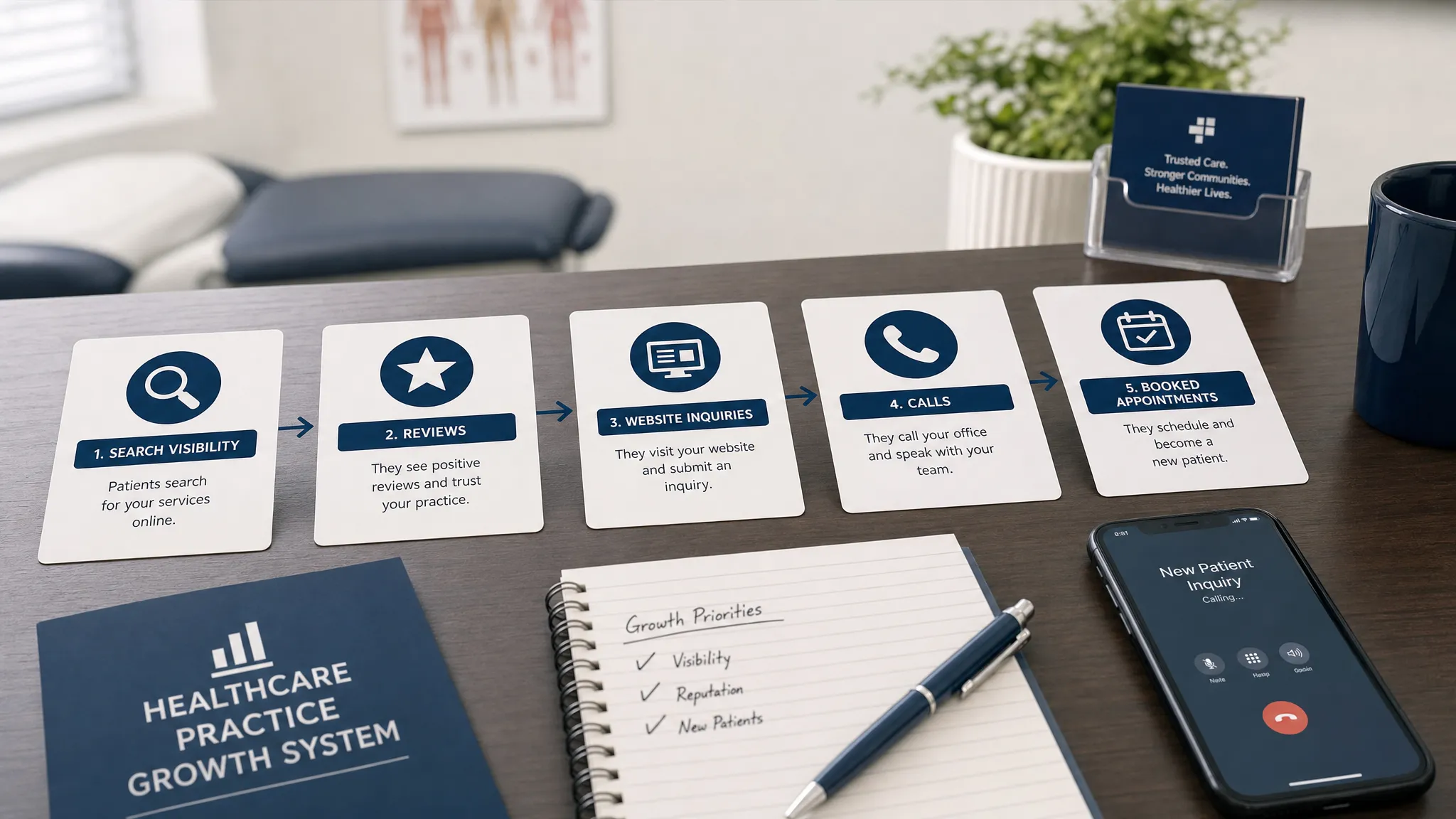
Most medical practices do not need more random traffic. They need more of the right patients finding them, trusting them, contacting them, and actually showing up for scheduled care.
That is the difference between generic digital marketing and medical practice marketing built around appointments. A dental implant page that ranks but does not generate consults is not enough. A Google Ads campaign that drives calls from unqualified patients is not enough. A beautiful website that makes people hunt for a phone number is not enough.
For dentists, orthodontists, optometrists, chiropractors, pain physicians, physical therapists, and specialty practices, the goal is simple: turn local demand into booked appointments with a system you can measure.
Why Medical Practice Marketing Often Fails
Healthcare marketing breaks down when it focuses on activity instead of patient acquisition. Many practices are told they need more impressions, more social posts, more website visitors, or more ad clicks. Those metrics can be useful, but they do not pay for chairs, operatories, exam rooms, staff, equipment, or provider time.
The real problem is usually not one broken channel. It is a disconnected patient journey. A patient searches for care, compares options, reads reviews, visits the website, checks whether the service matches their need, looks for insurance or payment information, and decides whether contacting the practice feels easy and safe. If any step creates friction, the appointment goes to a competitor.
Common breakdowns include weak local visibility, unclear service pages, slow mobile websites, poor review volume, generic ads, missed calls, delayed follow-up, and tracking that stops at form submissions instead of booked appointments. Medical practice marketing has to connect all of those pieces.
Start With the Appointment, Not the Channel
Before choosing SEO, Google Ads, social media, or automation, define the appointment outcome you actually want. A pediatric dental practice trying to fill hygiene openings needs a different strategy than an oral surgeon trying to attract implant referrals. A LASIK center needs a different funnel than an optometry clinic promoting annual eye exams. A pain management clinic may need to separate high-intent patients from people simply researching symptoms.
A strong strategy starts with practical questions:
- Which service lines have capacity and profit potential?
- Which patients are a good fit clinically, financially, and geographically?
- Which appointment types need immediate demand, and which can be built through long-term education?
- What happens after a call, form fill, chat, or booking request?
- How will the practice measure booked appointments, not just leads?
That last question matters. A lead is only valuable if the patient is qualified, reachable, and likely to schedule. A marketing campaign that sends 100 low-quality inquiries to an already busy front desk can hurt the practice more than it helps.
The Appointment-Driving Marketing System
Effective medical practice marketing works like a connected system. Each layer has a job, and each should be measured against its contribution to appointments.
| Marketing layer | What it does | Appointment-focused metric |
|---|---|---|
| Local SEO and Google Business Profile | Captures patients searching nearby for services | Calls, direction requests, appointment clicks, local landing page conversions |
| Service-line SEO | Builds visibility for high-value treatments and conditions | Organic consult requests, new patient forms, booked visits by service |
| Google Ads | Creates immediate visibility for high-intent searches | Cost per qualified lead, cost per booked appointment |
| Conversion-focused website | Turns visitors into calls, forms, and booking actions | Conversion rate, call volume, form completion rate |
| Reviews and reputation | Builds trust before the patient contacts you | Review volume, rating quality, review recency, conversion lift |
| Follow-up automation | Responds quickly and consistently to inquiries | Speed to lead, contact rate, scheduled appointment rate |
| Reporting and attribution | Shows what is producing patient growth | Source-to-appointment tracking, show rate, revenue influence |
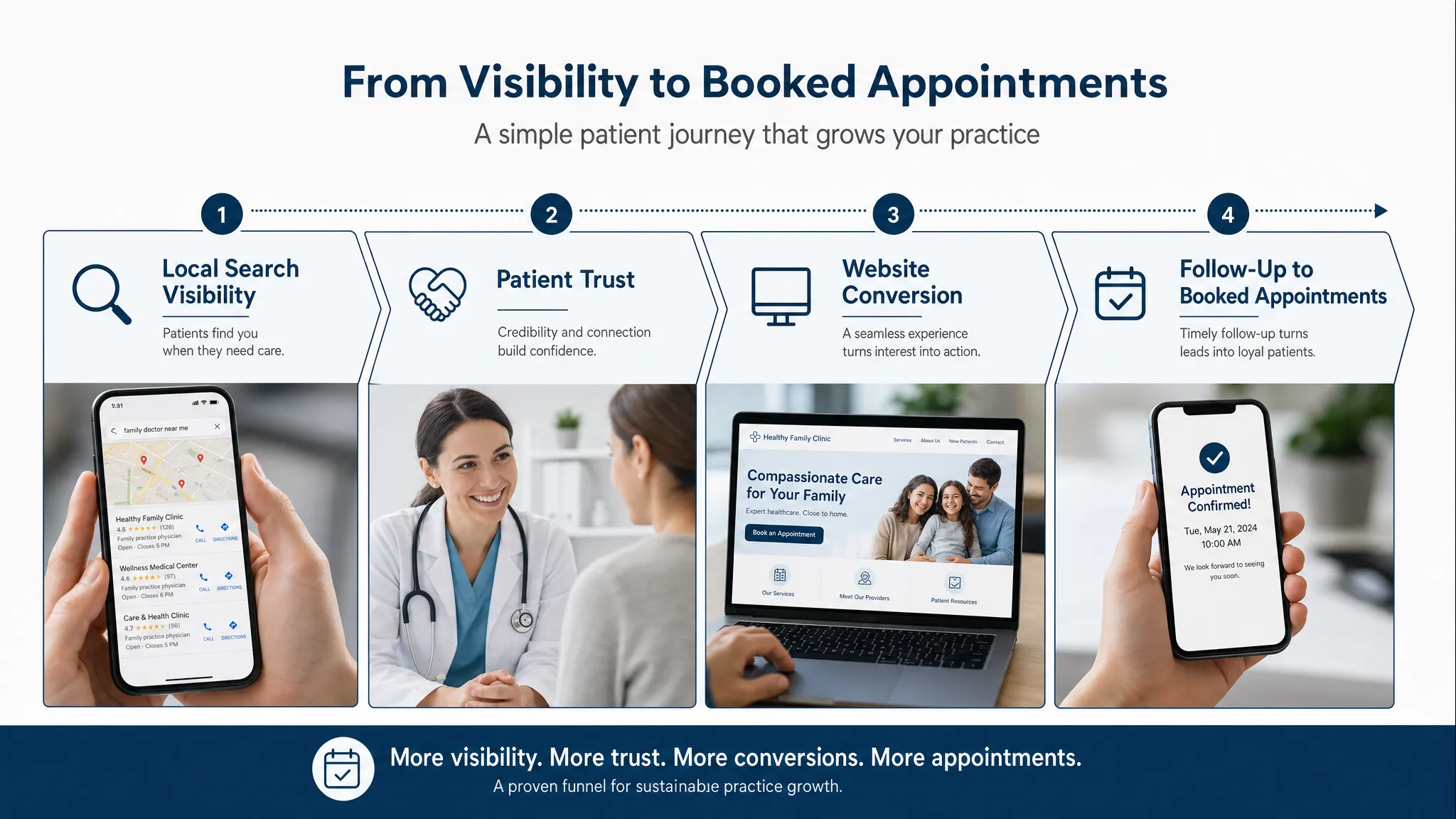
The most important insight is that no single channel carries the whole system. SEO without conversion is wasted visibility. Ads without landing pages become expensive. Reviews without follow-up still leak appointments. Automation without qualified demand just accelerates noise.
Local SEO: Win the Patients Searching Nearby
For many healthcare practices, local search is the highest-value place to start because patients often search with immediate intent. Queries like emergency dentist near me, chiropractor in Louisville, dry eye doctor, dental implants near me, or physical therapy for back pain are not passive research searches. They often come from someone who is ready to compare options.
Local SEO includes the practice website, Google Business Profile, reviews, citations, service pages, location pages, and local authority signals. Your Google Business Profile should accurately reflect your services, categories, hours, photos, appointment options, and location information. Your website should reinforce the same information with strong pages for each major service line.
For healthcare practices, service pages should do more than list treatments. They should answer patient questions, explain who the service is for, describe what happens at the first visit, address common concerns, and make the next step obvious. A dental implant page should not read like a textbook. It should help a nervous patient understand whether a consultation is worth scheduling.
If your practice serves Louisville or nearby communities, local SEO should also reflect how patients search across neighborhoods and suburbs. A practice may draw patients from St. Matthews, Middletown, Jeffersontown, Prospect, New Albany, or other nearby areas, depending on specialty and convenience. For a deeper local search foundation, see Louisville Web Lab’s guide to local SEO for Louisville businesses.
Google Ads: Capture Demand When You Need Appointments Now
SEO compounds over time, but many practices also need appointment volume sooner. Google Ads can help capture patients already searching for a specific service, especially for competitive or high-value categories like dental implants, orthodontics, LASIK, cataract surgery, pain management, or urgent dental care.
The mistake is treating Google Ads like a traffic machine. In healthcare, the campaign structure should mirror patient intent. A person searching for same day dentist has different urgency than someone searching for veneers cost. A patient searching for shoulder pain doctor is in a different mindset than someone searching regenerative medicine near me.
High-performing healthcare ad campaigns usually need tightly grouped keywords, strong negative keyword lists, location controls, call tracking, conversion-focused landing pages, and ad copy that matches the patient’s intent. Ads should lead to pages built for scheduling, not generic homepages.
Healthcare advertisers also need to understand policy and privacy constraints. Google has specific rules for healthcare and medicines advertising, and practices should be careful with claims, targeting, remarketing, and sensitive health information. The goal is not just to get clicks. The goal is to generate compliant, qualified appointment demand.
If you want a channel-by-channel view of paid search, Louisville Web Lab’s Google Ads guide explains how local campaigns can be structured for measurable leads.
Your Website Must Convert Trust Into Action
Your website is often the deciding factor between a patient calling your office or going back to Google. A healthcare website has to answer two questions quickly: can this practice help me, and can I trust them?
That means your site needs clear service pages, provider credibility, location details, patient-friendly language, strong calls to action, mobile speed, and easy contact options. Patients should not have to dig for your phone number, appointment form, address, hours, or accepted next steps.
Conversion-focused healthcare websites often include:
- Prominent phone and appointment buttons on mobile
- Dedicated pages for major treatments, conditions, and specialties
- Provider bios that communicate credentials and approachability
- Patient reviews, testimonials, and before-and-after examples when appropriate and compliant
- Clear explanations of first visits, consultations, financing, insurance, or referral requirements when relevant
- HIPAA-conscious forms, tracking, chat, and analytics decisions
The best websites do not pressure patients. They reduce uncertainty. They make it easier for a patient to move from research to action.
This is especially important for higher-consideration services. A patient may not schedule dental implants, LASIK, or interventional pain care after one page view. Your website has to support both immediate contact and thoughtful decision-making. For more on the conversion side, read Louisville Web Lab’s guide to building a lead generation website that converts.
Reviews and Reputation Are Part of the Funnel
Reviews are not just a reputation asset. They are a conversion asset. Patients use reviews to judge trust, bedside manner, professionalism, wait times, staff friendliness, and whether people like them had a positive experience.
A practice with strong visibility but weak reviews may get seen and skipped. A practice with excellent reviews but poor visibility may be trusted by too few people. Appointment-driving marketing needs both.
The best review systems are simple, consistent, and ethical. Ask at the right moment, make the process easy, train the team, and respond professionally. In healthcare, review responses require extra care. A response should never confirm that someone is a patient or reveal protected information. A safe response can be appreciative and general without discussing treatment details.
Practices should also stay aligned with review and testimonial rules. The FTC provides guidance on endorsements, testimonials, and reviews, including the importance of honest representation. For local review strategy, see Louisville Web Lab’s guide to online reputation management.
Follow-Up Is Where Many Practices Lose Revenue
A patient who fills out a form is not the same as a patient who books. A missed call is not the same as a lost cause. A consultation request sent after hours may still be highly valuable if the practice follows up quickly the next morning.
This is where marketing automation and front-desk processes become part of patient acquisition. The practice needs a reliable way to respond to inquiries, confirm appointments, route leads, send reminders, request reviews, and re-engage patients who did not schedule.
Automation should support staff, not replace human care. For example, an automated confirmation text can help a patient know the request was received, while a trained team member can answer clinical, insurance, or scheduling questions. The combination is what improves contact rates and appointment completion.
Healthcare practices should also be thoughtful about privacy. The U.S. Department of Health and Human Services has published guidance on HIPAA and online tracking technologies, which is important for practices using analytics, pixels, forms, chat tools, or advertising platforms. Your marketing stack should be built with compliance conversations in mind.
Louisville Web Lab’s guide to marketing automation for small businesses covers the operational side of faster follow-up and nurture workflows.
AI Search Is Changing How Patients Discover Practices
In 2026, patients are not only using traditional Google results. They are also seeing AI Overviews, asking AI assistants questions, and relying on summarized answers before clicking through to a website. This does not replace local SEO, but it raises the standard for clarity, authority, and structured information.
Medical practices should publish content that answers real patient questions in plain language. A chiropractor might explain when to seek care for back pain. An optometrist might explain dry eye symptoms and treatment options. A dentist might explain the difference between a crown, veneer, and implant. These pages should be medically responsible, easy to understand, and connected to the appropriate appointment path.
AI search optimization is not about tricking algorithms. It is about making your practice easier to understand, cite, and trust. That means clear service pages, strong local signals, consistent business information, provider expertise, FAQs, schema markup where appropriate, and content that matches patient intent.
What to Measure If You Care About Appointments
If the goal is booked appointments, reporting should go beyond rankings and traffic. Those metrics help diagnose performance, but they are not the finish line.
| Metric | Why it matters | What to watch |
|---|---|---|
| Qualified lead volume | Shows whether marketing is attracting the right inquiries | Calls, forms, chats, and booking requests tied to target services |
| Cost per qualified lead | Helps compare paid channels and campaigns | Spend divided by qualified inquiries, not total clicks |
| Cost per booked appointment | Connects marketing to actual scheduling | Ad spend or campaign cost divided by scheduled appointments |
| Appointment show rate | Reveals whether lead quality and reminders are working | Scheduled visits compared with completed visits |
| Service-line mix | Shows whether marketing is filling the right appointment types | New appointments by treatment, specialty, or provider |
| Source-to-appointment attribution | Identifies which channels produce patients | Organic, GBP, paid search, referrals, direct, social, email |
A practice does not need a perfect enterprise analytics setup to improve. It needs a clear feedback loop. If calls are high but bookings are low, listen to calls and review intake steps. If traffic is high but forms are low, improve page clarity and calls to action. If ads generate leads but few show up, review keyword intent, patient expectations, and reminder workflows.
A Practical 90-Day Plan for More Booked Appointments
The first 30 days should focus on diagnosis and fixes that remove obvious friction. Audit the website, Google Business Profile, tracking, top service pages, reviews, ad accounts, phone handling, forms, and follow-up. Identify which appointment types matter most and where the patient journey is leaking.
Days 31 to 60 should focus on building the appointment engine. Improve priority service pages, tighten calls to action, update Google Business Profile, launch or restructure paid search campaigns, add review requests, and make sure every lead source is tracked. This is also the right time to align the front desk on how inquiries should be handled.
Days 61 to 90 should focus on optimization. Review call quality, conversion rates, search terms, form submissions, booked appointments, and show rates. Shift budget toward the best-performing services, improve weak landing pages, build supporting content, and refine automation based on real patient behavior.
This sequence keeps the practice from jumping straight into more spend before the foundation is ready. More traffic only helps when the system can convert and follow up.
Common Mistakes to Avoid
The most expensive mistake is treating healthcare marketing like a generic local business campaign. Medical practices have higher trust requirements, more sensitive patient concerns, compliance considerations, and a more complex path from search to appointment.
Another common mistake is over-investing in one channel while ignoring the rest of the journey. A practice may spend heavily on ads while sending visitors to weak pages. Another may publish blogs for years without fixing local SEO or conversion tracking. Another may have excellent doctors and strong outcomes but too few reviews to prove it online.
The final mistake is not involving the front desk. Marketing can create demand, but the practice team helps turn that demand into scheduled care. If calls are missed, forms sit unanswered, or patients receive inconsistent information, marketing performance will always look worse than it should.
Frequently Asked Questions
What is medical practice marketing? Medical practice marketing is the strategy and execution used to attract, convert, and retain patients for healthcare practices. It can include local SEO, Google Ads, website design, review generation, content, automation, and appointment tracking.
Which marketing channel drives appointments fastest for a medical practice? Google Ads can often create faster visibility for high-intent searches, while local SEO and Google Business Profile optimization build durable demand over time. The best approach usually combines paid search for immediate opportunities with SEO for long-term growth.
How should a medical practice measure marketing success? Practices should measure qualified leads, booked appointments, appointment show rate, cost per booked appointment, and service-line growth. Traffic and rankings matter, but they should be connected to scheduling outcomes.
Do reviews really help medical practices get more appointments? Yes. Reviews support trust and can influence whether patients choose to call, click, or book. They also support local visibility when combined with a complete Google Business Profile and strong website content.
Is healthcare marketing different from regular local business marketing? Yes. Healthcare marketing requires more trust-building, more careful claims, privacy awareness, and patient-friendly communication. It also needs to account for provider credentials, treatment complexity, insurance or payment concerns, and compliance considerations.
Can Louisville Web Lab help with medical practice marketing outside of dentistry? Yes. Louisville Web Lab works with healthcare practices across dental, vision, pain, physical therapy, primary care, and specialty categories through SEO, Google Ads, websites, automation, and patient acquisition systems.
Turn Search Visibility Into Booked Appointments
If your practice is getting traffic but not enough appointments, the problem may not be one channel. It may be the system connecting search visibility, ads, website conversion, reviews, and follow-up.
Louisville Web Lab helps healthcare practices build marketing systems focused on measurable patient growth. If you want a clearer picture of what is working, what is leaking, and what to fix first, book a diagnostic call with Louisville Web Lab.