
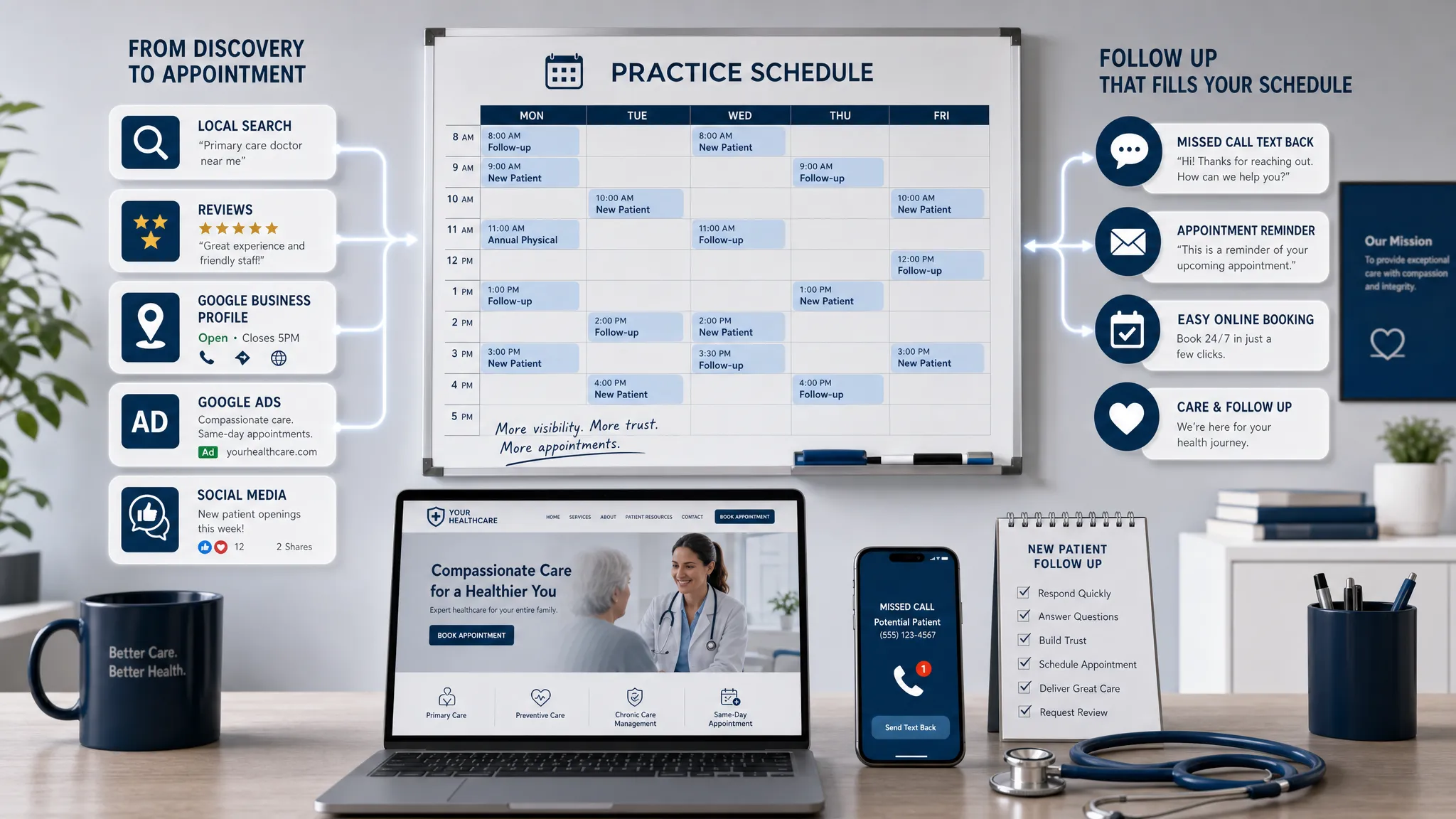
A full calendar is not the result of “doing more marketing.” It is the result of building a patient acquisition system where search visibility, trust, conversion, follow-up, and scheduling all work together.
For dentists, orthodontists, optometrists, chiropractors, pain physicians, physical therapists, and specialty practices, healthcare practice marketing has to do more than create awareness. It has to attract the right patients, answer their questions, reduce friction, and turn demand into booked appointments.
That means the best strategy is not simply “rank higher” or “run ads.” The best strategy starts with the schedule itself.
Start with the schedule, not the channel
Most practices begin marketing conversations with a channel: SEO, Google Ads, social media, a new website, or reviews. Those channels matter, but they should be selected only after you understand what your schedule needs.
A pediatric dentist with a packed hygiene schedule has a different marketing problem than an implant dentist trying to book consults. An optometrist with dry eye technology needs a different strategy than a chiropractic clinic trying to fill same-week new patient evaluations. A pain management practice may need more qualified referrals and procedure consults, not just more phone calls.
Before spending another dollar, define the appointment outcomes you want to create:
- Which providers or locations have capacity?
- Which appointment types are most valuable to grow?
- Which days or times consistently have openings?
- Which services need better patient education before booking?
- Which leads fail to schedule, show up, or follow through?
This schedule-first approach keeps your marketing from chasing vanity metrics. Traffic, impressions, and clicks matter only when they lead to qualified appointments.
| Schedule metric | Why it matters | What to improve |
|---|---|---|
| Appointment requests | Shows whether marketing creates demand | SEO, ads, content, landing pages |
| Booked appointments | Shows whether demand turns into calendar activity | Website CTAs, phone handling, online booking, follow-up |
| Show rate | Shows whether patients commit after booking | Reminders, expectation setting, scheduling experience |
| Cost per booked appointment | Shows whether campaigns are financially efficient | Ad targeting, landing pages, conversion tracking |
| Service-line mix | Shows whether you are attracting the right cases | Service pages, ads, local SEO, content strategy |
| Time to first response | Shows whether leads are being lost after inquiry | Automation, call routing, text follow-up |
Capture high-intent local searches
Most healthcare decisions start with a local search. Patients search for phrases like “dentist near me,” “Invisalign Louisville,” “dry eye treatment,” “chiropractor for sciatica,” “pain management near me,” or “physical therapy after knee surgery.” These searches often come from people who are close to taking action.
That is why local SEO and Google Business Profile optimization are foundational. If your practice is not visible when nearby patients search, competitors get the call before your team ever has a chance to help.
The most effective local visibility strategy includes three layers.
Google Business Profile optimization
Your Google Business Profile should clearly communicate what you do, where you serve, and why patients should choose your practice. Categories, services, hours, photos, Q&A, reviews, appointment links, and location information all influence how confident patients feel before calling.
For local healthcare searches, your profile often acts like a second homepage. Many patients will compare your reviews, proximity, photos, and services before they ever visit your website. If your profile is incomplete or outdated, you may lose appointments even if your clinical care is excellent.
If you are unsure how much weight to give your profile compared with your website SEO, this guide on Google Business Profile vs SEO explains how both work together.
Service and location pages
Your website needs pages that match how patients search. A general “Services” page is rarely enough. A dental practice may need separate pages for dental implants, emergency dentistry, pediatric dentistry, cosmetic dentistry, and clear aligners. An optometry practice may need pages for eye exams, dry eye, myopia management, contact lenses, and medical eye care.
Each page should answer the patient’s immediate questions, explain next steps, show trust signals, and make booking easy. The goal is not to overload visitors with clinical detail. The goal is to help them feel informed enough to take the next step.
Local authority and AI search readiness
Google is not the only discovery channel anymore. Patients also ask AI assistants and search features for recommendations, explanations, and comparisons. Practices that publish clear, trustworthy, locally relevant content are better positioned to be referenced in AI-assisted search experiences.
That does not mean writing generic health articles. It means creating useful content that answers real patient questions with local context, clinician expertise, and clear next steps. Louisville Web Lab covers this shift in more detail in its guide to AI Overviews and Google search.
Create service-line pages that move patients to action
A high-performing healthcare website is not just a brochure. It is a conversion tool that helps patients choose, contact, and book.
Every priority service should have a dedicated page with a clear path to scheduling. This is especially important for higher-consideration services like dental implants, orthodontics, LASIK, dry eye treatment, regenerative medicine, pain procedures, and physical therapy programs. Patients usually need more reassurance before booking these appointments.
Strong service-line pages typically include:
- A plain-language explanation of the service
- Who the service is for and when to seek care
- What to expect at the first visit or consultation
- Provider credentials, patient reviews, and trust signals
- Clear calls to call, request an appointment, or book online
- Location details for patients searching nearby
The same principle applies across healthcare and wellness categories.
The key is clarity. If a patient lands on your page and has to hunt for the next step, you are leaking appointments.
Use Google Ads to fill specific appointment gaps
SEO builds compounding visibility, but it takes time. Google Ads can create faster demand when your campaigns are built around appointment economics instead of click volume.
For healthcare practices, paid search works best when it is tied to a specific goal. That might be filling new patient exams, increasing dental implant consultations, booking dry eye evaluations, promoting orthodontic consults, or driving same-week chiropractic appointments.
A strong healthcare Google Ads campaign should separate campaigns by service line, use location targeting carefully, send traffic to focused landing pages, and track real conversions. Calls, form submissions, online booking clicks, and booked appointments should all be measured as closely as privacy and platform rules allow.
| Campaign focus | Best use case | Schedule impact |
|---|---|---|
| New patient searches | General dentistry, optometry, chiropractic, primary care | Builds steady appointment demand |
| High-value service searches | Implants, orthodontics, LASIK, pain procedures | Drives consults for priority services |
| Urgent care searches | Emergency dentistry, acute pain, same-week availability | Fills near-term openings |
| Brand protection | Competitors bidding on your practice name | Helps protect existing demand |
| Policy-compliant remarketing | General awareness where allowed by platform and privacy rules | Supports longer decision cycles |
Healthcare advertisers also need to be careful with compliance. Avoid ad copy that implies guaranteed outcomes, uses sensitive personal attributes, or creates unrealistic expectations. Campaigns should respect HIPAA, platform healthcare advertising policies, and patient privacy.
For a deeper look at local paid search strategy, see Louisville Web Lab’s Google Ads Louisville guide.
Turn your website into a booking system
Even strong SEO and ads will underperform if your website does not convert. Many healthcare practices lose patients after the click because their websites are slow, confusing, outdated, or difficult to use on mobile.
Patients are usually not browsing casually. They are trying to solve a problem, compare options, and decide whether your practice is the right fit. Your website should help them do that quickly.
Conversion-focused healthcare websites usually share several qualities:
- Fast mobile load times
- Tap-to-call buttons on mobile
- Clear appointment request forms
- Prominent calls to action on every major page
- Simple navigation by service and location
- Reviews and testimonials presented responsibly
- Provider bios and credentials
- Insurance, financing, or payment information when applicable
- Privacy-conscious forms and tracking
The home page should make your positioning obvious. The service pages should match patient search intent. The contact and appointment pages should remove friction. If a patient is ready to book, the site should never make them work for it.
Louisville Web Lab’s guide on building a lead generation website covers the conversion principles that matter most for appointment-driven businesses.
Build a review and reputation flywheel
Reviews are one of the strongest trust signals in healthcare practice marketing. They influence local search visibility, Map Pack performance, and patient confidence.
For many patients, reviews answer questions your website cannot fully answer: Was the team kind? Was scheduling easy? Did the provider listen? Was the visit rushed? Did the office feel professional? These details shape whether someone calls your practice or keeps comparing options.
A strong review system is consistent, ethical, and simple. Ask at the right moment, make the process easy, and respond professionally. Do not incentivize reviews or pressure patients. In healthcare, responses should also avoid confirming someone is a patient or discussing protected health information.
A good response to a positive review can be warm without revealing private details. A good response to a negative review should be calm, brief, and invite the person to contact the office directly.
Review generation should be part of operations, not an occasional campaign. The best practices ask consistently, monitor feedback, and use common themes to improve the patient experience.
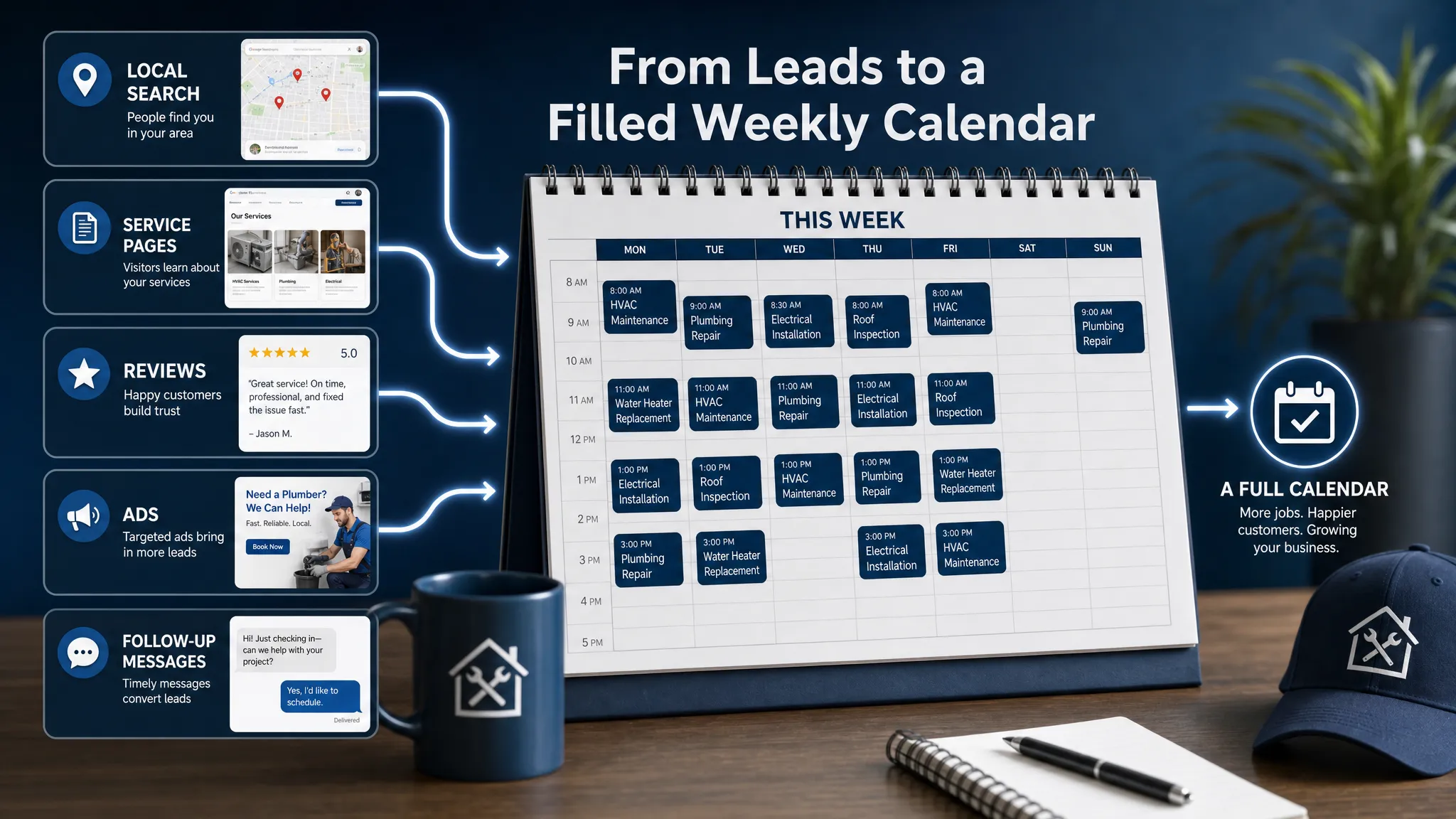
Close the gaps with patient follow-up automation
Many practices do not have a demand problem. They have a leakage problem.
A patient fills out a form after hours and does not hear back until the next afternoon. A call comes in during lunch and goes to voicemail. A patient requests an appointment but never confirms. Someone starts treatment planning but does not schedule the next step.
Automation helps close those gaps without adding more pressure to the front desk. The goal is not to replace human care. The goal is to make sure interested patients receive fast, helpful communication when attention is highest.
| Schedule leak | What it looks like | Automation fix |
|---|---|---|
| Missed calls | Patients call once and move to another provider | Missed-call text-back and call tracking |
| Slow form response | Web leads go cold before the team replies | Instant confirmation and staff notification |
| No-shows | Patients forget or lose motivation | Appointment reminders by approved channels |
| Unscheduled consults | Leads ask questions but never book | Follow-up sequences with helpful information |
| Dormant patients | Existing patients are overdue for care | Recall or reactivation campaigns |
| Cancellations | Openings remain unfilled | Waitlist and short-notice appointment outreach |
Healthcare automation should be built with consent, privacy, and compliance in mind. Keep messages helpful, avoid unnecessary sensitive details, and make opt-out options clear where required.
For practices that rely heavily on phone calls and forms, automation can improve speed-to-lead almost immediately. Louisville Web Lab explains these systems in its guide to marketing automation for small businesses.
Use content to earn trust before the first visit
Patients often need education before they schedule. This is especially true when they are unsure whether symptoms are serious, whether treatment is worth it, or which provider type they need.
Content helps your practice meet patients earlier in the decision process. It also supports SEO, improves AI search visibility, and gives your team useful resources to share during follow-up.
The best healthcare content is specific. It answers real patient questions, avoids jargon, and connects education to an appropriate next step.
| Practice type | Useful content topics | Appointment path |
|---|---|---|
| Dentistry | “Do I need a crown or filling?” “How dental implants work” | Exam, consult, treatment planning |
| Orthodontics | “Invisalign vs braces” “When should kids see an orthodontist?” | Consultation |
| Optometry | “Dry eye symptoms” “How often should adults get eye exams?” | Eye exam or specialty evaluation |
| Chiropractic | “Sciatica symptoms” “What to expect at your first chiropractic visit” | New patient appointment |
| Pain management | “Back pain red flags” “When injections may be considered” | Consultation or referral pathway |
| Physical therapy | “PT after surgery” “How long does rehab take?” | Evaluation |
Content should not diagnose patients online or promise outcomes. It should educate, build trust, and guide people toward appropriate care.
This is also where answer engine optimization becomes important. Well-structured FAQ sections, clear definitions, clinician-reviewed explanations, and local context can help your practice show up when patients ask more conversational questions. If you want to understand this shift, start with Louisville Web Lab’s guide to Answer Engine Optimization.
Measure the numbers that actually fill schedules
A marketing report that only shows traffic and clicks is incomplete. Healthcare practices need reporting that connects marketing activity to appointment outcomes.
At minimum, your dashboard should help answer these questions:
- Which channels generate appointment requests?
- Which campaigns generate booked appointments?
- Which service lines are growing?
- Which leads are not being reached fast enough?
- Which landing pages convert best?
- Which appointment types produce the best return?
Some practices can track this directly through call tracking, form tracking, CRM data, and booking reports. Others need a more careful setup because of software limitations or privacy requirements. Either way, the goal is to make better decisions from better data.
| Metric | Formula | Why it matters |
|---|---|---|
| Website conversion rate | Leads divided by website visitors | Shows whether the site turns traffic into inquiries |
| Lead-to-booked rate | Booked appointments divided by leads | Shows whether intake and follow-up are working |
| Cost per lead | Marketing spend divided by leads | Shows campaign efficiency before scheduling |
| Cost per booked appointment | Marketing spend divided by booked appointments | Shows real appointment acquisition cost |
| Show rate | Completed visits divided by booked visits | Shows appointment quality and reminder effectiveness |
| Revenue or production by source | Revenue or production tied to channel when available | Shows which channels support growth |
The most useful reporting is simple enough to review every week. If a campaign generates calls but few booked visits, the issue may be intake. If a service page ranks but does not convert, the issue may be messaging. If ads get clicks but no calls, the offer, landing page, or keyword intent may be wrong.
Build a 90-day plan to fill the calendar
You do not need to rebuild everything at once. A focused 90-day plan can create momentum while laying the foundation for long-term growth.
| Timeframe | Focus | What to implement | Expected outcome |
|---|---|---|---|
| Days 1 to 30 | Fix leaks and clarify goals | Capacity review, tracking audit, GBP updates, top service page improvements, call and form checks | Better visibility into what is working and where leads are being lost |
| Days 31 to 60 | Create demand for priority services | Launch or refine Google Ads, build landing pages, start review requests, publish key service content | More qualified appointment requests for targeted services |
| Days 61 to 90 | Improve conversion and retention | Add automation, optimize campaigns, review booked appointment data, create reactivation campaigns | Higher booking rates, fewer missed opportunities, more predictable schedule growth |
The biggest mistake is trying to do random tactics without a system. The second biggest mistake is waiting for the schedule to become a crisis before marketing consistently.
Full schedules are built through steady visibility, strong trust signals, fast follow-up, and conversion-focused patient journeys.
Frequently Asked Questions
How quickly can healthcare practice marketing fill schedules? Google Ads and follow-up automation can often create faster movement when the website and intake process are ready. Local SEO, content, reviews, and AI search visibility usually take longer, but they build more durable demand over time.
Is SEO or Google Ads better for a healthcare practice? Most growing practices need both. Google Ads can target specific appointment gaps quickly, while SEO builds long-term visibility for local and service-based searches. The best mix depends on your capacity, competition, budget, and growth goals.
Do healthcare practices need separate pages for each service? Yes, priority services usually need dedicated pages. Patients searching for dental implants, dry eye treatment, LASIK, sciatica care, or physical therapy after surgery have different questions and concerns. A focused page is more likely to rank, convert, and support paid campaigns.
How should healthcare practices handle HIPAA in marketing? Avoid using protected health information in ads, reviews, responses, analytics, or automation without proper authorization. Keep review responses general, use privacy-conscious tools, and consult qualified compliance guidance for your specific situation.
How can a practice fill open appointments without discounting? Start with reactivation, recall, cancellation lists, service-line campaigns, local search improvements, and faster lead response. Discounting is not the only lever. Many schedule gaps come from poor visibility or weak follow-up rather than price resistance.
What is the most important marketing metric for a healthcare practice? Booked appointments are more meaningful than clicks or impressions. Cost per booked appointment, lead-to-booked rate, show rate, and service-line growth give a clearer picture of whether marketing is actually filling the schedule.
Turn patient demand into booked appointments
If your practice is getting traffic but not enough appointments, or if your schedule has gaps you cannot consistently fill, the solution is not another isolated tactic. You need a connected healthcare practice marketing system.
Louisville Web Lab helps healthcare practices grow through local SEO, Google Ads, conversion-focused websites, reviews, automation, and patient acquisition strategy. If you want to understand what is holding back your schedule, book a diagnostic call with Louisville Web Lab and get a clearer plan for turning visibility into appointments.