
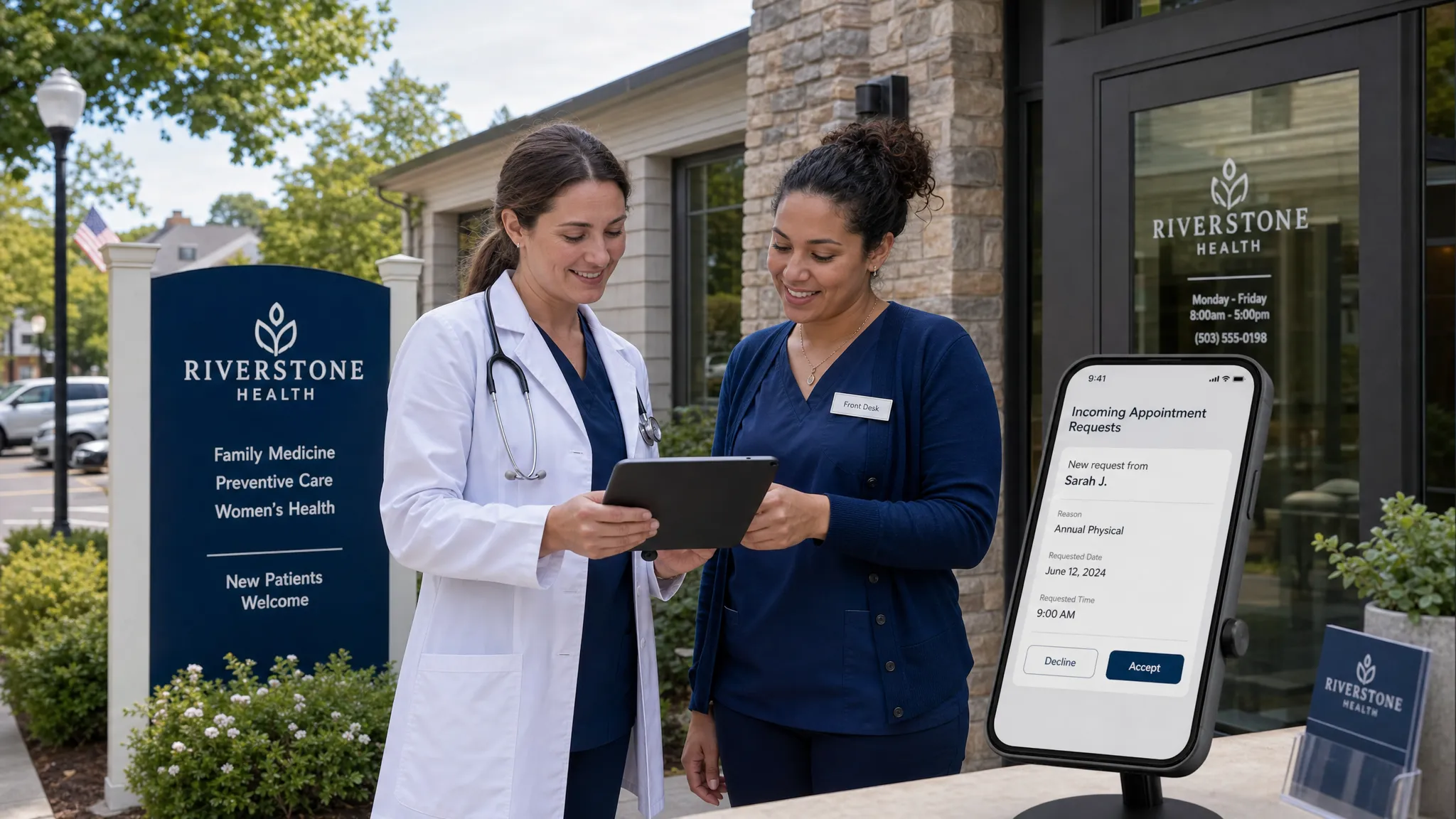
For a growing healthcare practice, patient acquisition is not just getting more clicks, calls, or form fills. It is building a repeatable system that turns the right local searches into scheduled appointments, completed visits, and long-term patient relationships.
That distinction matters. A dental implant inquiry that never receives a call back is not growth. A chiropractic lead from outside your service area is not useful. A LASIK consultation request from someone who cannot afford the procedure may create activity, but not profitable capacity.
The strongest healthcare practices in 2026 are not relying on one channel. They are combining local SEO, Google Business Profile optimization, paid search, conversion-focused websites, reviews, automation, and front-desk accountability into one patient acquisition engine.
What Patient Acquisition Really Means
Patient acquisition is the process of attracting, converting, and scheduling new patients who fit your practice’s services, geography, insurance or payment model, and capacity goals.
For a growing healthcare practice, the goal is not simply more leads. The goal is more of the right patients for the right services at the right time.
A healthy acquisition system answers four questions:
- Where do high-intent patients find us?
- What makes them trust us enough to contact us?
- How quickly and effectively do we respond?
- Which channels produce booked and completed appointments?
This is why patient acquisition touches both marketing and operations. SEO can create visibility, Google Ads can generate demand, and a website can convert traffic, but poor phone handling or slow follow-up can still drain revenue from the system.
Start With the Services You Actually Want to Grow
Before investing in campaigns, clarify what growth means for your practice. A pediatric dentist, orthodontist, dry eye clinic, physical therapy clinic, and pain management practice may all need new patients, but their acquisition strategies should not look identical.
Start with your priority service lines. For example, a dental practice may want more implant consultations or Invisalign cases, not just hygiene appointments. An optometry clinic may want to grow dry eye treatment, specialty contacts, or myopia management. A pain physician may want qualified interventional pain consults, not general wellness inquiries.
This helps you build campaigns around commercial intent instead of vague awareness.
| Practice goal | Better acquisition focus | Why it matters |
|---|---|---|
| Fill unused provider capacity | Local SEO, Google Ads, appointment landing pages | Captures patients already looking for care now |
| Grow high-value procedures | Procedure-specific pages, paid search, review strategy | Builds trust around complex decisions |
| Expand into a new location | Google Business Profile, local landing pages, citations | Establishes visibility in the new service area |
| Reduce dependence on referrals | Organic search, paid search, reputation building | Creates a more predictable patient pipeline |
| Improve lead quality | Better targeting, stronger forms, call tracking | Filters out poor-fit inquiries before staff time is wasted |
Once you know the services you want to grow, your marketing becomes easier to measure. Instead of asking whether traffic increased, you can ask whether implant consults, LASIK evaluations, new patient exams, or pain management appointments increased.
Capture Local Demand With SEO and Google Business Profile
Most patient acquisition starts with local intent. Patients search for things like dentist near me, chiropractor in Louisville, orthodontist for teens, dry eye treatment, cataract surgeon, or physical therapy after knee surgery.
According to Google’s local search research, 76% of people who search on their smartphone for something nearby visit a related business within a day. Healthcare is more complex than a retail visit, but the behavior is still clear: local visibility influences real-world action.
Your Google Business Profile is often the first impression. For many searches, patients will see your reviews, photos, hours, location, categories, and call button before they ever reach your website.
A strong profile should include accurate categories, consistent contact information, current photos, service descriptions, appointment links, and regular review activity. For multi-location groups, each location needs its own complete profile and location-specific strategy.
Local SEO extends beyond the profile. Your website should have dedicated pages for each core service, each location, and the major conditions or procedures patients search for. A chiropractor should not rely on one general page to rank for back pain, neck pain, sciatica, auto accident care, and sports injury treatment. A dental practice should not expect one services page to compete for implants, veneers, emergency dentistry, Invisalign, and pediatric care.
If your practice is unsure where visibility is leaking, this guide on healthcare practice marketing strategies that fill schedules explains how SEO, ads, reviews, and follow-up work together.
Build Service Pages That Reduce Patient Anxiety
Healthcare decisions involve trust. Patients are not just comparing prices or convenience. They are asking themselves whether your practice understands their problem, whether the provider is credible, whether the process will be painful or confusing, and whether the next step is easy.
That is why service pages should do more than list treatments. A strong acquisition page explains who the service is for, what symptoms or goals it addresses, what the patient can expect, and how to schedule.
For example, an orthodontic Invisalign page should speak to adults, teens, financing concerns, treatment timelines, and provider experience. A pain management page for epidural steroid injections should explain appropriate use cases, evaluation steps, and what happens before treatment. A dry eye page should help patients recognize symptoms, understand testing, and know when to book.
Your service pages should include:
- A clear headline tied to the patient’s need
- Provider or practice credibility
- Plain-language explanations of the condition or service
- Photos where appropriate and compliant
- Reviews or testimonials when allowed and properly handled
- FAQs that answer common patient objections
- Prominent phone, form, and booking calls to action
Avoid exaggerated medical claims. Healthcare marketing should be persuasive, but it must remain accurate, ethical, and compliant with applicable rules. If you use patient information in marketing or communications, review HHS guidance on HIPAA and marketing and consult qualified legal or compliance counsel.
Use Google Ads for Immediate Patient Acquisition
SEO compounds over time, but Google Ads can help fill near-term schedule gaps. This is especially useful for competitive service lines, new locations, seasonal demand, and high-value procedures.
The best healthcare Google Ads campaigns are built around intent. Someone searching emergency dentist near me, cataract surgery consultation, physical therapy for shoulder pain, or pain management doctor is much closer to booking than someone casually reading about general wellness.
For patient acquisition, Google Ads should not send traffic to a generic homepage. Each campaign should use a dedicated landing page that matches the searcher’s need. If the ad promotes dental implants, the landing page should be about dental implants. If the ad promotes dry eye treatment, the page should be about dry eye treatment.
Important campaign elements include call tracking, conversion tracking, negative keywords, location targeting, ad extensions, and regular search term review. Without these, practices often pay for irrelevant clicks and have no clear view of which campaigns actually produce appointments.
Google Ads can be powerful, but it is not a substitute for a weak intake process. If calls go unanswered or forms sit in an inbox for hours, paid acquisition becomes expensive fast.
Turn Your Website Into a Scheduling Engine
Your website is the bridge between interest and action. If it is slow, confusing, outdated, or vague, patients may choose a competitor even if your practice is clinically excellent.
A conversion-focused healthcare website should make the next step obvious on every important page. Mobile users should be able to tap to call, request an appointment, find directions, and understand your services without digging through a menu.
Patients also need trust signals. Provider bios, credentials, before-and-after galleries where appropriate, insurance or payment information, reviews, location details, and clear service explanations all reduce friction.
The most common website problem is not bad design in the artistic sense. It is unclear design. Patients land on the page and cannot quickly answer basic questions: Do you treat my problem? Are you near me? Can I trust you? How do I schedule?
For a deeper breakdown of conversion fundamentals, see Louisville Web Lab’s guide on how to build a lead generation website that converts.
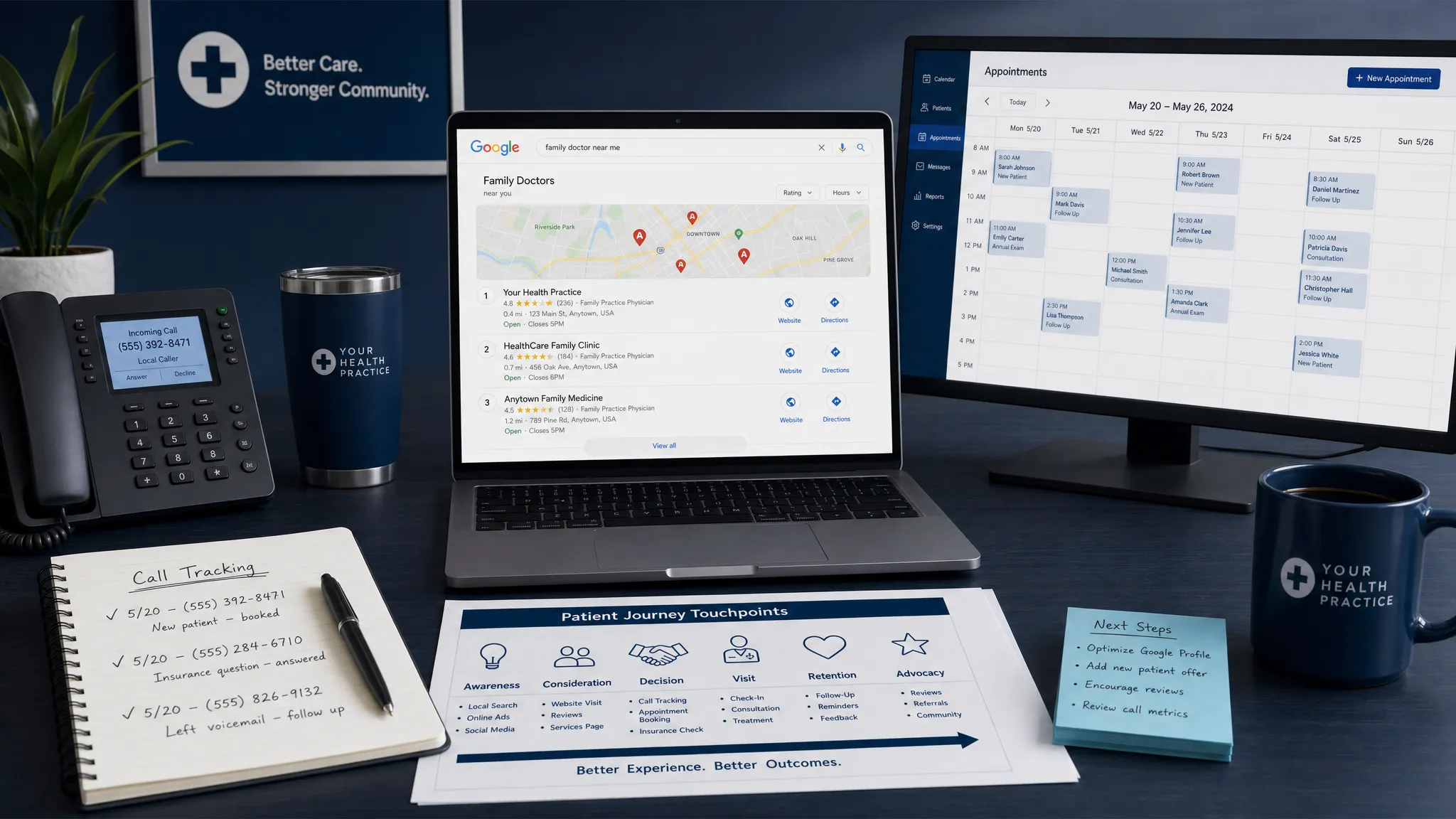
Make Reviews Part of the Acquisition System
Reviews are not just reputation assets. They are conversion assets. A patient comparing three dentists, optometrists, chiropractors, or physical therapy clinics will often use reviews to decide who feels safest and most credible.
For local SEO, review quantity, quality, recency, and relevance can all influence patient behavior. A steady stream of recent reviews is more persuasive than a large number of old reviews with no recent activity.
The key is to build a consistent review request process. Ask at the right moment, make the process simple, and avoid pressuring patients or filtering only for positive feedback. Train the front desk and clinical team to identify appropriate moments, such as after a successful visit, completed treatment milestone, or positive patient comment.
Responding matters too. Thoughtful responses show that the practice is attentive. For negative reviews, stay professional, avoid disclosing protected information, and move the conversation offline when appropriate.
Close the Follow-Up Gap With Automation
Many practices do not have a lead generation problem. They have a follow-up problem.
A patient submits a form after hours, calls during lunch, or asks a question through a website form. If no one responds quickly, that patient may contact the next practice on the search results page.
Marketing automation helps reduce that leakage. For healthcare practices, useful automations often include instant form confirmations, missed-call text responses, appointment request alerts, nurture emails for consultation-based services, review requests, and reactivation campaigns for inactive patients.
The goal is not to replace staff. The goal is to make sure no serious inquiry disappears.
Automation should be implemented carefully. Use consent-based communication, avoid sharing sensitive information through inappropriate channels, and make sure any tools handling patient data are reviewed for compliance needs.
A simple patient acquisition workflow might look like this:
| Patient action | System response | Practice goal |
|---|---|---|
| Patient submits appointment form | Immediate confirmation and staff alert | Reassure the patient and prompt fast follow-up |
| Patient calls after hours | Missed-call text or voicemail workflow | Keep the conversation alive |
| Patient requests a consult | Email or SMS reminders before visit | Reduce no-shows |
| Patient completes appointment | Review request when appropriate | Build reputation and local trust |
| Patient becomes inactive | Re-engagement message | Recover lost revenue from existing demand |
The faster your practice responds, the more value you get from every marketing channel.
Use Content to Answer Questions Before the First Call
Patients often research before they book. They want to know whether their symptoms are serious, what treatment might involve, how much discomfort to expect, whether insurance may apply, and when to seek care.
Educational content helps your practice appear earlier in the patient journey. It also builds trust before the first phone call.
For dental practices, this could include content around dental implant candidacy, clear aligner comparisons, emergency tooth pain, or pediatric first visits. For optometry and ophthalmology, topics might include dry eye symptoms, LASIK vs PRK, cataract surgery timing, or myopia control. For pain and musculoskeletal practices, content might cover sciatica, regenerative medicine questions, sports injuries, or when to choose physical therapy.
Content should not be written just to fill a blog. It should support service-line growth. Each article should connect naturally to a relevant service page and a clear next step.
In 2026, content also supports AI visibility. Search engines and AI assistants increasingly summarize answers, compare providers, and surface entities they can understand. Clear service pages, FAQs, provider bios, structured data, and consistent local information all help your practice become easier to interpret across search and AI-driven experiences.
Strengthen Referral and Community Channels
Digital channels are essential, but patient acquisition should not ignore relationships. Many healthcare practices grow through a combination of search visibility and referral trust.
For specialists, referral development may include relationships with general dentists, primary care physicians, optometrists, physical therapists, chiropractors, surgeons, or employer wellness programs. For consumer-facing practices, community events, school partnerships, sports sponsorships, and local education can create meaningful awareness.
The mistake is treating offline activity and digital marketing as separate. If your orthodontic practice sponsors a local school event, your website, social media, Google Business Profile, and email list should reinforce that presence. If your pain clinic gives an educational talk, the topic can become a blog post, landing page, short video, and email campaign.
This is where process matters. AI-powered creative platforms such as Needle show how quickly campaign production is evolving, but healthcare practices still need human review, clinical accuracy, compliance awareness, and a strategy tied to booked appointments.
Measure What Actually Drives Appointments
Patient acquisition becomes much easier to improve when you measure the full funnel. Many practices track website traffic but do not track scheduled appointments by source. That creates blind spots.
At minimum, track calls, forms, booked appointments, show rates, cost per booked appointment, and new patient revenue by channel when possible. You do not need a perfect attribution model to make better decisions. You need enough clarity to see which channels create real patient flow.
| Metric | Why it matters | What to watch for |
|---|---|---|
| Website conversion rate | Shows whether traffic becomes inquiries | Low conversion may signal weak pages or unclear calls to action |
| Call answer rate | Reveals front-desk leakage | Missed calls can waste SEO and ad spend |
| Cost per lead | Helps compare channels | Low-cost leads may still be poor quality |
| Cost per booked appointment | Better measure of acquisition efficiency | High cost may indicate targeting or intake problems |
| Show rate | Connects marketing to actual visits | No-shows may require reminders or better qualification |
| Revenue by service line | Shows whether growth matches priorities | More patients do not always mean better profitability |
For healthcare practices, attribution should be practical rather than obsessive. A patient may see a Google ad, read reviews, visit your website, and call two days later. The goal is to understand patterns well enough to invest confidently.
A 90-Day Patient Acquisition Plan for Growing Practices
If your acquisition system feels scattered, use a 90-day plan to create momentum without trying to fix everything at once.
Days 1 to 30: Diagnose the funnel
Review your Google Business Profile, local rankings, website conversion paths, service pages, reviews, ad accounts, call handling, and appointment follow-up. Identify which services have the highest growth priority and where patients are dropping off.
This stage should produce a clear list of fixes, not a vague marketing wishlist.
Days 31 to 60: Build the acquisition foundation
Improve priority service pages, add stronger calls to action, update Google Business Profile content, launch or clean up Google Ads, implement call tracking, and create a basic review request process. If your website is the bottleneck, prioritize landing pages before increasing ad spend.
Days 61 to 90: Optimize and scale
Review search terms, conversion rates, booked appointments, cost per appointment, and front-desk response data. Shift budget toward the campaigns and services that create real appointments. Add content based on patient questions and expand local SEO around the highest-value opportunities.
By the end of 90 days, your practice should have a clearer view of what is working, what is leaking, and where to invest next.
Common Patient Acquisition Mistakes to Avoid
The first mistake is chasing volume without quality. More leads can overwhelm staff if they are poorly targeted or low intent.
The second mistake is investing in ads before fixing the website. Paid traffic will not save a confusing page, weak offer, or broken appointment form.
The third mistake is ignoring the front desk. Your intake team is part of the marketing funnel. Call scripts, speed to lead, follow-up attempts, and scheduling confidence can dramatically affect results.
The fourth mistake is underinvesting in reviews. Patients want proof. If competitors have stronger, fresher reviews, your ads and SEO may still underperform.
The fifth mistake is treating marketing channels separately. SEO, Google Ads, reviews, website conversion, and automation work best as a connected system.
Frequently Asked Questions
What is the best patient acquisition strategy for healthcare practices? The best strategy is usually a combination of local SEO, Google Business Profile optimization, Google Ads, strong service pages, reviews, and fast follow-up. The right mix depends on your specialty, market, budget, and capacity.
How long does patient acquisition take to improve? Google Ads can generate inquiries quickly if campaigns and landing pages are set up well. SEO and reputation building usually take longer, often several months, but they create compounding value over time.
Is patient acquisition different from lead generation? Yes. Lead generation focuses on creating inquiries. Patient acquisition focuses on turning qualified inquiries into scheduled and completed appointments, then measuring which channels create real practice growth.
Should healthcare practices use Google Ads or SEO first? If you need appointments quickly, Google Ads can help create immediate visibility. If you want long-term growth and lower dependence on paid media, SEO is essential. Many growing practices use both.
How can a small practice compete with larger healthcare groups? Smaller practices can compete by focusing on specific service lines, stronger local SEO, better reviews, faster follow-up, more personal website messaging, and highly targeted campaigns instead of broad advertising.
Build a Patient Acquisition System That Converts
Growing a healthcare practice requires more than marketing activity. It requires a system that connects search visibility, patient trust, website conversion, follow-up, and measurement.
Louisville Web Lab helps healthcare practices grow through SEO, Google Ads, websites, automation, reputation strategy, and patient acquisition systems built around booked appointments. If you want to find the leaks in your current funnel and identify the highest-impact opportunities, book a diagnostic call with Louisville Web Lab.