

Multi-specialty practices have a unique growth problem. A single-location dental office or chiropractic clinic can usually focus its advertising around a narrower set of services, keywords, and patient needs. A multi-specialty group has to do something more complex: attract the right patients for the right service line, in the right market, at the right time, without letting one department consume the entire budget.
That is where local Google Ads become especially valuable.
For dental groups, orthopedic and pain practices, vision clinics, physical therapy groups, and other healthcare organizations with multiple specialties, Google Ads can do more than generate clicks. When built correctly, they can help balance provider schedules, support new service lines, fill capacity gaps, and connect high-intent patients with the care they are already searching for nearby.
The key phrase is built correctly. Local intent in healthcare is not generic. Someone searching for a pediatric dentist, dry eye doctor, knee pain clinic, dental implant consultation, or chiropractor near them is often much closer to booking than someone casually reading about symptoms. Multi-specialty practices need an ad strategy that recognizes those differences.
Multi-specialty practices compete in many local markets at once
A multi-specialty practice is rarely competing in just one category. Even under one brand, each specialty faces a different local search environment.
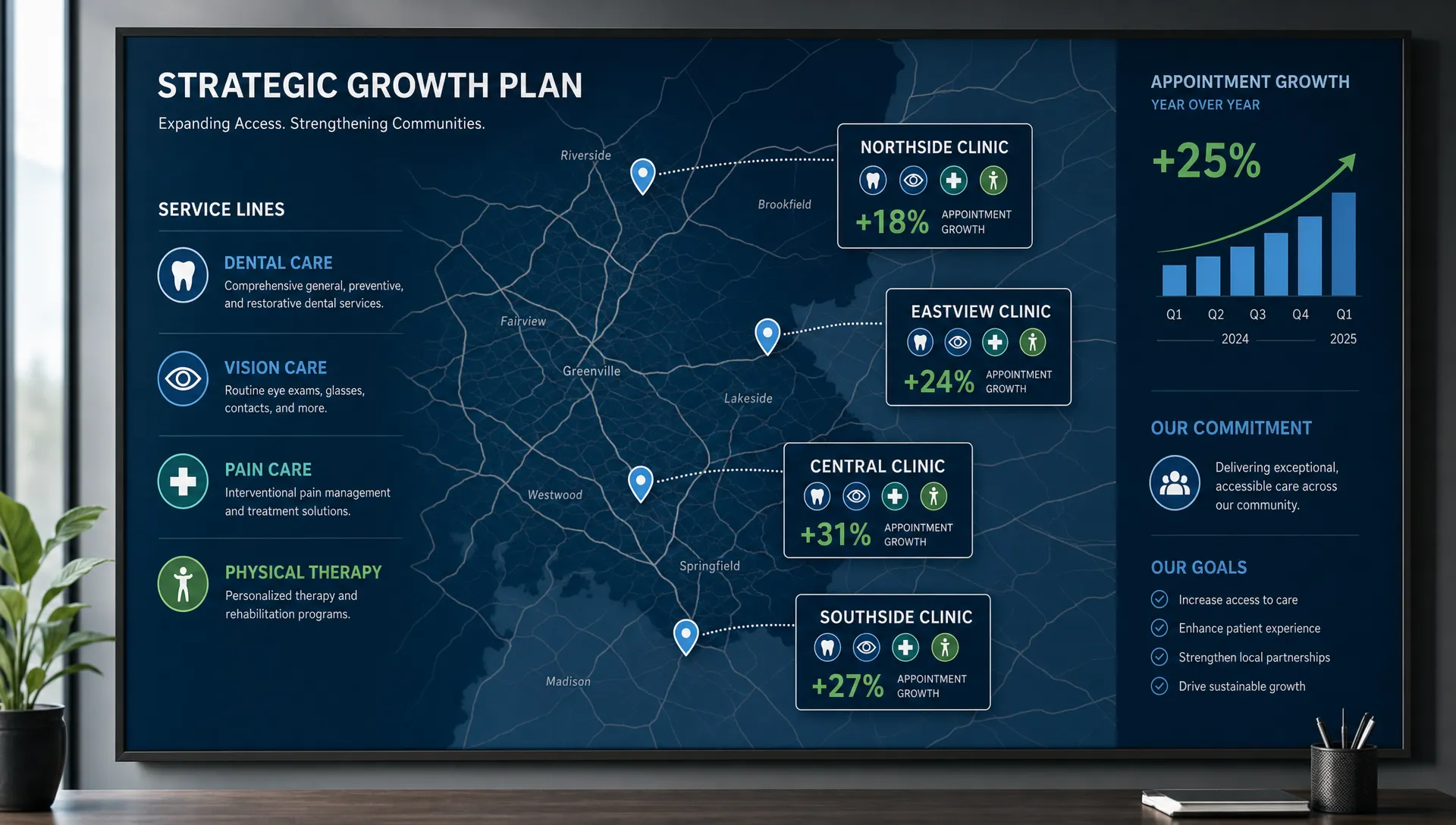
A dental group may need visibility for general dentistry, orthodontics, pediatric dentistry, oral surgery, dental implants, and emergency dental care. A musculoskeletal practice may advertise chiropractic, physical therapy, pain management, sports medicine, regenerative medicine, and orthopedic services. A vision group may promote routine eye exams, dry eye treatment, cataract evaluations, LASIK consultations, and medical eye care.
Each of those service lines has its own:
- Patient intent
- Competition level
- Average lead value
- Appointment urgency
- Insurance or payment considerations
- Geographic draw radius
- Provider availability
- Conversion path
This is why a single broad campaign for the entire practice often underperforms. It may bring traffic, but it rarely gives leadership a clear view of which specialties are producing booked appointments and which are simply spending money.
Local Google Ads help solve this by allowing campaigns to be structured around specific specialties, locations, and patient needs. Instead of asking one campaign to do everything, a practice can separate high-intent searches for urgent, elective, routine, and specialty care.
Local search intent is where patient demand becomes visible
Healthcare marketing works best when it meets patients at the moment they are ready to act. Google Search is one of the clearest windows into that intent.
A patient searching for back pain treatment near me is not behaving the same way as someone reading a general article about back pain causes. A parent searching for pediatric dentist accepting new patients is likely much closer to making a phone call. A patient searching for cataract surgeon near me may be actively comparing providers.
Local Google Ads let multi-specialty practices show up when that intent is present and geographically relevant.
For practices trying to understand how search intent impacts campaign performance, the principles behind Google Search Ads for healthcare practices are especially important. Search campaigns are most effective when they are built around the real language patients use when they are ready to schedule, not just broad medical terminology.
In a multi-specialty environment, this matters because the same patient may search differently depending on their problem. One person searches by symptom, another by treatment, another by provider type, and another by insurance or location. A strong local ad strategy maps these search patterns to the correct specialty and appointment pathway.
Why local Google Ads matter more as practices grow
As a practice adds specialties, providers, or locations, the marketing challenge becomes less about visibility alone and more about coordination. Leadership needs to know which services are growing, where demand is strongest, and how marketing dollars affect appointment volume.
Local Google Ads can support that level of control in several important ways.
They help route patients to the right service line
A multi-specialty website may have dozens of service pages. Without targeted campaigns and landing pages, patients can land on pages that are too general or not aligned with their immediate need.
For example, a patient searching for same day tooth extraction should not land on a generic dental homepage if the goal is to convert that search into a consultation. A patient searching for dry eye specialist should not have to navigate through general optometry content to find the right next step.
Local ads can send each searcher to a focused page that matches the service, location, and call to action. That improves user experience and makes conversion tracking more meaningful.
They allow budget control by specialty
Not every specialty should receive the same budget. Some services have higher margins, longer patient lifetime value, more open provider capacity, or more urgent growth goals.
A local campaign structure can give practices better control over where money goes. For example, a group may choose to increase ad spend for dental implants, LASIK consultations, interventional pain procedures, or physical therapy evaluations while maintaining a smaller but steady presence for routine services.
This is particularly useful when leadership is trying to evaluate ad performance based on patient acquisition, not surface-level metrics. If ROI is the priority, practices should examine how campaigns connect to real appointments, as explained in more detail in this guide on Google ad services for practices focused on ROI.
They support location-level growth
A multi-specialty practice may have one location that is fully booked, another that needs more new patients, and a third that is launching a new provider or specialty. Treating every location the same in Google Ads can waste budget.
Local Google Ads can help target neighborhoods, cities, ZIP codes, or defined service areas based on each location’s needs. Google’s own documentation explains how advertisers can use location targeting in Google Ads to show ads to people in selected geographic areas.
For healthcare practices, this targeting must be paired with practical knowledge of patient behavior. A patient may drive farther for surgery, implants, or specialty pain care than they would for a routine cleaning or eye exam. Campaign geography should reflect that reality.
They make capacity management easier
Marketing should not just create demand. It should create the right demand for the schedule the practice actually has.
If a chiropractor has openings on certain weekdays, a physical therapy location needs more evaluations, or a new orthodontist is building a patient base, local ads can be adjusted more quickly than organic campaigns. Budgets, ad schedules, and specialty emphasis can change based on provider capacity.
This flexibility is one of the biggest advantages of paid search for multi-specialty groups. SEO and reputation work remain essential, but ads can respond faster when the practice needs appointments now.
How local Google Ads solve common multi-specialty growth problems
The value of local ads becomes clearer when connected to the operational problems multi-specialty practices face every week.
| Practice challenge | How local Google Ads help | What to measure |
|---|---|---|
| One specialty gets most of the leads while another has open capacity | Separate campaigns and budgets by service line | Booked appointments by specialty |
| New provider or location needs patient volume | Target nearby searches and direct traffic to a relevant landing page | Calls, forms, scheduled consults, show rates |
| High-value services are buried under general campaigns | Create campaigns around specific treatments or procedures | Cost per qualified lead and cost per booked patient |
| Patients land on generic pages and do not convert | Match ads to focused local landing pages | Conversion rate and call quality |
| Leadership cannot see which services are profitable | Track campaigns by service, location, and appointment outcome | Revenue attribution where appropriate and compliant |
| Ads generate traffic from outside the service area | Tighten geography, intent, and negative keywords | Search terms, location reports, wasted spend |
For a multi-specialty practice, the goal is not simply to get more leads. The goal is to generate more of the right patient opportunities, then understand which ones became real appointments.
What makes local Google Ads different for multi-specialty healthcare?
A campaign for a multi-specialty practice should not be managed like a simple local business campaign. Healthcare advertising has more complexity, more compliance considerations, and more operational consequences.
Campaigns need specialty-level structure
Campaign structure is the foundation. If all keywords, locations, and services are grouped together, performance data becomes muddy. It may look like the campaign is generating leads, but leadership cannot tell whether those leads are for the services that matter most.
A stronger structure typically separates campaigns or ad groups by service category, location, or patient intent. For example, a dental organization may separate emergency dentistry, implants, orthodontics, and pediatric dentistry. A pain practice may separate neuropathy, back pain, joint pain, regenerative medicine, and sports injury care.
The exact structure depends on the practice, but the principle is consistent: the campaign should reflect how the business actually grows.
Keywords should match patient language
Medical teams often describe services differently than patients do. Patients may search for tooth pain, eye doctor for dry eyes, knee pain doctor, back pain relief, or physical therapy near me. They may not know the clinical term for the treatment they need.
This is why keyword strategy should include both service-based and problem-based searches when appropriate. It should also exclude irrelevant searches through negative keywords, especially for information-only queries, jobs, training programs, free services, unrelated specialties, or conditions the practice does not treat.
The search terms report is especially valuable. It shows the real queries that triggered ads, which can reveal patient language, wasted spend, and new opportunities.
Landing pages should reduce decision friction
A local ad is only as strong as the page it sends people to. Multi-specialty practices often lose conversions because the landing page is too broad, too cluttered, or too disconnected from the search.
A strong local landing page should make the next step obvious. It should clarify the service, location, provider or care team when relevant, insurance or financing guidance when appropriate, and the action the patient should take next.
For healthcare, trust signals matter. Reviews, provider credentials, patient-friendly explanations, location details, and clear phone or scheduling options can all help a patient feel confident enough to reach out.
Tracking must go beyond form fills
Clicks and form submissions are not enough. Multi-specialty practices need to know whether leads became qualified conversations, scheduled appointments, completed consultations, or new patients.
This requires thoughtful conversion tracking. Phone calls, forms, appointment requests, and landing page actions should be measured in a way that supports business decisions. At the same time, healthcare practices must be careful about privacy and compliance. Teams should avoid passing sensitive health information into advertising platforms and should work with qualified legal, compliance, or IT advisors when connecting marketing data with patient systems.
The U.S. Department of Health and Human Services provides guidance on HIPAA and online tracking technologies, which is important for healthcare organizations evaluating analytics, pixels, forms, and advertising tools.
Local Google Ads should work with SEO, not replace it
Paid search is powerful because it can create visibility quickly, but it should not operate in isolation. For multi-specialty practices, Google Ads, local SEO, Google Business Profile optimization, reviews, website content, and patient follow-up all influence growth.
Local ads can generate faster demand while SEO builds durable visibility. Ads can also reveal which services and search terms are converting, which can inform future content, location pages, and service pages.
For groups with multiple locations, the connection between paid and organic visibility becomes even more important. Consistent location data, optimized Google Business Profiles, strong review generation, and localized content all support patient acquisition. If your practice is managing several offices, this overview of outsourced local SEO for multi-location medical practices explains why local visibility becomes harder as the footprint grows.
The best strategy is usually not ads versus SEO. It is ads and SEO working together, with each channel measured against booked patient outcomes.
When local Google Ads are especially important
Local Google Ads are useful for many healthcare practices, but they become especially important during specific growth moments.
Launching a new specialty
If an established practice adds a new service line, patients may not yet associate the brand with that specialty. Ads can help introduce the service to people already searching nearby.
For example, a general dental group adding implants or clear aligners may need immediate visibility for those specific searches. A chiropractic group adding physical therapy may need campaigns that educate patients on the expanded care model while still matching high-intent searches.
Opening or expanding a location
A new location cannot rely solely on existing brand awareness, especially if it is entering a competitive local market. Ads can help the practice appear for nearby searches while local SEO, reviews, and referral relationships develop.
This is also useful when a location has capacity but the overall brand does not need more demand everywhere. Local targeting can focus spend where it is needed most.
Competing in high-value service categories
Some healthcare searches are extremely competitive because the patient value is high. Dental implants, LASIK, cataract surgery, pain procedures, orthodontics, regenerative medicine, and certain specialty consultations often attract aggressive advertising.
If a practice is not visible for these local searches, competitors may capture patients before the practice is even considered.
Filling gaps in provider schedules
A multi-specialty group may have uneven capacity. One provider is booked out for weeks, while another has availability. One location may be growing, while another is flat. One service line may be seasonal.
Local ads can help adjust demand more quickly than most other marketing channels, especially when campaigns are monitored closely and connected to scheduling realities.
Signs your local Google Ads are not built for a multi-specialty practice
Many practices run ads for months without realizing the campaign structure is working against them. The symptoms are usually visible if you know what to look for.
Common warning signs include:
- One campaign contains every specialty and every location
- Ads send all traffic to the homepage
- Reports focus on clicks and impressions instead of booked appointments
- Search terms include unrelated conditions or services
- Budget is spent evenly even when provider capacity is not even
- Phone calls are counted as conversions regardless of quality
- The same ad copy is used for very different specialties
- Campaigns target areas that patients are unlikely to drive from
None of these issues means Google Ads cannot work. They usually mean the strategy has not been adapted to the way a multi-specialty healthcare business actually operates.
What practices should measure instead of clicks
Clicks matter only because they can lead to patient action. For multi-specialty practices, reporting should connect marketing activity to operational outcomes.
Important metrics include:
- Cost per qualified lead
- Cost per scheduled appointment
- Lead-to-appointment conversion rate
- Appointment show rate
- Calls by specialty and location
- Form submissions by landing page
- Search terms that generate real patients
- Budget allocation by provider capacity
- New patient volume by service line
The more specialties a practice has, the more important this reporting becomes. Otherwise, a campaign can look successful while still failing to support the services leadership cares about most.
How to think about budget allocation
There is no universal budget for local Google Ads because competition, geography, specialty, and growth goals vary widely. A multi-specialty practice should think about budget in terms of business priorities, not just ad platform recommendations.
A practical budget discussion should include these questions:
- Which specialties have the most capacity to accept new patients?
- Which services have the strongest patient lifetime value?
- Which locations need growth most urgently?
- Which service lines are most competitive in local search?
- Which campaigns have proven they can produce qualified appointments?
- Which services need short-term demand while SEO matures?
Budget should be reviewed regularly. If one campaign is generating low-quality calls while another is producing booked consults, spend should shift. If a provider’s schedule fills, the campaign may need to slow down or redirect demand to another location or specialty.
This is where local Google Ads become a management tool, not just an advertising channel.
Frequently Asked Questions
Are local Google Ads worth it for multi-specialty practices? Yes, when campaigns are structured around service lines, locations, and patient intent. They are especially useful for practices that need to fill specific provider schedules, promote high-value services, or grow multiple locations.
Should each specialty have its own Google Ads campaign? Often, yes. Separate campaigns or tightly organized ad groups can make it easier to control budget, write relevant ads, send patients to better landing pages, and measure performance by specialty. The right structure depends on the size and goals of the practice.
How are local Google Ads different from local SEO? Local Google Ads can create faster visibility for high-intent searches, while local SEO builds long-term organic and map visibility. Multi-specialty practices usually benefit from both because ads support immediate demand and SEO strengthens durable local presence.
What should healthcare practices track in Google Ads? Practices should track more than clicks. Important metrics include qualified calls, appointment requests, scheduled appointments, cost per booked patient, landing page conversion rate, and performance by specialty and location.
Can Google Ads help a new provider or location grow faster? Yes. Local campaigns can target nearby patients searching for relevant services while the provider or location builds organic visibility, reviews, and referral momentum.
Turn local searches into better patient opportunities
For a multi-specialty practice, local Google Ads are not just about appearing at the top of search results. They are about matching patient intent to the right specialty, location, provider capacity, and next step.
When campaigns are structured around how the practice actually grows, paid search becomes far more useful. It can show which services have demand, which locations need support, which landing pages convert, and which marketing dollars are turning into scheduled care.
Louisville Web Lab helps healthcare practices use SEO, Google Ads, websites, and automation to turn search visibility into booked appointments and measurable growth. If your practice wants a clearer view of how local advertising can support patient acquisition across multiple specialties, book a diagnostic call with Louisville Web Lab.