
Hiring a Google Ads agency is not just a marketing decision. For a healthcare practice, it can affect schedule utilization, front desk workload, patient quality, and how confidently you invest in growth.
The problem is that many agencies sound similar during a sales call. They all mention keywords, conversion tracking, landing pages, and monthly reports. But a campaign for dental implants, LASIK, pain management, orthodontics, or physical therapy needs more than generic PPC management. It needs clear strategy, careful tracking, healthcare-aware messaging, and a plan for turning searches into booked appointments.
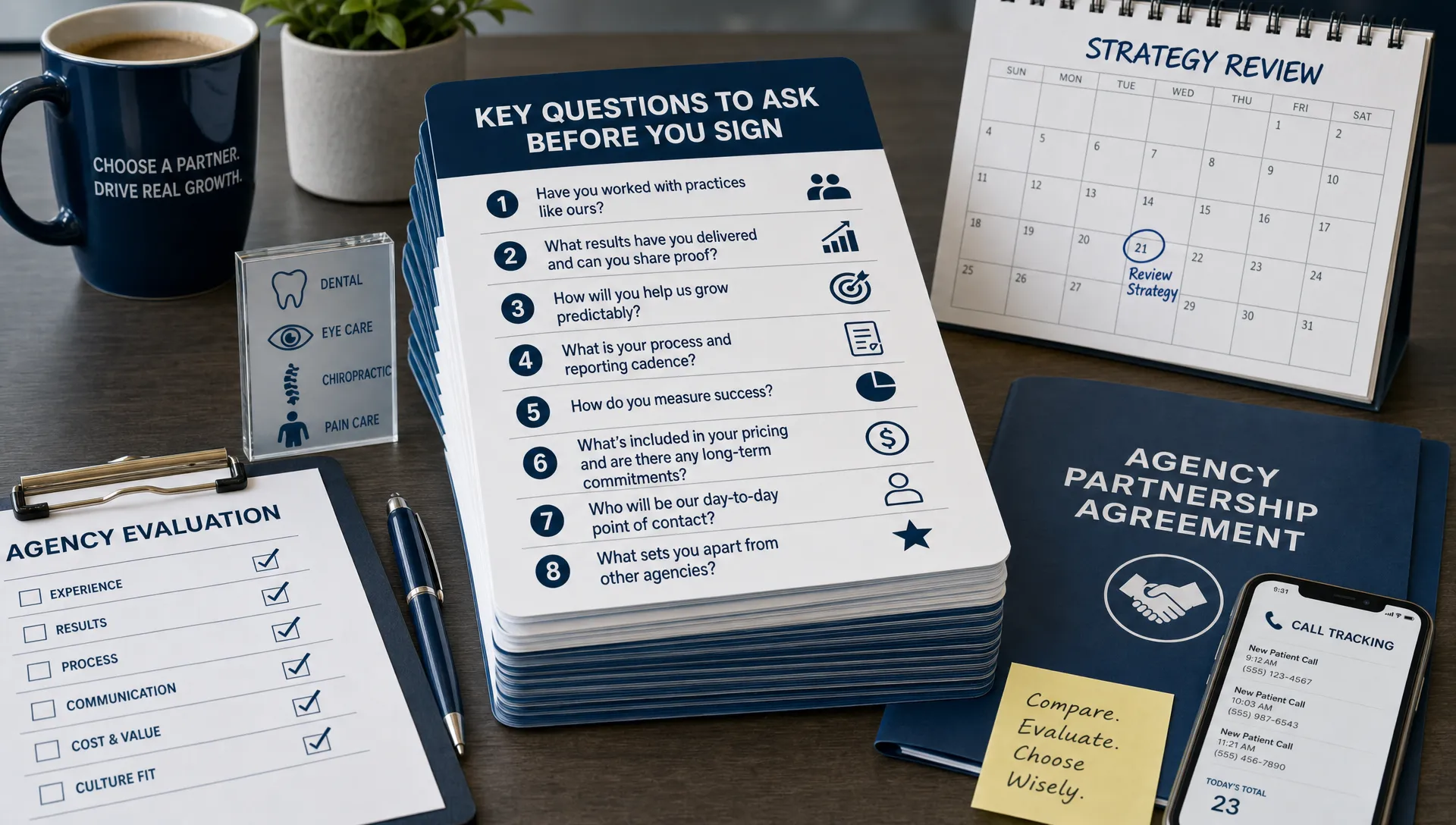
Before you sign a contract, use the seven questions below to separate a true growth partner from a vendor that simply spends your ad budget.
Quick checklist: what to ask before you hire
| Question | What a strong answer should include | Red flag |
|---|---|---|
| Have you managed healthcare campaigns like ours? | Relevant patient acquisition examples, service line strategy, local market understanding | Only generic ecommerce or national lead gen experience |
| How do you define success? | Booked appointments, qualified calls, cost per opportunity, revenue influence | Focuses mostly on clicks and impressions |
| How do you improve lead quality? | Keyword intent, negative keywords, landing pages, call review, follow-up alignment | Promises more leads without discussing quality |
| How will you structure campaigns and budget? | Separate campaigns by service, location, intent, and priority | One broad campaign for every service |
| How do you handle compliance and privacy? | Awareness of Google policies, healthcare restrictions, HIPAA-sensitive workflows | Casual use of patient data or aggressive medical claims |
| What happens after the click? | Landing page strategy, conversion paths, phone tracking, form optimization | Sends all traffic to the homepage |
| What reporting and ownership do we get? | Transparent access, plain-English reporting, clear account ownership | You cannot access your own Google Ads account |
1. Have you managed Google Ads for healthcare practices like ours?
A Google Ads agency may be excellent in one industry and still struggle in healthcare. Patient acquisition has different constraints than selling a product online or generating generic home service leads.
A cosmetic dentistry campaign, for example, may need to balance high-value treatment intent with trust-building language. An orthodontic campaign may involve parents researching options for a child. A pain management campaign may need to avoid overpromising outcomes while still communicating relief, access, and expertise. An optometry or LASIK campaign may require separating routine eye exams from surgical or specialty care.
Ask the agency what types of practices they have worked with and how they approach different service lines. You are not looking for a vague answer like, “We work with local businesses.” You want to hear how they think about patient intent, local competition, appointment value, insurance or cash-pay considerations, and the path from search to scheduled visit.
Good follow-up questions include:
- Which healthcare specialties have you managed campaigns for?
- How do you adjust strategy for high-value procedures versus routine appointments?
- What patient intent signals do you look for in search terms?
- How do you account for local competition and geography?
If you are also deciding between hiring one person and hiring a team, this breakdown of a Google Ads specialist vs agency for healthcare practices can help clarify the tradeoffs.
2. How will you define success beyond clicks?
Clicks are easy to buy. Appointments are harder.
A healthcare practice should be cautious of any agency that leads with traffic volume, impressions, or click-through rate as the primary win. Those metrics matter, but they do not prove that your ads are producing qualified patient opportunities.
For most practices, stronger performance indicators include phone calls from new patients, completed appointment request forms, scheduled consults, cost per qualified lead, cost per booked appointment, and revenue influenced by campaigns. The exact KPI depends on your specialty. A dental implant campaign may justify a higher cost per lead than a routine cleaning campaign because the potential case value is different. A physical therapy campaign may need to measure referral-friendly appointment requests and insurance-fit calls.
Ask how the agency will connect ad spend to business outcomes. Google’s own conversion tracking documentation emphasizes tracking valuable customer actions after an ad interaction. In healthcare, that usually means tracking calls, forms, booking actions, and other meaningful steps while respecting privacy rules.
A strong agency should be able to explain which conversions they will track, which ones they will optimize toward, and which ones they will treat as secondary signals. Not every form fill is equal. Not every call is a qualified lead. Not every lead becomes an appointment.
3. How do you improve lead quality, not just lead volume?
More leads can become a problem if your front desk is flooded with wrong-location calls, insurance mismatches, job seekers, existing patients, or people looking for services you do not provide.
Lead quality starts with search intent. Someone searching “emergency dentist near me” has a different need than someone searching “how much do veneers cost.” Someone searching “chiropractor open Saturday” is likely closer to booking than someone searching “back pain causes.” A capable Google Ads agency should know how to separate research intent from appointment intent and build campaigns accordingly.
They should also talk about negative keywords. These are terms that prevent ads from showing for irrelevant searches. For healthcare practices, negative keywords can protect budget from searches related to free services, employment, education, DIY care, unrelated conditions, or services outside your scope.
The agency should also review what happens after leads come in. If call tracking shows that many patients are asking about a service you do not offer, campaign targeting needs adjustment. If callers are qualified but not booking, the issue may involve landing page clarity, scheduling availability, or front desk follow-up.
This is why lead quality is not only a PPC issue. It is a full patient acquisition issue. If you want a deeper look at this topic, Louisville Web Lab has covered how a Google Ads expert improves lead quality through targeting, keywords, landing pages, and follow-up alignment.
4. How will you structure campaigns and allocate budget?
Campaign structure affects almost everything: budget control, reporting clarity, optimization speed, and lead quality.
A weak setup might put every service into one campaign with broad keywords and one shared budget. That makes it hard to know whether spending is driving valuable consults or low-intent clicks.
A stronger setup usually separates campaigns or ad groups by service line, location, urgency, and intent. A dental practice might separate emergency dentistry, implants, Invisalign, and general dentistry. An eye care practice might separate eye exams, dry eye, LASIK, and cataracts. A pain or chiropractic practice might separate back pain, neck pain, sports injury, and regenerative medicine if those services have distinct economics and patient intent.
Budget should follow business priorities, not just keyword volume. If a practice wants more implant consults, the campaign should not allow routine low-value searches to consume the entire budget. If a physical therapy clinic has capacity at one location but not another, budget should reflect that operational reality.
Ask the agency how they decide where the first dollars go, when they expand, and when they cut waste. Their answer should include a balance of search demand, competition, cost per click, conversion rate, appointment value, and practice capacity.
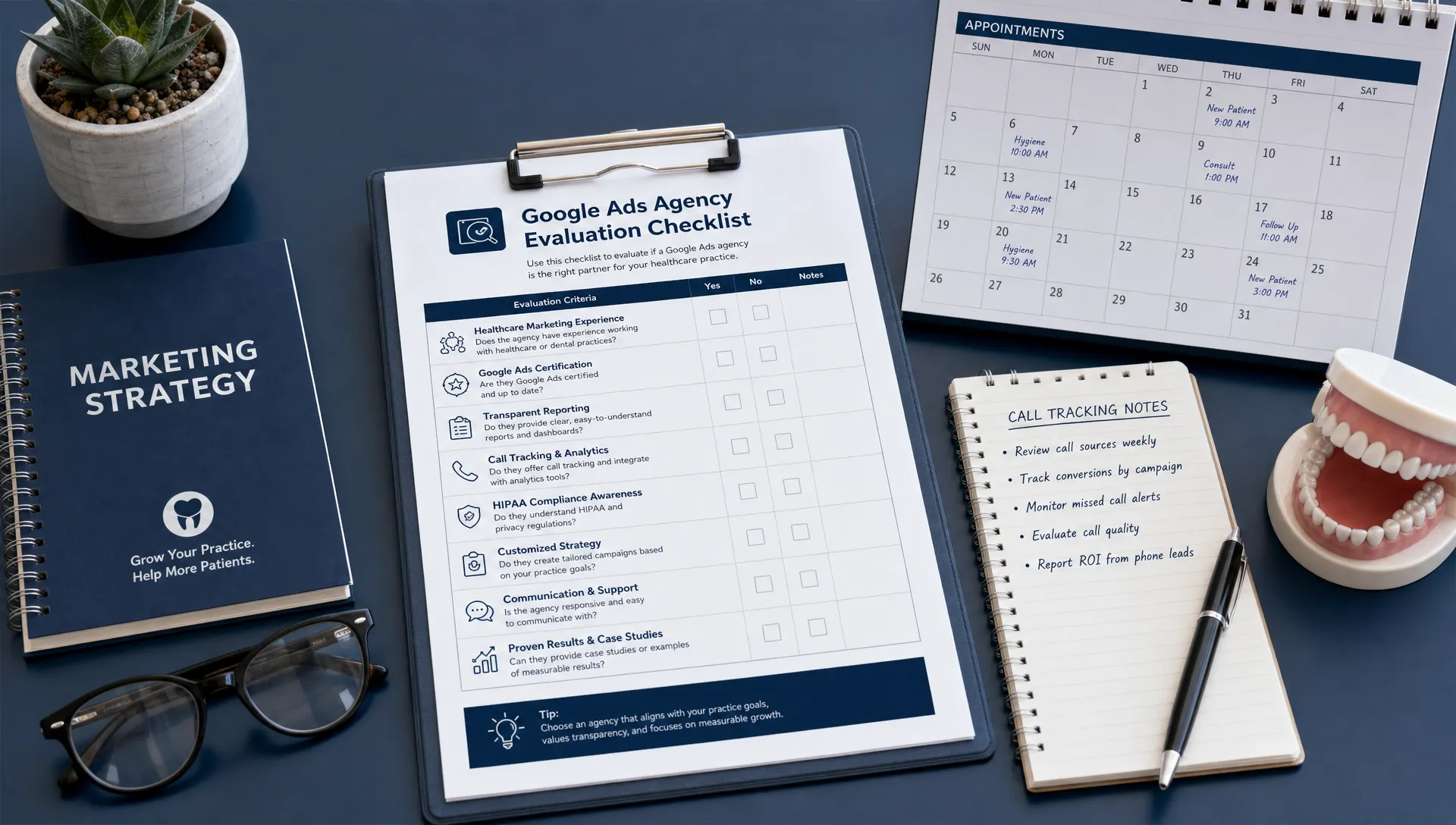
It is also worth asking which ad types they recommend. Search campaigns are often the foundation for high-intent patient acquisition, but other formats may support the funnel depending on your market and goals. This guide to Google advertising services practices should compare explains how Search Ads, Local Services Ads, landing pages, tracking, and other options can fit into a broader strategy.
5. How do you handle healthcare compliance, privacy, and ad policy issues?
Healthcare advertising requires more caution than many other categories. You need compelling messaging, but you also need to avoid misleading claims, inappropriate use of sensitive health information, and policy violations that can restrict or suspend campaigns.
Google has specific rules for healthcare-related advertising. Its healthcare and medicines advertising policy covers restricted medical content, approved advertisers in certain categories, and limitations that vary by country and product type. Even if your practice is not advertising pharmaceuticals, your agency should understand that medical advertising is subject to extra scrutiny.
Privacy matters too. The U.S. Department of Health and Human Services provides guidance on HIPAA and marketing, and healthcare practices should be careful about how patient information is collected, stored, and used. Your agency should not casually upload patient lists, expose protected health information, or build remarketing audiences in ways that create privacy concerns.
Ask how the agency handles call recordings, form submissions, tracking scripts, CRM integrations, and access permissions. You do not need every technical detail in the sales call, but you do need confidence that they take privacy seriously.
A trustworthy agency will avoid exaggerated promises such as “guaranteed pain relief,” “perfect vision guaranteed,” or “best dentist in town” unless the claim is substantiated and compliant. Healthcare marketing should be persuasive, but it should also be accurate, ethical, and aligned with professional standards.
6. What landing page and website improvements are included?
Even the best campaign can underperform if the landing page does not convert.
Many practices send paid traffic to a homepage and hope visitors find the right service. That often creates friction. A patient who searched for “dental implants near me” should land on a page that clearly explains implant options, trust factors, next steps, financing or consultation information if applicable, and a simple way to call or request an appointment. A patient searching for “dry eye specialist” should not have to dig through a general optometry site to understand whether the clinic treats dry eye.
Ask whether the Google Ads agency builds or advises on landing pages. If they do not, ask how they will coordinate with your website team. Paid search performance depends heavily on message match, page speed, mobile usability, trust signals, calls to action, and form design.
For healthcare practices, landing pages should answer practical patient questions without overwhelming the visitor. They should make it easy to understand:
- What service is being offered
- Who the service is for
- Why the practice is credible
- What the patient should do next
- How quickly the patient can reach the office
A good agency should also care about phone call behavior. Many healthcare leads still come through calls, especially for urgent or high-consideration services. If the phone number is hard to find, the page loads slowly, or the call to action is vague, your cost per booked appointment can rise quickly.
7. What reporting, communication, and ownership will we have?
Before hiring an agency, clarify what you will see, how often you will see it, and who owns the work.
A monthly report should not be a confusing spreadsheet full of PPC jargon. It should explain what happened, what changed, what was learned, and what the agency recommends next. You should be able to see spend, conversions, cost per conversion, search term insights, campaign changes, and progress toward practice-level goals.
Communication cadence matters too. Some practices need monthly strategy calls. Others need more frequent check-ins during launch or when scaling a high-priority service line. Ask who your main contact will be, how quickly they respond, and whether you will speak with someone who actually understands the account strategy.
Ownership is another important issue. Ideally, your practice should own or have appropriate administrative access to its Google Ads account, conversion assets, landing pages, and tracking infrastructure. If an agency insists that everything must live in an account you can never access, be careful. Lack of transparency makes it difficult to evaluate performance or transition later.
You should also ask what happens in the first 30, 60, and 90 days. Early campaign management should involve data collection, search term refinement, tracking validation, bid adjustments, landing page learning, and lead quality review. Google Ads is not “set it and forget it.” It is an ongoing optimization process.
Red flags when evaluating a Google Ads agency
Some warning signs are obvious. Others sound harmless until you are three months into a contract with poor visibility and little progress.
Be cautious if an agency guarantees a specific number of patients without understanding your market, budget, website, schedule capacity, or offer. Be cautious if they avoid discussing tracking. Be cautious if they only talk about clicks and never mention booked appointments. Be cautious if they push broad match automation without a plan to monitor search terms and lead quality.
The biggest red flag is a lack of curiosity. A strong healthcare marketing partner should ask about your services, margins, capacity, locations, ideal patients, competitive landscape, intake process, and follow-up workflow. If the agency does not ask good questions, it is unlikely to build a good campaign.
What a strong agency conversation should feel like
A good discovery call should feel more like a diagnostic conversation than a generic sales pitch. The agency should be trying to understand where growth is getting stuck.
They may ask which procedures or appointment types you want more of, which ones you want less of, where your best patients come from, how many new patients you can handle, and what happens when a lead calls after hours. They may ask whether your practice has multiple locations, whether your doctors have different specialties, and whether your website currently converts mobile visitors.
That level of detail is a positive sign. It means the agency is thinking about revenue, operations, and patient experience, not just ad clicks.
Frequently Asked Questions
How much should a healthcare practice spend on Google Ads? The right budget depends on specialty, location, competition, cost per click, and appointment value. A high-value service like dental implants, LASIK, or regenerative medicine may require a larger test budget than a routine appointment campaign. The agency should recommend a budget based on your goals and market, not a one-size-fits-all number.
Should I hire a local Google Ads agency or a healthcare-specific agency? Local market knowledge is useful, but healthcare-specific experience is often more important. Ideally, you want both: an agency that understands your local competition and knows how healthcare patient acquisition works.
How long does it take to know if Google Ads is working? You can often validate tracking, search terms, and early lead quality within the first month. Stronger conclusions about cost per booked appointment and scaling potential usually require more data, especially in competitive healthcare markets.
Should my agency manage landing pages too? If possible, yes. Google Ads and landing pages are closely connected. If the agency does not build landing pages, they should still provide clear recommendations for improving conversion rates and patient trust.
What should I ask for before signing a contract? Ask for the scope of work, reporting example, account ownership terms, communication cadence, tracking plan, launch timeline, and cancellation terms. You should understand exactly what the agency will manage and how success will be measured.
Need a healthcare-focused Google Ads review?
If you are comparing agencies or wondering whether your current campaigns are producing the right kinds of patient opportunities, Louisville Web Lab can help you evaluate the strategy behind the spend.
We work with healthcare practices on SEO, Google Ads, websites, automation, and patient acquisition systems designed to turn visibility into booked appointments. If you want a clearer plan before you invest more into paid search, book a diagnostic call with Louisville Web Lab.