
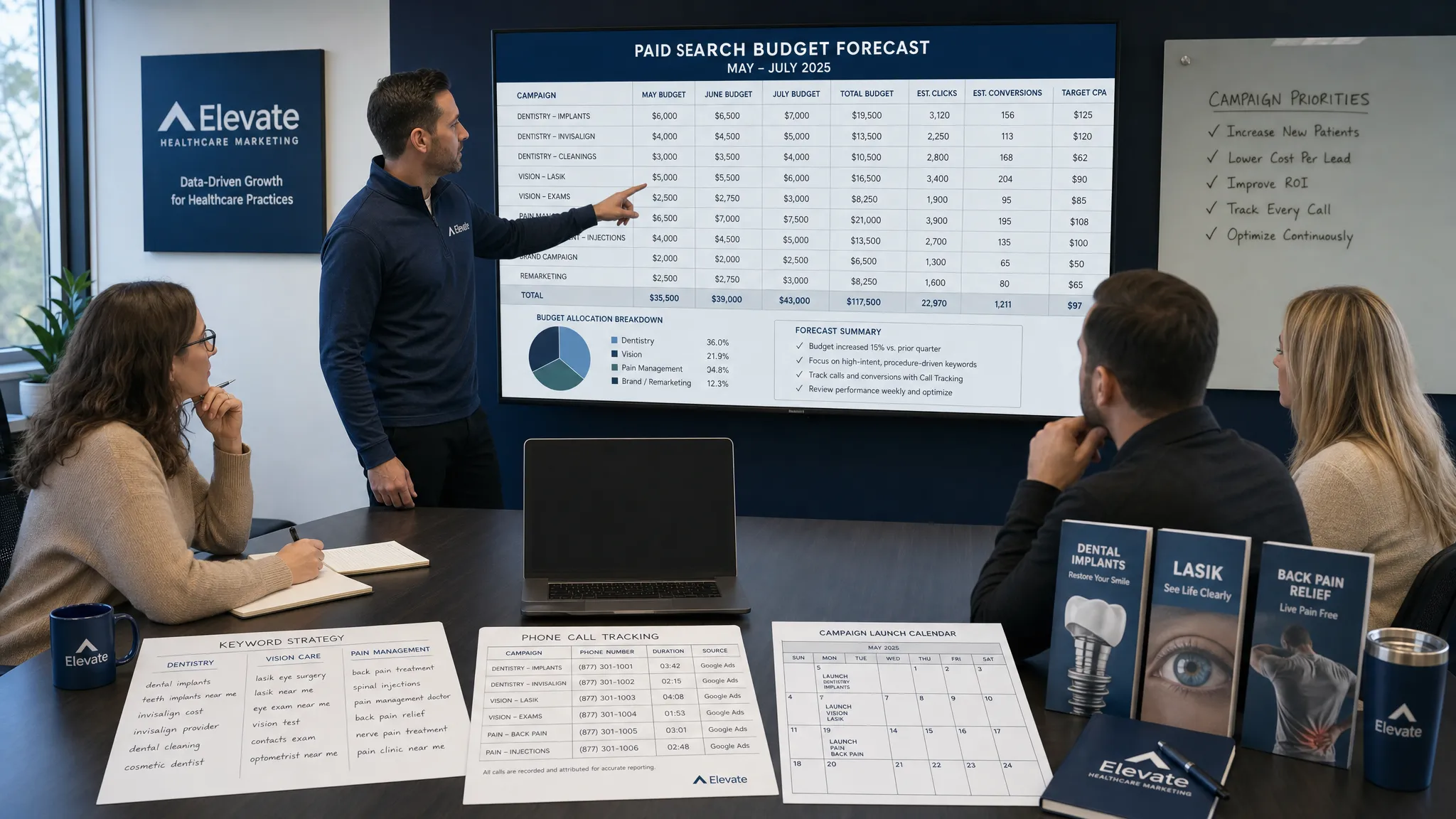
Google Ads cost for healthcare practices in 2026 is not a single number. A pediatric dentist in a suburban market, a LASIK center in a major metro, and a pain management clinic promoting high-value procedures can all use the same ad platform and see very different costs.
The better question is not “How much does Google Ads cost?” It is “How much should we invest to produce a booked appointment at a profitable acquisition cost?”
For healthcare practices, Google Ads can be one of the fastest ways to reach patients who are actively searching for treatment. But it can also waste money quickly if the campaign targets the wrong keywords, sends clicks to a generic website page, or fails to track phone calls and appointment outcomes.
This guide breaks down practical 2026 budget ranges, the factors that influence cost, and how dentists, orthodontists, optometrists, chiropractors, pain physicians, physical therapists, and other healthcare practices can make smarter spending decisions.
The short answer: what should a healthcare practice budget for Google Ads in 2026?
Most local healthcare practices should think about Google Ads in terms of monthly media spend, not just cost per click. Media spend is the money paid directly to Google for traffic. Your total investment may also include campaign management, landing pages, call tracking, conversion tracking, and follow-up automation.
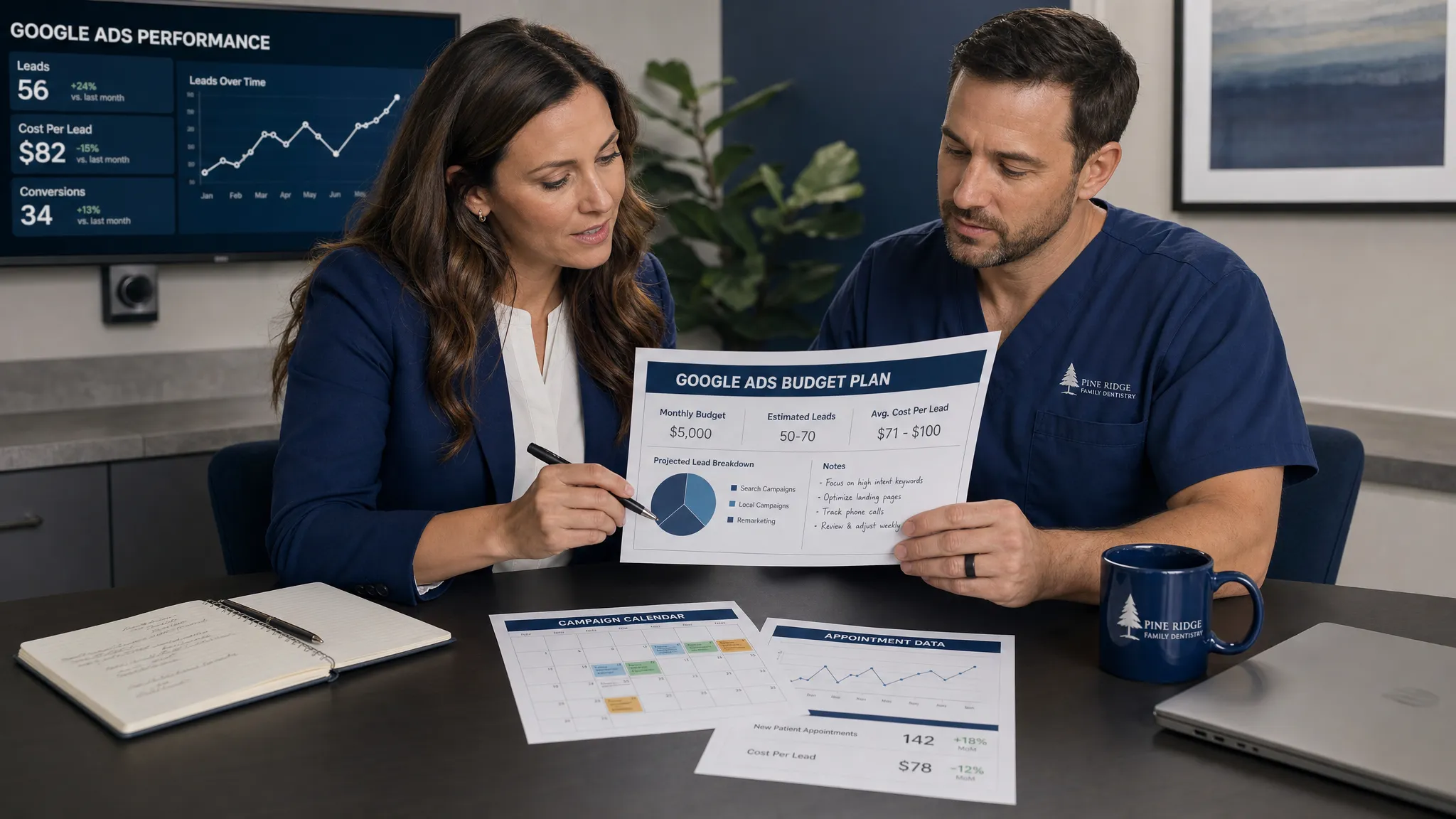
As a planning range, many single-location healthcare practices start with $2,000 to $6,000 per month in ad spend for a focused campaign. Competitive specialties, procedure-based campaigns, and multi-location practices often need $6,000 to $20,000+ per month to generate meaningful volume.
These are not guarantees. Your actual Google Ads cost depends on your market, specialty, radius, competition, conversion rate, and patient value.
| Practice situation | Monthly ad spend planning range | Best use case |
|---|---|---|
| Small local practice testing paid search | $1,500 to $3,000 | One core service, tight geography, proof of concept |
| Established single-location practice | $3,000 to $8,000 | Multiple services, consistent lead flow, local growth |
| Competitive specialty or procedure campaign | $6,000 to $15,000 | Implants, LASIK, pain procedures, orthodontics, cosmetic treatments |
| Multi-location healthcare group | $10,000 to $50,000+ | Several markets, multiple service lines, larger acquisition goals |
A lower budget can work if the campaign is narrow and well built. A higher budget can still fail if the offer, landing page, tracking, or front desk follow-up is weak.
Why cost per click is only one part of the real cost
Google Ads is an auction. You do not pay a fixed price to appear in search results. You compete against other advertisers based on your bid, ad relevance, landing page experience, expected click-through rate, and other signals.
That means the same keyword can cost very different amounts depending on the city, competition, device, time of day, and ad quality. But cost per click is only the beginning.
A practice owner should track the full path from click to booked patient:
| Metric | What it tells you | Why healthcare practices should care |
|---|---|---|
| Cost per click | How expensive traffic is | Useful for budgeting, but not enough by itself |
| Landing page conversion rate | How many visitors call or submit a form | A better page can lower cost per lead without lowering bids |
| Cost per lead | How much each call or form costs | Helpful, but some leads are not qualified |
| Lead-to-appointment rate | How many leads become scheduled patients | Front desk speed and scripting matter here |
| Cost per booked appointment | What you actually pay to fill the schedule | More useful than cost per click |
| Cost per acquired patient | What you pay after no-shows and cancellations | Best metric for profitability |
For example, a $35 click might be profitable if it turns into a booked implant consultation. A $4 click might be wasteful if it comes from someone searching for free advice, a school assignment, or a treatment you do not provide.
2026 Google Ads cost ranges by healthcare specialty
The following ranges are practical planning estimates for search campaigns in competitive U.S. markets. They should be used as a starting point, not as a substitute for local keyword research inside your actual service area.
| Specialty or service line | Typical 2026 CPC planning range | Budget notes |
|---|---|---|
| General dentistry | $5 to $20 | Costs rise for emergency, same-day, and high-density metro searches |
| Cosmetic dentistry and veneers | $10 to $45+ | Higher patient value usually creates more competition |
| Dental implants and oral surgery | $15 to $60+ | Often needs strong landing pages, financing messaging, and call handling |
| Orthodontics | $8 to $35 | Parent-focused searches and Invisalign-related terms can be competitive |
| Optometry and eye exams | $4 to $18 | Local intent matters, insurance and appointment availability can influence conversion |
| LASIK and cataract surgery | $20 to $80+ | High-value procedures often require larger budgets and longer follow-up |
| Chiropractic | $5 to $25 | Emergency, accident, and pain-related terms can vary widely by market |
| Physical therapy | $4 to $18 | Insurance, referrals, and location convenience affect conversion quality |
| Pain management and regenerative medicine | $15 to $75+ | Policy compliance, patient intent, and procedure value are major factors |
| Primary care and specialty medicine | $5 to $30 | Costs depend heavily on access, payer mix, and patient urgency |
The most important takeaway is that high CPC does not automatically mean a campaign is too expensive. If the patient lifetime value is strong and the campaign produces qualified appointments, a higher click cost can still be acceptable.
On the other hand, low CPC does not automatically mean efficient marketing. Low-cost clicks can hide poor intent, weak conversion rates, or unqualified leads.
What drives Google Ads cost for healthcare practices?
Local competition
Healthcare advertising is local, even when the platform is national. A dental implant campaign in a large, affluent metro can cost much more than a general cleaning campaign in a smaller market. Competitors also matter. If multiple practices, DSOs, hospital systems, and national lead aggregators are bidding on the same terms, costs increase.
This is why local forecasting matters. If your practice is in Kentucky or Southern Indiana, a local strategy will look different from a national template. For a deeper local breakdown, Louisville Web Lab’s guide to Google Ads in Louisville explains how market dynamics affect campaign planning.
Specialty and patient value
Google Ads costs tend to rise when the potential value of a new patient rises. Dental implants, cosmetic dentistry, LASIK, pain procedures, orthodontics, and other high-value services attract aggressive bidding because a single new case can justify a larger acquisition cost.
That does not mean every high-value service should receive the largest budget immediately. It means your campaign should match budget to economics. A high-value procedure can support a higher cost per appointment, but only if the lead quality and close rate are strong.
Keyword intent
Not every search has the same value. “Dentist near me” is broad. “Emergency dentist open Saturday” shows urgency. “Dental implants cost near me” may indicate a patient who is comparing treatment options. “What causes tooth pain” may be informational and less likely to convert immediately.
The more specific and urgent the search, the more expensive it can be. But intent is often worth paying for. A smaller campaign focused on high-intent keywords can outperform a larger campaign that chases broad traffic.
Landing page quality
A weak landing page makes every click more expensive. If patients cannot quickly understand your service, location, insurance or payment options, provider credibility, and next step, they leave. Then you pay again for another visitor.
Healthcare landing pages should be focused, fast, mobile-friendly, and built around one primary action: call, request an appointment, or start a qualification flow. A page for dental implants should not be the same as a page for routine cleanings. A dry eye page should not feel like a generic optometry homepage.
Reviews and local trust
Patients often click an ad, then check reviews before calling. Your Google Business Profile, star rating, review quality, photos, categories, and business details can influence whether a paid click becomes a patient.
A strong paid search campaign works better when local trust signals are also in place. If your practice has not fully optimized its profile, this guide to a Google listing for healthcare businesses explains the essentials that help support both organic visibility and paid conversion.
Tracking and follow-up
Many practices think Google Ads is failing when the real problem is tracking or follow-up. Calls go unanswered. Forms sit in inboxes. The front desk does not know which services the campaign is promoting. No-shows are not measured. Campaigns are optimized for form fills instead of booked appointments.
In 2026, this is one of the biggest cost control opportunities. Practices that connect ad clicks to real appointment outcomes can make better decisions than practices that only track clicks and impressions.
A simple formula to estimate your cost per booked patient
You can estimate Google Ads cost with a simple model:
Estimated ad spend needed = desired leads ÷ landing page conversion rate × average cost per click
Then estimate booked appointments:
Booked appointments = leads × lead-to-appointment rate
Here is a simplified example for planning only:
| Scenario | Average CPC | Landing page conversion rate | Leads from 200 clicks | Lead-to-appointment rate | Estimated booked appointments | Estimated ad spend |
|---|---|---|---|---|---|---|
| General dental new patient campaign | $12 | 10% | 20 | 60% | 12 | $2,400 |
| Dental implant consultation campaign | $35 | 8% | 16 | 50% | 8 | $7,000 |
| Physical therapy evaluation campaign | $9 | 12% | 24 | 65% | 16 | $1,800 |
| LASIK consultation campaign | $55 | 7% | 14 | 45% | 6 | $11,000 |
This table shows why campaign economics matter. The LASIK campaign has the highest cost, but it may still be profitable if a booked consultation has a high close rate and strong case value. The physical therapy campaign has lower click costs, but profitability may depend on payer mix, visit frequency, and capacity.
Hidden costs healthcare practices should plan for
The visible cost is what you pay Google. The hidden costs are the systems required to turn that spend into appointments.
Common budget items include:
- Campaign management: Strategy, keyword research, ad testing, bidding, exclusions, reporting, and optimization.
- Landing page creation: Dedicated pages for high-value services, urgent care needs, or location-specific campaigns.
- Call tracking and form tracking: Attribution that shows which campaigns produce real inquiries.
- Follow-up systems: Missed call response, form follow-up, reminders, and reactivation workflows.
- Compliance review: Healthcare ads must avoid misleading claims, inappropriate targeting, and careless use of sensitive patient information.
These costs are not “extras” if your goal is patient acquisition. They are part of the system that makes media spend accountable.
How to lower Google Ads cost without hurting lead quality
The goal is not simply to get cheaper clicks. The goal is to reduce the cost of qualified booked appointments.
Tighten your geography
Do not pay for clicks from patients who are unlikely to drive to your office. Most healthcare practices should start with a realistic service radius, then expand only after the campaign proves profitable.
For some specialties, patients will travel farther. For routine services, convenience matters more. A general dentist may need a tighter radius than a specialty surgeon. A LASIK or implant campaign may justify a wider area if the offer and follow-up process are strong.
Separate services by intent
A campaign for “emergency dentist” should not be managed the same way as a campaign for “veneers.” A pain management campaign for back pain should not be blended carelessly with a regenerative medicine campaign. Different searches represent different patient needs, timelines, and values.
Separate campaigns or ad groups make it easier to control budget, write relevant ads, build better landing pages, and measure results by service line.
Use negative keywords aggressively
Negative keywords prevent your ads from showing for irrelevant searches. Healthcare campaigns often need exclusions for jobs, school, free, DIY, symptoms you do not treat, insurance terms you do not accept, and services outside your scope.
This is not a one-time setup task. Search term review should happen continuously, especially in the first 60 to 90 days of a campaign.
Improve the landing page before raising the budget
If your landing page converts at 4%, doubling your budget may simply double your waste. If you improve conversion from 4% to 8%, you can often cut cost per lead in half without lowering bids.
Good landing pages answer patient questions quickly. They show the provider, location, service, benefits, trust signals, reviews, insurance or payment considerations, and the next step. They also load quickly on mobile, because many healthcare searches happen on phones.
Train the front desk around the campaign
Google Ads does not end at the click. If your team misses calls, uses generic scripts, or cannot answer basic campaign-related questions, acquisition cost rises.
Before launching a campaign, the front desk should know which services are being promoted, what the appointment goal is, how to handle pricing questions, and how quickly to follow up with forms. Small operational improvements can create a major reduction in cost per booked patient.
Build a broader patient acquisition system
Paid search works best when it is part of a larger system. SEO, reviews, Google Business Profile optimization, conversion-focused pages, follow-up automation, and referral systems all influence how efficiently a practice grows.
For a broader framework, Louisville Web Lab’s guide to medical practice marketing that drives appointments explains how to connect marketing channels to booked patient outcomes instead of vanity metrics.
What is different about Google Ads in 2026?
Google Ads in 2026 is more automated, more competitive, and more dependent on clean conversion data. Smart bidding and AI-assisted campaign types can help, but they are only as good as the signals you feed them.
For healthcare practices, this creates a practical challenge. You want Google to optimize toward valuable outcomes, but you also need to protect sensitive patient information and stay within advertising policies. Practices should avoid uploading protected health information into advertising platforms and should get compliance guidance before implementing advanced tracking.
Another change is how patients research care. Many patients search Google, read reviews, ask friends, compare websites, and look at community discussions before they ever call. Some practices also monitor patient questions in public forums to understand demand and language.
The practices that win in 2026 will not be the ones that simply spend the most. They will be the ones that use better data, better pages, better follow-up, and clearer positioning.
When is Google Ads worth the cost for a healthcare practice?
Google Ads is usually worth considering when your practice has capacity, clear service lines, a realistic patient value, and a team that can respond quickly to leads.
It is especially useful when you want to:
- Fill open appointment slots for a specific service.
- Promote a high-value procedure or consultation.
- Enter a competitive local market faster than SEO alone allows.
- Support a new location, new provider, or expanded schedule.
- Test demand before investing heavily in long-term content.
It may not be the right first move if your website is outdated, your phones are not answered consistently, your reviews are weak, or your practice cannot track calls and appointment outcomes. In those cases, fixing the conversion system first can make every future ad dollar work harder.
A simple break-even question helps:
How many new patients or cases do we need from this campaign to justify the monthly investment?
If the answer is realistic based on search volume, budget, and conversion rates, Google Ads can be a strong growth channel. If the answer requires impossible close rates or unrealistic patient volume, the campaign needs a different strategy.
Frequently Asked Questions
How much does Google Ads cost for a healthcare practice in 2026? Many single-location healthcare practices should plan for $2,000 to $6,000 per month in media spend for a focused campaign. Competitive procedure-based campaigns may require $6,000 to $20,000+ per month, depending on the market and growth goals.
Why are healthcare Google Ads clicks so expensive? Healthcare clicks can be expensive because patient value is often high, competition is local and intense, and urgent or procedure-specific searches have strong commercial intent. Costs also rise when hospitals, private practices, DSOs, and lead generation companies compete for the same terms.
What is more important, cost per click or cost per booked appointment? Cost per booked appointment is more important. Cost per click tells you what traffic costs, but it does not tell you whether those clicks became qualified patients. A higher CPC can be profitable if it leads to valuable booked appointments.
How long does it take to know if Google Ads is working? You can often see early lead data within the first few weeks, but most healthcare campaigns need 60 to 90 days of testing to evaluate keywords, landing pages, call quality, and booked appointment outcomes. High-value procedures with longer decision cycles may take longer.
Can healthcare practices use remarketing in Google Ads? Healthcare advertisers must be careful with remarketing and personalized advertising because health-related interests and conditions are sensitive. Practices should follow Google policies, avoid using protected health information, and get compliance guidance before launching advanced tracking or retargeting.
Should a healthcare practice run Google Ads or focus on SEO? The strongest answer is often both. Google Ads can generate faster visibility for high-intent searches, while SEO builds long-term local authority. Practices with limited budgets may start with the channel most likely to produce near-term appointments, then expand into a balanced system.
Get a clearer Google Ads budget for your practice
If you are trying to estimate Google Ads cost for your healthcare practice, the right budget depends on your specialty, market, services, conversion system, and appointment goals.
Louisville Web Lab helps healthcare practices turn search visibility into booked appointments through SEO, Google Ads, websites, and patient acquisition systems. If you want a practical budget based on your market and growth goals, book a diagnostic strategy call with Louisville Web Lab.