
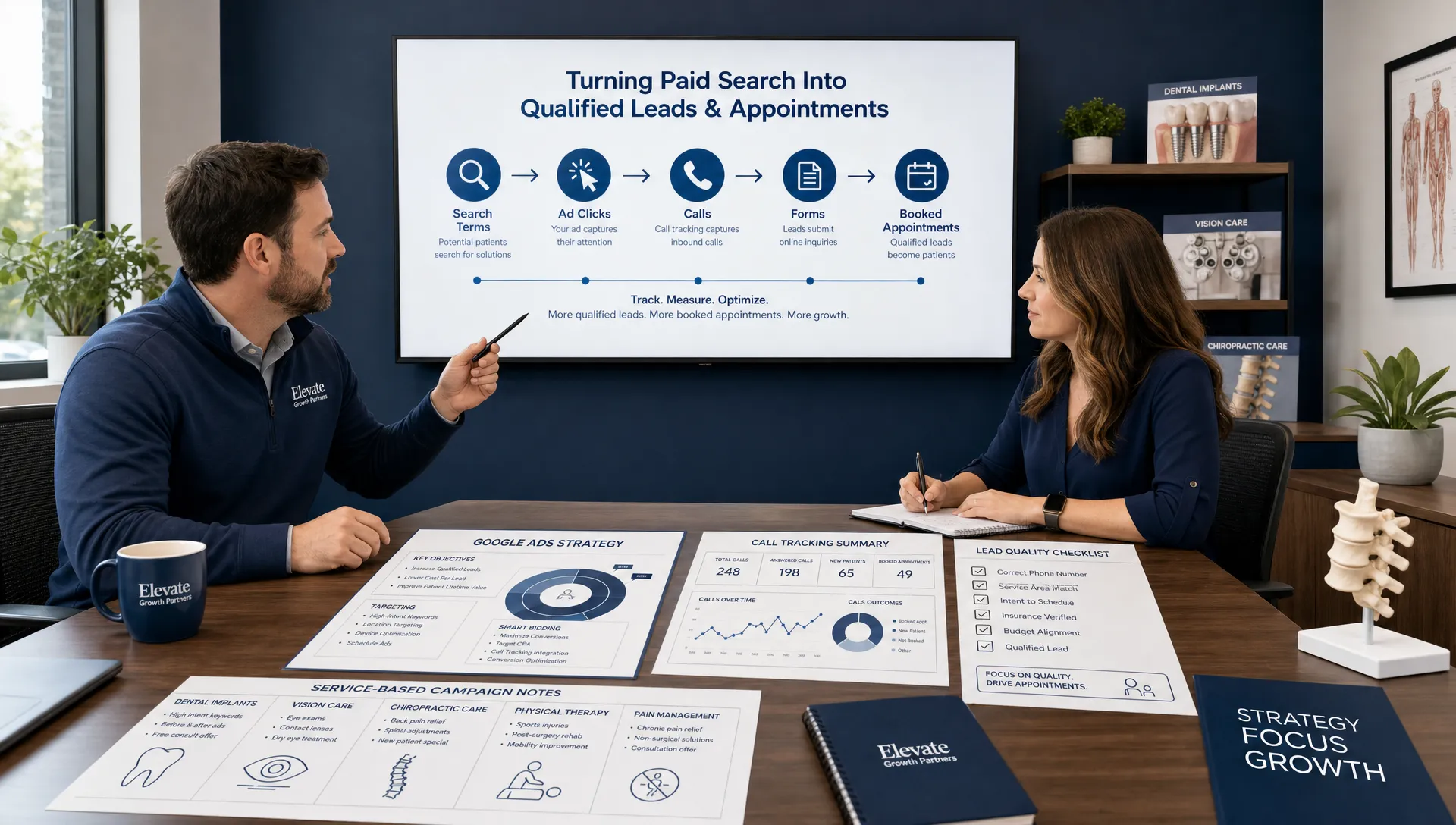
Most small businesses do not need more traffic. They need more of the right people taking the next step, calling, booking, submitting a form, or scheduling a consultation.
That is especially true for healthcare practices. A dental implant office, optometry clinic, chiropractic practice, physical therapy group, or pain management provider can spend thousands on clicks and still feel like Google Ads “doesn’t work” if the campaign is optimized for the wrong action. The goal is not to get the cheapest click. The goal is to generate qualified leads that can become booked appointments.
Google Ads for small business works best when it is treated as a patient acquisition system, not a traffic source. That means aligning search intent, ad copy, landing pages, tracking, and follow-up around one measurable outcome: leads that your team can actually convert.
What a lead-generating Google Ads campaign really looks like
A lead is not just any form fill. For a healthcare practice, a real lead usually has four qualities: the person is local, they need a service you provide, they are reasonably close to making a decision, and they give your team enough information to follow up.
That is why a small business campaign should be judged on more than impressions, clicks, or even the number of conversions reported inside Google Ads. A campaign can look healthy in the dashboard while producing low-value inquiries, spam, out-of-area calls, or patients looking for services you do not offer.
A better scorecard looks like this:
| Metric | What it tells you | Why it matters |
|---|---|---|
| Cost per qualified lead | How efficiently you attract real prospects | Helps separate volume from quality |
| Call answer rate | Whether your office is capturing demand | Missed calls can waste strong ad traffic |
| Form-to-appointment rate | How many inquiries become scheduled visits | Shows whether the offer and follow-up are working |
| Booked appointment cost | What you pay for actual patient opportunities | More useful than cost per click |
| New patient value by service | Which campaigns create profitable growth | Helps budget toward the right procedures |
For small businesses with limited budgets, this distinction is everything. If you optimize for the wrong metric, Google can find more of the wrong people very efficiently.
Start with search intent, not keywords alone
Keywords still matter, but intent matters more. A person searching “dentist near me open today” is in a different mindset than someone searching “how long do dental implants last.” Both may be valuable, but they should not be treated the same way.
For healthcare practices, paid search usually performs best when it prioritizes high-intent service searches first. These are searches that suggest the person is actively looking for a provider, appointment, solution, or second opinion.
Examples include:
- “emergency dentist near me”
- “orthodontist in Louisville”
- “dry eye treatment near me”
- “chiropractor for back pain”
- “pain management clinic near me”
- “physical therapy after knee surgery”
Research searches can still be useful, but they often need different landing pages, remarketing, or educational follow-up. If your budget is modest, start where intent is strongest.
This is also where many small business accounts go wrong. They use broad, generic keywords like “dentist,” “eye doctor,” or “back pain” without enough controls. Those terms may attract a mix of serious prospects, students doing research, people outside your area, and users looking for free advice. A tighter structure gives Google a clearer signal about who you want.
If you want a more tactical walkthrough for practice-specific campaign setup, Louisville Web Lab has a deeper guide on setting up Google Ads for better healthcare leads.
Build campaigns around services, not your whole business
A small business Google Ads account should not be one giant campaign with every service, every keyword, and every ad mixed together. That approach makes reporting muddy and optimization slow.
Instead, campaigns should be organized around the services that have distinct intent, economics, and patient journeys. For example, a dental practice might separate emergency dentistry, implants, Invisalign, cosmetic dentistry, and general new patient appointments. An eye care practice might separate routine exams, dry eye, myopia management, LASIK consultations, and cataract evaluations.
This structure matters because each service may need a different message. Someone searching for urgent dental pain does not need the same landing page as someone comparing cosmetic veneer options. A patient looking for dry eye care may need reassurance about diagnosis and treatment options. A person searching for regenerative medicine may need education, eligibility guidance, and a clear consultation path.
Service-based campaign structure also makes budget decisions easier. If implant leads are profitable and emergency dentistry leads are inconsistent, you can see that clearly. If dry eye clicks are expensive but appointment quality is high, you can make an informed decision instead of cutting spend too early.
Use local targeting carefully
For local healthcare practices, geography can make or break performance. Google Ads gives you location targeting options, but they need to be configured intentionally.
Many small businesses accidentally advertise to people who are “interested in” a location rather than physically located there. That can create wasted spend from users outside your service area. For practices that rely on in-person appointments, it is usually better to focus on people in or regularly in your target locations, then monitor location reports for waste.
Your radius should reflect real patient behavior. A general dentist may draw most patients from a tight local area, while an oral surgeon, LASIK center, or specialty pain clinic may draw from a wider region. The more specialized the service, the more you may be able to expand the map.
Ad scheduling matters too. If calls are your main conversion, running ads heavily when nobody answers the phone can hurt results. You may still capture form leads after hours, but calls deserve special attention. If your front desk is available from 8 a.m. to 5 p.m., your bidding and call assets should reflect that reality.
Send clicks to landing pages that match the search
One of the fastest ways to waste Google Ads spend is sending paid traffic to a generic homepage. Your homepage has to serve everyone. A lead-generation landing page has one job: help the visitor decide whether to contact you about the specific service they searched for.
A strong landing page for Google Ads should answer the visitor’s immediate questions without making them hunt. It should clarify the service, location, appointment options, trust signals, insurance or financing considerations when appropriate, and the next step.
For healthcare, trust is especially important. Patients are not buying a commodity. They are choosing a provider. Your landing page should make it easy to understand who you help, what happens next, and why your practice is a credible option.
A high-converting page usually includes:
- A clear headline tied to the searched service
- A visible phone number and form near the top
- Location details and service area cues
- Provider or practice credibility signals
- Reviews, testimonials, or reputation markers when compliant and appropriate
- A simple explanation of the appointment process
- A focused call to action, such as “Request an Appointment” or “Schedule a Consultation”
The same principle applies outside healthcare. Lead generation improves when the ad, page, and next step all match the searcher’s intent.
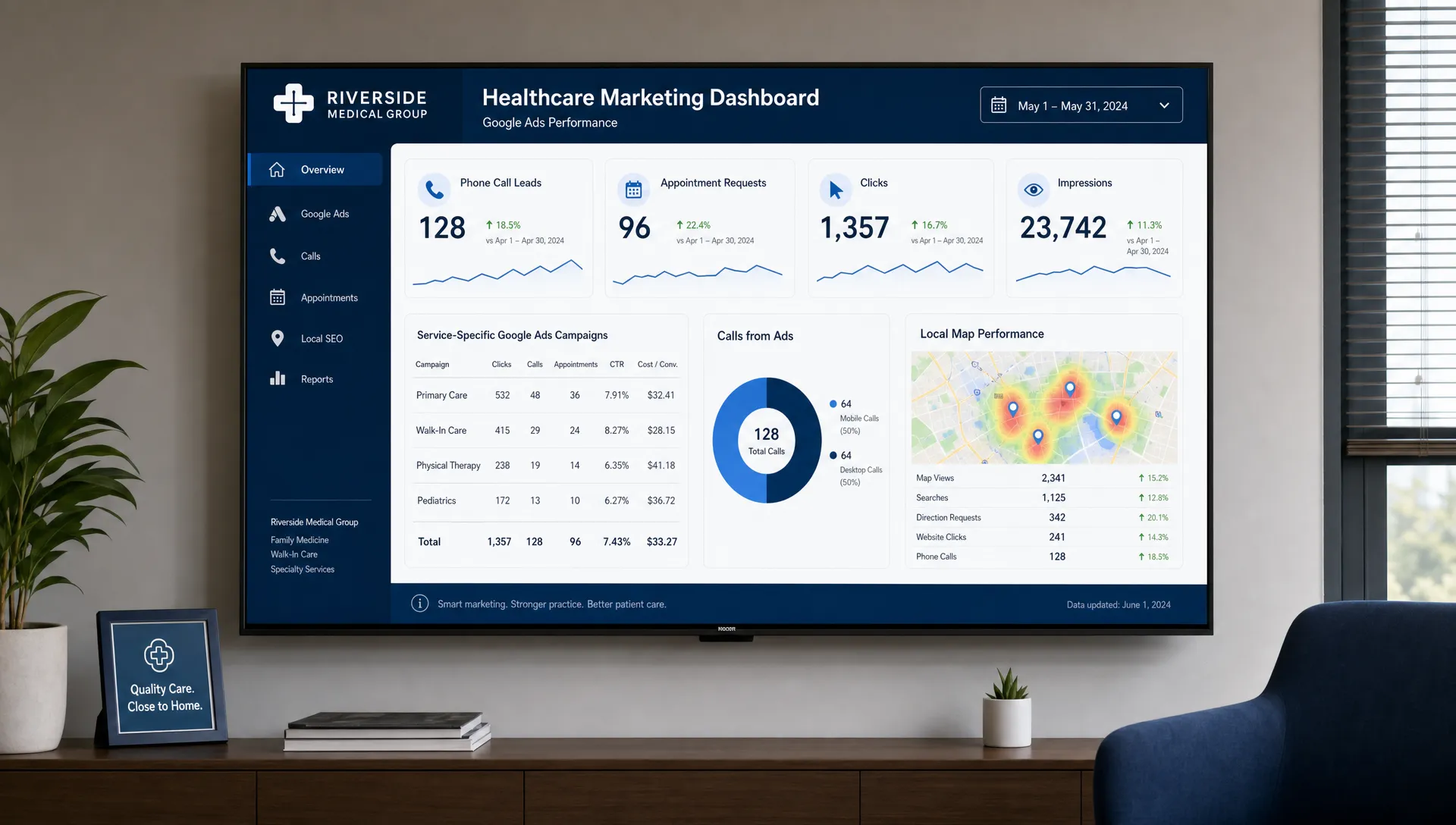
Track the full path from click to appointment
If your tracking stops at “form submitted” or “call clicked,” you are missing the most important part of the story. A small business needs to know which campaigns create conversations, which conversations become appointments, and which appointments produce real revenue.
At minimum, a healthcare Google Ads account should track calls, form submissions, appointment requests, and landing page conversions. But the best insights usually come from connecting ad data with front-desk outcomes. Did the person answer the callback? Were they a good fit? Did they schedule? Did they show up?
This does not mean sending private health details into advertising platforms. Healthcare practices need to be careful with patient data, privacy expectations, and platform policies. In general, tracking should focus on marketing events and business outcomes, not sensitive personal health information. If you use call tracking, CRM integrations, or offline conversion imports, make sure your tools and workflows are reviewed for compliance needs.
Without this feedback loop, Google may optimize toward leads that look good digitally but do not help the practice grow. With it, you can teach the campaign what a better lead looks like over time.
Write ads that qualify, not just attract
Small businesses often try to make ads as broad and clickable as possible. That can increase traffic, but it can also reduce lead quality. The best Google Ads copy attracts the right people and gently filters out poor-fit clicks.
For a healthcare practice, ad copy should be clear, specific, and compliant. Avoid exaggerated claims or language that makes people feel targeted based on sensitive health conditions. Instead, focus on the service, location, patient experience, and next step.
For example, a better ad message might say “Dental Implant Consultations in Louisville” rather than “Missing Teeth? We Can Fix Your Smile Today.” The first is specific and service-oriented. The second may feel aggressive and could create policy or trust issues depending on the context.
Good ad copy can also pre-qualify by mentioning appointment type, location, provider category, or service focus. If you only offer certain procedures, say so. If your clinic is referral-based, make that clear. If consultations are required before treatment, set that expectation early.
This is one of the reasons expert management can improve results. It is not just about changing bids. It is about aligning targeting, copy, landing pages, and follow-up so the campaign produces better opportunities. For more on that process, see this breakdown of what a Google Ads expert does to improve lead quality.
Budget for learning, then scale what proves itself
Google Ads for small business often fails because the budget is spread too thin. If you advertise too many services across too many locations with too little spend, the account may never collect enough data to improve.
A better approach is to start with a focused budget around one or two high-intent services. Give the campaign enough time and conversion volume to identify patterns. Then shift budget toward what produces qualified leads and booked appointments.
You can estimate a starting budget with a simple formula:
| Planning question | Example use |
|---|---|
| How many new leads do you need? | A practice wants 20 qualified inquiries per month |
| What cost per qualified lead is acceptable? | The practice defines an acceptable cost from patient value and conversion rates |
| What is the test budget? | Enough qualified traffic to evaluate booking quality and downstream revenue |
| What is the real success metric? | Booked appointments and downstream revenue, not clicks |
The numbers will vary by market, specialty, competition, and conversion rate. The important part is having a target before launching. If you do not know what a lead is worth, it is hard to know whether your ads are working.
Improve follow-up before blaming the ads
Even a well-built Google Ads campaign can underperform if the follow-up process is weak. Paid search creates moments of intent. Those moments do not last long.
If a patient calls and nobody answers, they may call the next practice. If a form submission sits unanswered for a day, the lead may go cold. If the front desk does not know which service the person asked about, the experience feels disconnected.
Small businesses that generate consistent leads usually have a clear intake process. Calls are answered or returned quickly. Forms trigger notifications. Staff know how to handle campaign-specific inquiries. Missed calls are reviewed. Appointment requests are tracked to completion.
This is where marketing automation can help, but the workflow matters more than the tool. The goal is simple: every paid lead should get a fast, relevant, human follow-up path.
Common reasons Google Ads leads do not convert
When small businesses say Google Ads did not generate leads, the cause is often one of a few familiar problems. The campaign may be targeting broad keywords, sending traffic to a homepage, tracking weak conversions, running outside the real service area, or failing to follow up quickly.
Another common issue is optimizing too soon or too late. Some practices make major changes after only a few clicks, before there is enough data to learn from. Others let poor campaigns run for months because impressions and clicks look busy. A disciplined review cadence helps avoid both mistakes.
The best reviews look beyond Google Ads alone. They compare campaign data with phone logs, form quality, appointment outcomes, and practice capacity. If the ads are producing qualified calls but the schedule is full, that is a different problem than irrelevant clicks. If leads are coming in but not booking, the landing page or intake process may need work.
Frequently Asked Questions
How long does it take Google Ads to generate leads for a small business? Google Ads can generate inquiries quickly, sometimes within days of launch, but lead quality usually improves over several weeks as targeting, keywords, bidding, and landing pages are refined. For healthcare practices, the better question is how long it takes to generate qualified leads and booked appointments.
What is a good Google Ads budget for a small healthcare practice? There is no universal number because costs vary by specialty, city, competition, and service value. A useful starting point is to decide how many qualified leads you need, estimate an acceptable cost per lead, and build a focused test budget around one or two priority services.
Should small businesses use Google Ads or SEO? Both can work, but they serve different timelines. Google Ads can create demand quickly when campaigns are focused and tracked correctly. SEO builds long-term visibility and can reduce reliance on paid traffic over time. Many practices use both together.
Why am I getting clicks but no leads? Common causes include low-intent keywords, weak landing pages, poor mobile experience, unclear calls to action, irrelevant geography, or tracking problems. If calls are not answered or forms are not followed up quickly, good clicks can also fail to become appointments.
Do healthcare practices need special Google Ads compliance considerations? Yes. Healthcare advertisers should be careful with privacy, claims, targeting, remarketing, and sensitive health-related language. Campaigns should be built to generate measurable outcomes without mishandling patient information or creating misleading expectations.
Turn Google Ads into a real lead system
Google Ads can work for small businesses, but only when the campaign is built around the business outcome you actually want. For healthcare practices, that outcome is not more clicks. It is more qualified inquiries, better appointment opportunities, and measurable practice growth.
Louisville Web Lab helps healthcare practices connect Google Ads, landing pages, local SEO, websites, automation, and tracking into patient acquisition systems. If your practice is spending on ads but not seeing the right leads, book a diagnostic call with Louisville Web Lab and get a clearer path from search visibility to booked appointments.