

Google Ads marketing is still one of the fastest ways for healthcare practices to reach patients who are actively looking for care. But in 2026, the practices that win are not simply the ones with the biggest budgets. They are the ones that connect intent, compliance, landing pages, tracking, and follow-up into one patient acquisition system.
For dentists, orthodontists, optometrists, chiropractors, pain physicians, physical therapists, and specialty clinics, Google Ads can help fill the schedule when SEO takes time, referrals slow down, or a new service line needs visibility. The key is to stop treating ads like a traffic channel and start treating them like a measurable appointment engine.
Why Google Ads marketing still matters for healthcare in 2026
Healthcare decisions often begin with a search. A patient may type “emergency dentist near me,” “dry eye treatment Louisville,” “chiropractor for sciatica,” “dental implants cost,” or “pain management doctor near me” because they have an immediate need or are comparing providers.
That makes Google Ads different from many other marketing channels. Search ads can appear at the exact moment someone is looking for a solution, not weeks before they are ready. For healthcare practices, this matters because patient intent is usually more valuable than broad awareness.
In 2026, competition is also higher. More practices are investing in paid search, Google’s automation tools are more prominent, and patients compare providers quickly across ads, map results, reviews, and websites. A campaign that only optimizes for clicks will usually waste money. A campaign built around booked appointments, qualified calls, and service-line ROI has a much better chance of creating growth.
Google Ads should not replace local SEO, reputation building, referral relationships, or a strong website. It should work alongside them. If your practice needs a broader growth plan beyond paid search, Louisville Web Lab’s guide to healthcare practice marketing strategies that fill schedules explains how SEO, ads, reviews, automation, and follow-up fit together.
What makes healthcare Google Ads different
Healthcare advertising has higher stakes than typical local service advertising. A bad campaign does not just waste budget. It can attract the wrong patients, create compliance risk, overwhelm the front desk, or generate leads that never become appointments.
The biggest differences are:
- Patient intent varies widely, from urgent care needs to long research cycles.
- Certain claims, conditions, medications, and treatment categories may be restricted by Google Ads policies.
- Conversion tracking must be handled carefully to protect patient privacy.
- Landing pages need to build trust quickly without making unsupported medical claims.
- Follow-up speed can determine whether a lead books with you or a competitor.
Google’s Healthcare and medicines advertising policy is an important reference for practices and agencies because rules can vary by treatment type, country, and claim. Practices also need to be careful with patient information. HHS guidance on HIPAA and marketing is a useful starting point, especially when campaigns involve remarketing, tracking, or patient communications.
The practical takeaway is simple: healthcare Google Ads should be built for performance, but never at the expense of trust, accuracy, or privacy.
Start with patient intent, not campaign settings
Before choosing keywords, bids, or ad formats, define the type of patient you want to attract. This is where many healthcare campaigns go wrong. They target broad keywords because they have search volume, but search volume does not always mean appointment value.
A dental implant specialist does not need every person searching “dentist.” A dry eye clinic does not need every person searching “eye doctor.” A pain management practice may not want general “back pain exercises” traffic if the goal is consultations for interventional care.
Strong campaigns separate keywords by intent level:
| Intent level | Example search | Likely patient mindset | Campaign approach |
|---|---|---|---|
| Urgent need | “emergency dentist near me” | Ready to call now | High priority Search campaign with call-focused ads |
| Service-specific | “Invisalign provider near me” | Comparing providers | Dedicated landing page and proof points |
| Condition-specific | “treatment for sciatica pain” | Looking for options | Educational but conversion-focused page |
| Research stage | “dental implant cost” | Comparing price and process | Useful content, clear next step, careful qualification |
| Low intent | “what causes knee pain” | Informational | Usually better for SEO than paid search |
For most healthcare practices, the best starting point is high-intent Search campaigns. These capture patients already looking for a provider or treatment. Broader campaigns can work later, but only after the practice has strong tracking, conversion data, and a follow-up system.
If you want a deeper look at high-intent paid search, this related guide on Google Search Ads for healthcare practices covers what tends to work best for patient acquisition.
Structure campaigns around service lines and economics
A common mistake is putting too many services into one campaign. That makes it hard to control budget, write relevant ads, choose the right landing pages, and measure ROI.
A better approach is to structure campaigns around the services that matter most to the practice. For example, a dental office may separate emergency dentistry, cosmetic dentistry, implants, and Invisalign. An optometry practice may separate eye exams, dry eye treatment, myopia management, and specialty lenses. A pain practice may separate sciatica, joint pain, regenerative medicine, and neuropathy-related searches if those services are offered.
This structure helps you answer the questions that actually matter:
- Which service lines generate qualified leads?
- Which ads produce booked appointments, not just form submissions?
- Which keywords bring patients the practice actually wants?
- Which landing pages convert at an acceptable rate?
- Which campaigns deserve more budget?
The economics of each service should guide the campaign. A high-value treatment plan can often support a higher cost per lead than a low-margin appointment. But that does not mean you should overspend. It means your targets should be based on real appointment value, close rate, and capacity.
Landing pages are where healthcare ads win or lose
A patient clicking a healthcare ad is usually making a fast trust decision. They want to know whether you treat their problem, whether you are nearby, whether you look credible, and whether taking the next step feels easy.
Sending all paid traffic to the homepage is rarely the best option. A homepage has to serve many audiences. A campaign landing page can focus on one service, one patient need, and one next step.
A strong healthcare landing page usually includes:
- A clear headline tied to the patient’s search.
- The practice location or service area.
- Provider trust signals, such as credentials, experience, or relevant affiliations.
- Reviews or reputation indicators where appropriate.
- Simple explanations of the service and who it is for.
- A prominent call button and appointment request form.
- Insurance, financing, or consultation details when relevant and accurate.
- Privacy-conscious forms that avoid unnecessary sensitive information.
The page should also match the ad. If the ad mentions same-day emergency dental care, the landing page should not make the patient hunt for emergency information. If the ad is for dry eye treatment, the page should not be a generic eye exam page.
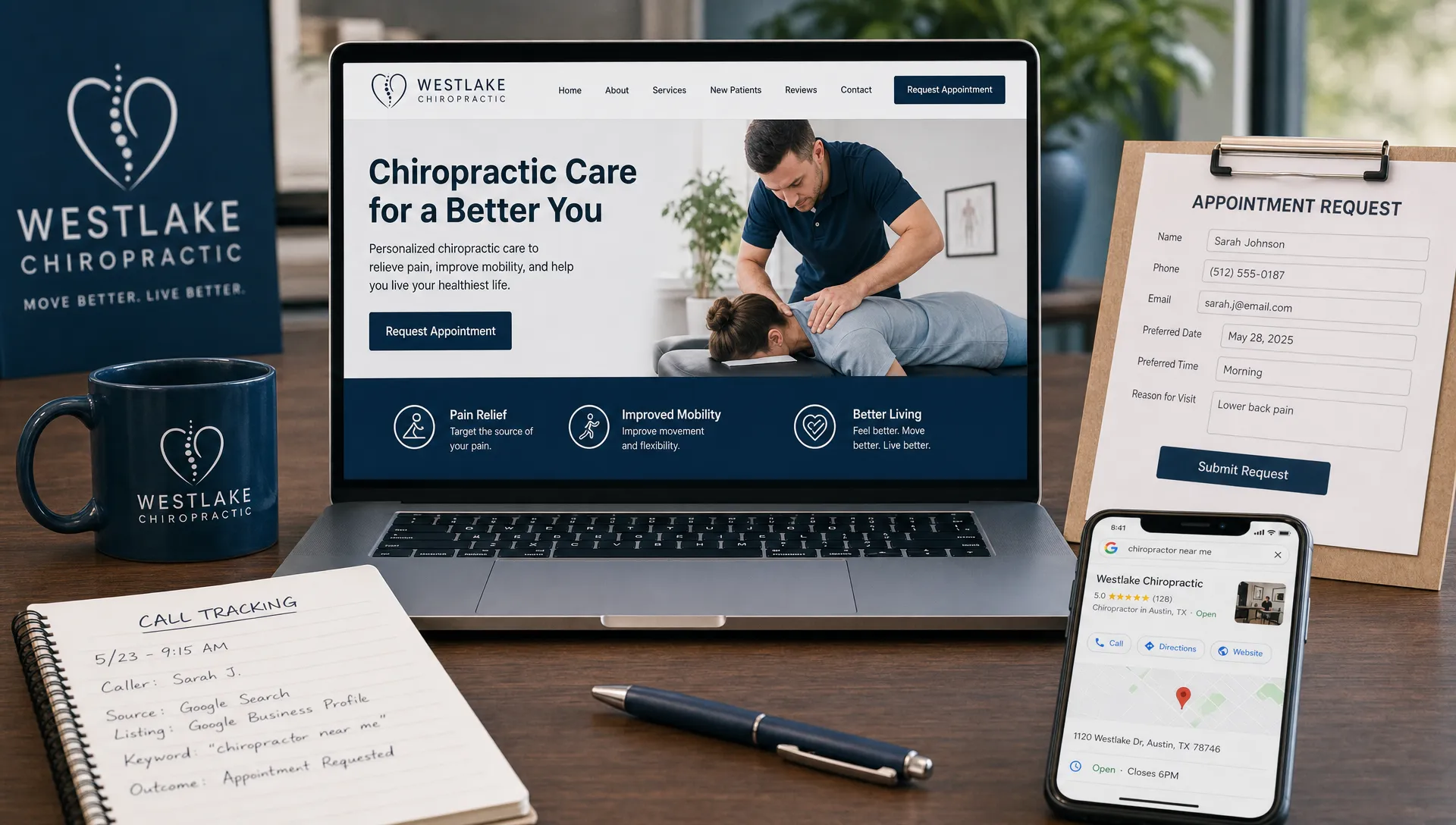
Trust does not stop at the landing page. Patients also evaluate the experience when they arrive at the office.
Tracking should focus on booked patients, not just leads
Many healthcare practices think their Google Ads are working because they see clicks, form fills, or phone calls. Those metrics are useful, but they are not the finish line.
A lead is only valuable if it is qualified and has a real chance of becoming a patient. A campaign that generates 80 low-quality calls can be worse than a campaign that generates 15 qualified appointment requests.
In 2026, healthcare practices should track the full path from search to scheduled appointment as carefully as privacy rules allow. That means separating meaningful actions from weak signals.
| Metric | What it tells you | Why it matters |
|---|---|---|
| Click-through rate | Whether the ad matches the search | Helps improve relevance, but does not prove ROI |
| Cost per lead | How much you pay for calls or forms | Useful, but incomplete without lead quality |
| Qualified lead rate | How many leads match the service and location | Shows whether targeting is working |
| Booked appointment rate | How many leads schedule | Reveals front desk and follow-up performance |
| Cost per booked appointment | Spend divided by booked appointments | Better ROI metric than cost per click |
| New patient value | Revenue or lifetime value estimate | Helps determine acceptable acquisition cost |
Call tracking, form tracking, CRM notes, and appointment outcomes can help practices understand what is really happening. However, privacy must be a priority. Avoid sending sensitive patient details into ad platforms. Keep conversion names general, limit unnecessary form fields, and work with qualified legal and compliance advisors when needed.
Use Google automation carefully
Google’s automation has become more powerful, but automation is not a strategy by itself. Smart bidding, broad match, Performance Max, and AI-assisted campaign tools can help in the right context. They can also waste budget quickly when tracking is weak or goals are too broad.
For healthcare practices, automation works best when the inputs are clean. That means campaigns need clear conversion goals, accurate location targeting, negative keywords, well-organized landing pages, and enough meaningful conversion data.
A practical 2026 approach looks like this:
- Start with tightly focused Search campaigns for high-intent services.
- Use phrase and exact match where control matters most.
- Add negative keywords regularly based on real search terms.
- Optimize for qualified calls and appointment requests, not every page visit.
- Consider broader automation only after the account has reliable data.
Performance Max may have a place for some practices, especially when there is enough conversion data and a clear patient acquisition strategy. But it should not be the default replacement for high-intent Search campaigns. Most practices need control before scale.
Write ads that are specific, compliant, and patient-centered
Healthcare ad copy should be clear without being sensational. Patients want confidence, but they do not want exaggerated promises. Regulators and ad platforms also take medical claims seriously.
Good healthcare ad copy often emphasizes:
- The service or condition being treated.
- The location or convenience factor.
- Appointment availability when accurate.
- Provider expertise without unsupported claims.
- A clear next step, such as calling or requesting an appointment.
Be cautious with words like “cure,” “guaranteed,” “best,” or “pain-free” unless they are appropriate, substantiated, and compliant. Also be careful with overly personal language that implies knowledge of someone’s medical condition. For example, “Struggling with severe chronic pain?” may be more sensitive than “Pain management options in Louisville.”
Ad copy should meet patients where they are emotionally, but it should not exploit fear or overpromise outcomes.
Budget based on capacity and ROI, not guesswork
A practice with open hygiene chairs, a new associate, or a new treatment offering has a different paid search goal than a fully booked office trying to attract only high-value cases. Budget should follow capacity and economics.
Start by defining the gap. How many additional booked appointments do you need per month? Which service lines have room to grow? What is a reasonable cost per booked patient based on your close rate and patient value?
From there, budget becomes more strategic. You are not asking, “How much should we spend on Google Ads?” You are asking, “What level of investment can profitably fill this part of the schedule?”
If you need benchmark guidance, Louisville Web Lab has a separate breakdown of Google Ads cost for healthcare practices in 2026 that explains why spend varies by specialty, market, competition, and campaign quality.
The front desk is part of the campaign
Google Ads can generate demand, but the front desk often determines whether that demand becomes revenue. Missed calls, slow form responses, unclear scheduling processes, and poor lead handling can make a good campaign look bad.
Every paid search campaign should be paired with a lead response plan. Who answers calls? What happens after hours? How fast are forms handled? Are missed calls returned? Does the team know which services the campaign is promoting?
This is especially important for high-intent searches. Someone looking for an emergency dentist, LASIK consultation, or pain specialist may contact multiple providers. The practice that responds first and communicates clearly often wins.
Marketing automation can help with reminders, follow-up, and missed lead recovery, but it should support the patient experience rather than replace it. The goal is to make the next step easy and human.
Common Google Ads marketing mistakes healthcare practices should avoid
Even well-funded campaigns can underperform if the foundation is weak. The most common problems are usually operational, not just technical.
Avoid these mistakes:
- Running one campaign for every service.
- Sending all traffic to the homepage.
- Optimizing for clicks instead of booked appointments.
- Ignoring negative keywords.
- Targeting too large of a geographic area.
- Using generic ad copy that could apply to any practice.
- Failing to listen to call recordings or review lead quality.
- Letting automation expand before tracking is reliable.
- Making claims that create compliance or trust concerns.
The best campaigns improve over time. Search term data reveals waste. Call quality reveals patient fit. Landing page performance reveals friction. Appointment outcomes reveal whether the campaign is truly growing the practice.
Frequently Asked Questions
Is Google Ads marketing worth it for healthcare practices in 2026? Yes, when campaigns are built around high-intent searches, strong landing pages, accurate tracking, and fast follow-up. It is usually most effective for practices that know which services they want to grow and can measure booked appointments.
Which healthcare specialties can benefit most from Google Ads? Many specialties can benefit, including dentistry, orthodontics, optometry, ophthalmology, chiropractic, pain management, physical therapy, orthopedics, and specialty medicine. The strategy should be customized around patient intent, service value, competition, and local demand.
Should healthcare practices use Search Ads or Performance Max? Most practices should start with Search Ads because they offer more control over high-intent keywords. Performance Max can be useful in some situations, but it works best when tracking is strong and the account already has quality conversion data.
What should a healthcare practice track in Google Ads? Track qualified calls, form submissions, booked appointments, cost per booked appointment, and patient value where possible. Clicks and impressions are helpful diagnostic metrics, but they do not prove practice growth.
Can Google Ads help a new healthcare practice grow faster? Yes, paid search can create visibility while SEO and referrals are still developing. New practices should focus on service-specific campaigns, strong local landing pages, review generation, and a reliable process for answering and following up with leads.
Turn Google Ads into a patient acquisition system
In 2026, successful Google Ads marketing for healthcare practices requires more than keywords and bids. It requires the right strategy, compliant messaging, conversion-focused pages, accurate tracking, and a team that knows how to turn inquiries into appointments.
Louisville Web Lab helps healthcare practices connect Google Ads, SEO, websites, automation, reputation, and patient acquisition into a measurable growth system. If your practice wants more qualified leads and a clearer path from search visibility to booked appointments, schedule a diagnostic strategy call with Louisville Web Lab.