
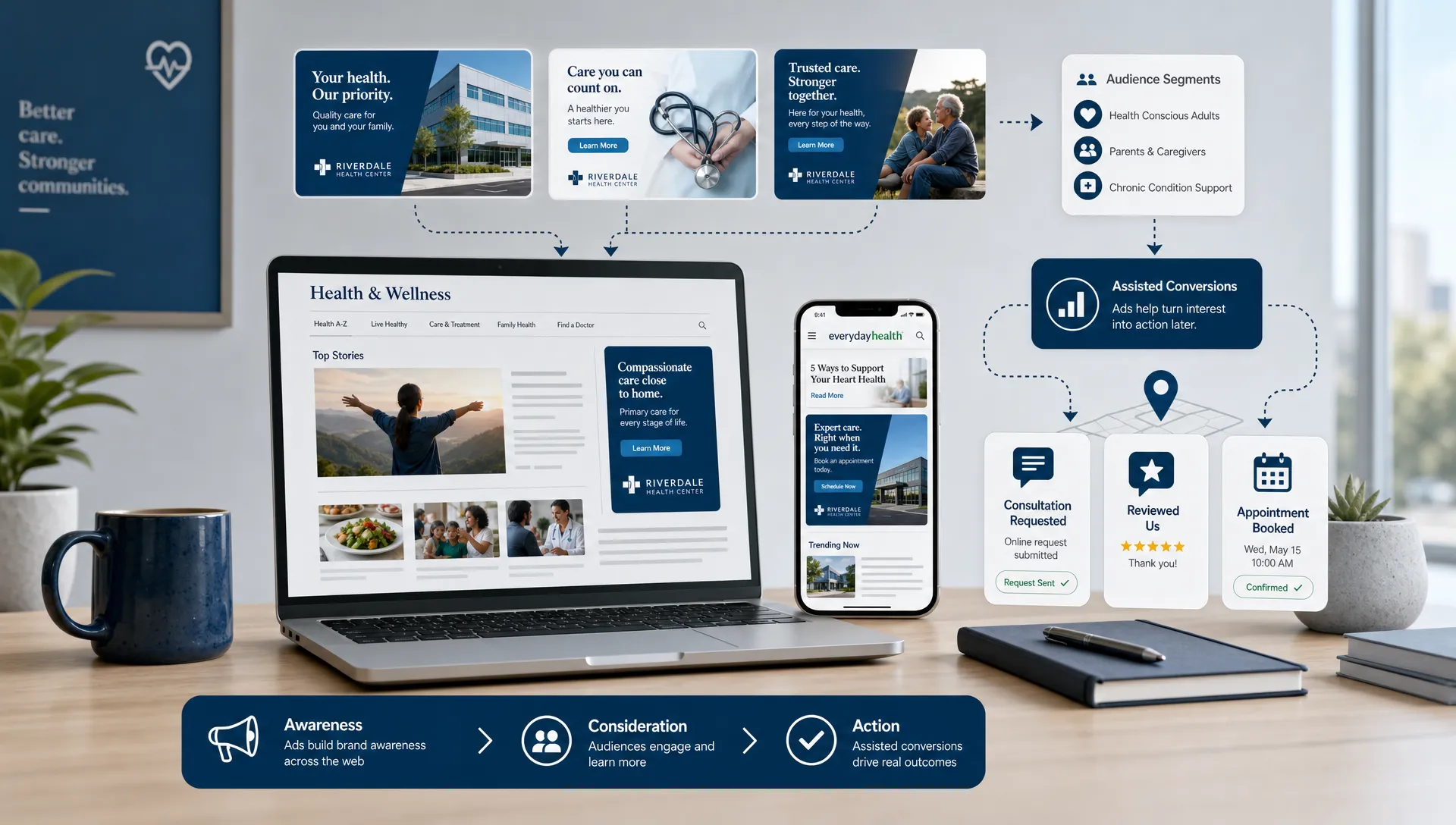
Google Display Ads can be useful for healthcare practices, but only when they are used for the right job.
They are not usually the best channel for someone searching “emergency dentist near me,” “LASIK consultation Louisville,” or “pain doctor accepting new patients.” Those patients are expressing active intent, so Search Ads usually deserve priority. If that is the situation you are solving first, start with a strong intent-based foundation like Google Search Ads for healthcare practices.
Display is different. It puts visual ads across Google’s display inventory, including websites and apps, reaching people while they are reading, researching, comparing, or simply browsing. That means it is usually not a last-click appointment engine. Its best role is to build familiarity, support other channels, and stay present during longer healthcare decision cycles.
For dentists, orthodontists, optometrists, chiropractors, pain physicians, physical therapists, and specialty practices, the question is not “Do Google Display Ads work?” The better question is “Where in the patient journey can display help without wasting budget or creating compliance risk?”
What Google Display Ads Actually Do in Healthcare
Google Display Ads are image-based or responsive ads that appear outside the search results page. They can show on publisher websites, apps, and other eligible inventory. In 2026, display exposure can also appear as part of broader Google Ads campaign types, so practices need to understand what display is contributing even when it is not managed as a standalone campaign.
Display is interruption-based advertising. The person seeing the ad is not necessarily looking for your practice at that moment. That is why display usually produces lower direct conversion intent than search. But it can still influence the path to conversion.
A parent may see an orthodontic ad several times before finally searching for “braces consultation near me.” A patient considering LASIK may notice a local eye center’s brand while reading about vision correction. Someone with chronic back pain may see a chiropractic or physical therapy message before they are ready to compare providers.
That influence is valuable, but it has to be measured differently than high-intent search traffic.
When Google Display Ads for Healthcare Actually Work
Display works best when it is tied to a clear strategic purpose. If the campaign is simply “show our logo to everyone within 25 miles,” the budget will usually disappear without a meaningful impact. But when the audience, message, offer, and measurement plan fit together, display can support patient growth.
1. When the service has a longer decision cycle
Display is more useful when patients take time to consider the service. This is common with elective, higher-value, or comparison-heavy healthcare decisions.
Examples include orthodontic treatment, dental implants, cosmetic dentistry, LASIK, cataract consultations, regenerative medicine, physical therapy programs, and certain pain management services. These patients may not book the first time they hear about a provider. They often research cost, outcomes, financing, reviews, convenience, and trust signals.
In these cases, display can help your practice become familiar before the patient searches. Familiarity matters because patients are more likely to click and call a provider they recognize.
2. When search demand is expensive or competitive
In many healthcare markets, Search Ads are competitive. Dental implants, emergency dentistry, LASIK, pain management, and orthodontics can attract high cost per click because the patient value is significant.
Display will not replace search in those categories, but it can support it. A patient who has already seen your brand may be more likely to click your search ad later. Display can also help create branded search demand, which is often less expensive and more likely to convert than broad non-branded traffic.
This is why display should often be evaluated alongside your total Google Ads mix, not in isolation. If you are deciding how display fits with Search, Local Services Ads, Performance Max, landing pages, and tracking, it can help to compare the Google advertising services healthcare practices should evaluate before assigning budget.
3. When the practice has a strong local brand story
Display can work well when a practice has something credible and memorable to show. Healthcare is trust-based. A generic stock photo with “Book Now” rarely builds that trust.
Better display campaigns often highlight real differentiators, such as convenient locations, family-friendly care, advanced technology, a specific consultation offer, a long-standing local reputation, or a specialty focus. The message should feel concrete, not vague.
For example, “Schedule a children’s dental visit before school starts” is more actionable than “Your smile matters.” “Considering LASIK? Start with a consultation” is clearer than “See better today.”
4. When the landing page is built for conversion
A display click is fragile. The patient did not begin with strong intent, so the landing page must quickly explain why the visit is worth their time.
A good healthcare display landing page should make the service obvious, show location relevance, include trust signals, answer common concerns, and provide a simple next step. If the page is slow, generic, or built around the practice instead of the patient’s decision, display traffic will underperform.
This is one reason many display campaigns fail. The ad may get attention, but the landing page does not turn curiosity into action.
5. When the campaign respects healthcare privacy rules
Display can be powerful, but healthcare has strict privacy and advertising considerations. Google’s personalized advertising policies restrict the use of sensitive interest categories, including many health-related conditions. Google’s healthcare and medicines policy also sets requirements for certain healthcare advertisers and services.
This means tactics that seem normal in other industries can be risky in healthcare. Uploading patient lists, remarketing to people based on visits to sensitive treatment pages, or implying that a viewer has a specific condition can create policy and privacy problems. HIPAA also matters when protected health information is involved, and HHS guidance explains that certain uses of PHI for marketing may require authorization.
In plain English: do not treat healthcare display like e-commerce retargeting. The compliance bar is higher.
| Display use case | Usually a good fit? | Why |
|---|---|---|
| Orthodontic consultation awareness | Yes | Longer decision cycle, family research, strong local competition |
| Cosmetic dentistry or dental implant education | Often | High-value service, comparison-heavy, trust matters |
| LASIK or cataract consultation campaigns | Often | Patients research options before booking |
| Emergency dental appointments | Usually no | Search intent is stronger and more immediate |
| Sensitive condition remarketing | Usually no | Privacy and Google policy risk can outweigh performance |
| General brand awareness with no offer | Weak | Hard to measure and easy to waste budget |
When Display Ads Usually Waste Budget
The fastest way to waste money on display is to expect it to behave like Search Ads. Display is not built to capture urgent intent. It is built to create visibility and influence future behavior.
Display tends to struggle when a practice has no clear offer, no strong landing page, no conversion tracking, and no plan for follow-up. It also struggles when the audience is too broad. “Adults 25 to 65 within 30 miles” is not a strategy. It is a media buy with very little discipline.
Another common mistake is judging display only by direct appointment form fills. That can be useful, but it is incomplete. A patient may see a display ad, search your practice later, read reviews, and then call from your Google Business Profile. If your reporting only gives credit to the final click, display may look worse than it is. If your reporting gives too much credit to view-through conversions, display may look better than it is.
The solution is balanced measurement.
How to Structure Healthcare Display Campaigns That Have a Chance
Display campaigns need tighter discipline in healthcare than in many other categories. The campaign should start with one audience hypothesis, one service line, one geographic market, and one measurable objective.
A practical structure might focus on a single service, such as pediatric dentistry, dental implants, LASIK consultations, dry eye care, chiropractic care, physical therapy, or pain management consultations. The campaign should then connect that service to a specific patient need and a dedicated page.
Your creative should be simple. Patients scrolling through an article or app will not study a crowded ad. Use a clear headline, recognizable practice name, local relevance, and one action. Avoid fear-based language, exaggerated claims, or wording that implies the viewer has a specific health condition.
Strong display creative often includes:
- A clear service line, such as “Orthodontic Consultations in Louisville” or “LASIK Consultations Available”
- A trust cue, such as years in the community, provider expertise, or review volume if accurate and compliant
- A simple next step, such as “Request a Consultation” or “Schedule an Appointment”
- Visuals that match the service and feel credible for healthcare
Targeting should also be conservative. Contextual targeting, local geography, placement controls, and service-relevant content themes are often safer starting points than aggressive behavioral assumptions. For sensitive services, avoid strategies that make inferences about a person’s health status.
What Healthcare Practices Should Measure
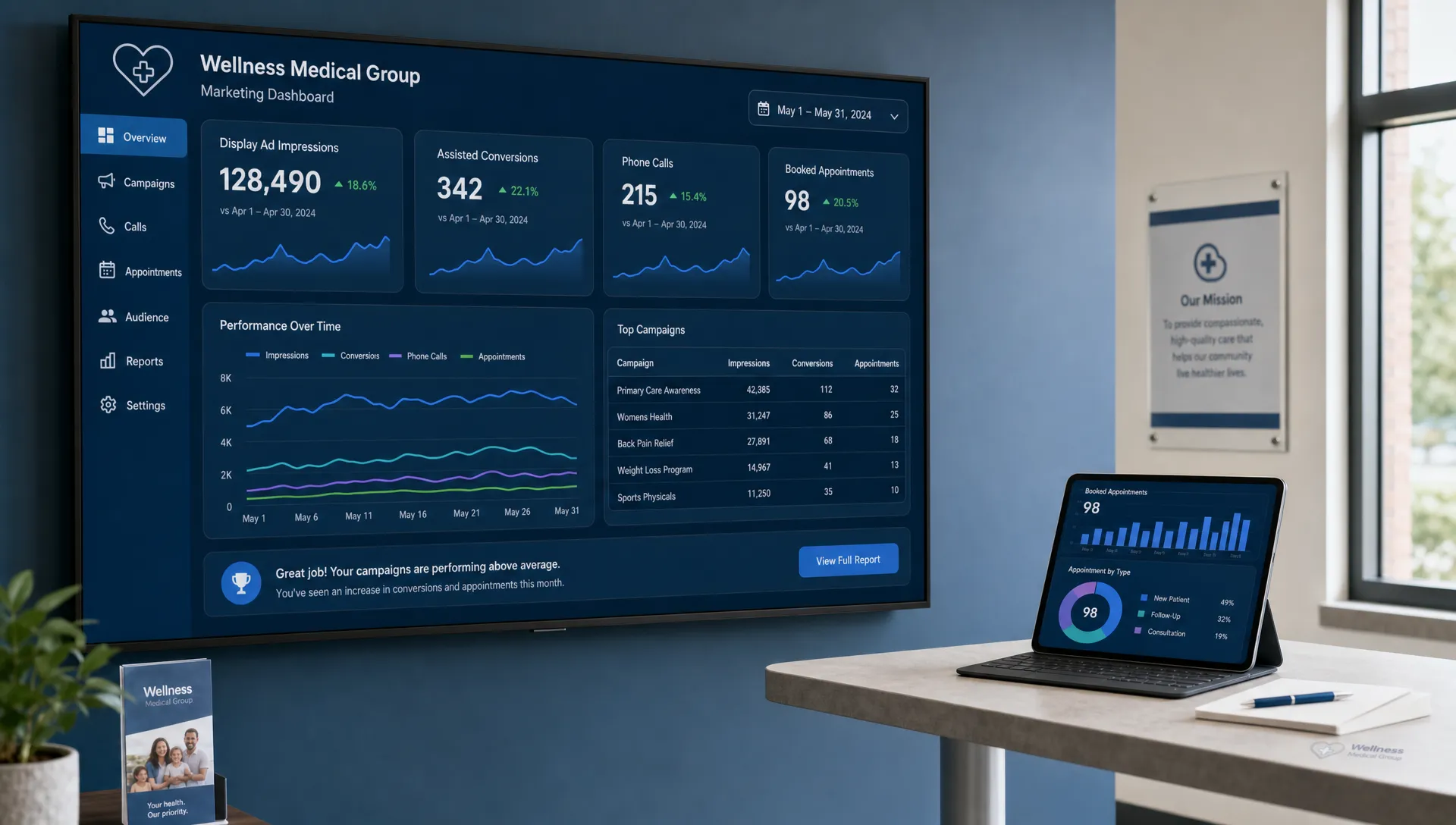
Display measurement should answer one question: did this campaign contribute to patient acquisition at a cost that makes sense?
Clicks alone are not enough. Impressions alone are not enough. Even direct form fills can be misleading if call tracking and booked appointment tracking are missing.
The most useful metrics usually include a mix of media, engagement, and business outcomes.
| Metric | What it tells you | How to interpret it |
|---|---|---|
| Reach and frequency | How many local people saw the ads and how often | Useful for awareness, but frequency can become wasteful if too high |
| Click-through rate | Whether the creative earns attention | Helpful for testing messages, but not proof of patient intent |
| Engaged sessions | Whether visitors stayed and explored | Better than clicks alone for low-intent traffic |
| Calls and form submissions | Whether the campaign generated leads | Must be filtered for quality and relevance |
| Booked appointments | Whether leads became real patient opportunities | The most important outcome for most practices |
| Branded search lift | Whether more people searched for the practice by name | A useful sign that display is supporting awareness |
| Assisted conversions | Whether display appeared in the path before conversion | Helpful, but should not be overvalued without context |
The key is to separate “marketing activity” from “practice growth.” A campaign with many impressions and cheap clicks can still be a poor investment if it does not influence qualified calls, consultations, or booked appointments.
Specialty-by-Specialty Examples
Display does not work the same way for every healthcare category. The patient’s urgency, sensitivity, decision cycle, and financial value all change the strategy.
| Practice type | Where display can work | Where to be careful |
|---|---|---|
| General dentistry | Recall-style awareness for families, new mover campaigns, seasonal appointment reminders using privacy-safe methods | Expecting display to drive emergency dental calls better than search |
| Orthodontics | Parent-focused awareness, consultation campaigns, back-to-school timing, brand familiarity before comparison searches | Overly broad family targeting with weak creative |
| Cosmetic dentistry | Veneers, whitening, smile makeover education, consultation demand support | Before-and-after claims, unrealistic outcome promises, or low-trust landing pages |
| Optometry | Annual exam awareness, eyewear promotions, dry eye education if handled carefully | Personalized targeting that implies a sensitive condition |
| LASIK and cataract surgery | Research-stage education and consultation campaigns | Treating display clicks as ready-to-book surgical leads |
| Chiropractic and physical therapy | Local awareness for mobility, recovery, and wellness-oriented care | Pain-related messaging that feels fear-based or implies a diagnosis |
| Pain management | Educational campaigns around consultation options | Sensitive-condition targeting, remarketing, and aggressive claims |
A good rule of thumb: the more urgent the patient need, the more Search Ads should lead. The longer and more considered the decision, the more display may help.
A Simple Testing Plan for Healthcare Display
If a practice wants to test Google Display Ads, the test should be controlled. Do not launch display across every service line at once. Pick a use case where display has a realistic role.
Start by choosing one service with a clear patient value and a defined geography. Build one landing page for that service. Create a small set of ad variations that test different messages, not random design changes. Make sure call tracking, form tracking, and booked appointment reporting are in place before launch.
In the first 30 days, evaluate whether the campaign is reaching the right market, whether frequency is reasonable, and whether the creative is earning engaged visits. In days 31 to 60, compare landing page behavior, lead quality, and early assisted conversion patterns. By days 61 to 90, decide whether display is producing enough contribution to justify more budget.
Do not scale display just because clicks are cheap. Scale it when it supports qualified demand.
Where Display Fits in the Full Patient Acquisition System
Google Display Ads work best as part of a broader system. For most healthcare practices, that system includes local SEO, Google Business Profile optimization, high-intent Search Ads, strong landing pages, reputation management, call handling, and follow-up automation.
Display can add reach and repetition, but it cannot fix a weak offer, poor reviews, slow intake, or unclear scheduling process. If patients click and nobody answers the phone, display is not the problem. If the landing page asks for too much information before explaining the value of the appointment, display is not the problem. If the campaign drives leads that never get followed up, display is not the problem.
This is why healthcare advertising should be measured all the way to booked appointments, not just impressions or clicks. A campaign that looks cheap at the ad platform level may be expensive at the patient acquisition level.
If your practice is trying to build a Google Ads system that connects targeting, landing pages, tracking, and patient follow-up, this guide on building a Google Ads campaign that books patients is a helpful next step.
Frequently Asked Questions
Are Google Display Ads good for healthcare practices? They can be, but they are usually best for awareness, education, and supporting longer patient decision cycles. They are rarely the best standalone channel for urgent, high-intent appointment demand.
Can healthcare practices use remarketing with Google Display Ads? Healthcare practices should be very cautious with remarketing. Google restricts personalized advertising based on sensitive health interests, and using patient data or treatment-page behavior can create policy and privacy risks. Many healthcare campaigns are better served by contextual, geographic, and non-sensitive strategies.
Should a dental or medical practice run Display Ads before Search Ads? Usually no. If patients are already searching for your service, Search Ads often deserve priority because intent is higher. Display can be added later to build brand familiarity, support competitive service lines, or influence longer consideration paths.
What budget should a healthcare practice spend on display? There is no universal number. The better approach is to fund high-intent channels first, then run a controlled display test for one service line with clear tracking. Increase budget only if display contributes to qualified leads, booked appointments, or measurable brand lift.
What makes a healthcare display ad compliant? Compliance depends on the service, location, targeting, claims, landing page, and data use. In general, avoid using protected health information, avoid implying the viewer has a condition, follow Google Ads policies, and consult legal or compliance guidance for sensitive campaigns.
Make Display Work as Part of a Real Growth System
Google Display Ads for healthcare work when they are used intentionally: the right service, the right market, the right message, the right compliance guardrails, and the right measurement plan.
They fail when they are treated as cheap traffic.
Louisville Web Lab helps healthcare practices connect Google Ads, SEO, websites, reputation, and automation into patient acquisition systems that are measured by real growth, not vanity metrics. If you want to know whether display belongs in your marketing mix, book a diagnostic strategy call with Louisville Web Lab and get a clearer plan for turning visibility into booked appointments.