
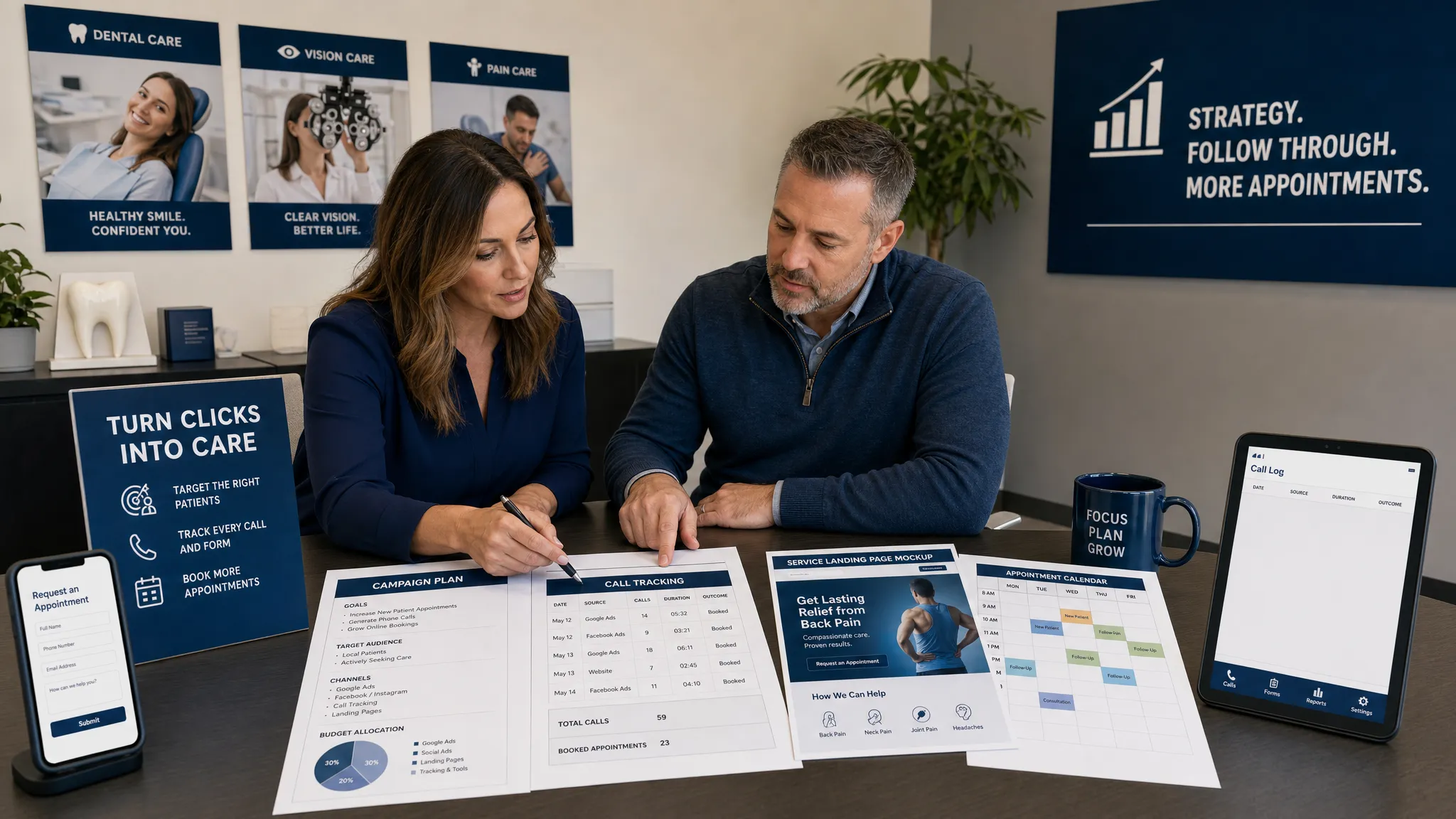
A Google Ads campaign can put your practice in front of people who are actively searching for care. But visibility alone does not fill a schedule. A campaign that books patients has to connect four things: the right search intent, the right offer, the right landing page, and a fast follow-up process inside the practice.
That is especially true for dentists, orthodontists, optometrists, pain physicians, and other healthcare practices. A click from someone searching “emergency dentist near me” or “chiropractor for back pain” is valuable only if the campaign helps that person take the next step with confidence.
Below is a practical framework for building a Google Ads campaign around booked appointments, not vanity metrics.
Start With the Appointment You Want to Book
Before opening Google Ads, define the exact type of patient visit you want the campaign to generate. Many healthcare campaigns underperform because they are built around broad visibility instead of a specific service line.
A pediatric dentist might want new patient exams. An implant dentist might want consultations. An optometrist might want dry eye evaluations or eye exams. A pain clinic might want qualified consultations for patients who have already tried conservative care. Each of those goals requires different keywords, ad copy, landing pages, budgets, and intake questions.
Start by answering three questions:
- Which service has enough margin and capacity to justify ad spend?
- What symptoms, treatments, or phrases do patients use when searching for it?
- What makes a patient qualified enough for the front desk or care team to prioritize follow-up?
This keeps your campaign focused on revenue-generating visits instead of generic traffic. If your practice needs a broader acquisition plan beyond paid search, Louisville Web Lab’s guide to patient acquisition strategies for growing healthcare practices explains how paid ads, local SEO, reviews, and follow-up systems work together.
Build Campaigns Around Intent, Not Just Services
A patient-search campaign should be organized by intent. In healthcare, intent usually falls into a few categories: urgent need, provider comparison, treatment research, and branded searches.
Urgent searches tend to convert quickly. Someone searching “same day dentist,” “eye doctor open today,” or “back pain chiropractor near me” is closer to booking. Research searches can still matter, but they often need more education before they convert. A campaign that mixes these audiences together becomes harder to manage because the budget may be spent on low-converting clicks before high-intent patients ever see your ad.
A cleaner structure looks like this:
| Campaign type | Example searches | Best use | Booking focus |
|---|---|---|---|
| High-intent service | “dental implants near me,” “dry eye treatment,” “pain management doctor” | Core revenue services | Consultation or appointment request |
| Urgent care need | “emergency dentist,” “walk in eye exam,” “same day chiropractor” | Time-sensitive demand | Calls and immediate scheduling |
| Condition or symptom | “sciatica treatment,” “tooth pain,” “blurry vision exam” | Education plus conversion | Qualification and next step clarity |
| Branded | Practice name, doctor name | Protecting demand | Easy contact and scheduling |
| Competitor or comparison | “best orthodontist near me,” “Invisalign provider” | Competitive markets | Differentiation and trust |
For most practices, the first campaign should not try to cover everything. Start with one or two service lines where patient intent is clear, then expand once tracking proves what works.
Choose Keywords That Match Real Patient Language
Healthcare providers often describe services differently than patients do. A practice may use clinical language like “temporomandibular disorder treatment,” while patients search “jaw pain doctor” or “TMJ dentist near me.” An ophthalmology group may describe “refractive surgery,” while patients search “LASIK consultation.”
Your keyword list should include service terms and patient-language terms. Use phrase match and exact match for your highest-value searches, then expand carefully after reviewing the search terms report. Broad match can work when paired with strong conversion data and smart bidding, but it can waste money quickly if your campaign is new, your budget is limited, or your conversion tracking is weak.
Negative keywords are just as important. They prevent your ad from showing for searches that are unlikely to become patients. Common healthcare negatives may include “jobs,” “salary,” “school,” “training,” “free,” “DIY,” “pictures,” “definition,” or unrelated conditions and services you do not provide.
The goal is not to get the most clicks. The goal is to pay for searches that indicate a person is ready to choose a provider.
Set Location Targeting Based on Patient Reality
Google Ads location targeting should reflect how far patients are actually willing to travel for the service. A patient may drive farther for oral surgery, orthodontics, LASIK, pain management, or a specialty consultation than for a routine cleaning or annual eye exam.
Use a tighter radius for routine care and a broader radius for higher-value or specialized services. In dense metro areas, ZIP code targeting may be more accurate than a large radius. In suburban or rural markets, radius targeting may make more sense.
Also check your location setting. For local healthcare campaigns, you generally want to reach people who are in or regularly in your targeted locations, not people merely showing interest in the area. This helps reduce wasted spend from out-of-market searches.
Scheduling matters too. If your campaign’s main conversion is a phone call, consider running call-heavy ads when your staff can answer. If after-hours calls go to voicemail and are returned the next day, your cost per booked appointment can rise even when your cost per lead looks acceptable.
Write Ads That Reduce Friction and Build Trust
Healthcare ad copy should be clear, specific, and compliant. Patients want to know whether you provide the service, whether you are nearby, whether you accept new patients, and what the next step is.
Strong ads usually include:
- The service or condition being searched
- The city, neighborhood, or service area
- A trust signal such as experience, technology, patient reviews, or specialty focus when accurate
- A simple call to action such as “Request an Appointment” or “Call Today”
- A reason to choose your practice that does not overpromise outcomes
Avoid fear-based copy, unrealistic claims, or language that implies you know private details about the searcher. Google’s healthcare and medicines advertising policy also places restrictions on certain healthcare-related ads, so practices should review policy requirements before launching campaigns in regulated categories.
For example, “Get guaranteed relief from chronic pain” is risky and likely inappropriate. “Schedule a consultation with a pain management specialist” is clearer and more responsible. “We know you have gum disease” is inappropriate. “Periodontal evaluations available in Louisville” is safer and more useful.
Send Every Click to a Landing Page Built for the Service
Sending paid traffic to your homepage is one of the fastest ways to lower conversion rates. A homepage has too many paths: staff bios, every service, insurance details, blog links, and general practice information. A patient who clicked an ad for “dental implant consultation” or “dry eye treatment” should land on a page that matches that exact need.
A strong healthcare landing page should answer the patient’s next questions quickly. What service is available? Who is it for? What symptoms or goals does it address? What happens during the first visit? Where is the office? How can the patient book or call?
Keep the page focused. A good landing page does not need to be long, but it does need to remove uncertainty. Include clear calls to action near the top and throughout the page, click-to-call functionality on mobile, a short form, office location details, provider or practice trust signals, and review proof when available.
If you want a deeper campaign setup checklist, this related guide on setting up Google Ads for better healthcare leads covers core setup decisions such as structure, keywords, landing pages, and conversion tracking.
Track Booked Appointments, Not Just Leads
A lead is not always a patient. In healthcare advertising, the difference between leads and booked appointments is where profitability is usually won or lost.
At minimum, track calls from ads, calls from landing pages, form submissions, and online booking starts or completions if your scheduling system supports it. Then create a simple process for your team to mark which leads became scheduled appointments, which were unqualified, and which were missed.
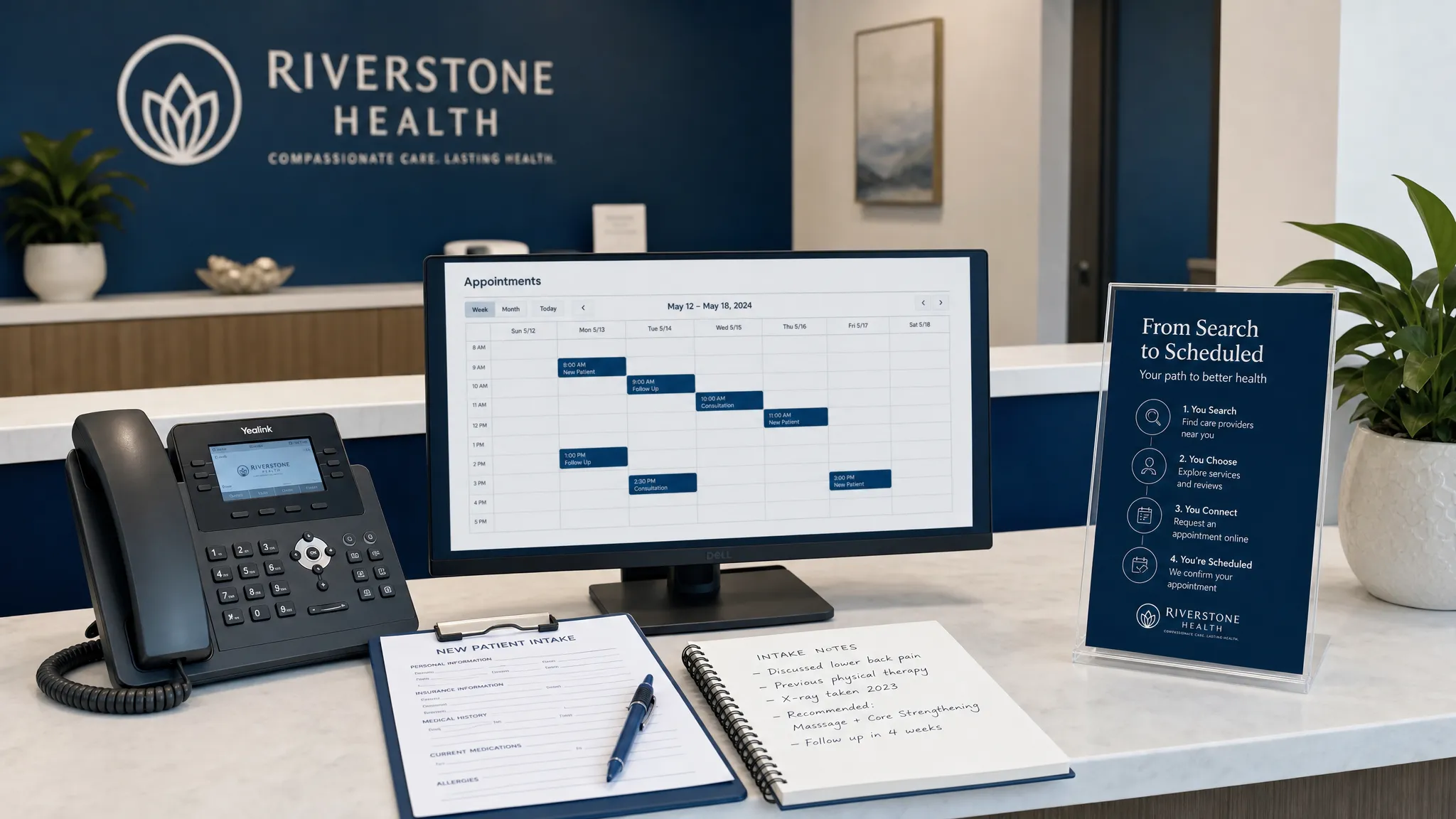
This is where many campaigns become misleading. A campaign may produce 40 leads, but if 12 were spam, 10 never answered, 8 wanted a service you do not offer, and only 5 booked, the real conversion rate is much lower than the Google Ads dashboard suggests.
For healthcare practices, tracking also needs to respect privacy obligations. Be careful with tracking scripts, call recordings, form fields, and any data passed into advertising platforms. The U.S. Department of Health and Human Services has published guidance on HIPAA and online tracking technologies, and practices should involve qualified legal or compliance counsel when patient data may be involved.
Set a Budget That Can Produce Meaningful Data
A Google Ads campaign needs enough budget to generate conversion data. If the daily budget is too small, Google may only capture a few clicks per day, which makes optimization slow and unreliable. On the other hand, spending aggressively before the campaign has clean tracking and a strong landing page can waste money quickly.
Budget should be based on specialty, competition, location, and the value of the appointment. A dental implant campaign will usually require a different budget than a routine eye exam campaign. A competitive metro area will usually cost more than a smaller market.
Instead of asking, “How little can we spend?” ask, “How much data do we need to make a confident decision?” A test budget that can buy only a few likely consultations will not tell you much. You need enough click and conversion volume to see patterns.
For 2026 budget planning, review Louisville Web Lab’s breakdown of Google Ads cost for healthcare practices to understand how spend expectations vary by specialty and market.
Match Bidding Strategy to Campaign Maturity
Smart bidding can work well, but it depends on conversion quality. If your campaign is tracking every form fill and every short phone call as equal, automated bidding may optimize toward easy leads rather than scheduled patients.
For a new campaign, start with tight targeting, clear conversion actions, and a bidding approach that gives you control while data builds. Once you have enough reliable conversion volume, test Maximize Conversions or target CPA strategies using the highest-quality conversion signals available.
Do not judge bidding performance only by cost per click. A more expensive click that books a high-value treatment consultation can be far more valuable than a cheap click from someone looking for free advice. The right metric is cost per qualified appointment, then ultimately cost per acquired patient.
Align the Front Desk With the Campaign
Google Ads cannot fix a broken intake process. If calls go unanswered, forms sit for hours, or staff members do not know which services the ads promote, booked appointments will suffer.
Before launch, give your team the campaign details. They should know the promoted service, the landing page offer, the target patient profile, common questions, and how to handle price shoppers or insurance questions. A short call script can help the team move from inquiry to appointment without sounding robotic.
Speed matters. A patient searching for urgent dental care, same-day eye care, or back pain help may contact multiple providers. The practice that responds first and makes scheduling easy often wins.
For multi-location groups or fast-growing healthcare organizations, the issue may not be ads at all. It may be leadership, staffing, or operational capacity.
Optimize Weekly Using Search Terms and Call Quality
A campaign that books patients is not built once. It is refined every week.
Review search terms to find irrelevant queries, new keyword opportunities, and language patients actually use. Listen to call recordings if your compliance process allows it, or review call outcomes with the front desk. Look for patterns: Are callers asking about insurance? Are they confused about the service? Are they outside your area? Are they trying to book after hours?
Then improve the campaign based on what you learn. Add negative keywords. Adjust location targeting. Rewrite ads to address common questions. Improve the landing page if patients are clicking but not converting. Shift budget toward campaigns with better booked appointment rates, not merely lower click costs.
Use a simple scorecard:
| Metric | Why it matters | What to watch |
|---|---|---|
| Search impression share | Shows whether budget or rank is limiting visibility | Low share on high-intent terms may mean missed opportunities |
| Cost per qualified lead | Measures lead efficiency | Separate spam and unqualified inquiries |
| Lead-to-appointment rate | Shows intake and offer quality | Low rates may signal follow-up or messaging issues |
| Cost per booked appointment | Connects ads to schedule growth | Use this as a primary optimization metric |
| New patient value | Measures business impact | Compare acquisition cost to actual revenue |
The best campaigns become smarter over time because the practice learns which patients are most likely to book, show up, and accept care.
Avoid the Most Common Healthcare Google Ads Mistakes
Most underperforming campaigns fail for predictable reasons. They target too broadly, send clicks to generic pages, track weak conversions, or ignore the front desk. They also try to optimize before the basics are in place.
Avoid these mistakes:
- Running one campaign for every service the practice offers
- Using broad keywords without enough negatives or conversion data
- Sending all paid traffic to the homepage
- Measuring form fills without confirming booked appointments
- Running call campaigns when nobody can answer the phone
- Making medical claims that are unsupported or noncompliant
- Ignoring local competitors, reviews, and Google Business Profile visibility
Paid search works best when it is part of a complete appointment system. That means ads, landing pages, tracking, reviews, local SEO, and patient follow-up all support the same goal. For a broader view of that system, read Louisville Web Lab’s guide to medical practice marketing that actually drives appointments.
Frequently Asked Questions
How long does it take for a Google Ads campaign to book patients? Some healthcare campaigns generate calls within days, especially for urgent or high-intent searches. However, it usually takes several weeks to collect enough data to improve keywords, bidding, landing pages, and lead quality.
Should a healthcare practice use Google Ads or local SEO first? Both can work together. Google Ads can generate near-term visibility for high-intent searches, while local SEO and Google Business Profile optimization build long-term visibility and trust. The best choice depends on your market, budget, and growth goals.
What is the most important conversion to track? Booked appointments are more important than clicks or raw leads. Track calls and forms, but also review which inquiries became qualified scheduled visits.
Can healthcare practices use remarketing in Google Ads? Healthcare remarketing can create privacy and advertising policy concerns. Practices should be cautious, avoid sensitive health-based targeting, and get compliance guidance before using remarketing or advanced audience strategies.
Why are my Google Ads getting leads but not patients? The issue may be keyword intent, landing page mismatch, weak qualification, slow follow-up, missed calls, or untrained intake staff. Review the full path from search term to booked appointment before increasing budget.
Turn Patient Searches Into Scheduled Visits
A profitable Google Ads campaign is not just a media buy. It is a patient acquisition system. The campaign has to attract the right searches, make the next step obvious, track real appointment outcomes, and support your front desk with a clear follow-up process.
If you want help finding the gaps in your current campaign or building a patient-booking system from the ground up, schedule a diagnostic call with Louisville Web Lab. We help healthcare practices turn search visibility into measurable growth through SEO, Google Ads, websites, and patient automation.