

When a healthcare practice invests in Google Ads, the goal is not just more clicks. The goal is better leads: calls from patients who are ready to book, form fills for the right services, and appointment requests your front desk can actually convert.
That is why setting up Google Ads for a dental, optometry, chiropractic, pain management, physical therapy, or specialty medical practice requires a different approach than setting up ads for an ecommerce store. You are dealing with local intent, patient privacy, medical advertising policies, high-trust decisions, and a limited service area. A sloppy setup can spend quickly without producing meaningful appointments.
The right setup starts before the first keyword is added. It begins with defining what a qualified lead looks like, matching campaigns to high-intent services, building landing pages that answer patient concerns, and tracking conversions in a way that supports smarter decisions without mishandling sensitive information.
Start With the Lead You Actually Want
Before opening Google Ads, define the patient actions that matter most to your practice. A lead for an emergency dentist might be a phone call during office hours. A lead for an orthodontist may be a consultation request. A LASIK center may care about scheduled evaluations, while a pain clinic may want form submissions for specific treatments.
This step matters because Google Ads optimizes toward the conversion signals you give it. If you tell the platform that every short phone call, low-intent form fill, and accidental click is a success, it will find more of those. If you track meaningful actions, your campaigns have a better chance of improving over time.
For most healthcare practices, useful conversion goals include:
- Calls from ads that last long enough to suggest real patient intent
- Calls from the website after an ad click
- Appointment request form submissions
- Online booking completions
- New patient consultation requests
- Qualified offline leads imported from your CRM or scheduling system
Do not treat all conversions equally. A 90-second call from someone searching for emergency tooth pain has a different value than a generic contact form asking about insurance. Your setup should reflect that difference as much as your tracking tools allow.
Build Campaigns Around Services, Not the Whole Practice
One of the most common mistakes in healthcare Google Ads is creating one broad campaign for every service. A general campaign with mixed keywords like dentist, veneers, teeth whitening, dental implants, and emergency dentist makes budget control and optimization difficult. The intent, urgency, landing page, and lead value are different for each service.
A better structure groups campaigns by service line and patient intent. This makes it easier to write relevant ads, send patients to the right landing page, set appropriate budgets, and measure which services are producing profitable leads.
| Practice type | Better campaign structure | Why it works |
|---|---|---|
| General dentistry | Emergency dental, dental implants, cosmetic dentistry, new patient exams | Separates urgent searches from elective and routine care |
| Orthodontics | Braces, Invisalign-style clear aligners, pediatric orthodontics | Matches ads to consultation intent and age group needs |
| Optometry | Eye exams, dry eye treatment, contact lenses, urgent eye care | Keeps routine care separate from condition-specific searches |
| Pain management | Back pain, neck pain, sciatica, regenerative medicine | Aligns search terms with patient symptoms and treatment interests |
| Physical therapy | Sports injury rehab, post-surgical rehab, back pain PT | Helps ads speak directly to the patient’s reason for searching |
This structure also protects your budget. If one service is expensive but profitable, you can fund it appropriately. If another attracts low-quality searches, you can reduce spend without hurting the rest of the account.
Choose Keywords Based on Intent, Not Volume
High search volume is not always good. In healthcare, broad keywords can attract students, job seekers, existing patients, insurance questions, and people outside your service area. The best keywords usually show clear local and appointment intent.
For example, a chiropractor may be tempted to bid on back pain. That term can work, but it is broad. Phrases like chiropractor for back pain near me, sciatica chiropractor Louisville, or same day chiropractic appointment often show stronger intent. A dental implant specialist may see better lead quality from dental implant consultation than from implants by itself.
Use a mix of phrase match and exact match keywords when launching. Broad match can be powerful in mature accounts with strong conversion data, but it can waste budget quickly if tracking is weak or negative keywords are missing.
A practical keyword setup includes service terms, location modifiers, near me phrases, and urgency terms when appropriate. It should also include a strong negative keyword list. For healthcare practices, negative keywords often include jobs, salary, school, training, free, DIY, at home, pictures, definition, and unrelated conditions or services you do not provide.
Set Location Targeting Carefully
Healthcare leads are local. Even specialty practices that draw from a wider region still need precise location targeting. In Google Ads, avoid targeting a huge metro area just because you technically can. A patient may click from 45 miles away, but that does not mean they will book or show up.
Start with the real patient draw area. For many practices, that means a radius around the office or a set of ZIP codes, cities, or counties. Use location reports after launch to see where qualified calls and appointment requests are coming from, then adjust bids or exclusions accordingly.
Also review the advanced location setting. In most local healthcare campaigns, you generally want to target people who are in or regularly in your selected locations, not people merely interested in them. This helps reduce clicks from users researching from outside your market.
If your Google Business Profile is accurate and active, connect location assets so ads can show your address, distance, and directions when eligible. If your profile needs work, fix that first. A complete local profile supports both paid and organic visibility, and this guide to setting up a Google Business Profile quickly can help practices avoid common local visibility gaps.
Write Ads That Match Patient Concerns
Healthcare ad copy has to do more than repeat the keyword. Patients are often anxious, uncertain, and comparing several options. Your ads should quickly communicate relevance, trust, and the next step.
Strong healthcare ads often include:
- The specific service or condition the patient searched for
- A local signal, such as city or neighborhood
- A clear appointment-oriented call to action
- Trust factors, such as years in practice, provider type, or patient-focused care, if accurate
- Practical details, such as same-week appointments or financing, only if true
Avoid claims that sound absolute or unsupported. Phrases like guaranteed results, cure your pain, or best in the city can create compliance and trust issues. Google also has specific healthcare and medicines advertising policies, so review the official Google Ads healthcare policy before promoting regulated treatments, prescriptions, or sensitive medical services.
Ad copy should be specific without making the patient feel targeted in a sensitive way. For instance, speak to the service, not an assumed personal attribute. Need a back pain evaluation is safer and more respectful than language that implies you know the user has a particular medical condition.
Send Clicks to Service-Specific Landing Pages
Your homepage is rarely the best destination for paid healthcare traffic. A patient who searches for dental implants, dry eye treatment, or sciatica care should land on a page focused on that exact need. If they have to hunt through your navigation, compare unrelated services, or call without enough context, conversion rates usually suffer.
A strong healthcare landing page should answer the patient’s immediate questions: What do you treat? Who provides care? What happens at the first visit? How soon can I be seen? Where are you located? How do I request an appointment?
For elective and aesthetic services, the page must also build confidence through clear explanations, realistic expectations, and provider credibility.
The best landing pages are not necessarily long, but they are focused. They remove distractions, make the appointment path obvious, and align tightly with the keyword and ad. This same principle applies across dental implants, LASIK evaluations, chiropractic care plans, pain consultations, and physical therapy appointments.
Set Up Conversion Tracking Without Ignoring Privacy
Google Ads needs conversion tracking to improve. Healthcare practices need privacy safeguards to protect patients and reduce risk. Both can be true, but the setup must be intentional.
At a minimum, track calls from ads, calls from your website, form submissions, and booking confirmations. If possible, connect qualified lead outcomes from your CRM or scheduling system so Google can learn which conversions turn into real appointments.
At the same time, avoid sending sensitive health information into ad platforms. Do not pass condition names, appointment reasons, patient names, insurance details, or form message contents into tracking events. Be careful with URLs, thank-you pages, form fields, call recordings, and third-party scripts. The U.S. Department of Health and Human Services has published guidance on HIPAA and online tracking technologies that healthcare organizations should review with legal or compliance advisors.
A safer tracking plan for healthcare often uses generic conversion names, limited form fields, consent-aware analytics, and internal lead qualification outside the ad platform. The goal is to measure performance without turning private patient context into marketing data.
Budget for Learning, Then Shift Toward What Works
A new Google Ads campaign needs enough budget to gather data. If the daily budget is too low for the cost per click in your specialty, the campaign may never produce enough clicks or conversions to optimize. That does not mean you should overspend. It means your launch budget should match the competitiveness and value of the service.
Dental implants, orthodontics, LASIK, pain management, and regenerative medicine can justify higher lead costs when the patient value is significant. Routine exams or lower-margin services may need tighter targeting and a different budget strategy.
If you are planning spend for the year, this breakdown of Google Ads cost for healthcare practices in 2026 gives more context on how budgets can vary by specialty and market. Use cost benchmarks as planning inputs, not guarantees. Your actual cost per lead will depend on competition, location, landing page quality, phone handling, reviews, and offer clarity.
When launching a new account, many practices start with manual control or a conservative automated bidding strategy while conversion data builds. Once you have enough reliable conversion volume, automated bidding strategies such as Maximize Conversions or Target CPA may become more useful. The key is not the bidding strategy alone. It is the quality of the conversion data feeding it.
Match Ads With Front Desk Follow-Up
A good Google Ads setup can still fail if the practice does not answer calls or follow up quickly. Healthcare leads are time-sensitive. A patient searching for urgent dental care, a new eye doctor, or back pain relief may contact several providers in one session. The first practice to respond clearly and compassionately often wins the appointment.
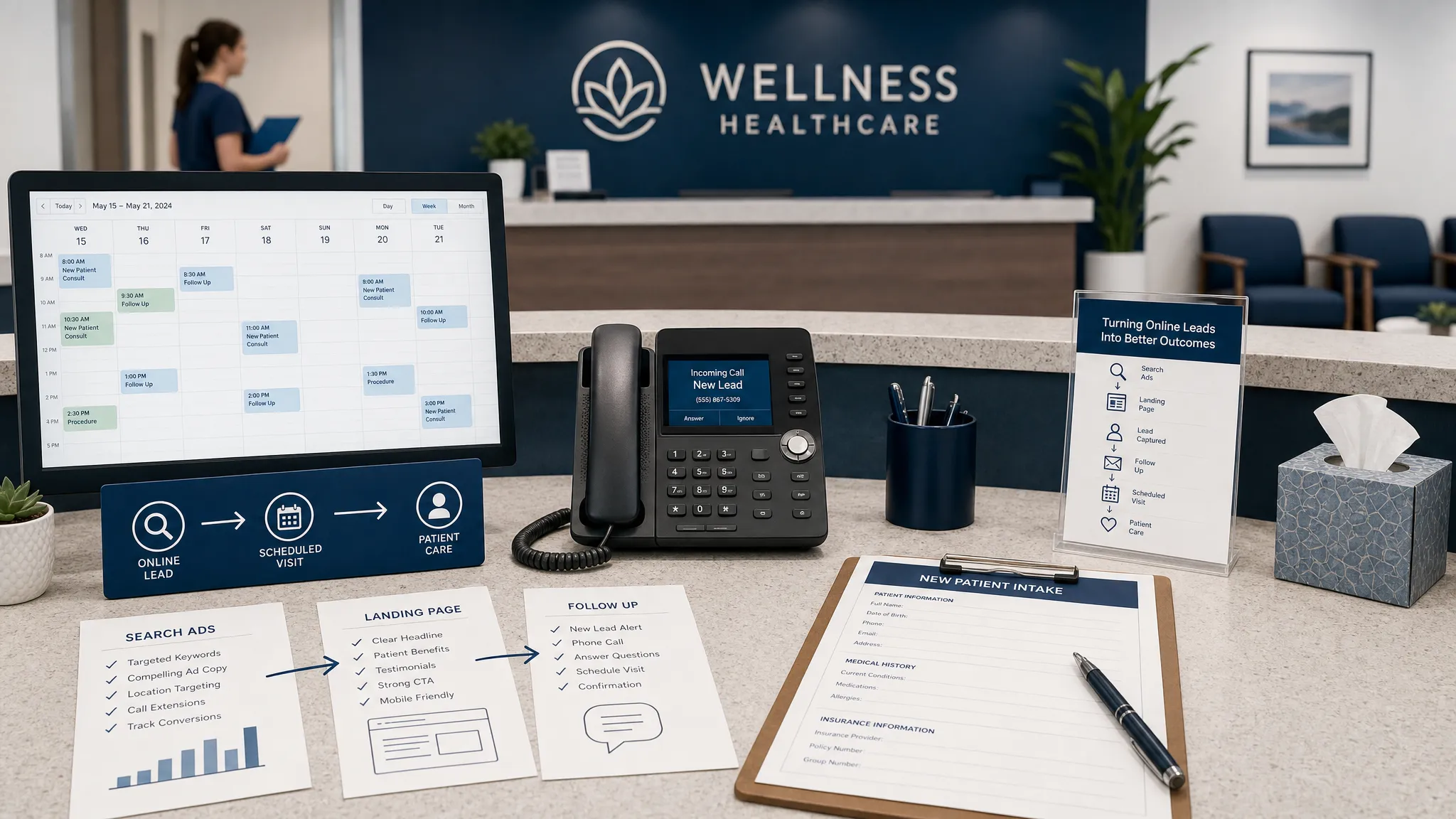
Your ad strategy should connect directly to front desk operations. Call extensions should run when someone can answer. Forms should trigger fast follow-up. Missed calls should be reviewed. Appointment requests should not sit in an inbox until the next day.
This is where paid search becomes part of a broader patient acquisition system rather than a standalone tactic. Google Ads can create demand, but your website, reviews, scheduling process, and follow-up determine how much of that demand becomes revenue.
Review Search Terms and Lead Quality Weekly
The first month of a healthcare Google Ads campaign is not set it and forget it. Review search terms weekly to identify irrelevant queries, new keyword opportunities, and patterns in lead quality. This is especially important for specialties where symptoms overlap with services you do not provide.
For example, a pain clinic may attract searches related to medication refills if the keywords are too broad. A chiropractor may attract massage searches. An optometrist may attract ophthalmology surgery queries they do not handle. A dental office may attract Medicaid, free clinic, or dental school searches if those are not aligned with the practice.
Weekly optimization should include search term cleanup, negative keyword additions, ad copy testing, location performance review, device performance review, landing page behavior, and call quality checks. Over time, the goal is to shift budget toward the terms, locations, and messages that produce qualified appointments.
Use Reviews and Reputation to Improve Conversion
Patients rarely choose a healthcare provider from an ad alone. They look at reviews, star ratings, proximity, website quality, provider bios, and whether the practice feels trustworthy. That means your Google Ads performance is influenced by assets outside the ad account.
If two practices bid on the same keyword, the one with stronger reviews, clearer service pages, and easier scheduling often converts better. This can lower the effective cost per booked appointment even if the cost per click is similar.
Reputation is especially important for high-consideration services like dental implants, cosmetic dentistry, orthodontics, LASIK, pain procedures, and regenerative medicine. Use real patient feedback ethically, keep review generation consistent, and make sure testimonials follow applicable healthcare advertising rules in your jurisdiction.
Common Setup Mistakes That Waste Healthcare Ad Spend
Most poor Google Ads outcomes come from a handful of avoidable setup problems. If your campaigns are spending but leads are weak, audit these areas first.
| Mistake | Why it hurts lead quality | Better approach |
|---|---|---|
| Sending all traffic to the homepage | Patients do not see a direct match to their search | Use service-specific landing pages |
| Using only broad keywords | Google may match loosely related searches | Start with exact and phrase match, then expand carefully |
| Tracking every click as a conversion | The algorithm optimizes for weak signals | Track meaningful calls, forms, and bookings |
| Running ads 24/7 with no call coverage | Missed calls reduce booked appointments | Align call campaigns with staffed hours |
| Ignoring negative keywords | Budget leaks into irrelevant searches | Review search terms every week |
| Targeting too wide an area | Clicks come from patients unlikely to travel | Focus on your real patient draw area |
| Making exaggerated medical claims | Creates trust and policy risks | Use accurate, patient-centered copy |
Fixing these issues can improve performance before increasing budget. More spend only helps when the foundation is working.
What a Strong First 30 Days Looks Like
The first 30 days should be treated as a controlled launch. You are not trying to prove every possible service line at once. You are trying to identify which campaigns can generate qualified conversations and where the account needs refinement.
A strong first month includes a limited number of high-intent campaigns, tightly matched landing pages, basic but accurate conversion tracking, a negative keyword process, and front desk feedback. Ask your team which calls were real opportunities. Review recordings if legally and operationally appropriate. Compare form submissions against actual appointments. Look for mismatch between what the ad promised and what the patient expected.
By the end of the first month, you should know which keywords are wasting money, which locations are producing leads, which ads are getting engagement, and whether your landing pages need changes. By months two and three, you can make better decisions about scaling, pausing, or restructuring campaigns.
Frequently Asked Questions
How long does it take Google Ads to generate healthcare leads? Some practices receive calls within days, especially for urgent services. Reliable optimization usually takes several weeks because the account needs enough click and conversion data to identify what is working.
Should healthcare practices use the homepage or landing pages for ads? Service-specific landing pages usually perform better because they match the patient’s search intent. A homepage can work for branded searches, but most non-branded service campaigns need a more focused destination.
What is the biggest mistake when setting up Google Ads for a medical or dental practice? The biggest mistake is tracking low-quality actions as conversions. If every short call or weak form fill is counted as success, the campaign may optimize toward leads that do not become patients.
Can Google Ads work for small healthcare practices? Yes, but the setup has to be focused. Smaller practices should usually start with a few high-intent services, a tight location radius, clear landing pages, and disciplined search term management.
Do healthcare Google Ads need compliance review? Often, yes. Practices should review ad claims, tracking, landing pages, and data handling with appropriate legal or compliance advisors, especially if they are subject to HIPAA or promote regulated treatments.
Turn Google Ads Into Booked Appointments
Setting up Google Ads for better healthcare leads is not just a technical task. It is a patient acquisition strategy. The account structure, keywords, ads, landing pages, tracking, and follow-up process all have to work together.
If your practice wants more qualified calls and appointment requests from search, Louisville Web Lab helps healthcare practices connect Google Ads with SEO, websites, automation, and conversion-focused patient acquisition systems. Book a diagnostic strategy call to find out where your current setup is leaking leads and what to fix first.