
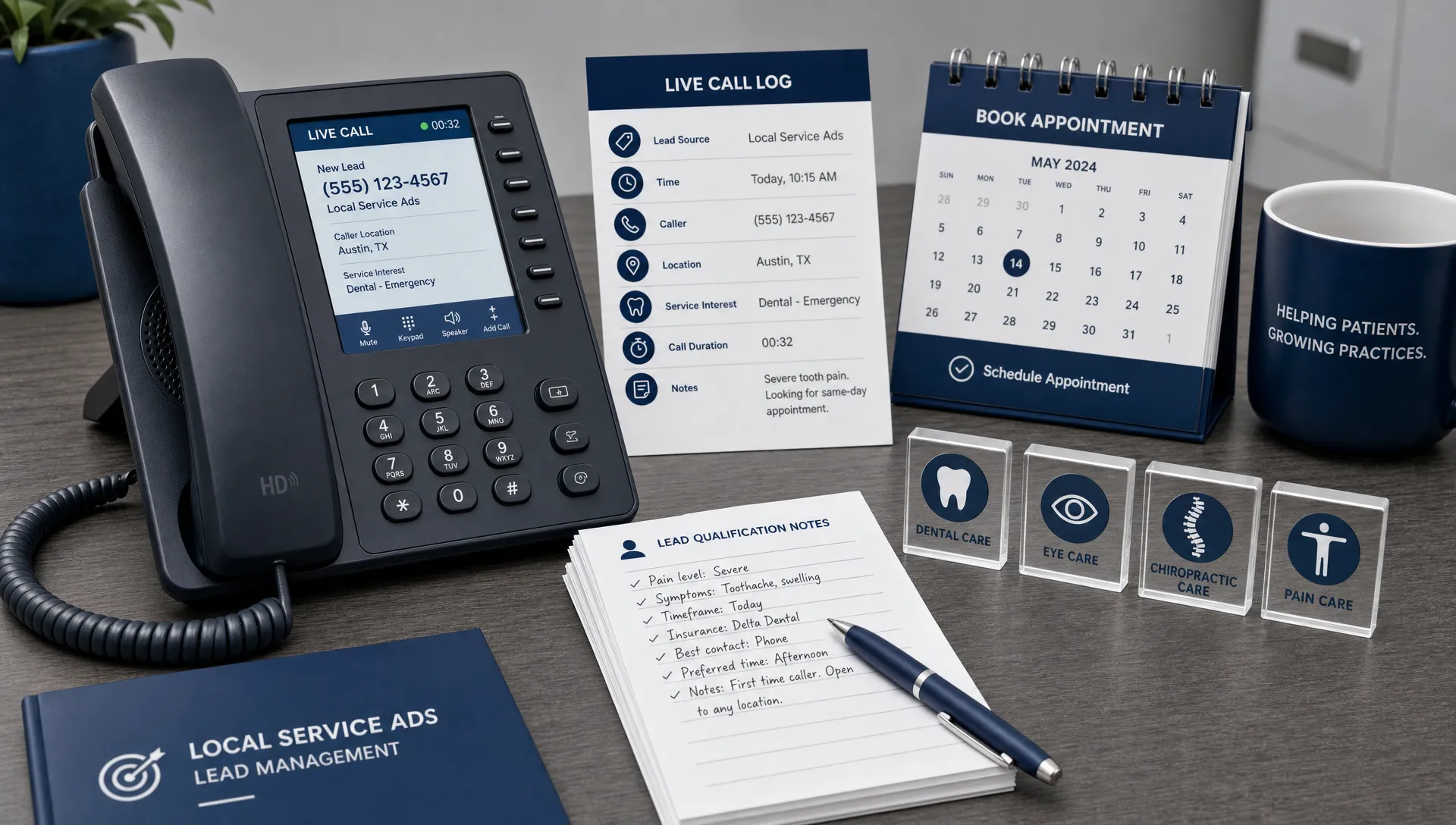
Local Service Ads sit in a tempting place: near the top of Google, close to the moment a patient is ready to call. For a healthcare practice, that can be a useful shortcut from local search intent to a phone conversation. It can also become a lead-quality problem if your practice is not ready to answer fast, filter properly and measure booked appointments.
The practical question is not whether local service ads work. It is whether they fit your specialty, economics, capacity and patient intake process.
What Local Service Ads are designed to do
Google Local Services Ads are a lead-generation ad format built around local intent. Instead of sending every searcher to a landing page first, the ad often encourages direct contact through a call, message or booking flow. You are generally paying for leads rather than clicks, although Google decides what counts as a valid lead under its current rules.
Compared with standard Google Search Ads, LSAs give practices less keyword and landing page control. They lean more heavily on business category, service area, reviews, profile details, budget and responsiveness. Depending on category and location, ads may show trust-related badges or screening status.
This structure is why LSAs can work well for healthcare practices with clear local demand and simple next steps. It is also why they can underperform for complex services that require education, insurance qualification or a longer clinical decision.
If you are deciding between the two formats, Louisville Web Lab's guide to Google Local Services vs Google Ads for local clinics offers a deeper channel comparison.
When Local Service Ads make the most sense
LSAs usually deserve a test when searchers already know what they need and are close to booking. A patient looking for an emergency dentist, chiropractor near me or eye exam near me is not browsing a long educational funnel. They want availability, trust and a fast answer.
Local Service Ads tend to fit healthcare practices with these conditions:
- High-intent, location-based searches: The service is commonly searched with city, neighborhood or near me language.
- Short path to appointment: The caller can be scheduled without a complex pre-qualification process.
- Fast intake response: Your front desk or call center can answer quickly during listed hours and return missed calls.
- Strong review profile: Ratings and review volume support patient trust in a crowded local result.
- Clear capacity: You have appointment availability for the services you are advertising.
- Known service scope: Your categories, accepted services and exclusions are not ambiguous.
This does not mean LSAs are only for urgent care or emergency dental. They can also make sense for routine but high-value local demand, such as dental implant consultations, orthodontic consults, dry eye evaluations, chiropractic exams, physical therapy assessments or pain consultations, if the category is available and your intake process can qualify patients without friction.
Best-fit examples by healthcare specialty
Every market is different, and Google category availability changes. Still, the pattern is consistent: LSAs are strongest when patients have a local problem, a clear need and a reason to act soon.
| Practice type | LSA can make sense when | Be careful when |
|---|---|---|
| Dental practices | Emergency care, new-patient exams, implants or clear aligner consults have open capacity | Insurance requirements, treatment complexity or price sensitivity need heavy screening |
| Orthodontics | Consults are easy to book and the market has strong local search volume | Parents need financing details, before-and-after proof and comparison content first |
| Optometry and eye care | Routine exams, urgent eye concerns or dry eye evaluations can be scheduled quickly | Medical eye care, surgical consults or insurance eligibility require detailed triage |
| Chiropractic and physical therapy | Same-week appointments are available for back, neck or sports injury searches | Referrals, prior authorization or payer restrictions create booking friction |
| Pain management and orthopedics | Consult requests can be screened safely and routed to the right provider | The practice attracts many poor-fit cases outside its clinical focus |
| Primary care or specialty medicine | The practice has clear new-patient availability and defined locations | Wait times are long or patients need extensive intake before scheduling |
A good rule: if a trained intake coordinator can determine whether the caller is likely to be a fit within a few minutes, LSAs are more promising. If most leads require back-and-forth, medical record review or payer research before anyone can schedule, Search Ads and SEO pages may carry the conversation better.
When Local Service Ads are probably not the right first move
Local Service Ads can look attractive because the interface feels simpler than traditional paid search. Simpler does not always mean safer for your budget.
They are usually not the best first move if your practice has weak local fundamentals. A thin review profile, inconsistent Google Business Profile information, unanswered calls or an outdated website can turn paid visibility into wasted demand. Patients still evaluate the practice before they schedule, even when the first contact starts inside Google's ad unit.
LSAs are also a poor fit when the service line needs a lot of clinical education. A patient researching regenerative medicine, complex dental implants, oral surgery, LASIK or chronic pain treatment may need more than a phone number. In those cases, a stronger landing page, provider credibility, financing information, patient FAQs and conversion tracking often matter more than being in the LSA pack.
Finally, avoid LSAs if your team cannot protect patient privacy in the lead handling process. Healthcare marketers need to think carefully about what patients might share in calls, messages and forms. Keep ad-driven intake focused on scheduling and general fit, limit unnecessary health details in marketing systems and review your process with the right compliance advisors.
The economics: a lead is not the same as a new patient
The biggest mistake practices make with local service ads is treating cost per lead as the final KPI. A lead is only valuable if it becomes a booked, attended and appropriate appointment.
For example, a campaign that produces cheap calls may still fail if half the callers are outside your service area, looking for Medicaid when you do not accept it, asking for a service you do not provide or calling after hours when no one answers. A more expensive channel can outperform LSAs if it produces better-fit patients and higher show rates.
Track the funnel in stages:
| Metric | What it tells you | Why it matters |
|---|---|---|
| Lead volume | How many calls, messages or booking inquiries came in | Shows whether the channel has enough demand to evaluate |
| Qualified lead rate | How many leads matched location, service, payer and appointment criteria | Separates activity from opportunity |
| Booking rate | How many qualified leads scheduled | Measures intake performance, not just ad performance |
| Show rate | How many scheduled patients arrived | Reveals whether leads are serious and properly confirmed |
| Cost per completed new patient | Ad spend divided by completed new-patient visits | Connects marketing spend to practice growth |
| Case value or treatment value | Revenue potential by service line over time | Helps decide whether the acquisition cost is acceptable |
For most healthcare practices, the decision should be made at the completed new-patient level. If you only optimize to lead count, Google may bring you more inquiries that are easy to generate but not profitable to serve.
What your practice needs before launching LSAs
A Local Service Ads test works best when your practice looks trustworthy before the patient calls and sounds trustworthy once the patient does call.
Start with the basics: accurate name, address, phone number, office hours, service categories, provider details and review presence. If Google requires licensing, insurance or background checks for your category, complete those steps before judging performance. Do not rush through profile setup, because LSAs rely heavily on structured information.
Your website still matters. Some patients will click through before calling, and others will search your brand after seeing the ad. They expect to find services, location details, payment information, hours, insurance guidance and a clear booking path.
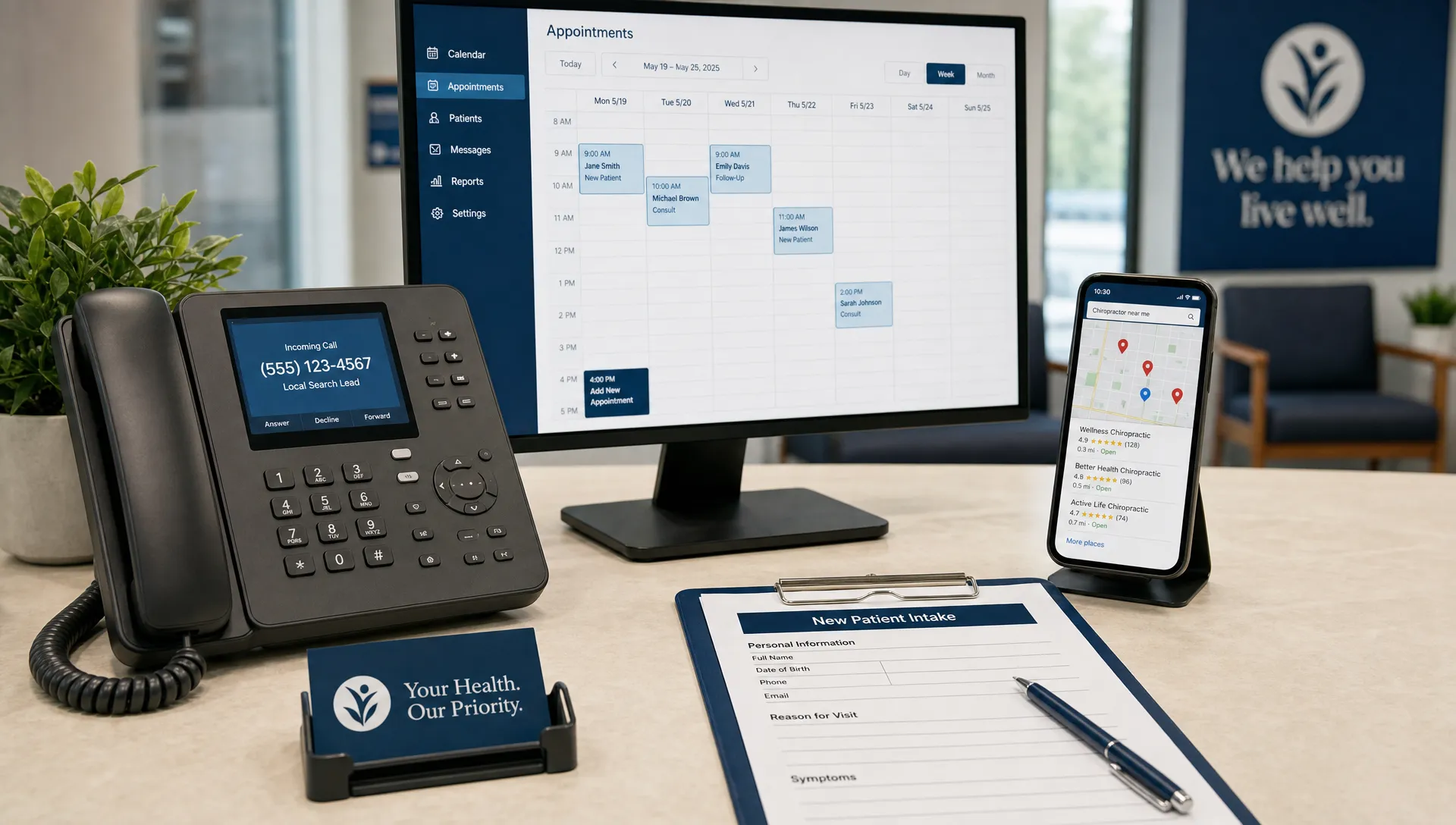
Your phone process matters even more. LSAs can place your practice in front of high-intent patients, but the channel rewards speed and clarity. Before launch, define who answers, what they say, how they qualify the caller and how quickly missed leads are returned. Use a simple intake script that confirms the service needed, location, urgency, appointment preference and basic payer fit without inviting unnecessary clinical detail.
How Local Service Ads fit with Search Ads, SEO and your website
LSAs should not replace your broader patient acquisition system. They are one demand-capture channel, not a complete strategy.
Search Ads are usually better when you need precise keyword control, tailored landing pages, detailed conversion tracking or segmented campaigns by treatment, location and payer. If your practice is advertising dental implants, LASIK, spine injections or high-value orthopedic services, standard search campaigns often give you more room to educate and qualify the patient before the call. Louisville Web Lab's article on Google Search Ads for healthcare practices explains how that setup should work when lead quality matters more than raw click volume.
SEO and Google Business Profile work support LSAs too. Strong local rankings, complete service pages and consistent review generation make patients more comfortable after they see your ad. In competitive markets, a patient may see your practice in an LSA, the map pack and organic results during the same decision. That repeated visibility can improve trust, but only if the message is consistent.
For growing practices, the real goal is not to choose one tactic forever. It is to build a system where SEO, paid search, Local Service Ads, website conversion and follow-up each play a clear role.
A practical decision framework
If you are unsure whether Local Service Ads make sense, use a short test-readiness scorecard before spending. You do not need a perfect score, but you do need enough operational strength to give the channel a fair evaluation.
| Question | If yes | If no |
|---|---|---|
| Is your specialty or service eligible in your market? | Continue setup and confirm category fit | Consider Search Ads, SEO or GBP optimization first |
| Do you have new-patient capacity within the next few days or weeks? | LSAs can capture immediate demand | Paid leads may become frustrated if scheduling is delayed |
| Can your team answer or return calls quickly? | Lead value is more likely to convert | Fix intake before adding call volume |
| Are your reviews competitive locally? | Your ad has stronger trust signals | Build review systems before scaling spend |
| Can you define a qualified lead clearly? | You can judge performance accurately | Expect noisy reporting and wasted follow-up |
| Do you know your cost per completed new patient? | You can evaluate ROI | Start tracking before expanding budget |
| Is your website credible and conversion-ready? | Patients have reassurance after seeing the ad | Paid visibility may expose weak positioning |
A reasonable test should have a defined budget, a defined service line and a defined evaluation window. Do not launch LSAs across every possible category at once. Start with one or two services where demand, capacity and value are clear. Review lead quality weekly, listen to call outcomes where your compliance process allows it and compare booked appointments against spend.
Common Local Service Ads mistakes healthcare practices should avoid
The most common mistake is overbroad targeting. If your profile implies that you provide services you do not truly want to promote, your front desk will spend time rejecting poor-fit leads. Service category discipline matters.
Another mistake is ignoring office hours and response behavior. A campaign can generate good leads and still fail if callers reach voicemail. If your highest-value leads come during lunch, evenings or weekends, adjust staffing, call routing or campaign expectations before blaming the ad format.
Practices also underestimate the role of reviews. Local Service Ads often appear in a trust-heavy environment where patients compare ratings, years in business, location and response options quickly. A practice with excellent clinical care but weak review generation may lose to competitors before anyone speaks to the front desk.
Finally, many practices fail to connect LSA data to appointment data. Google can tell you about leads. Your practice management system, call notes or CRM needs to tell you whether those leads became patients. Without that connection, budget decisions become guesswork.
So, when should a healthcare practice say yes?
Say yes to Local Service Ads when your practice has a clear local service, available appointments, strong reviews, fast intake and a way to measure booked patients. In that environment, LSAs can be a useful source of high-intent demand, especially for services where patients are ready to call now.
Say not yet when your practice needs better reviews, clearer service pages, stronger tracking or a more reliable phone process. Fixing those pieces first usually improves every channel, including LSAs.
Say no, at least for now, when your service requires substantial education, eligibility screening or clinical review before booking. In that case, standard Search Ads, SEO content, referral relationships and landing pages may support the patient's decision more effectively.
Frequently Asked Questions
Are Local Service Ads available for every healthcare specialty? No. Availability depends on Google's current categories, your location and the verification requirements for your business type. Before planning a campaign, confirm eligibility directly in the Local Services Ads setup flow.
Do Local Service Ads replace Google Search Ads? Usually no. LSAs are useful for direct local inquiries, while Search Ads offer more control over keywords, landing pages, ad copy and conversion tracking. Many practices test both, then allocate budget based on completed new patients.
How should a healthcare practice measure LSA performance? Measure cost per qualified lead, booking rate, show rate and cost per completed new patient. Lead volume alone is not enough because many inquiries may not match your services, location, insurance mix or appointment availability.
Are Local Service Ads safe for HIPAA-regulated practices? They can be used carefully, but your intake process must limit unnecessary health information in marketing channels. Keep lead handling focused on scheduling and general fit, then review privacy, call recording, messaging and data storage practices with qualified compliance advisors.
What budget should a practice start with? Start with a controlled test budget that can generate enough leads to judge quality without pressuring your team to accept poor-fit patients. The exact amount depends on specialty, market competition, service value and appointment capacity.
Want to know if Local Service Ads fit your practice?
Louisville Web Lab helps healthcare practices evaluate where paid search, local SEO, website conversion and patient automation should fit in the growth plan. If you are considering Local Service Ads, the best next step is not simply turning them on. It is diagnosing whether your market, service lines, intake process and tracking can turn paid visibility into booked patients.
You can book a diagnostic call with Louisville Web Lab to review your current patient acquisition system and identify the channels most likely to produce measurable growth.