
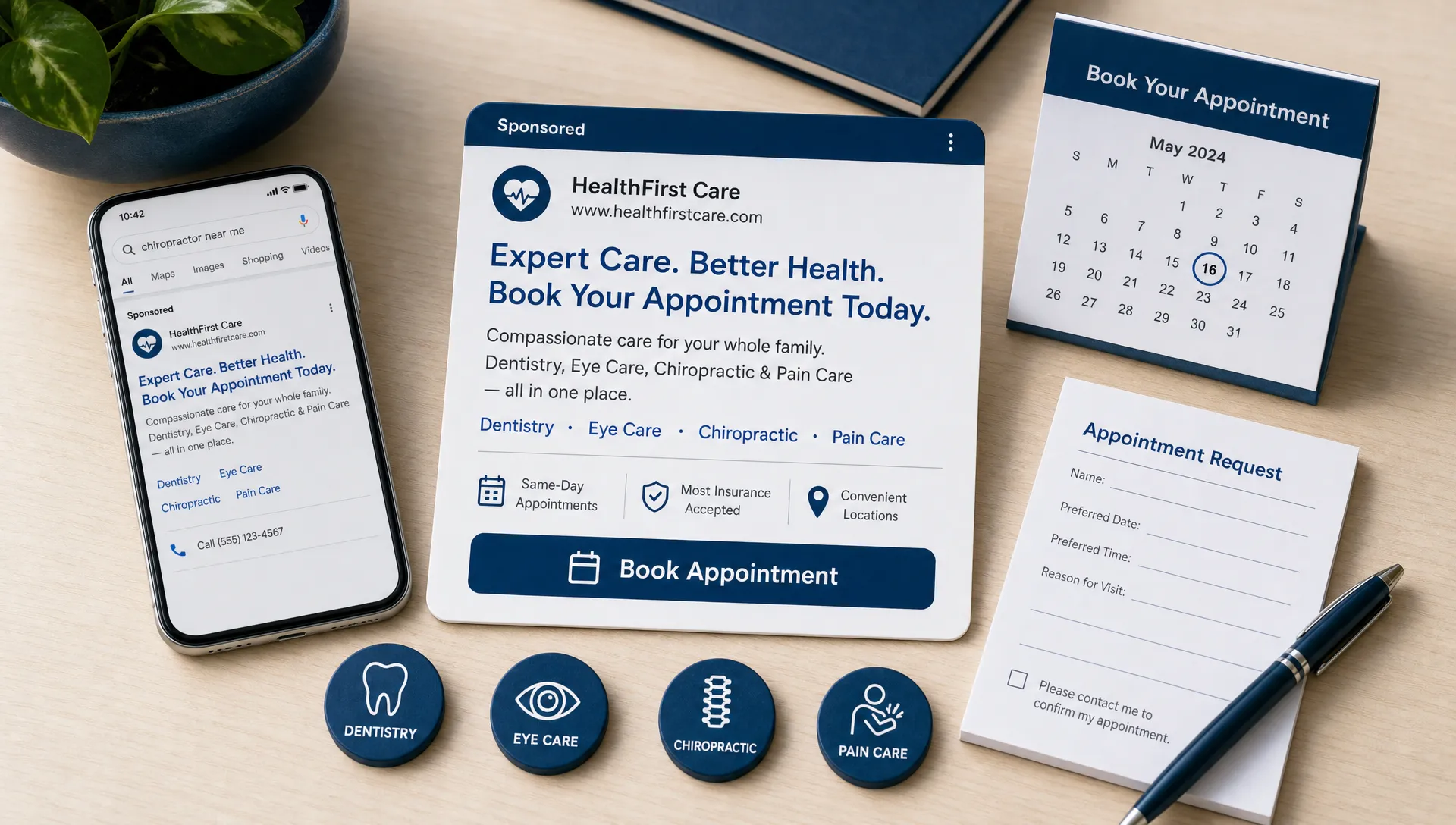
Google Ads is not one single channel. For a healthcare practice, it is a menu of campaign types, each with a different job: capturing urgent searches, staying visible during longer treatment decisions, building local trust or reconnecting with people who already visited your site.
That distinction matters. A dental implant campaign should not be built the same way as a pediatric dental awareness campaign. A pain management clinic promoting same-week consultations needs a different ad mix than an ophthalmology practice educating patients about cataract surgery. Choosing the right types of Google Ads helps you match the patient journey instead of paying for clicks that never turn into appointments.
Below are six Google Ads types healthcare practices can use, with practical guidance on when each makes sense, where it can waste budget and how to think about compliance.
Before choosing ad types, start with patient intent
Healthcare searches vary widely in urgency. Someone searching “emergency dentist near me” may be ready to call now. Someone watching videos about Invisalign may be months away from scheduling. Someone comparing “LASIK cost” may need reassurance, financing information and a strong consultation offer before converting.
The best Google Ads strategy usually combines a few campaign types around intent:
| Patient intent | Example search or behavior | Best-fit Google Ads types |
|---|---|---|
| High intent, ready to book | “chiropractor near me,” “dentist accepting new patients” | Search Ads, Local Services Ads, call-focused campaigns |
| Treatment research | “dental implants cost,” “cataract surgery recovery” | Search Ads, YouTube Ads, Performance Max |
| Local comparison | Looking at providers, reviews and maps | Search Ads, Local Services Ads, Performance Max |
| Awareness or education | Watching videos, browsing health content | YouTube Ads, Display Ads, Demand Gen |
| Re-engagement | Returned site visits, unfinished forms | Remarketing where policy-compliant |
Google also has strict advertising rules for healthcare. Its Healthcare and medicines policy and Personalized advertising policy restrict certain claims, targeting methods and sensitive health-based personalization. Practices should treat compliance as part of campaign strategy, not an afterthought.
1. Google Search Ads
Google Search Ads are the most direct option for practices that want appointment-ready traffic. These are the text ads that appear when someone searches on Google for a provider, symptom, service or treatment.
For most healthcare practices, Search Ads should be the foundation of paid acquisition because they capture existing demand. You are not trying to convince someone they need an orthodontist, optometrist or pain physician from scratch. You are appearing when they are already looking.
Search Ads work especially well for:
- General dentists seeking new patient exams
- Orthodontists promoting braces or Invisalign consultations
- Optometrists competing for eye exams
- Chiropractors targeting local pain-related searches
- Pain clinics promoting consultations for specific conditions
- Oral surgeons, implant dentists, LASIK centers and other high-value specialties
The key is separating high-intent searches from low-intent research. “Dental implants near me” and “dental implants pros and cons” are not equal. Both may have value, but they deserve different bids, landing pages and follow-up expectations.
A strong healthcare Search campaign usually includes tightly grouped keywords, local targeting, negative keywords, ad copy that reflects the actual service and landing pages built for conversion. Louisville Web Lab goes deeper into this channel in its guide to Google Search Ads for healthcare practices, including how practices can reduce wasted spend and track booked appointments instead of clicks alone.
The biggest mistake is treating all search terms like they have the same value. A broad campaign can quickly spend money on vague, educational or irrelevant searches. In healthcare, that problem gets expensive because cost per click can be high in competitive specialties.
2. Local Services Ads
Local Services Ads, often called LSAs, appear near the top of Google for certain local service searches. Instead of sending people to a typical landing page first, LSAs are designed around direct calls, messages and trust signals such as reviews and verification.
For eligible healthcare categories and markets, Local Services Ads can be useful because they align with how patients choose local providers. Patients want to know whether the practice serves their area, has strong reviews and can help with their specific need. LSAs compress that decision into a local listing-style ad.
They can be especially useful for appointment types where the patient wants to act quickly, such as urgent dental needs, chiropractic care or local eye exams. They may also support practices that already have strong Google review profiles.
That said, LSAs are not available for every healthcare specialty in every location, and eligibility requirements can change. Google explains category availability and screening requirements in its Local Services Ads help documentation. Practices should confirm eligibility before building a patient acquisition plan around them.
LSAs are best viewed as a supplement to Search Ads, not a replacement. Search Ads give you more control over keywords, landing pages, messaging and conversion tracking. Local Services Ads can add visibility at the top of local results, especially when the practice has strong review signals.
3. Google Display Ads
Google Display Ads are visual ads that appear across websites, apps and Google-owned inventory. They are not usually the best choice for capturing ready-to-book patients, but they can support awareness and re-engagement when used carefully.
Display Ads can work for healthcare practices when the goal is visibility around a local brand, a new location, a specific service line or a longer-consideration treatment. For example, an orthodontic practice might use display to stay visible to parents researching treatment options. A LASIK practice might use it to build awareness before driving users back through Search Ads. A physical therapy clinic might promote a new location to people in a defined local area.
The problem is that Display can generate cheap clicks that do not convert. Low cost per click does not mean low cost per patient. Many display clicks come from people casually browsing, not people actively looking for care.
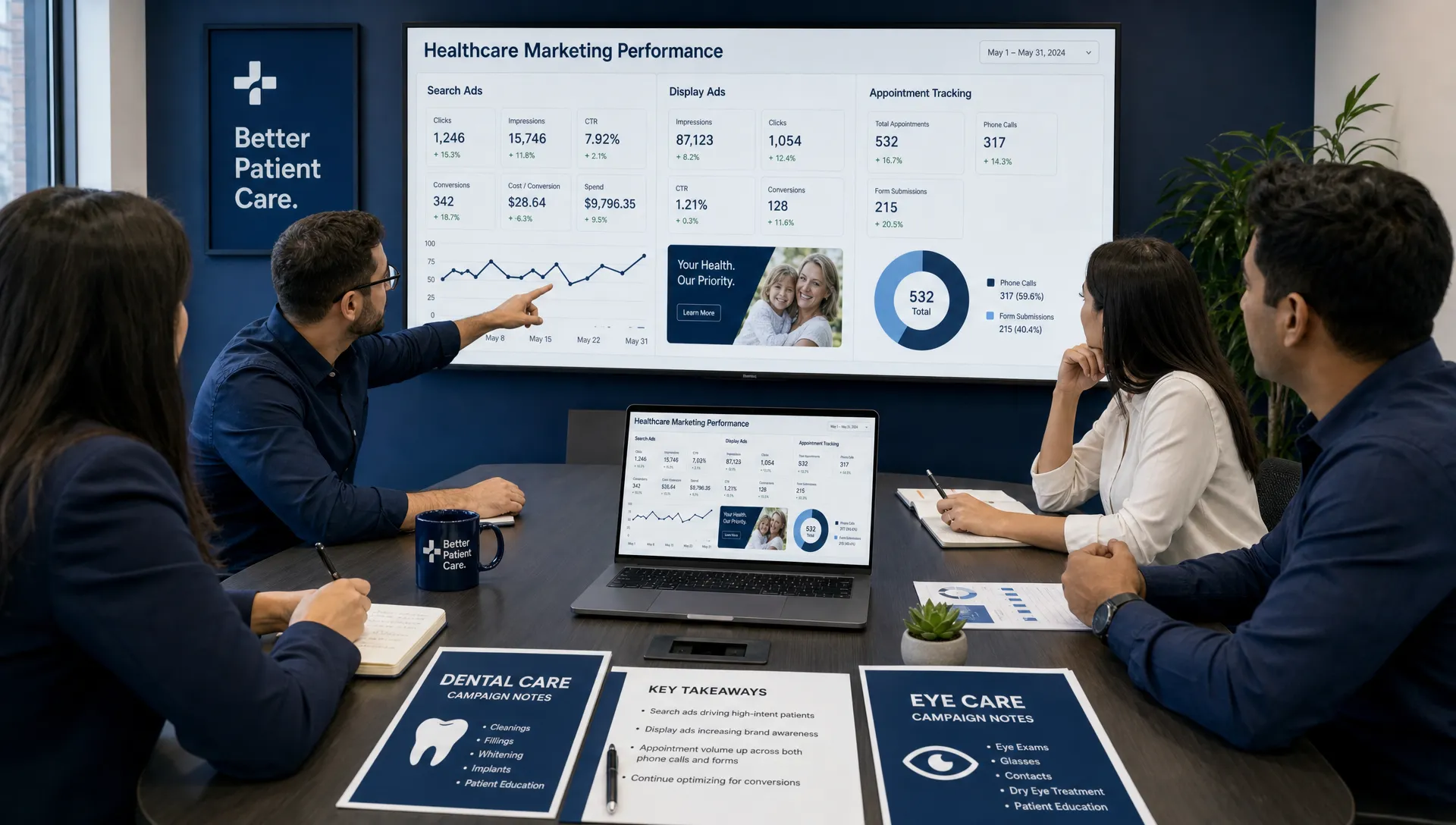
For healthcare practices, Display Ads should be judged by assisted value, not just direct form fills. Did branded search volume increase? Did more people return to the site? Did the campaign support a larger launch or seasonal push? Without that context, Display often looks either better or worse than it really is.
Privacy and policy rules matter here. Healthcare advertisers must be cautious with remarketing audiences, sensitive health categories and ad copy that implies knowledge of a user’s condition. For a deeper look at when this channel is worth using, see Louisville Web Lab’s article on Google Display Ads for healthcare.
4. YouTube Ads
YouTube Ads can help healthcare practices educate patients before they are ready to schedule. This is particularly useful for procedures or treatments that involve anxiety, comparison shopping or a higher financial commitment.
Good healthcare YouTube campaigns are not just commercials. They answer real patient questions in a calm, credible way. A dentist might explain what to expect during a dental implant consultation. An ophthalmology practice might address common cataract surgery concerns. A chiropractor or physical therapy clinic might clarify when pain should be evaluated by a professional.
YouTube can support:
- Cosmetic dentistry and orthodontic treatment education
- LASIK, cataract and dry eye awareness
- Dental implant and oral surgery decision-making
- Pain management, sports medicine and physical therapy education
- New provider introductions or practice brand building
The main advantage is trust. Patients often delay care because they do not understand the treatment, fear discomfort, worry about cost or feel unsure which provider to choose. A short, useful video can reduce friction before the person ever reaches the website.
The main limitation is intent. Someone watching a video may not be ready to book today. YouTube works best when it is connected to a larger funnel: educational video, relevant landing page, search retargeting where allowed, strong follow-up and clear appointment paths.
Practices should also avoid overpromising outcomes. Healthcare video ads should be accurate, professional and aligned with Google policies as well as any applicable clinical advertising rules in the practice’s state or specialty.
5. Performance Max campaigns
Performance Max is a goal-based campaign type that can show ads across multiple Google channels, including Search, Maps, YouTube, Display, Gmail and Discover. Instead of managing each placement separately, advertisers provide assets, audience signals and conversion goals while Google’s automation allocates delivery.
For healthcare practices, Performance Max can be useful, but only when the account has solid conversion tracking and enough strategic direction. If the campaign is optimized for weak actions, such as page views or low-quality form submissions, it may chase volume instead of appointments.
Performance Max can make sense when a practice wants broad local visibility for a defined service line, has strong creative assets and can track meaningful conversions. It may support multi-location dental groups, specialty practices with high-value procedures or clinics that already have mature Search campaigns.
The challenge is transparency. Performance Max can blend placements and queries in ways that are harder to control than traditional Search campaigns. That does not make it bad, but it does mean healthcare advertisers need careful guardrails.
Use Performance Max when:
- The practice has clear service-line goals
- Conversion tracking is tied to calls, forms or booked appointment actions
- Search campaigns are already capturing obvious high-intent demand
- The website and landing pages are strong enough to convert mixed traffic
- The account has a clean negative keyword and brand strategy where available
Avoid using it as a shortcut for poor campaign structure. Automation can amplify a good strategy, but it cannot fix unclear offers, weak landing pages or unreliable tracking.
6. Demand Gen and Discovery-style campaigns
Demand Gen campaigns are designed to reach people across visually driven Google placements such as YouTube, Discover and Gmail. For healthcare practices, this type of campaign is usually better for awareness, education and early-stage demand than for immediate appointment capture.
These campaigns can be useful when a practice needs to create demand for elective, specialty or higher-consideration services. Cosmetic dentistry, orthodontics, LASIK, dry eye treatment, regenerative medicine and some physical therapy programs may fit this category. The patient may not be typing “book consultation today,” but they may be open to learning about an option that solves a real problem.
Creative quality matters more here than in standard Search Ads. The campaign needs strong visuals, patient-friendly messaging and a clear next step. A generic “schedule today” ad may underperform if the audience still needs education. A better approach might offer a consultation, guide, quiz or condition-specific landing page, depending on what is appropriate for the practice.
Demand Gen should not replace Search Ads for core patient acquisition. It is better used to expand reach once the practice has a reliable conversion system in place.
How to choose the right Google Ads mix for your practice
The right mix depends on specialty, market competition, budget, patient value and how fast the practice needs results. A new pediatric dentist in a suburban market may need local Search and reputation-focused campaigns first. An established implant practice may need Search, YouTube and Performance Max to support a longer patient journey. A pain clinic with multiple service lines may need separate campaigns for different conditions, each with its own landing page and tracking.
A simple way to prioritize is to start closest to the appointment and work outward.
| Priority | Campaign type | Why it comes first or later |
|---|---|---|
| First | Search Ads | Captures patients actively looking for care |
| First or second | Local Services Ads | Can add high-visibility local calls if eligible |
| Second | Performance Max | Expands reach when tracking and landing pages are strong |
| Second or third | YouTube Ads | Builds trust for higher-consideration services |
| Third | Display Ads | Supports awareness or compliant re-engagement |
| Third | Demand Gen | Creates demand for elective or specialty services |
Budget also matters. Search should usually get the first serious investment because it is closest to patient intent. Broader channels need enough budget to learn, test creative and support the overall funnel. If you are still trying to estimate the investment required, Louisville Web Lab’s breakdown of Google Ads cost for healthcare practices in 2026 can help frame budget expectations by specialty and competition level.
What every healthcare Google Ads campaign needs
No campaign type can compensate for a weak patient journey. Whether a practice uses Search, YouTube, Display or Performance Max, the fundamentals stay the same.
A high-performing healthcare campaign needs relevant targeting, compliant ad copy, a landing page that matches the patient’s intent, fast load speed, clear calls to action, trustworthy provider information and reliable conversion tracking. Calls should be tracked when possible, forms should be simple and front desk follow-up should be part of the system.
The most useful metric is not clicks. It is not impressions. It is not even raw leads. The real question is how many qualified patient opportunities became booked appointments and how many of those appointments turned into revenue for the practice.
That is where many campaigns break down. Google Ads may generate interest, but if calls are missed, forms sit unanswered or landing pages fail to address patient concerns, the practice pays for demand it never captures.
Frequently Asked Questions
What are the main types of Google Ads healthcare practices can use? The main types include Search Ads, Local Services Ads, Display Ads, YouTube Ads, Performance Max and Demand Gen campaigns. Some practices may also use call-focused formats or remarketing when allowed by Google policy.
Which type of Google Ads is best for healthcare leads? Search Ads are usually the best starting point because they reach people actively looking for care. Local Services Ads can also work well for eligible practices with strong reviews and fast phone response.
Are Display Ads good for doctors, dentists or chiropractors? Display Ads can work for awareness, local visibility and compliant re-engagement, but they are rarely the strongest direct lead source. They should be measured as part of the broader patient journey.
Can healthcare practices use remarketing in Google Ads? Sometimes, but healthcare advertisers must be careful. Google restricts personalized advertising based on sensitive health interests, conditions and treatments. Practices should review policy requirements before using remarketing audiences.
Should a small practice use Performance Max? Performance Max can help some small practices, but it should not be the first campaign if tracking, landing pages and Search campaigns are not in good shape. It works best when there are clear conversion goals and enough data for optimization.
Build a Google Ads strategy around booked appointments
The best type of Google Ads is the one that matches how your patients actually make decisions. For most healthcare practices, that means starting with high-intent Search, adding local visibility where it fits and using broader campaign types only when they support a measurable patient acquisition system.
Louisville Web Lab helps healthcare practices turn search visibility into qualified leads, booked appointments and measurable growth through SEO, Google Ads, websites and automation. If you want a clearer plan for which Google Ads types fit your practice, book a diagnostic strategy call with Louisville Web Lab.