
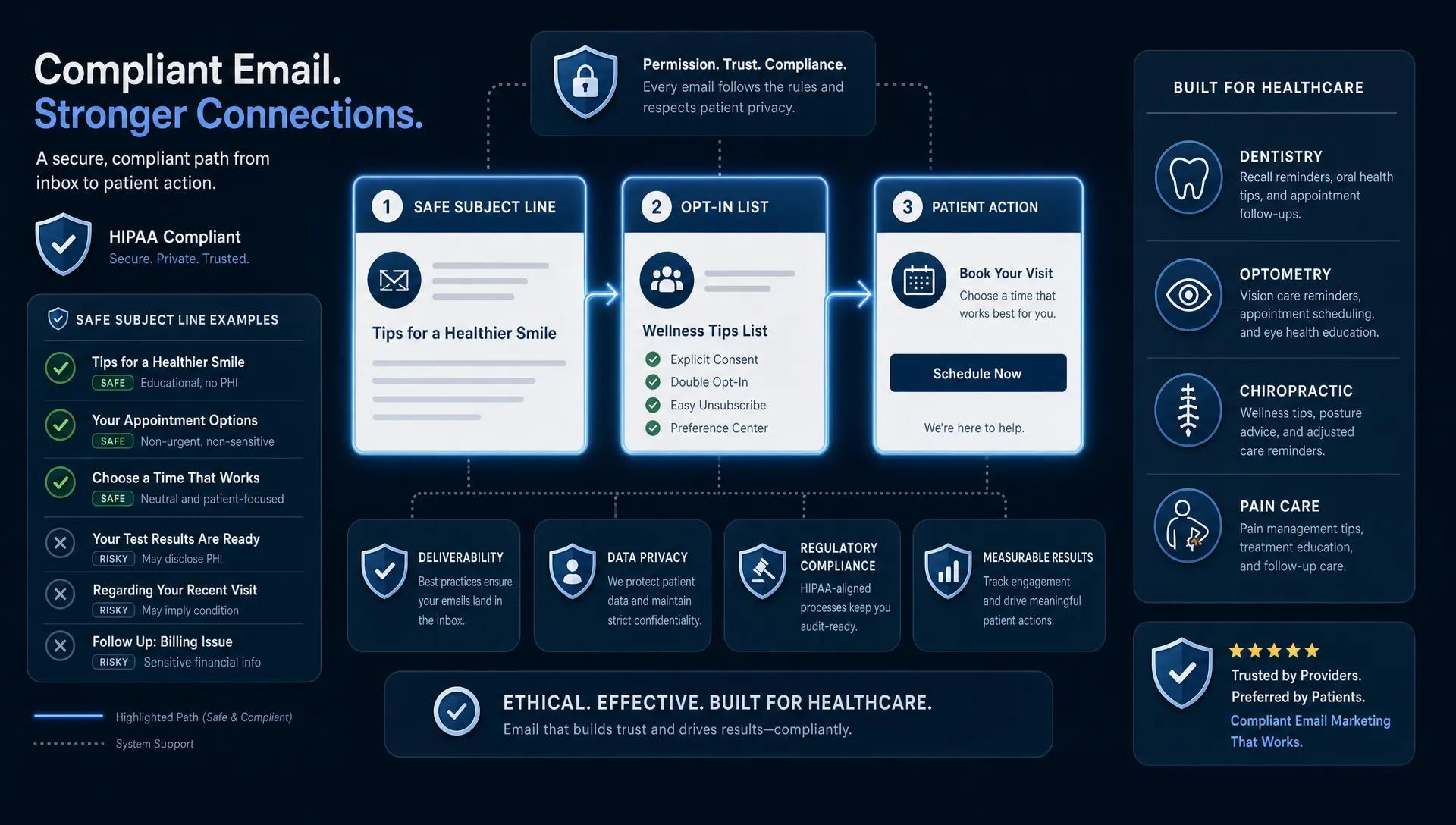
Email remains one of the most useful patient communication channels for healthcare practices, but it is also one of the easiest places to make privacy mistakes. A dental office can use email to reactivate overdue hygiene patients. An optometry clinic can remind patients about annual eye exams. A physical therapy practice can educate patients after an inquiry. A pain management clinic can nurture prospective patients who are not ready to call yet.
The challenge is that healthcare email is not ordinary ecommerce email. Once patient information, appointment history, diagnosis, treatment interests, or protected health information enter the campaign, HIPAA considerations come with it.
This is why the right goal is not simply more emails. The goal is a HIPAA-aware email marketing plan that helps your practice grow while reducing unnecessary privacy risk. This article is educational and should not replace legal advice, but it will give practice owners, administrators, and marketing teams a practical framework to discuss with their compliance officer, attorney, and vendors.
What HIPAA-aware email marketing means
HIPAA-aware email marketing means your practice designs campaigns with privacy, consent, data minimization, and vendor controls in mind from the start. It does not mean every email must be bland, generic, or ineffective. It means the campaign should avoid exposing patient data unnecessarily, and when protected health information may be involved, the practice should understand the compliance implications before hitting send.
The U.S. Department of Health and Human Services explains HIPAA marketing rules, including how certain communications that encourage the use of a product or service can be considered marketing and may require individual authorization unless an exception applies. In practice, this means healthcare teams should distinguish between treatment-related communications, general educational content, appointment reminders, practice updates, and promotional campaigns.
A HIPAA-aware plan asks questions like these before the campaign is built:
- Are we using patient data to decide who receives this email?
- Does the email reveal a condition, treatment, appointment, or patient relationship?
- Is the message educational, operational, or promotional?
- Are we using a vendor that may handle PHI?
- Do we have the right authorization, consent, unsubscribe process, and documentation?
The safest email marketing plans are not built around one giant patient list. They are built around clear use cases, limited data, strong permissions, and content that supports the patient journey without oversharing.
Start with the business goal, not the email tool
Many practices begin by choosing an email platform. That is backward. The first step is deciding what the email program should accomplish.
A general dentist may want to reduce hygiene gaps. An orthodontist may want to educate parents comparing clear aligners and braces. An ophthalmology group may want to explain cataract consultation steps. A chiropractor may want to follow up with new patient inquiries who did not book. A physical therapy clinic may want to keep discharged patients engaged so they return when a new issue appears.
Each of these goals needs a different type of message, data, timing, and compliance review. When email is part of a broader growth system, it should connect with your website, local SEO, Google Ads, reviews, and front desk follow-up. If your practice is still building that foundation, Louisville Web Lab's guide to patient acquisition strategies for growing healthcare practices is a useful companion to this email plan.
For most healthcare practices, email should support four core outcomes:
- Convert more inquiries into scheduled appointments
- Help existing patients stay on track with care
- Educate patients about services in a compliant, low-pressure way
- Improve retention, reviews, and long-term trust
Once the business goal is clear, you can decide what data is necessary. In a healthcare setting, the best data strategy is often the smallest data strategy that still gets the job done.
Define safe campaign categories
Not all healthcare emails carry the same risk. A monthly practice newsletter about oral health tips is very different from an email that references a patient's diagnosis, procedure, treatment plan, or appointment status.
Use a simple campaign map before writing copy. This helps your marketing team, compliance lead, and front desk understand what each campaign is allowed to say.
| Campaign type | Common goal | HIPAA-aware approach | Relative privacy risk |
|---|---|---|---|
| General education newsletter | Stay top of mind and build trust | Use broad topics that do not imply the recipient has a condition | Lower |
| Appointment reminder or recall | Encourage scheduling or follow-up | Use approved systems and minimal details where possible | Moderate |
| Inquiry nurture sequence | Convert leads who requested information | Base emails on the form submission and avoid sensitive specifics in subject lines | Moderate |
| Service awareness campaign | Promote services like implants, LASIK, or physical therapy | Send broad educational content unless authorization and data rules support more targeted messaging | Moderate to higher |
| Post-visit care instructions | Support treatment or recovery | Use secure workflows approved by the practice and compliance team | Higher |
| Review request | Build reputation after a visit | Avoid mentioning diagnosis, treatment, or procedure in the message | Moderate |
This table is not a legal classification. It is a planning tool. Your actual rules depend on your practice type, vendor setup, patient permissions, and legal guidance.
Build your list with permission and clarity
A healthy healthcare email list starts with clear expectations. Patients and prospects should understand what they are signing up for and how to opt out.
For website forms, avoid vague language like, Sign up for updates, if the follow-up will include promotional content. Instead, use plain language that describes the type of communication. For example, a dental implant page might invite visitors to receive educational information about consultation steps, financing questions, and treatment planning. An optometry practice might invite patients to receive eye health tips and practice updates.
For existing patients, work with your compliance advisor to determine what types of communications are permitted, what requires authorization, and how opt-outs should be honored. Also remember that general commercial email rules may apply. The FTC's CAN-SPAM Act compliance guide explains requirements for commercial email, including accurate header information, non-deceptive subject lines, identification of the message as an ad when applicable, and a clear opt-out mechanism.
A strong list-building process should include:
- A clear signup source, such as website form, patient portal, intake form, event, or phone request
- A recorded permission or authorization status where appropriate
- Separate categories for patients, prospects, referring providers, and community contacts
- A way to honor unsubscribes promptly
- A process for correcting email addresses and removing inactive contacts
For healthcare email marketing services in Louisville, KY, this is where local strategy and compliance awareness need to meet. A campaign should feel relevant to the local patient population, but relevance should never come from careless use of sensitive data.
Keep PHI out of subject lines whenever possible
Subject lines and preview text are high-risk areas because they may appear on lock screens, shared computers, tablets, or workplace inboxes. Even if the email body is carefully written, a revealing subject line can create avoidable exposure.
Compare these examples:
| Riskier subject line | Safer alternative |
|---|---|
| Your periodontal disease treatment plan | Information from our dental team |
| Schedule your back pain injection follow-up | A follow-up note from our office |
| Cataract surgery instructions for next week | Important information for your upcoming visit |
| Your Invisalign payment options | Information about your consultation options |
Safer does not have to mean useless. The goal is to preserve context without broadcasting sensitive details. The email body can direct the patient to call the office, log in to a secure portal, or review information through an approved channel when details are sensitive.
Segment without overexposing
Segmentation is one of the biggest advantages of email marketing, but it is also where healthcare practices can create risk. In retail marketing, a business might segment based on abandoned carts, product views, or past purchases. In healthcare, similar behavior-based tactics can be problematic if they reveal a patient's condition or treatment interest.
The safer strategy is to segment by non-sensitive or lower-risk categories whenever possible. Examples include location, language preference, new patient status, inquiry date, referral source, or general interest selected by the user on a form. If your practice wants to segment by treatment category, diagnosis, procedure, or appointment history, involve your compliance advisor and make sure your systems, permissions, and vendor agreements support that use.
Some practices also sell or distribute physical products, such as contact-lens supplies, post-procedure care kits, skincare, orthotics, or wellness products. If email campaigns promote those items, keep fulfillment data separate from clinical records wherever possible.
Choose vendors with healthcare workflows in mind
Your email platform, CRM, website forms, call tracking tools, analytics setup, and automation software can all touch patient information. That means vendor selection is not just a marketing decision. It is also a privacy and operations decision.
Before launching healthcare email campaigns, document the flow of information from the first website visit to the appointment request, intake process, email follow-up, and reporting dashboard. This helps your team identify where PHI may be collected, stored, transmitted, or exported.
Ask vendors direct questions:
- Do you sign a business associate agreement when required?
- What data is stored in the platform?
- Can we control what fields sync into email campaigns?
- How are unsubscribes, permissions, and audit trails handled?
- Who on your team can access patient or lead data?
- How long is data retained, and how can it be deleted?
A polished email template is not enough. The underlying data process must be defensible.
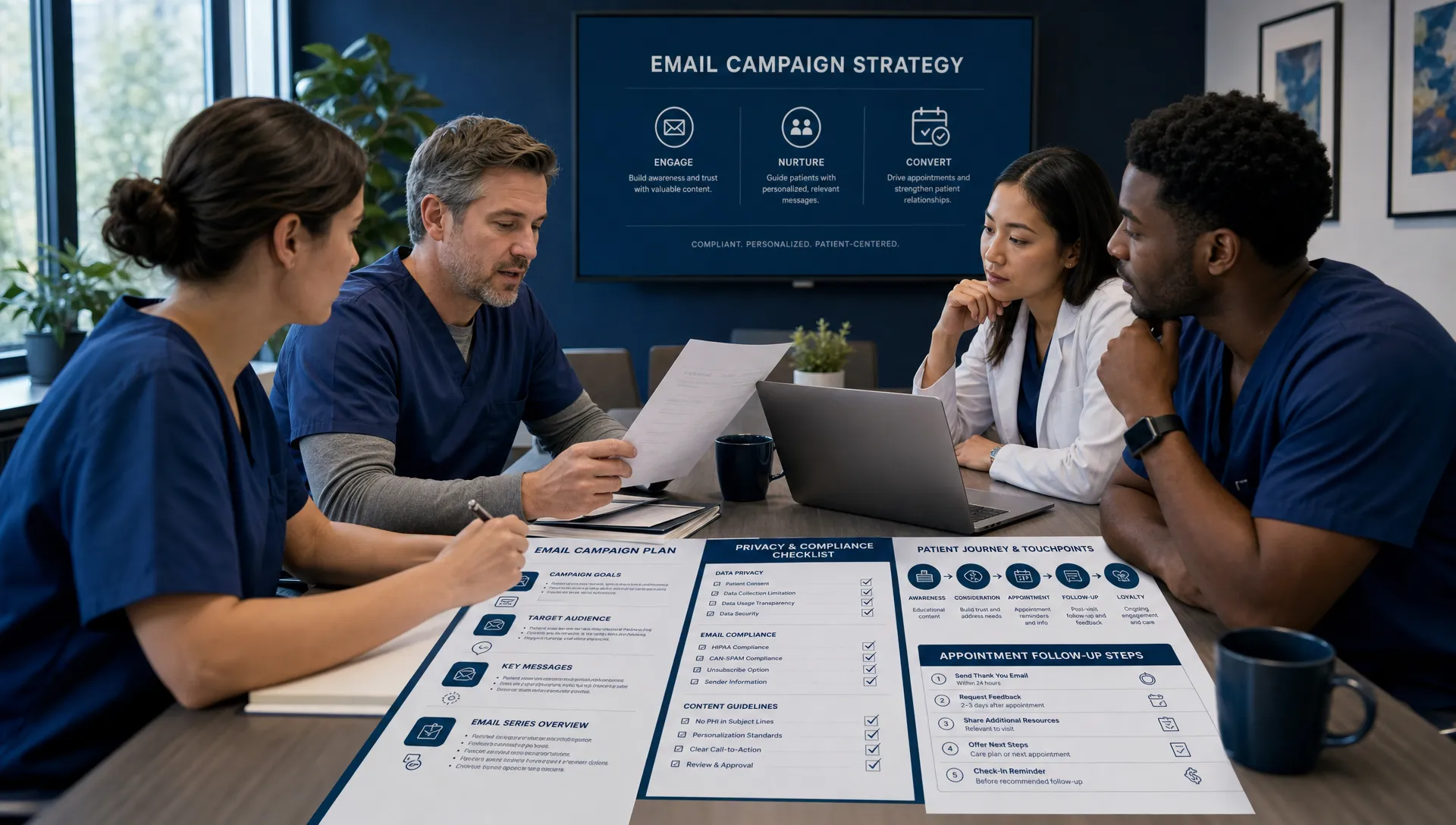
Create a simple email plan for the patient journey
A good healthcare email program does not need dozens of complicated automations. Start with the stages where patients need help making a decision or staying on track.
New inquiry follow-up
When someone completes a form on a service page, they may not be ready to schedule immediately. A short email sequence can help them understand next steps, what to expect at the consultation, accepted appointment types, and how to contact the office.
Keep the content tied to the information the person requested. Avoid adding sensitive assumptions. For example, if someone downloads a general guide about dental implants, do not write as if they have already been diagnosed as a candidate. Use language like, If you are exploring tooth replacement options, instead of, Because you need dental implants.
Existing patient education
General education builds trust and helps patients take action earlier. A pediatric dental practice can send seasonal prevention tips. An optometry clinic can explain why annual exams matter even when vision seems stable. A chiropractic or physical therapy practice can share posture, mobility, or injury-prevention education.
These emails work best when they are useful on their own, not just disguised appointment requests. Educational content also supports your broader search strategy because the same questions patients ask in the inbox often belong on your website. Louisville Web Lab's article on healthcare practice marketing strategies that fill schedules explains how content, search visibility, conversion pages, reviews, and follow-up can work together.
Recall and reactivation
Recall campaigns can be valuable for dental cleanings, annual eye exams, therapy follow-ups, wellness visits, and other appropriate care intervals. Keep messages simple and avoid unnecessary health details. Make the desired action obvious, such as calling the office or requesting an appointment.
A reactivation email should not shame patients or imply a medical problem. It should make returning feel easy. For example, We would be happy to help you find a convenient time for your next visit, is better than, You are overdue and putting your health at risk.
Review and reputation requests
Review requests are often sent after appointments, but they should avoid revealing the service received. A message like, Thank you for visiting our office, would you be willing to share feedback, is safer than, Thank you for your root canal appointment.
This is especially important because patients may forward emails, use shared devices, or receive notifications in public settings.
Write content that earns trust
Healthcare email should sound human, professional, and specific to the practice. Patients do not need hype. They need reassurance, clarity, and a reason to take the next step.
Strong healthcare emails usually include five elements: a clear purpose, a privacy-conscious subject line, helpful educational context, one primary call to action, and an easy way to contact the office.
For example, an orthodontic practice could send an email titled, Questions to ask before starting orthodontic treatment. The body could cover consultation expectations, treatment timelines, hygiene responsibilities, and payment conversation basics. The call to action could invite the reader to request a consultation. The message is valuable, relevant, and growth-oriented without exposing sensitive data.
An ophthalmology practice could send a cataract education email that explains common symptoms, the exam process, and when to schedule an evaluation. The email should not imply that every recipient has cataracts unless the list, authorization, and workflow support that level of targeting.
A pain management or chiropractic practice could explain how new patient evaluations work, what records to bring, and how the team approaches care planning. Again, the email can reduce anxiety without referencing a specific condition in a risky way.
Connect email with landing pages and front desk follow-up
Email rarely works alone. If the email sends patients to a confusing page, a slow website, or a generic contact form, the campaign will underperform. The best results come when email, landing pages, call handling, and scheduling workflows are aligned.
Each campaign should send readers to a page that matches the message. A dental implant email should lead to a dental implant consultation page. A dry eye email should lead to a dry eye evaluation page. A physical therapy reactivation email should lead to a scheduling option or a page that explains how returning patients can restart care.
This is where website quality matters. If your practice is improving its digital front door, the guide on website design services every healthcare practice needs outlines the core elements that help visitors become booked appointments.
Front desk alignment is just as important. If an email campaign promotes a specific consultation, the team answering calls should know what patients saw, what questions they may ask, and how to book the correct appointment type.
Measure performance without collecting more data than needed
Email analytics can help improve patient communication, but measurement should not become a reason to collect unnecessary sensitive information. Start with practical, lower-risk metrics.
Track campaign-level performance rather than building overly detailed individual profiles unless your compliance framework supports it. Useful metrics include delivery rate, open rate directionally, click-through rate, appointment requests, calls, unsubscribes, spam complaints, and booked appointment volume.
Email open rates have become less precise due to privacy features in major email clients, so do not overvalue them. Clicks, replies, calls, and appointment requests usually tell a more meaningful story.
A simple reporting model may include:
| Metric | Why it matters | How to use it |
|---|---|---|
| Delivery rate | Shows whether messages are reaching inboxes | Clean lists and remove invalid addresses |
| Click-through rate | Indicates message relevance | Improve content and calls to action |
| Appointment requests | Connects marketing to revenue opportunity | Compare campaigns by service line or audience |
| Unsubscribe rate | Signals message fit and frequency | Reduce volume or improve segmentation |
| Booked appointments | Measures business impact | Align email with front desk follow-up |
The goal is not to prove that every patient opened every email. The goal is to understand whether your communication is helping more people take the next appropriate step.
A 90-day rollout plan for healthcare practices
A staged rollout is safer and more effective than launching every automation at once.
Days 1 to 30: Audit and plan
Review your existing email lists, website forms, CRM fields, automation tools, and vendor agreements. Identify where PHI may enter the marketing workflow. Choose two or three campaign types to launch first, such as general education, inquiry follow-up, and review requests.
During this phase, define your approval process. Decide who reviews copy, who checks compliance concerns, who approves campaign timing, and who monitors results.
Days 31 to 60: Build and test
Create templates, write the first campaigns, and connect forms or lists carefully. Test every workflow before sending. Confirm that unsubscribe links work, contact information is correct, subject lines are privacy-conscious, and landing pages match the campaign.
Send initial campaigns to small, appropriate audiences. Watch for replies, confusion, unsubscribes, and front desk feedback.
Days 61 to 90: Optimize and expand
Review performance and make improvements. If the first campaigns are working, add one more workflow, such as recall, reactivation, or service education. Keep the system manageable. A small number of well-built campaigns will outperform a large number of risky or inconsistent emails.
By the end of 90 days, your practice should have a documented process, approved campaign categories, cleaner lists, better follow-up, and a clearer connection between email and booked appointments.
Common mistakes to avoid
The biggest mistake is treating healthcare email like retail email. Healthcare patients are not just leads in a funnel. They are people trusting your practice with personal information, health concerns, and major decisions.
Avoid these common problems: sending promotional messages to everyone without reviewing authorization requirements, using diagnosis or procedure details in subject lines, syncing too much patient data into marketing tools, buying third-party email lists, failing to document consent, and measuring success only by opens instead of booked appointments.
Another mistake is sending email without a scheduling strategy. If patients click but cannot easily book, the campaign creates frustration instead of growth.
Frequently Asked Questions
Can healthcare practices send marketing emails under HIPAA? Yes, but the details matter. Some communications may be allowed under treatment or healthcare operations, while other promotional messages may require specific authorization. Practices should review campaign types with a compliance advisor before sending.
Is a regular email marketing platform safe for healthcare campaigns? It depends on the data being used and whether the platform will handle PHI. If PHI is involved, the practice should evaluate vendor safeguards, data access, and whether a business associate agreement is needed.
What should healthcare practices avoid in subject lines? Avoid details that reveal a condition, treatment, procedure, appointment type, or patient relationship when possible. Use neutral subject lines that direct patients to appropriate next steps without exposing sensitive information.
How often should a healthcare practice email patients? Frequency depends on the audience and purpose. Many practices can start with a monthly educational email plus targeted operational or inquiry follow-up messages. Quality, relevance, and privacy awareness matter more than volume.
What is the best first email campaign for a healthcare practice? A general education newsletter or new inquiry follow-up sequence is often a practical starting point. These campaigns can support growth while giving the team time to refine consent, data, and approval processes.
Turn email into a safer patient growth system
Email can help healthcare practices stay connected, educate patients, and recover missed appointment opportunities. But it works best when it is part of a larger patient acquisition system, not a disconnected batch of promotional messages.
Louisville Web Lab helps healthcare practices grow through SEO, Google Ads, websites, automation, reputation strategy, and patient acquisition systems. If your practice wants a clearer plan for turning search visibility and follow-up into booked appointments, schedule a diagnostic strategy call with Louisville Web Lab.