
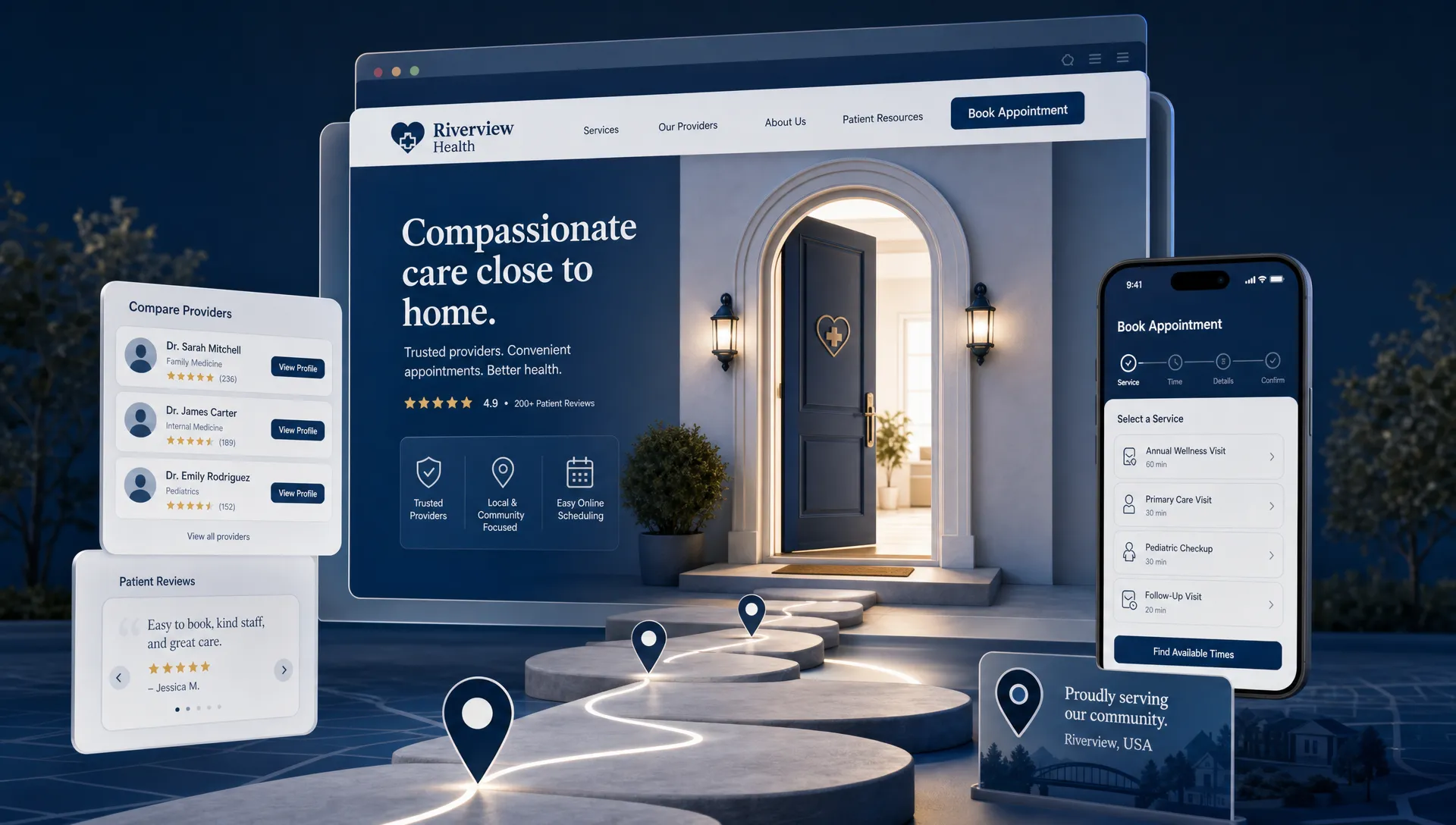
For most healthcare practices, a website is not a digital brochure. It is the front door patients use before they call, schedule, read reviews, compare providers, or decide whether your practice feels trustworthy enough for their care.
That is why healthcare website design services should go far beyond colors, fonts, and a modern homepage. A strong site must help a patient answer four questions quickly: Can this practice help me? Do I trust them? Are they near me? What should I do next?
Whether you run a dental office, orthodontic practice, optometry clinic, chiropractic office, pain management group, physical therapy clinic, or specialty medical practice, the right website design services can directly affect search visibility, patient confidence, and booked appointments.
Why healthcare website design is different
A healthcare website has a higher trust burden than a typical small business site. Patients may be anxious, in pain, dealing with vision changes, looking for a second opinion, or trying to choose care for a child or parent. They are not just shopping for a product. They are evaluating expertise, safety, comfort, insurance fit, location, and urgency.
That means generic web design is usually not enough. Healthcare sites need clear service information, provider credibility, local search structure, mobile usability, accessible content, secure forms, and strong conversion paths. The design must support the way patients actually make decisions.
This is also true in other professional fields where trust and risk matter. Healthcare practices need the same clarity, with additional attention to patient privacy, local SEO, and appointment flow.
Here is the simple test: if a new patient lands on your website from Google, can they understand what you treat, why they should choose you, where you are located, and how to book in under one minute?
The essential website design services healthcare practices need
The best healthcare websites are built as patient acquisition systems. They combine strategy, design, SEO, content, conversion, and ongoing improvement.
| Website design service | What it includes | Why it matters for practices |
|---|---|---|
| Strategy and positioning | Audience research, service priorities, competitive review | Makes the site relevant to your highest-value patients |
| Mobile-responsive design | Fast, usable layouts for phones and tablets | Most local healthcare searches happen on mobile devices |
| Service page development | Dedicated pages for treatments, specialties, and conditions | Helps patients and search engines understand what you offer |
| Local SEO structure | Location pages, metadata, schema, Google Business Profile alignment | Improves visibility in local search results |
| Conversion design | Calls, appointment buttons, forms, landing pages | Turns traffic into inquiries and bookings |
| Trust-building content | Provider bios, reviews, photos, FAQs, before-and-after guidance where appropriate | Reduces uncertainty and improves patient confidence |
| HIPAA-aware form planning | Secure form strategy, privacy-conscious messaging, PHI considerations | Helps reduce risk around sensitive patient information |
| Accessibility and usability | Readable content, clear navigation, contrast, keyboard support | Makes the site easier for more patients to use |
| Performance and maintenance | Speed, updates, backups, broken link checks, security monitoring | Protects the site and supports long-term growth |
Each of these services supports a different part of the patient journey. If one is missing, the website may look good but fail to produce consistent results.
1. Strategy before design
The first website design service every healthcare practice needs is strategic planning. Before choosing a layout or writing a homepage headline, your team should clarify the business goal of the site.
For example, a dental implant practice may want more high-value consults. A pediatric dentist may need to build trust with parents and highlight a child-friendly experience. A dry eye clinic may need to educate patients who do not yet know there are treatment options. A pain management practice may need to separate itself from general orthopedic or chiropractic competitors.
Good strategy answers practical questions:
- Which services should the website prioritize?
- Which patient types are most valuable to the practice?
- Which locations or neighborhoods should the site target?
- Which objections stop patients from booking?
- What should a visitor do next after reading a page?
Without this step, design becomes subjective. With it, every page has a job.
If your practice is already investing in SEO, ads, or patient automation, your website strategy should connect to those channels. A landing page built for Google Ads, for instance, has a different job than a broad educational blog post or a homepage. Louisville Web Lab breaks down this connection further in its guide to how website design and SEO services drive more bookings.
2. Mobile-responsive design that fits real patient behavior
Patients often search for care while multitasking. They may be in a parking lot, on a lunch break, sitting with a child, or dealing with pain. If your website is hard to use on a phone, many of those patients will leave before they ever meet your team.
Responsive design means your website adapts cleanly to different screen sizes. For healthcare practices, that should include more than shrinking the desktop site. Mobile visitors need prominent click-to-call buttons, easy appointment requests, readable service content, fast-loading pages, and maps or location details that are simple to access.
Common mobile design mistakes include tiny phone numbers, hidden appointment buttons, popups that block the screen, oversized images that slow down loading, and menus that require too many taps.
A mobile-ready healthcare website should make the next step obvious. If someone is looking for an emergency dentist, LASIK consultation, chiropractic appointment, or physical therapy evaluation, they should not have to hunt for the phone number or form.
For a deeper look at this topic, see these responsive web design tips for practices that want to book more patients.
3. Clear service pages for each major treatment or specialty
One of the most common website problems in healthcare is trying to explain too much on one page. A single “Services” page with a short list of treatments is rarely enough for patients or search engines.
Each core service deserves its own page. A dental practice might need separate pages for dental implants, Invisalign, emergency dentistry, veneers, pediatric dentistry, and sedation dentistry. An optometry clinic may need pages for eye exams, dry eye treatment, myopia management, contact lenses, and medical eye care. A pain or musculoskeletal practice may need pages for back pain, neck pain, regenerative medicine, sports injuries, and physical therapy.
A strong service page should explain:
- What the service treats or solves
- Who it is for
- What symptoms or concerns may lead a patient to seek care
- What the appointment or treatment process may look like
- Why the practice is qualified to provide it
- What the patient should do next
These pages should be written for humans first, but structured for search engines. That means clear headings, helpful answers, location relevance, descriptive title tags, internal links, and plain language that matches how patients search.
4. Trust signals that reduce patient hesitation
Patients rarely book with a healthcare practice based on design alone. They look for proof.
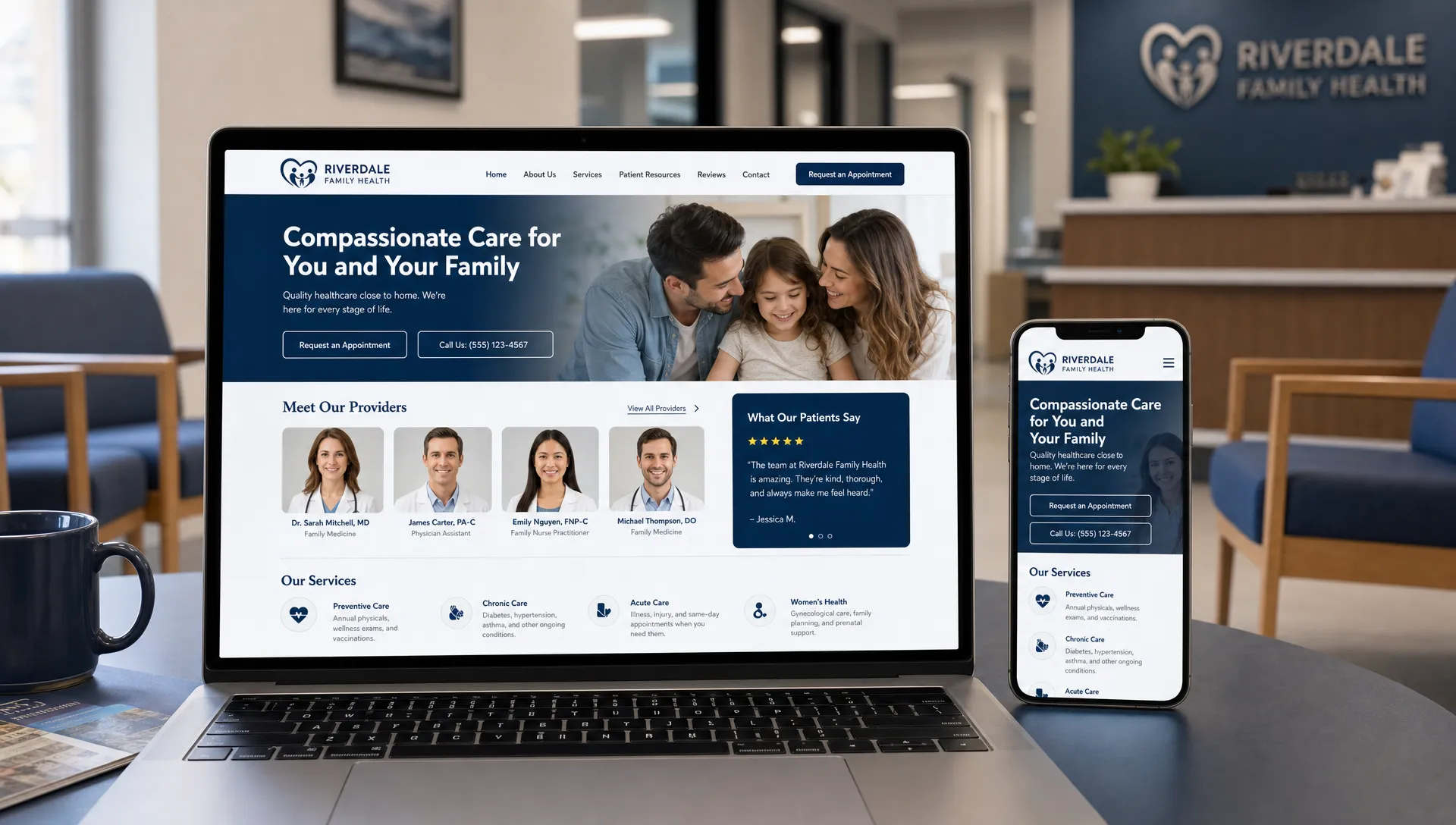
Trust-building website design services focus on the elements that make a practice feel credible, safe, and approachable. These may include real provider photos, team bios, credentials, patient reviews, professional memberships, technology highlights, office images, insurance information, and answers to common concerns.
For healthcare practices, authenticity matters. Stock photos can make a website look polished, but they often do not build the same confidence as real photos of the office, doctors, hygienists, assistants, front desk team, treatment rooms, and patient experience.
Reviews are also powerful, but they should be handled carefully. Avoid making guarantees or overstating outcomes. Instead, use reviews to reinforce themes like communication, comfort, responsiveness, professionalism, and patient experience.
Provider bios deserve special attention. Patients want to know who will be treating them. A strong bio should be warm, specific, and useful. It can include training, areas of focus, treatment philosophy, community connection, and personal details when appropriate.
5. Conversion paths that turn visits into appointments
Traffic is only valuable if the website helps patients take action. Conversion-focused design removes friction between interest and booking.
For healthcare practices, conversion paths usually include phone calls, appointment request forms, online scheduling links, chat or text options where appropriate, and dedicated landing pages for campaigns. The best option depends on the practice type, staffing, scheduling workflow, and patient urgency.
A high-performing website should place calls to action in predictable locations: the header, hero section, service pages, provider pages, and near the end of educational content. The language should be clear and patient-centered. “Request an Appointment” is usually better than vague wording like “Submit” or “Learn More.”
Conversion design also includes reducing anxiety. If a form asks for too much information, patients may abandon it. If the site does not explain what happens after the form is submitted, they may hesitate. A simple note such as “Our team will contact you to confirm appointment availability” can make the process feel more comfortable.
For practices running Google Ads, conversion landing pages are especially important. Sending paid traffic to a generic homepage often wastes budget. A patient searching for “Invisalign consultation near me” or “chiropractor for sciatica” should land on a page that matches that intent.
6. HIPAA-aware forms, privacy, and security planning
Healthcare websites must be careful with sensitive information. A contact form, appointment request, chat tool, tracking script, or online intake workflow can create privacy considerations if protected health information is collected or transmitted.
The U.S. Department of Health and Human Services provides information about the HIPAA Privacy Rule, but every practice should work with its own compliance, legal, and technology advisors to define the right setup. Website designers should not casually treat healthcare forms like ordinary lead forms.
At a practical level, HIPAA-aware web design may include secure forms, careful field selection, privacy notices, appropriate vendor review, SSL, access controls, and clear internal processes for handling submissions. The website should collect only what is necessary for the intended purpose.
This does not mean every healthcare website needs a complicated patient portal. It means the design process should consider what information is being requested, where it goes, who can access it, and whether the tools involved are appropriate for a healthcare environment.
7. Accessibility and usability for all patients
Healthcare practices serve people with different ages, devices, abilities, reading levels, and health conditions. Accessibility is not just a technical checkbox. It is part of patient-centered design.
A website should be easy to read, navigate, and understand. This includes strong color contrast, descriptive link text, keyboard-friendly navigation, readable font sizes, alt text for meaningful images, captions or transcripts for important media, and forms that are clear and properly labeled.
The Web Content Accessibility Guidelines are a widely used standard for improving digital accessibility. While implementation can become technical, the practical goal is simple: more patients should be able to use your website without frustration.
Accessibility also improves general usability. Larger buttons help mobile visitors. Clear headings help busy parents scan. Plain language helps patients understand unfamiliar treatments. Good design benefits everyone.
8. Local SEO built into the site structure
Healthcare is local. Patients typically search by service and location, such as “dentist in Louisville,” “orthodontist near me,” “dry eye doctor,” “pain clinic,” or “physical therapy near St. Matthews.” If your site is not structured for local search, it may never reach the patients who are actively looking.
Local SEO website design services can include optimized title tags, location-specific content, service pages, internal links, schema markup, Google Business Profile alignment, review strategy, and consistent name, address, and phone information.
For multi-location practices, each location should usually have its own page with unique details. That may include address, hours, phone number, directions, nearby landmarks, providers at that location, services offered there, and appointment options.
Local SEO should not feel forced. The goal is not to repeat a city name dozens of times. The goal is to make your relevance clear to patients and search engines.
9. Content that educates without overwhelming
Healthcare content has to strike a balance. It should be detailed enough to answer patient questions, but not so dense that it feels like a medical textbook.
The best practice websites use content to guide decisions. A page about dental implants should explain candidacy, benefits, process, timeline, and consultation steps. A page about dry eye should explain symptoms, causes, evaluation, and treatment options. A page about pain management should clarify the conditions treated and what a first visit may involve.
Content also supports AI search and featured snippets. Search engines increasingly reward pages that answer questions clearly, use structured headings, and demonstrate topical depth. Healthcare practices should focus on accurate, helpful, patient-friendly information rather than thin pages written only for keywords.
Content should also be reviewed periodically. Services change, providers join or leave, insurance details shift, and patient questions evolve. Outdated healthcare content can create confusion and reduce trust.
10. Analytics, call tracking, and performance measurement
A healthcare website should not be judged only by how it looks. It should be measured by what it produces.
At minimum, practices should know how many people visit the site, which pages attract traffic, how many appointment forms are submitted, which phone calls come from the website, and which marketing channels produce qualified inquiries. For paid campaigns, tracking becomes even more important because it affects budget decisions.
Useful website performance indicators may include organic traffic, local landing page visits, call clicks, form submissions, appointment requests, conversion rate, cost per lead for ads, and ranking improvements for important services.
The goal is not to drown the practice in dashboards. The goal is to make better decisions. If a service page gets traffic but no conversions, the issue may be messaging, trust, offer clarity, or call-to-action placement. If a page converts well but gets little traffic, the opportunity may be SEO or ads.
11. Ongoing website maintenance and improvement
A website launch is not the finish line. Healthcare websites need maintenance to stay secure, accurate, fast, and effective.
Maintenance can include software updates, backups, uptime monitoring, broken link fixes, form testing, page speed checks, SEO reviews, content updates, and security improvements. Practices should also review appointment flows regularly to make sure leads are not being lost because of broken forms, disconnected phone tracking, or outdated scheduling links.
This is especially important for healthcare organizations because trust can be damaged quickly. A broken appointment form or outdated provider page may make a patient question whether the practice is attentive and reliable.
Louisville Web Lab has a separate guide on the website maintenance services healthcare practices should have if your site is already live and you want to understand what ongoing support should include.
How to know if your current website is underperforming
Many healthcare practices do not need to guess whether their site is holding them back. The warning signs are usually visible.
Your website may need professional redesign or optimization if patients say they had trouble finding information, your mobile experience feels clunky, your service pages are thin, your competitors outrank you locally, your appointment form rarely gets submissions, your site loads slowly, or your ads generate clicks but few booked appointments.
Another sign is mismatch. If your practice offers advanced care, premium services, or a highly personalized patient experience, but your website looks outdated or generic, patients may never understand your real value.
The best redesigns are not cosmetic resets. They are strategic upgrades that align your positioning, search visibility, patient experience, and conversion paths.
Frequently Asked Questions
What website design services does a healthcare practice need first? Start with strategy, mobile-responsive design, clear service pages, local SEO structure, trust-building content, and appointment conversion paths. These elements have the most direct impact on patient acquisition.
How often should a healthcare practice redesign its website? Many practices should evaluate their website every 2 to 3 years, but a full redesign depends on performance, technology, branding, search visibility, and whether the site still supports current growth goals.
Can better website design help my practice rank on Google? Yes, when design is paired with SEO. Search-friendly service pages, local structure, fast performance, clear internal links, and useful content can all support better visibility.
Should healthcare websites include online scheduling? Online scheduling can reduce friction, but it depends on your practice workflow, software, and patient intake process. At minimum, the website should make calling or requesting an appointment easy on every key page.
Is a beautiful website enough for a healthcare practice? No. A healthcare website also needs trust signals, patient-focused content, local SEO, conversion strategy, accessibility, privacy-aware forms, and ongoing maintenance to support real growth.
Build a website that supports practice growth
The right website design services can help your healthcare practice look credible, rank locally, educate patients, and turn more searches into booked appointments. The wrong approach can leave you with a nice-looking site that does little for growth.
Louisville Web Lab helps healthcare practices connect website design with SEO, Google Ads, automation, reputation, and patient acquisition strategy. If you want to understand where your current site is helping or hurting your growth, book a diagnostic call with Louisville Web Lab and get a clearer plan for turning visibility into appointments.