
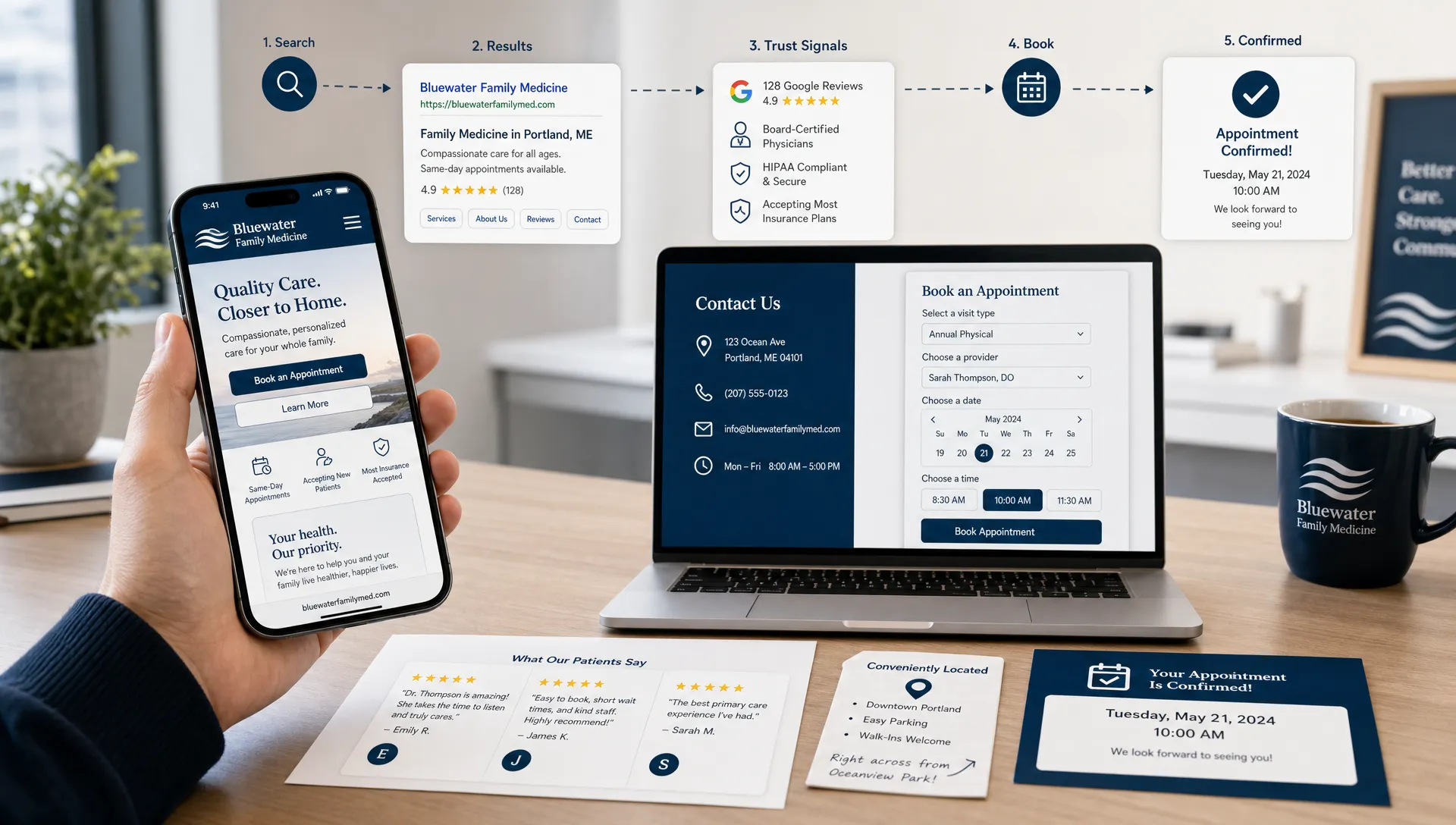
Patients rarely choose a healthcare provider from a website alone. They search, scan reviews, compare options, check location, look for proof, and decide whether booking feels easy enough to do right now. That is why website design and SEO services work best when they are planned together, not purchased as separate projects.
For dentists, orthodontists, optometrists, pain physicians, and specialty practices, the goal is not simply “more traffic.” The goal is more of the right patients taking the next step, whether that means calling, submitting a form, requesting an appointment, or booking online.
A well-designed website turns interest into action. SEO brings in qualified local patients at the moment they are searching for care. When those two systems support each other, your practice can generate more bookings without depending entirely on referrals, insurance directories, or word of mouth.
Why website design and SEO should not be treated separately
Many practices make the mistake of building a nice-looking website first and thinking about SEO later. Others invest in SEO while sending visitors to pages that load slowly, feel generic, or make booking difficult. Both approaches leave revenue on the table.
SEO answers the question, “Can patients find you?” Website design answers, “Do they trust you enough to book?” You need both.
A practice can rank well for a high-intent search like “emergency dentist near me” or “chiropractor for back pain in Louisville,” but if the landing page hides the phone number, lacks reviews, or fails on mobile, many patients will leave. On the other hand, a beautiful website that no one finds in search is like a modern office with no signage, no map listing, and no street visibility.
Think of it as a patient acquisition system:
| Component | What it does | Booking impact |
|---|---|---|
| Local SEO | Helps patients find your practice in Google Search, Maps, and AI-assisted results | Increases qualified visibility |
| Service pages | Match specific patient needs, such as implants, LASIK, dry eye, or pain management | Attracts higher-intent visitors |
| Mobile-first design | Makes information easy to scan and actions easy to take on a phone | Reduces friction before booking |
| Trust signals | Reviews, credentials, photos, treatment explanations, and clear policies | Helps patients feel confident |
| Conversion paths | Calls, forms, scheduling links, and follow-up automation | Turns interest into appointments |
What healthcare patients need before they book
Healthcare searches are not casual. Patients often arrive with urgency, discomfort, anxiety, cost concerns, or uncertainty about which provider is right for them. A parent looking for a pediatric dentist, a patient comparing cataract surgeons, and someone seeking pain management after months of symptoms all need different information before they act.
Strong website design and SEO services account for that intent. A patient searching for “dental implants Louisville” is likely evaluating expertise, cost, timeline, and before-and-after credibility. A patient searching for “same day chiropractor appointment” may care most about availability, location, reviews, and fast contact options.
Your website should quickly answer the patient’s silent questions:
- Do you treat my specific problem?
- Are you close enough to visit?
- Do you seem credible and experienced?
- What happens if I call or request an appointment?
- Will this be difficult, confusing, or expensive?
- Can I trust this practice with my health, my child, or my long-term care?
SEO brings those questions to the surface through keyword research, local search data, and patient behavior patterns. Design makes the answers clear, calm, and easy to act on.
Design elements that turn search traffic into bookings
A healthcare website does not need to be flashy. It needs to be fast, clear, credible, and easy to use. Patients should understand who you help, what you offer, where you are located, and how to schedule without hunting through the site.
The most booking-focused design improvements are often practical rather than decorative.
Clear calls to action
Every core page should make the next step obvious. “Call Now,” “Request an Appointment,” “Schedule a Consultation,” or “Book an Eye Exam” should appear in natural places across desktop and mobile. For many healthcare practices, phone calls still matter, so click-to-call buttons should be easy to tap on mobile.
The best CTA depends on the service. An emergency dental page may need immediate phone access. A cosmetic dentistry or LASIK page may benefit from a consultation request. A physical therapy clinic may need a referral-friendly inquiry path.
Mobile usability
Many local healthcare searches happen on smartphones. If your website has tiny text, slow-loading pages, hard-to-tap buttons, or forms that feel tedious, patients may return to Google and choose another provider.
Mobile-first design is especially important for urgent searches. Someone in pain, a parent managing a child’s appointment, or a patient searching during a work break will not tolerate friction for long. For a deeper look at mobile layout, speed, and patient-friendly design, Louisville Web Lab’s guide to responsive web design that helps practices book more patients breaks down the practical elements that matter most.
Service pages built around patient intent
A generic “Services” page is rarely enough. Search engines and patients both prefer specificity. A dental practice may need separate pages for implants, Invisalign, emergency dentistry, pediatric care, and cosmetic treatments. An eye care practice may need pages for eye exams, dry eye treatment, LASIK evaluations, cataract care, and specialty testing.
Each page should explain the condition or service in plain language, who it is for, what to expect, and how to schedule. The copy should not sound like a medical textbook. It should help patients feel oriented and ready to take the next step.
Trust signals that reduce hesitation
Healthcare decisions carry more risk than buying a product. Patients want reassurance before sharing information or calling your office. Design should make credibility visible without overwhelming the page.
Useful trust signals include provider bios, review highlights, professional credentials, insurance or financing guidance when appropriate, real office photos, treatment explanations, and clear location details. Testimonials and reviews should be handled responsibly and in line with applicable healthcare advertising rules.
SEO services that attract patients ready to take action
SEO for healthcare practices is not just blogging. It includes technical structure, local visibility, service page optimization, reputation signals, content strategy, and ongoing improvements based on how patients search.
Local SEO is especially important because most patients are choosing a provider within a reasonable distance. A practice that appears prominently in map results, organic search results, and relevant local pages has more opportunities to earn calls and appointments.
A strong healthcare SEO strategy typically includes:
- Google Business Profile optimization for accurate categories, services, hours, photos, and contact details
- Location and service page optimization for the treatments patients actually search for
- Review strategy that supports trust and local relevance
- Technical SEO improvements, including crawlability, site speed, indexation, and structured content
- Content that answers patient questions before they call
- Conversion tracking that connects search visibility to calls, forms, and booked appointments
For Louisville-area practices, local search strategy should account for neighborhoods, surrounding communities, and how patients describe their needs. The guide on how SEO helps Louisville practices win more local patients explains why visibility in search, Maps, and AI-powered results has become central to patient growth.
Where bookings leak from the patient journey
Even when SEO is working, practices often lose potential patients between the search result and the scheduled visit. These leaks are usually fixable, but only if you look at the full path from query to appointment.
| Booking leak | What patients experience | How design and SEO fix it |
|---|---|---|
| Ranking for the wrong terms | Visitors arrive but are not a good fit | Refine keyword targeting around services, location, and intent |
| Weak page messaging | Patients do not know if the practice treats their issue | Improve service page copy and page structure |
| Poor mobile experience | Patients abandon the site before calling | Simplify navigation, buttons, forms, and page speed |
| Missing trust signals | Patients compare you with competitors and hesitate | Add reviews, credentials, photos, and clear explanations |
| Confusing contact options | Patients cannot tell how to book | Use visible CTAs, click-to-call, and streamlined forms |
| No follow-up process | Leads go cold after an inquiry | Add timely, compliant follow-up workflows |
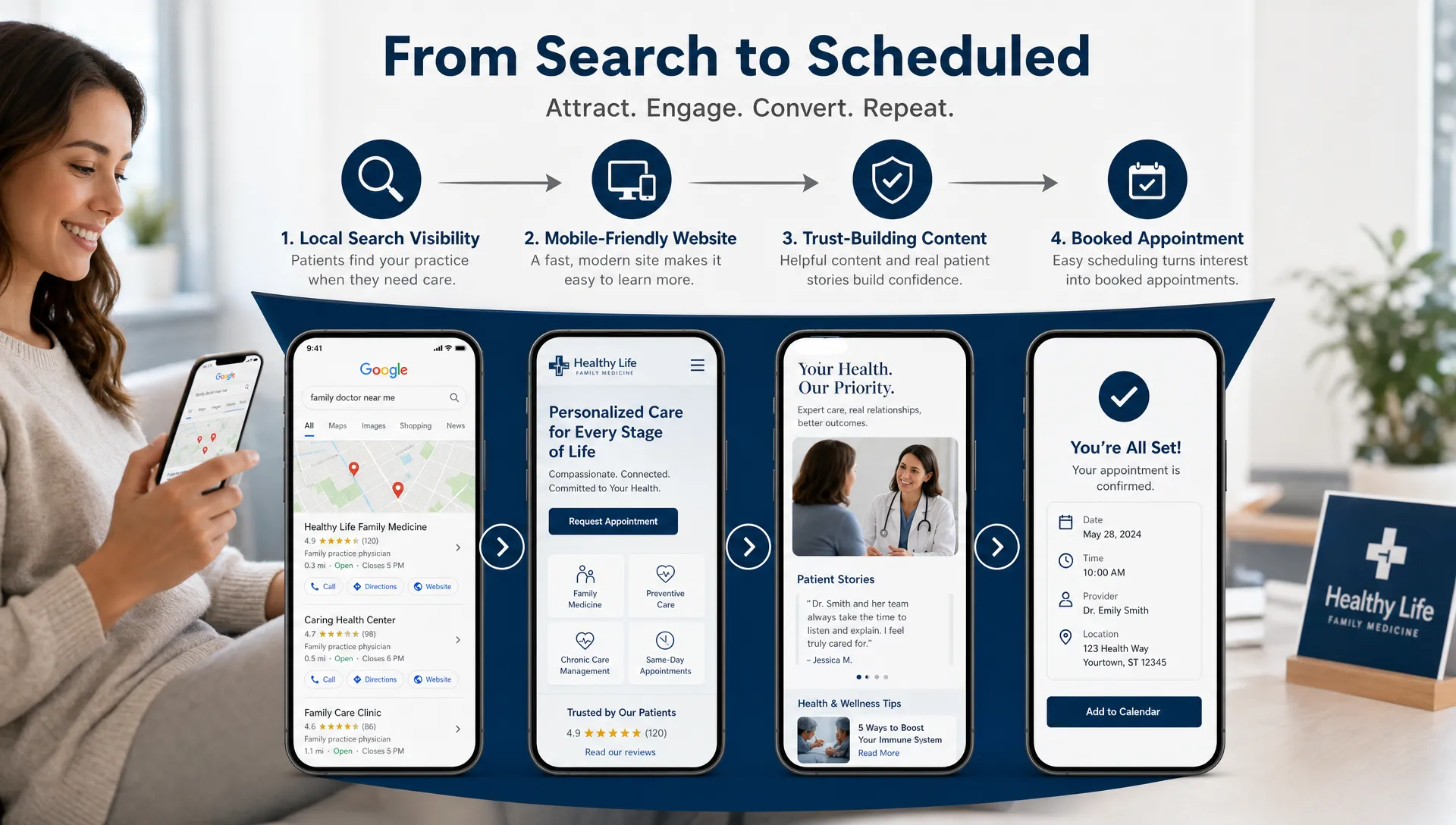
The most important insight is that a booking problem may not be an SEO problem alone. It may be a page design problem, a messaging problem, a tracking problem, or a follow-up problem. That is why website design and SEO services should be evaluated by appointment outcomes, not just rankings or traffic charts.
How to measure whether design and SEO are driving bookings
Healthcare marketing can become misleading if the wrong metrics are used. Traffic matters, but only if it is qualified. Rankings matter, but only if they lead to patient actions. A practice should know which pages, searches, ads, and local listings are contributing to real appointment opportunities.
At minimum, practices should track calls, form submissions, online booking clicks, and the pages that generated those actions. If your office uses call tracking, form tracking, or a CRM, make sure patient privacy and compliance requirements are handled properly. Marketing systems should avoid unnecessary protected health information, and practices should involve appropriate compliance guidance when needed.
Useful performance questions include:
- Which service pages generate the most appointment requests?
- Which searches bring patients with the highest booking intent?
- Which pages get traffic but few conversions?
- Are mobile visitors booking at a lower rate than desktop visitors?
- Are calls being answered, missed, or abandoned?
- Which marketing channels produce scheduled appointments, not just leads?
This is where a conversion-focused website becomes more valuable over time. Once you can see where patients are entering, what they are reading, and where they drop off, you can improve the system instead of guessing.
What effective website design and SEO services should include
When evaluating a partner, look beyond portfolio screenshots or generic SEO promises. Healthcare marketing has unique challenges, including patient trust, local competition, sensitive decision-making, compliance considerations, and high-value services with long research cycles.
A strong partner should be able to connect design choices to search intent and booking outcomes. That means service pages are not just written for keywords. They are designed to help a real patient understand the service and take action. It also means SEO work does not stop at visibility. It continues through conversion paths, reputation signals, and follow-up strategy.
For healthcare practices, the most useful website design and SEO services usually include strategy, local SEO, technical SEO, service page development, conversion-focused design, analytics setup, and ongoing optimization. Depending on the growth plan, Google Ads, landing pages, review generation, and patient automation may also support the system.
If you want a broader view of how these pieces fit into growth, Louisville Web Lab’s article on medical practice marketing that drives appointments explains why practices should prioritize booked appointments over vanity metrics.
When your practice is ready to invest
Not every practice needs a full rebuild. Sometimes the smartest move is to improve high-value pages, fix mobile friction, strengthen local SEO, and add better tracking. Other times, the website is outdated enough that small fixes will not solve the core problem.
Your practice may be ready for integrated website design and SEO support if:
- You get traffic but not enough appointment requests
- Your website looks outdated compared with local competitors
- Patients frequently ask questions that your website should answer
- Your Google Business Profile gets views but not enough calls
- You rank for your practice name but not your main services
- Your forms, calls, and booking sources are not being tracked clearly
- You are investing in ads but sending clicks to weak pages
The key is to diagnose the bottleneck before spending heavily. More traffic is not always the answer. If your website cannot convert patients, increasing traffic can simply increase wasted opportunity.
Frequently Asked Questions
How do website design and SEO services increase bookings? SEO helps patients find your practice when they search for relevant services, while website design turns that attention into action through clear messaging, trust signals, mobile usability, and easy booking paths.
Should a healthcare practice redesign its website before investing in SEO? It depends on the current site. If the website is slow, confusing, outdated, or difficult to use on mobile, fixing design and conversion issues before scaling SEO can prevent wasted traffic.
What pages are most important for healthcare SEO? Core service pages, location pages, provider pages, and contact or appointment pages are usually the most important. The right mix depends on your specialty, market, and patient search behavior.
How long does SEO take to generate more appointments? SEO usually takes time because search engines need to crawl, evaluate, and rank improved pages. Some local and technical improvements can help sooner, but sustainable appointment growth often requires ongoing optimization.
Can a better website improve Google Ads performance too? Yes. A clearer, faster, more relevant landing page can improve the patient experience after the click, which can lead to better conversion rates and more efficient ad spend.
Turn search visibility into scheduled patients
Your website should do more than look professional. It should help local patients find your practice, understand why you are the right fit, and take the next step with confidence.
Louisville Web Lab helps healthcare practices connect SEO, website design, Google Ads, automation, and patient acquisition strategy into a system focused on measurable growth. If your practice wants more booked appointments from search, start with a diagnostic look at where patients are finding you, where they are dropping off, and what needs to change next.