
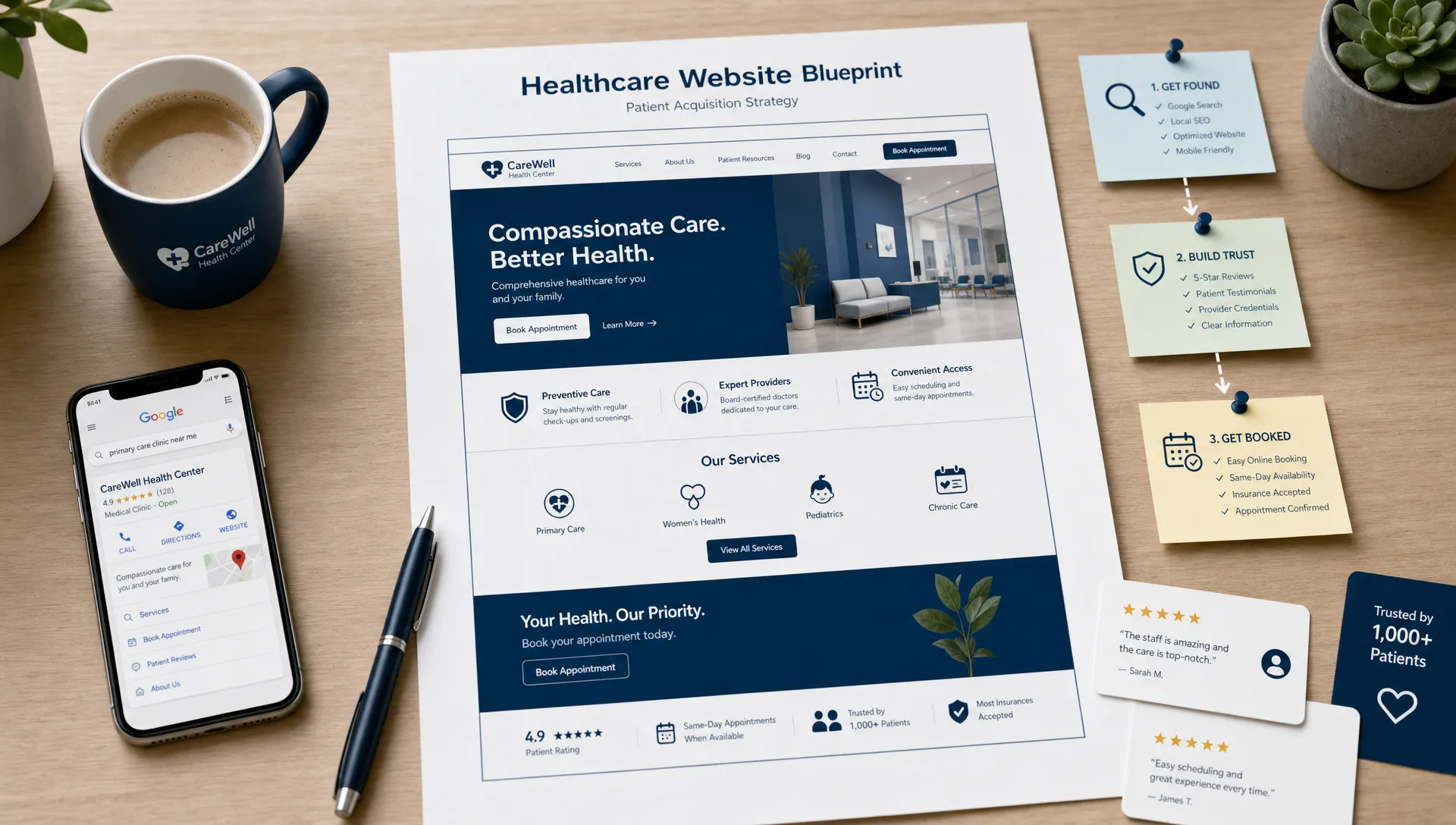
Most healthcare websites fail for a simple reason: they are built as online brochures instead of patient acquisition systems.
A homepage may look polished, the color palette may feel modern, and the photos may be professional, but none of that guarantees more calls, consult requests, or booked appointments. A great website design company understands that design is not decoration. It is the structure that helps the right patient find you, trust you, and take the next step.
For dentists, orthodontists, optometrists, pain physicians, and specialty practices, the stakes are even higher. Patients are not shopping for a T-shirt. They may be anxious, in pain, comparing insurance options, evaluating clinical credibility, or trying to decide whether a procedure is worth the investment.
That changes what “good web design” means.
It starts with practice growth, not a mood board
Average web design projects often begin with questions like “What colors do you like?” or “Which websites do you think look cool?” Those questions can be useful later, but they should not lead the strategy.
A strong website design company starts with business questions:
- Which services are most profitable or most important to grow?
- Which locations need more visibility?
- What types of patients are the best fit?
- Where are current leads coming from?
- What is stopping website visitors from booking?
- How will success be measured after launch?
For a dental implant practice, the goal may be more high-intent consultation requests. For an orthodontic office, it may be more clear aligner starts. For an optometry practice, it may be a better mix of routine eye exams, dry eye visits, and eyewear sales. For a pain management clinic, it may be qualified inquiries from patients who have tried conservative care and need a specialist.
The design should follow those goals. Page structure, navigation, calls to action, service content, local SEO, and tracking all need to support the practice’s growth strategy.
This is one reason healthcare practices should be cautious about hiring purely visual designers with no acquisition strategy. A beautiful site that does not rank, does not explain services clearly, and does not convert mobile visitors is not a growth asset. It is a digital business card.
It builds around patient intent
Patients arrive at a healthcare website with different levels of urgency and awareness. A great website design company plans for all of them.
Some visitors are problem-aware. They search for symptoms, pain, discomfort, or questions. Others are treatment-aware and comparing options, such as Invisalign versus braces, LASIK versus contacts, or chiropractic care versus physical therapy. The most valuable visitors are often ready to act, searching for a provider near them, checking reviews, and looking for a fast way to schedule.
A high-performing website maps pages to these intent levels instead of forcing every visitor through the same generic homepage.
| Patient intent | What the patient is thinking | Website design response |
|---|---|---|
| Problem-aware | “Why does my jaw hurt?” or “Why is my vision blurry?” | Educational content, clear next steps, internal links to relevant services |
| Treatment-aware | “Is this procedure right for me?” | Service pages with benefits, candidacy details, FAQs, provider expertise, and trust signals |
| Provider-aware | “Is this the right practice?” | Reviews, location information, insurance guidance, doctor bios, photos, and booking options |
| Ready-to-book | “Can I get an appointment?” | Prominent phone numbers, online scheduling, short forms, click-to-call buttons, and fast-loading pages |
This intent-based approach is especially important in healthcare because patients often need reassurance before they act. They want to know whether you treat their condition, whether you accept their situation, what the visit may involve, and whether they can trust your team.
If your website answers those questions clearly, the design is doing its job.
It treats trust as conversion infrastructure
Trust is not a decorative section near the bottom of a page. It is a conversion requirement.
Healthcare patients are evaluating risk. They want to know whether the practice is credible, whether the provider has experience with their issue, whether other patients had positive experiences, and whether the office feels professional and accessible.
A strong healthcare website uses trust signals throughout the journey, including:
- Provider bios with credentials, specialties, and a human tone
- Clear service descriptions written in patient-friendly language
- Reviews and testimonials presented ethically and accurately
- Office photos that reduce uncertainty before the first visit
- Insurance, financing, or payment information when appropriate
- Location details, parking guidance, and contact options
- Before-and-after content only when it is clinically appropriate and compliant
Different specialties need different trust signals. A cosmetic dentistry site may need smile galleries, financing information, and examples of treatment planning. A pediatric dentistry site may need a warm tone, parent-focused FAQs, and office photos that make the visit feel less intimidating.
The key is not to overload the site with proof. The key is to place the right proof near the moment of decision.
It designs for search visibility from the beginning
A common mistake is treating SEO as something to “add later.” A great website design company knows that search visibility is shaped during the planning and build process.
The site’s structure determines how search engines understand the practice. The content determines which patient searches you can compete for. The technical foundation affects speed, crawlability, and mobile performance. The location strategy influences how well the site supports Google Business Profile visibility.
For healthcare practices, search-focused design usually includes:
- A clear service page structure, not one vague “services” page
- Location-specific content when the practice serves multiple areas
- Fast mobile performance and clean technical architecture
- Internal links that help patients and search engines move through related topics
- Page titles, headings, and copy aligned with real patient searches
- Local trust signals, such as address, phone number, provider names, and community relevance
This is why SEO web design services outperform pretty sites for practices that depend on local search. A patient cannot book with you if they never find you.
Search strategy also needs to account for how discovery is changing. In 2026, patients still use Google heavily, but they also compare providers through map results, review platforms, AI-generated summaries, voice search, and referral-driven browsing. A strong website gives search engines and AI systems clear, consistent information about who you help, where you practice, and what services you provide.
It makes conversion feel easy, not pushy
Many healthcare websites create unnecessary friction at the exact moment a patient is ready to act.
The phone number is hidden. The online form is too long. The scheduling button disappears on mobile. The service page ends without a next step. The contact page asks for too much information. The site uses vague calls to action like “Submit” instead of specific language like “Request an Appointment” or “Schedule a Consultation.”
A great website design company removes that friction.
Good conversion design does not mean pressuring patients. It means making the next step obvious and comfortable. For healthcare practices, that often includes a sticky mobile call button, a clear appointment request form, service-specific calls to action, and reassuring microcopy that explains what happens after a patient reaches out.
It also means being thoughtful about compliance and privacy. Appointment forms should avoid requesting unnecessary sensitive health information unless the practice has the right systems and guidance in place. A website design partner should understand that healthcare conversion is not the same as e-commerce conversion.
The best patient journeys feel simple: understand the problem, evaluate the practice, choose a next step, and contact the office without confusion.

It understands that each specialty has a different patient journey
Generic web design treats every business the same. Healthcare web design cannot.
A pediatric dentist, LASIK surgeon, chiropractor, pain management physician, and physical therapy clinic may all need modern websites, but their patient journeys are different. Their objections are different. Their decision timelines are different. Their content requirements are different.
| Practice type | Common patient concern | Website elements that matter most |
|---|---|---|
| Dental and orthodontics | Cost, comfort, appearance, treatment time | Service pages, financing details, reviews, smile examples, easy scheduling |
| Optometry and ophthalmology | Insurance, exam availability, procedure expertise | Appointment access, condition pages, provider credentials, eyewear or surgical information |
| Pain and musculoskeletal care | Severity, treatment options, trust in diagnosis | Condition pages, treatment explanations, outcomes language, clear referral or appointment paths |
| Physical therapy | Location, insurance, recovery timeline | Local pages, therapist bios, condition-specific content, simple booking flow |
| Specialty medicine | Expertise, access, seriousness of condition | Physician authority, service depth, referral clarity, FAQs, patient education |
This is where a specialized healthcare marketing perspective becomes valuable. The design is not only about how pages look. It is about understanding why someone hesitates, what they need to know, and what gives them enough confidence to call.
If a practice serves multiple patient segments, the website should guide each segment without becoming cluttered. A dental practice offering general dentistry, cosmetic dentistry, implants, and emergency care needs distinct pathways. A pain clinic treating back pain, neuropathy, joint pain, and sports injuries needs content that reflects those conditions clearly.
A great website design company creates clarity without making the site feel overwhelming.
It writes copy for patients, not committees
Healthcare websites often suffer from one of two copy problems. Either the content is too thin to be useful, or it is written like a clinical textbook.
Patients need accuracy, but they also need clarity. A strong website explains care in a way that is understandable, respectful, and specific.
Instead of saying, “We provide comprehensive dental solutions utilizing advanced technology,” a better page might explain who the service is for, what problems it solves, what the visit involves, and how to schedule. Instead of listing every clinical term related to dry eye, an optometry page should help patients recognize symptoms, understand treatment options, and know when to book an exam.
Good copy also handles objections naturally. Patients want to know:
- Will this hurt?
- How much might it cost?
- Do you accept my insurance?
- How soon can I be seen?
- Is this provider experienced with my issue?
- What happens at the first appointment?
When a website answers these questions, patients feel less uncertain. When it avoids them, patients leave and keep searching.
It connects design, SEO, ads, and automation
A website is not an isolated project. It sits at the center of your marketing system.
If you run Google Ads, your landing pages need to match the ad intent and convert paid traffic efficiently. If you invest in local SEO, your service pages and location signals need to support that work. If you request reviews, your reputation strategy should strengthen both trust and local visibility. If your front desk is busy, automation can help follow up with new inquiries and reduce missed opportunities.
This is where many practices lose money. They hire one vendor for a website, another for ads, another for SEO, and another for forms or automation. Each piece may function on its own, but the patient journey feels disconnected.
A better approach connects the full acquisition path:
| Marketing component | What it should do | What happens when it is disconnected |
|---|---|---|
| Website | Educate, build trust, and convert visitors | Traffic arrives but does not turn into leads |
| SEO | Bring in high-intent local searchers | Pages fail to rank or attract the wrong visitors |
| Google Ads | Capture demand quickly for priority services | Paid clicks go to weak pages and waste budget |
| Reviews | Increase confidence and local credibility | Patients hesitate or choose a competitor |
| Automation | Follow up and reduce lead leakage | Inquiries go cold before the office responds |
For practices focused on measurable growth, the question is not “Do we like the website?” The better question is “Does the website help turn visibility into booked appointments?” Louisville Web Lab covers this connection more deeply in its guide on how website design and SEO services drive more bookings.
It measures performance after launch
Launching a website is not the finish line. It is the starting point for improvement.
A great website design company sets up measurement so the practice can see what is working. That may include call tracking, form tracking, Google Business Profile performance, organic traffic trends, landing page conversion rates, ad performance, and booked appointment quality.
The point is not to drown the practice in dashboards. The point is to identify what needs attention.
If a service page gets traffic but few calls, the issue may be weak copy, unclear next steps, poor mobile experience, or a mismatch between search intent and page content. If Google Ads generate forms that do not become patients, the issue may be lead quality, follow-up speed, or the offer. If map visibility improves but calls do not, the practice may need stronger reviews, better photos, or clearer service positioning.
Good measurement turns opinions into decisions. Instead of redesigning based on preference, the practice can improve based on evidence.
It is honest about tradeoffs and timelines
One of the clearest signs of a strong website design company is honesty.
No agency can guarantee instant rankings. No redesign can fix a weak offer overnight. No landing page can fully compensate for poor phone follow-up. No website can create trust if reviews, service quality, and patient experience are misaligned.
A credible partner will explain tradeoffs clearly. A highly customized site may take longer than a simple refresh. A competitive SEO strategy may require ongoing content and authority building. Paid ads may create faster visibility, but they need strong landing pages and careful tracking. Automation can improve follow-up, but the office still needs a process for handling serious inquiries.
This kind of honesty is valuable because it protects the practice from unrealistic expectations. Great design companies do not just sell a website. They help leadership make better growth decisions.
If you are comparing partners, it can help to review what to ask before signing a contract. This guide on what to look for in a website design and SEO company breaks down several evaluation points for healthcare practices.
Red flags that a website design company may not be the right fit
Not every agency is built for healthcare growth. Some are excellent at branding but weak on search. Others build attractive templates but do not understand patient behavior. Some focus on traffic while ignoring whether that traffic becomes appointments.
Watch for these warning signs:
- They lead with visuals but cannot explain the patient acquisition strategy.
- They do not ask about your priority services, locations, or ideal patients.
- They treat SEO as an optional add-on after the site is built.
- They cannot explain how calls, forms, and conversions will be tracked.
- They use generic copy that could apply to any practice in any city.
- They make unrealistic promises about instant rankings or guaranteed results.
- They do not understand healthcare trust, privacy, reviews, or compliance sensitivities.
A website is too important to be treated as a one-time design task. For most healthcare practices, it is the hub of local search, paid advertising, patient education, reputation, and conversion.
What great looks like in practice
A great website design company creates a site that patients can understand quickly and search engines can interpret clearly. It makes the practice feel credible without overwhelming visitors. It supports local visibility. It reduces friction. It tracks outcomes. It helps the office grow with more confidence.
The difference is not always obvious in a screenshot. Two websites can both look modern, but one may be built around patient intent, search visibility, service-line growth, and appointment conversion while the other is simply a collection of attractive pages.
For healthcare practices, that difference matters.
A great website should help answer three questions for every visitor:
- “Can this practice help me?”
- “Do I trust them?”
- “What should I do next?”
If your site answers those questions clearly, it is doing more than looking good. It is working.
Frequently Asked Questions
What should a healthcare practice look for in a website design company? Look for a company that understands patient acquisition, local SEO, conversion strategy, healthcare trust signals, mobile performance, and measurable outcomes. The best partner should ask about your services, locations, ideal patients, and booking process before discussing design preferences.
How is healthcare website design different from regular business web design? Healthcare websites must account for patient anxiety, clinical credibility, privacy considerations, reviews, insurance questions, provider expertise, and appointment access. A generic business website may look polished but fail to address the trust and decision-making needs of patients.
Does a new website automatically improve SEO? Not automatically. A redesign can help SEO when it includes strong technical structure, clear service pages, local signals, optimized content, and proper redirects. A redesign can also hurt SEO if it removes important content, changes URLs carelessly, or ignores search intent.
How often should a healthcare practice redesign its website? Many practices benefit from evaluating their site every 2 to 3 years, but performance matters more than age. If your site is slow, hard to use on mobile, difficult to update, weak in search, or not generating qualified leads, it may be time to redesign sooner.
What is the biggest mistake practices make when hiring a website design company? The biggest mistake is choosing based only on appearance or price. A healthcare website should be judged by its ability to attract the right patients, build trust, support search visibility, and turn visitors into booked appointments.
Ready to build a website that works harder for your practice?
Louisville Web Lab helps healthcare practices turn search visibility into qualified leads and booked appointments through SEO, Google Ads, website design, and patient acquisition systems.
If your current website looks fine but is not producing the growth you need, schedule a diagnostic strategy call with Louisville Web Lab and find out where your patient journey is leaking opportunities.