

Your practice does not need a website that simply looks modern. It needs a digital front door that patients can find, trust, understand, and use to book an appointment.
That is why choosing a website design and SEO company is different for healthcare practices than it is for restaurants, home services, or ecommerce brands. A dental, orthodontic, optometry, chiropractic, pain management, physical therapy, or specialty care website has to do more than display services. It has to reduce patient uncertainty, support local search visibility, communicate clinical credibility, and move people from search result to scheduled visit.
The right partner should bring design, SEO, content, conversion strategy, and measurement together. If any one of those pieces is missing, you may get traffic without appointments, a beautiful site no one finds, or reports that look positive but do not translate into revenue.
Start with the outcome: booked appointments, not just pages
A good website design and SEO company should be able to explain how its work connects to practice growth. That means the conversation should quickly move beyond color palettes, homepage mockups, and keyword lists.
For a healthcare practice, the real outcome is usually one or more of the following: more qualified phone calls, more form submissions, more scheduled consultations, stronger visibility for high-value services, higher patient trust, and better follow-up after a lead comes in.
A company that understands this will ask about your service mix, margins, provider capacity, location strategy, insurance positioning, patient demographics, and appointment bottlenecks. For example, a cosmetic dentist may need service pages and visual proof that support elective treatment decisions. A pediatric dentist may need parent-friendly trust signals and clear insurance information. A pain physician or chiropractor may need pages that explain conditions, treatment paths, and referral relationships without overpromising outcomes.
If an agency starts with your brand colors before it understands your growth goals, keep asking questions.
Look for healthcare-specific marketing judgment
Healthcare decisions are personal, local, and trust-driven. Patients are often comparing providers while dealing with pain, anxiety, urgency, insurance questions, or uncertainty about what treatment they need. That changes how your website and SEO should be built.
A generalist agency may understand design trends, but a healthcare-focused partner should understand the details that influence patient behavior. Those details include provider bios, service-line pages, location pages, reviews, before-and-after policies where appropriate, appointment calls to action, privacy-conscious forms, and language that is clear without sounding generic.
They should also understand the line between persuasive marketing and inappropriate claims. In healthcare, content should be accurate, clinically reviewed when needed, and careful about promising results. Your marketing partner does not need to act as your attorney or compliance officer, but they should be HIPAA-aware and know when to flag tracking, form, testimonial, or content issues for review.
A strong partner will also understand that local search is not optional. For many practices, Google Maps visibility, Google Business Profile optimization, location relevance, and review quality are just as important as traditional organic rankings. If you want to go deeper into the local visibility side, this guide on how SEO helps Louisville practices win more local patients explains why Maps, organic search, and patient intent need to work together.
Evaluate the strategy before the design
Design is important, but strategy should come first. Before anyone shows you a homepage concept, they should be able to define the structure of the site and the role each major page will play.
For a healthcare practice, that usually means mapping pages around services, locations, patient questions, provider expertise, and conversion paths. A website for an orthodontist with multiple locations should not be planned the same way as a single-location cataract surgery center or a pain management clinic focused on procedure-based searches.
A clear strategy should answer questions like these:
- Which services deserve dedicated pages because patients search for them directly?
- Which pages need local modifiers, location details, and map signals?
- What patient objections should each page answer before someone calls?
- What calls to action make sense for new patients, referrals, consultations, or urgent needs?
- What content should be rewritten, consolidated, redirected, or removed during a redesign?
This is where many projects succeed or fail. A redesign without SEO planning can erase rankings, break URLs, bury important service pages, and confuse Google about what your practice offers. A site built only for SEO can feel stiff and fail to convert. The best companies plan both together from the beginning.
For more on that balance, Louisville Web Lab has covered why SEO web design services outperform pretty sites when the goal is actual patient acquisition.
Make sure they understand conversion design
Traffic is only valuable if patients take action. A conversion-focused healthcare website makes the next step obvious without making the experience feel pushy.
Important conversion elements include visible phone numbers, appointment buttons, short forms, mobile-friendly navigation, provider credentials, accepted insurance information when relevant, review signals, service explanations, location details, and fast-loading pages. The site should guide a patient from concern to confidence.
For example, someone searching for dental implants may need education, proof of experience, financing or consultation information, and a way to request an appointment. Someone searching for an emergency dentist needs a faster path to calling. Someone comparing LASIK providers may need technology details, candidacy information, pricing guidance, and trust-building content.
Ask the company how they design for different patient intents. If every page uses the same generic layout, it may not support how patients actually decide.
Confirm they can handle technical SEO without making it mysterious
Technical SEO is often hidden, but it has a major impact on performance. Your agency should be able to explain the technical foundation of your site in plain English.
At minimum, they should know how to manage site speed, mobile usability, crawlability, indexation, redirects, internal linking, metadata, schema markup, image optimization, XML sitemaps, and analytics setup. For redesigns, they should have a migration plan that protects existing rankings and prevents avoidable traffic drops.
The key is clarity. You do not need to become an SEO technician, but you should understand what they are doing and why it matters. If the agency hides behind jargon or cannot explain the practical impact of technical work, that is a warning sign.
A capable company should also know how technical choices affect patient experience. Slow pages can reduce calls. Confusing navigation can bury profitable services. Broken forms can waste ad spend. Weak redirects can damage rankings. These are not abstract SEO problems. They are revenue problems.
Look for content that reflects real patient questions
High-performing healthcare SEO is not built on thin service pages. It is built on useful, accurate content that matches how patients search and how they make decisions.
A good website design and SEO company should help you create content for core services, conditions, treatments, locations, FAQs, provider expertise, and comparison-stage questions. The goal is not to publish endless blog posts. The goal is to build a content system that helps search engines understand your relevance and helps patients feel confident enough to contact you.
This matters even more in 2026, as search experiences increasingly include AI summaries, local packs, traditional organic listings, and question-based results. Clear content structure, plain-language answers, strong internal linking, and accurate service information make your site easier for both patients and search systems to understand.
The company should have a process for reviewing healthcare content with your team. They should not invent clinical claims, exaggerate outcomes, or publish generic AI-written pages without expert review. Your practice’s credibility is too important for that.
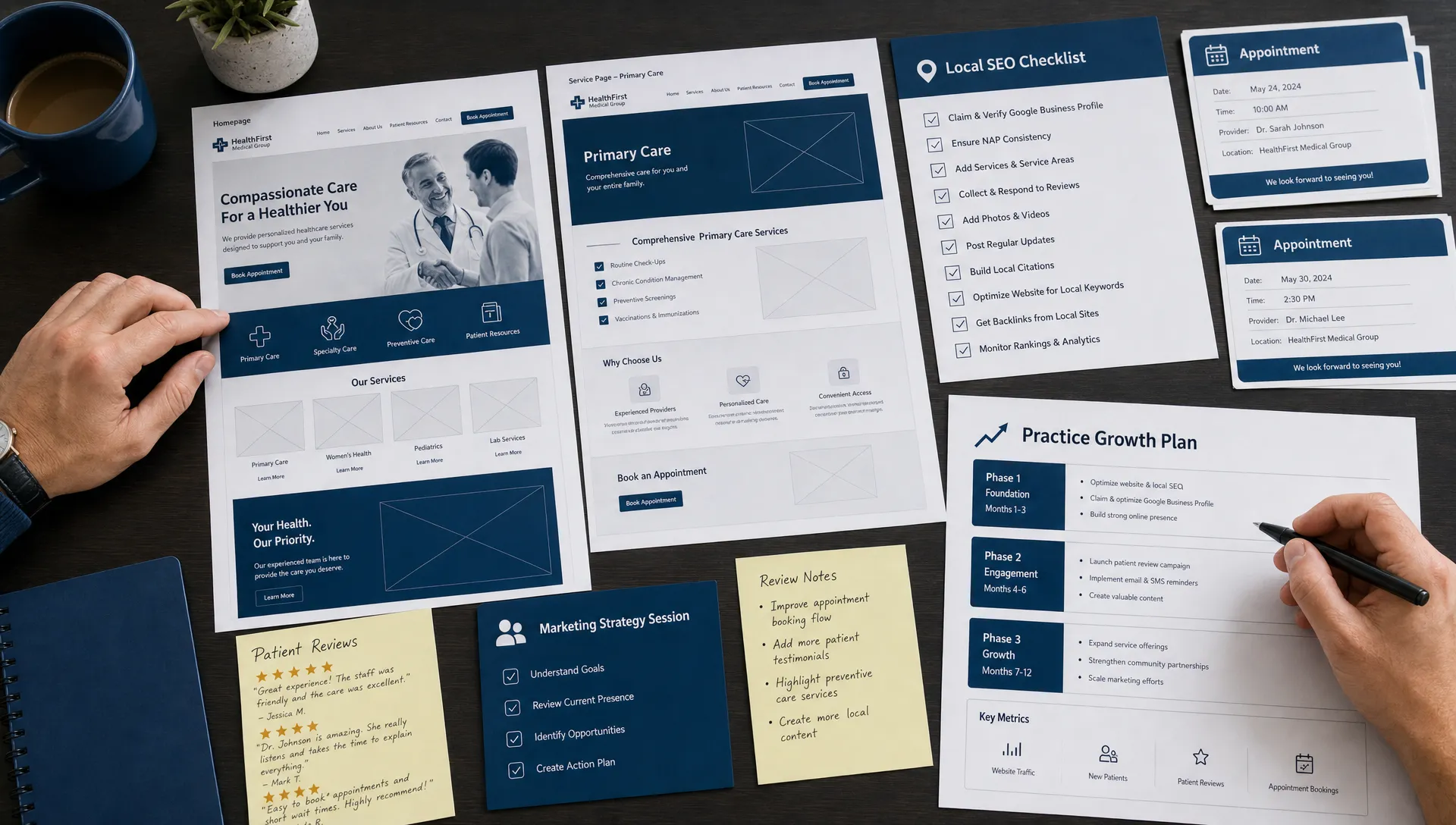
Ask how they measure what matters
SEO reports can look impressive while hiding the most important question: did this work help the practice grow?
Rankings and traffic matter, but they are not enough. A good company should also help you understand calls, forms, appointment requests, conversion rates, top-performing service pages, Google Business Profile actions, lead quality, and trends by location or service line when possible.
For healthcare practices, measurement should be practical. You want to know which services are gaining visibility, which pages are producing inquiries, whether leads are qualified, and where follow-up may be breaking down. This is especially important if your practice runs Google Ads alongside SEO, because landing page performance and lead tracking affect both channels.
Here is a simple way to compare what different companies emphasize:
| Area to evaluate | What a strong company can show | What to question |
|---|---|---|
| Strategy | A plan tied to services, locations, and patient acquisition goals | A proposal focused only on pages, keywords, or design concepts |
| Local SEO | Google Business Profile, reviews, local pages, and map visibility planning | No clear explanation of how local patients will find you |
| Conversion design | Calls, forms, mobile UX, trust signals, and page-specific CTAs | A beautiful site with weak appointment paths |
| Technical SEO | Speed, redirects, schema, indexation, and migration planning | Vague technical promises with no process |
| Reporting | Calls, forms, rankings, traffic, page performance, and lead quality | Vanity metrics without connection to appointments |
| Healthcare fit | Accurate content, HIPAA-aware workflows, and patient trust factors | Generic claims that could apply to any industry |
If you are specifically trying to connect design and search visibility to patient volume, this article on how website design and SEO services drive more bookings is a useful companion piece.
Check their process for ads, SEO, and landing pages
Many healthcare practices use both SEO and Google Ads. That can work well, but only if the website and landing pages are built to convert.
If an agency offers ads, ask whether they build dedicated landing pages, track calls and forms, review search terms, improve page speed, and refine messaging based on lead quality. A poor landing page can make a good ad campaign look expensive. A strong landing page can help your practice learn which services, offers, and messages produce better patient inquiries.
The same lesson applies to SEO. A page that ranks but does not convert needs improvement. A page that converts but gets no traffic may need stronger optimization or internal links. Website design and SEO should not operate in separate silos.
Pay attention to communication and continuing education
Digital marketing changes quickly. Google updates search results, ad platforms change tracking rules, patients use new search behaviors, and AI-assisted search keeps evolving. You want a partner that has a learning culture, not a company relying on tactics from five years ago.
Training alone is not enough, though. You should also look for judgment. Certifications do not automatically mean a company understands healthcare marketing, local patient behavior, or how to turn search visibility into appointments. The best partners combine ongoing learning with real-world execution and clear communication.
During the sales process, notice how they explain tradeoffs. Do they give thoughtful answers, or do they default to buzzwords? Do they ask about your operations, or do they only talk about deliverables? Do they explain what they need from your team, or do they pretend everything can happen without practice involvement?
Good communication before you sign is often a preview of what working together will feel like after the contract starts.
Understand what should be in the scope
A vague proposal creates vague results. Before hiring a website design and SEO company, make sure the scope is clear.
For a healthcare website and SEO engagement, the scope may include discovery, site architecture, copywriting, design, development, technical SEO, local SEO, content planning, Google Business Profile support, analytics setup, call tracking, conversion landing pages, review strategy, maintenance, and ongoing optimization.
Not every project needs every service at the same intensity. A new practice may need foundational local SEO and a fast launch. A growing multi-location practice may need a full content architecture, location strategy, and reporting by service line. A practice with an old website may need redesign, migration planning, and speed improvements before aggressive SEO can work.
What matters is that you know what is included, what is not included, who owns the assets, how revisions work, what the timeline looks like, and how success will be reviewed.
Ongoing support is especially important after launch. Websites need updates, security attention, SEO checks, form testing, speed monitoring, and content improvements. If you are unsure what that should include, review these website maintenance services every healthcare practice should have.
Watch for red flags before you sign
Some warning signs are easy to miss when a proposal looks polished. Slow down if you notice any of these patterns:
- They guarantee specific rankings in a short period of time.
- They cannot explain how website pages will support patient conversion.
- They recommend a redesign without discussing current SEO performance.
- They focus on traffic but avoid calls, forms, or appointment quality.
- They use the same site structure for every healthcare client.
- They are vague about ownership of your website, content, data, or ad accounts.
- They publish healthcare content without a review process.
- They make HIPAA or compliance promises without explaining the actual scope.
- They do not discuss mobile speed, local SEO, reviews, or Google Business Profile.
A trustworthy company will not promise magic. They will explain the work, the timeline, the risks, the opportunities, and the decisions your practice needs to make.
Questions to ask before choosing a company
The best way to compare agencies is to ask specific questions and listen for practical answers. Use these during discovery calls or proposal reviews:
| Question | What you are listening for |
|---|---|
| How will you decide which pages our website needs? | A strategy based on services, locations, patient intent, and search demand |
| How do you protect SEO during a redesign? | Redirect planning, content audits, URL mapping, analytics review, and technical checks |
| How do you improve local visibility? | Google Business Profile work, reviews, local pages, citations where relevant, and Maps strategy |
| What conversion actions will you track? | Calls, forms, appointment requests, landing page conversions, and lead quality feedback |
| How will healthcare content be reviewed? | A process that includes practice input and avoids unsupported clinical claims |
| What happens after launch? | Ongoing SEO, maintenance, reporting, testing, and content improvements |
| Who owns the website and data? | Clear ownership of assets, accounts, content, domains, and tracking setup |
The answers should feel specific to your practice. If the agency could give the same response to a law firm, gym, or roofing company, they may not be thinking deeply enough about healthcare growth.
Frequently Asked Questions
How do I know if a website design and SEO company is good at healthcare marketing? Look for evidence that they understand local patient search, service-line content, provider trust signals, appointment conversion, reviews, and HIPAA-aware workflows. They should ask about your services, locations, patient types, and operational capacity before recommending tactics.
Should I hire one company for web design and SEO or separate vendors? One integrated partner is often easier because design, SEO, content, tracking, and conversion strategy affect each other. Separate vendors can work, but you need strong coordination so the website does not look good while losing rankings or ranking well while failing to convert.
How long does SEO take for a healthcare practice? It depends on competition, location, website history, content quality, reviews, and technical health. Many practices should expect SEO to be a long-term growth channel, with early improvements in technical health and content followed by gradual gains in visibility, calls, and booked appointments.
What should a healthcare website proposal include? A strong proposal should explain strategy, sitemap planning, page types, copywriting, design, development, technical SEO, local SEO, analytics, conversion tracking, launch support, ownership, timeline, and ongoing optimization. It should also clarify what is excluded.
Can a new website hurt SEO? Yes, if the redesign ignores existing rankings, URLs, content, internal links, redirects, and technical SEO. A proper migration plan helps protect current visibility while improving the site’s structure, speed, content, and conversion paths.
Ready to choose a partner with confidence?
The right website design and SEO company should help your practice do three things well: get found by the right local patients, build trust quickly, and turn interest into booked appointments.
Louisville Web Lab specializes in healthcare marketing for dental, orthodontic, optometry, chiropractic, pain, physical therapy, primary care, and specialty practices. If you want a clearer plan for SEO, Google Ads, website design, automation, reviews, and patient acquisition, start with a diagnostic strategy call through Louisville Web Lab.