
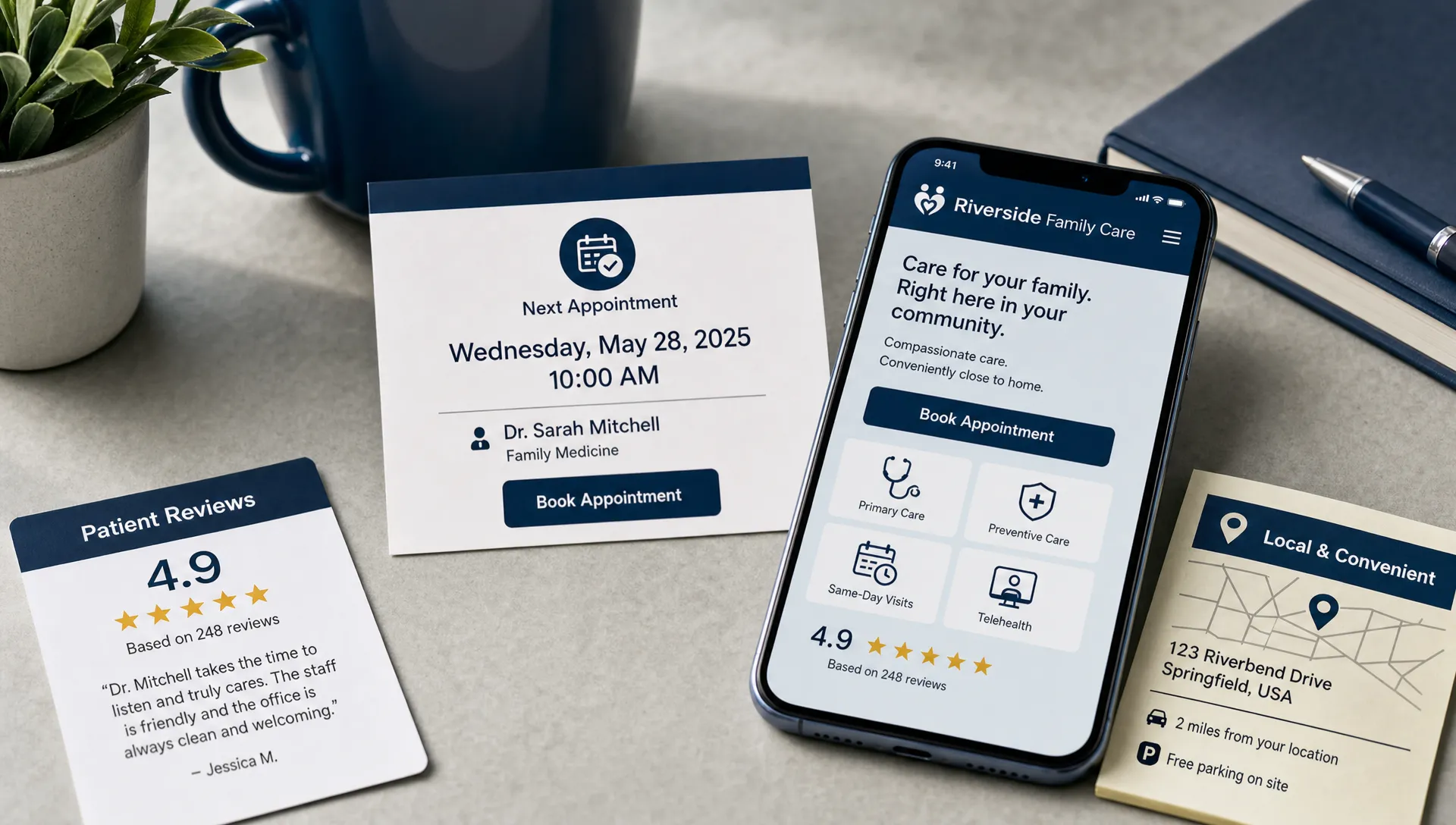
Patients do not choose a healthcare practice from a logo alone. They choose after a sequence of small trust decisions: Can I find this practice? Do they treat my problem? Do they seem credible? Is the office close? Can I book without friction? For Louisville healthcare practices, your website is where those decisions either become a scheduled appointment or disappear into another provider’s calendar.
That is why Louisville website design still drives patient growth in 2026, even as AI search, social media, paid ads, online reviews, and referral networks keep evolving. A modern healthcare website is not just a digital brochure. It is the center of your patient acquisition system, connecting visibility, trust, education, conversion, and follow-up.
For dentists, orthodontists, optometrists, chiropractors, pain physicians, physical therapists, and specialty clinics, the right website does more than look professional. It helps the right local patients take the next step.
Website design is still where patient intent becomes action
Many healthcare practices invest in Google Ads, SEO, reputation management, direct mail, or social media, but all of those channels eventually send patients somewhere. In most cases, that destination is the website.
A patient searching for dental implants in Louisville, dry eye treatment near me, chiropractor for back pain, or pain management clinic Louisville is already showing intent. They may not be ready to call within seconds, but they are actively comparing options. Your website has to meet that intent quickly.
A growth-focused healthcare website answers five questions almost immediately:
- What does this practice do?
- Do they treat my specific condition or need?
- Can I trust them with my health, comfort, or family?
- Are they convenient for my location, schedule, and insurance expectations?
- What is the easiest way to call, request an appointment, or book online?
If the site is slow, vague, outdated, or hard to navigate on a phone, the patient does not need to formally reject you. They simply leave.
This is why design and growth are inseparable. Good design guides attention. It reduces uncertainty. It makes the next step obvious. In healthcare, that can be the difference between a high-intent visitor and a booked appointment.
Local trust matters more in healthcare than in most industries
Patients are not shopping for a commodity. They are choosing someone who may examine their eyes, treat their child’s teeth, manage chronic pain, perform a procedure, or help them recover mobility. That makes trust the primary conversion factor.
For a Louisville practice, trust has a local layer. Patients want to know that you understand the community, are easy to reach, have credible providers, and offer a comfortable experience. A generic website with stock language may look acceptable, but it rarely communicates why a local patient should choose your practice over another provider three miles away.
Healthcare website design should support trust through:
- Clear provider and team presentation
- Condition-specific or service-specific pages
- Visible reviews and reputation signals
- Realistic explanations of care, comfort, and expectations
- Simple contact and appointment pathways
- Location details that help patients picture the visit
This is especially important for higher-anxiety services. A dental patient may delay treatment because of fear. A pain patient may feel skeptical after failed treatments. A parent may want reassurance before choosing a pediatric dentist or orthodontist. A vision patient may want confidence before LASIK, cataract, or dry eye care.
The best healthcare websites speak to those concerns before asking for the appointment.
The lesson for local practices is not to copy another clinic, but to notice how patient reassurance and conversion cues work together.
The website is the hub of SEO, ads, and AI visibility
Search visibility does not stop at rankings. A website must support what happens after the click.
For healthcare practices, SEO usually depends on strong service pages, local relevance, technical performance, helpful content, and clear signals about who you serve. Google Ads also depends heavily on landing page relevance, page experience, and conversion paths. AI search experiences increasingly summarize providers and answers from across the web, which makes clear, structured, trustworthy website content even more important.
In other words, your website is not separate from marketing. It is the place where marketing becomes measurable.
| Growth channel | What sends patients to the site | What the website must do next |
|---|---|---|
| Local SEO | Google Search, Maps, and location-based queries | Match patient intent with relevant services, locations, and trust signals |
| Google Ads | High-intent paid searches | Create a fast, focused path from keyword to call or form submission |
| Reviews and referrals | Patients researching after hearing your name | Reinforce credibility, services, and convenience |
| Social media | Awareness and educational content | Turn curiosity into a clear next step |
| AI search | Summaries, recommendations, and answer engines | Provide structured, accurate, patient-centered information |
This is also why healthcare practices should avoid treating web design as a one-time cosmetic project. If you are investing in SEO or paid ads, the site needs to be built to capture that demand. Louisville Web Lab explains this relationship in more detail in its guide on how website design and SEO work together to drive more bookings.
Mobile experience is now a patient access issue
Most patients do not begin their search on a large desktop monitor in a quiet room. They search from a phone between meetings, in the school pickup line, on the couch, during a lunch break, or while dealing with discomfort.
That changes what good Louisville website design needs to accomplish.
A mobile healthcare website should load quickly, make phone numbers easy to tap, keep forms short, show location details clearly, and allow patients to move from symptoms or services to scheduling without hunting through menus. If a patient has to pinch, zoom, wait, or dig, the design is creating resistance at the exact moment the patient is considering care.
Mobile design also affects perception. A dated or clunky mobile site can make a practice feel less current, even if the clinical care is excellent. Patients may not consciously think, this site is poorly optimized. They simply feel uncertainty.
For practices in competitive areas of Louisville, that feeling matters. A patient comparing three orthodontists, two optometrists, or several pain clinics may choose the one that feels easiest, clearest, and most trustworthy online.
Service pages turn broad interest into qualified appointments
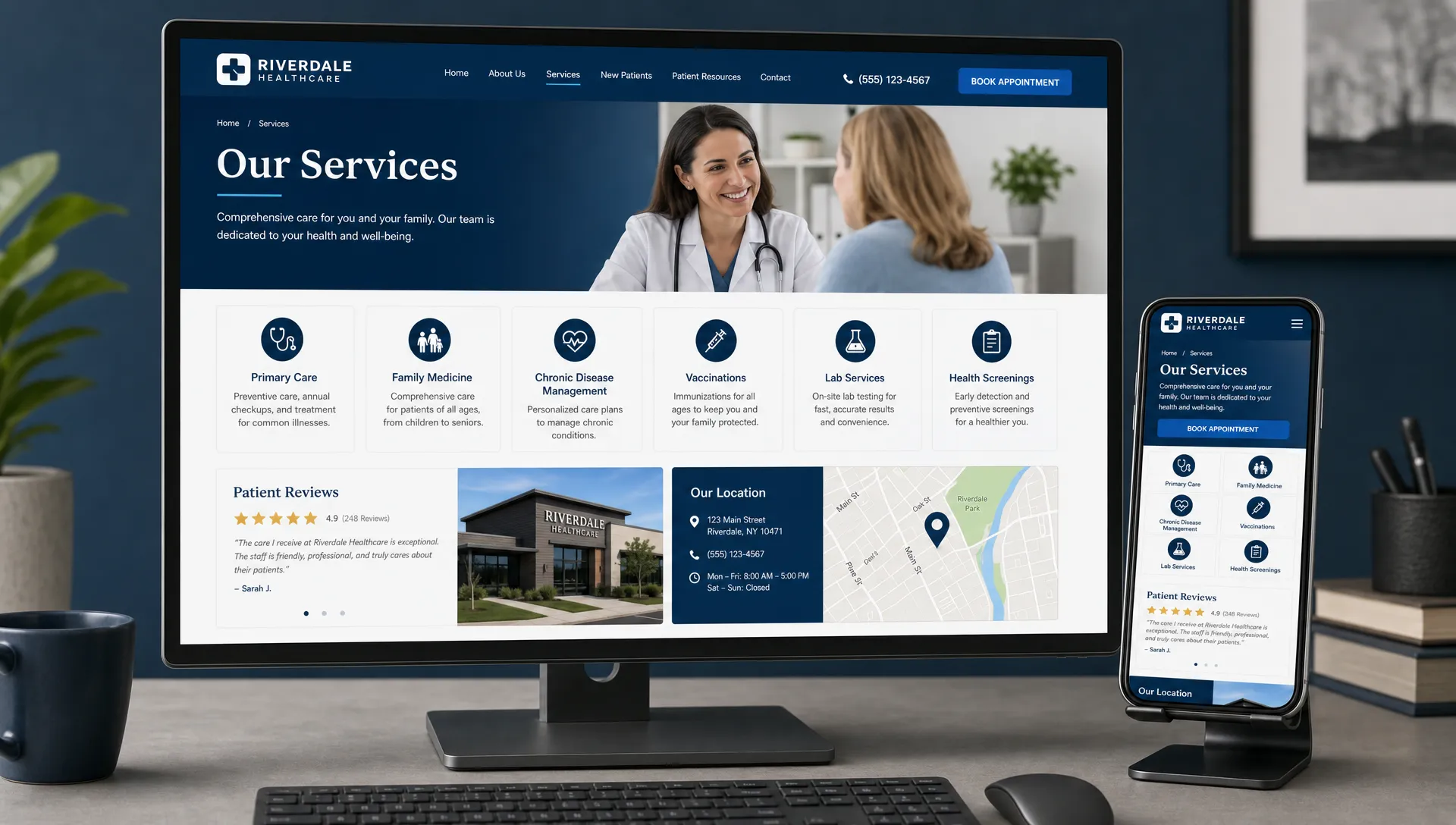
One of the biggest website mistakes healthcare practices make is relying on a single general services page. A short list of treatments might technically tell visitors what you offer, but it rarely captures search intent or answers patient questions.
A general dentist, for example, may need separate pages for preventive care, emergency dentistry, cosmetic dentistry, dental implants, clear aligners, and pediatric dentistry if those services are part of the growth strategy. An optometry practice may need pages for eye exams, dry eye, contact lenses, myopia management, diabetic eye exams, or specialty testing. A pain or chiropractic practice may need pages organized by condition, treatment, and patient goal.
Strong service pages help growth because they do three jobs at once. They improve relevance for search engines, educate patients in plain language, and create a more direct path to booking.
A good healthcare service page usually includes:
- The condition, symptom, or treatment explained clearly
- Who the service is for
- What patients can expect during the visit
- Why timely care matters
- Trust signals such as provider experience, reviews, or technology when accurate
- A clear call to schedule, call, or request an appointment
This structure matters because patients often search by their immediate problem, not by your internal service categories. They may type tooth pain, blurry vision, sciatica, knee pain, migraines, or Invisalign cost before they search for a specific provider.
Conversion design reduces leakage from every marketing channel
Patient growth is not only about getting more traffic. It is also about losing fewer qualified visitors.
A practice might already receive plenty of website visits from Google, ads, social posts, directory listings, or referrals. If the site does not convert, the growth problem may not be visibility. It may be leakage.
Common conversion leaks include buried phone numbers, unclear appointment buttons, long forms, weak service pages, no location context, generic copy, slow mobile speed, outdated visuals, and calls to action that appear only at the bottom of the page.
A better website creates repeated, natural opportunities to act. That does not mean aggressive pop-ups or pushy language. In healthcare, conversion design works best when it feels helpful. Patients should be able to call from the header, request an appointment from service pages, find office information quickly, and understand what happens after they reach out.
For example, an emergency dental patient needs a fast path to contact. A parent comparing pediatric dentists may need reassurance first. A pain patient considering injections or regenerative medicine may need education and credibility before scheduling. A LASIK or cataract patient may need information about candidacy and consultation steps.
Design should adapt to those different decision paths.
Healthcare websites need a different strategy than generic local business sites
A restaurant website can lead with atmosphere and a menu. A home services website can lead with urgency and pricing. A healthcare website has to balance marketing with clarity, trust, ethical communication, and patient experience.
That is why a healthcare practice should not judge a web design partner only by whether the site looks modern. The more important question is whether the site supports patient acquisition in a medically appropriate way.
Healthcare website design has to consider patient anxiety, service line complexity, provider credibility, review signals, local SEO, accessibility, privacy expectations, and appointment workflow. It also has to avoid vague claims that sound impressive but do not help patients make decisions.
For a deeper comparison, Louisville Web Lab has covered why Louisville website design for healthcare should differ from a generic business site. The key point is simple: medical practices need websites that guide people through trust, understanding, and action, not just visual polish.
Design also shapes the quality of patient leads
More leads are not always better. A busy front desk can quickly become overwhelmed by unqualified calls, confused form submissions, insurance mismatch questions, or patients asking for services the practice does not prioritize.
Good website design helps pre-qualify patient interest without creating barriers. It clarifies what you treat, who you serve, where you are located, how to start, and what the patient should expect. That means the people who contact you are more likely to be aligned with the care you provide.
This is especially valuable for specialty and higher-value services, including dental implants, orthodontics, LASIK, cataract surgery, pain management, physical therapy, sports medicine, and regenerative care. The website should not just create volume. It should create the right conversations.
For example, a dental implant page should help patients understand the consultation process, the importance of evaluation, and the practice’s approach to restoring function and confidence. A dry eye page should help patients recognize symptoms and understand that treatment may require more than over-the-counter drops. A pain management page should help patients see the difference between temporary relief and a structured care plan.
When patients arrive more informed, calls become more productive and appointments become easier to schedule.
Reputation and reviews need to be built into the site experience
Reviews influence patient decisions, but many practices treat them as something that only lives on Google Business Profile or third-party platforms. Your website should bring reputation into the patient journey.
That does not mean copying every review onto every page. It means using reputation signals where they support the decision being made. A homepage may feature overall credibility. A service page may include testimonials relevant to that type of care if available and appropriate. A location page may reinforce convenience and local patient experience.
For healthcare practices, reputation also includes more than star ratings. It includes the clarity of provider bios, the professionalism of the site, the quality of educational content, the consistency of branding, and how easy it is to contact the practice.
Patients are asking, can I trust this team? Every element of the website contributes to the answer.
What Louisville practices should prioritize in 2026
The fundamentals of patient growth have not disappeared. They have become more integrated. A site that looked acceptable five years ago may now underperform because patient expectations, mobile behavior, search results, and competitor websites have moved forward.
In 2026, Louisville healthcare practices should prioritize the website improvements most connected to growth:
- Faster mobile loading and cleaner page structure
- Service pages aligned with patient search behavior
- Prominent click-to-call and appointment options
- Clear provider, location, and review signals
- Content that answers real patient questions without jargon
- SEO foundations that support local visibility
- Landing pages for ads and high-priority service lines
- Tracking that connects traffic sources to calls, forms, and booked appointments
For a more tactical look at what is changing now, see Louisville Web Lab’s guide to 2026 website design trends for healthcare practices. Trends matter most when they improve patient trust, speed, and scheduling behavior.
How to tell if your website is holding growth back
A website does not need to be broken to be underperforming. In many cases, the practice team is too close to the site to see the friction patients experience.
Here are practical signs your website may be limiting patient growth:
- Your traffic is steady, but appointment requests are weak
- Google Ads generate clicks but not enough qualified leads
- Patients frequently call with basic questions that the site should answer
- Your highest-value services are hard to find from the homepage
- The mobile site feels slower or harder to use than competitor sites
- Provider credibility, reviews, and location details are not immediately visible
- Your pages explain what you offer, but not why patients should act now
If several of these sound familiar, the issue may not be your market. It may be the way your website is translating attention into action.
A growth-focused audit should look at search visibility, page speed, mobile usability, service page depth, calls to action, lead tracking, and the full path from first click to booked appointment. The goal is not just to redesign. The goal is to remove the barriers between patient intent and scheduling.
Frequently Asked Questions
Does website design really affect patient growth? Yes. Website design affects how easily patients find information, trust the practice, and take action. For healthcare practices, better design can improve calls, form submissions, appointment requests, and the quality of patient inquiries.
What makes Louisville website design different for healthcare practices? Local healthcare websites need to combine community relevance, patient trust, service clarity, mobile usability, and conversion paths. A practice website must support sensitive decision-making, not just present a business online.
Should my practice redesign its website or focus on SEO first? If the website is slow, unclear, or difficult to use, SEO alone may send traffic to a poor experience. In many cases, website design and SEO should be planned together so visibility turns into booked appointments.
How often should a healthcare practice update its website? Practices should review performance at least quarterly and consider a deeper strategic update when services change, rankings decline, mobile performance lags, or competitors offer a clearer online experience. A full redesign timeline depends on site quality and growth goals.
What pages are most important for patient acquisition? The homepage, service pages, location pages, provider bios, contact page, and high-priority landing pages usually matter most. For growth, each page should answer patient questions and offer a clear next step.
Turn your website into a patient growth system
Louisville website design still drives patient growth because patients still need clarity before they choose care. Search engines, ads, reviews, and referrals can create awareness, but your website is where trust becomes action.
If your practice serves patients in dentistry, orthodontics, optometry, chiropractic, pain management, physical therapy, or specialty care, your website should be more than attractive. It should help the right patients find you, understand you, trust you, and schedule with you.
Louisville Web Lab helps healthcare practices connect SEO, Google Ads, website design, automation, reputation, and conversion strategy into patient acquisition systems. If you are unsure whether your website is helping or holding back growth, start with a diagnostic strategy conversation and identify the highest-impact opportunities first.