
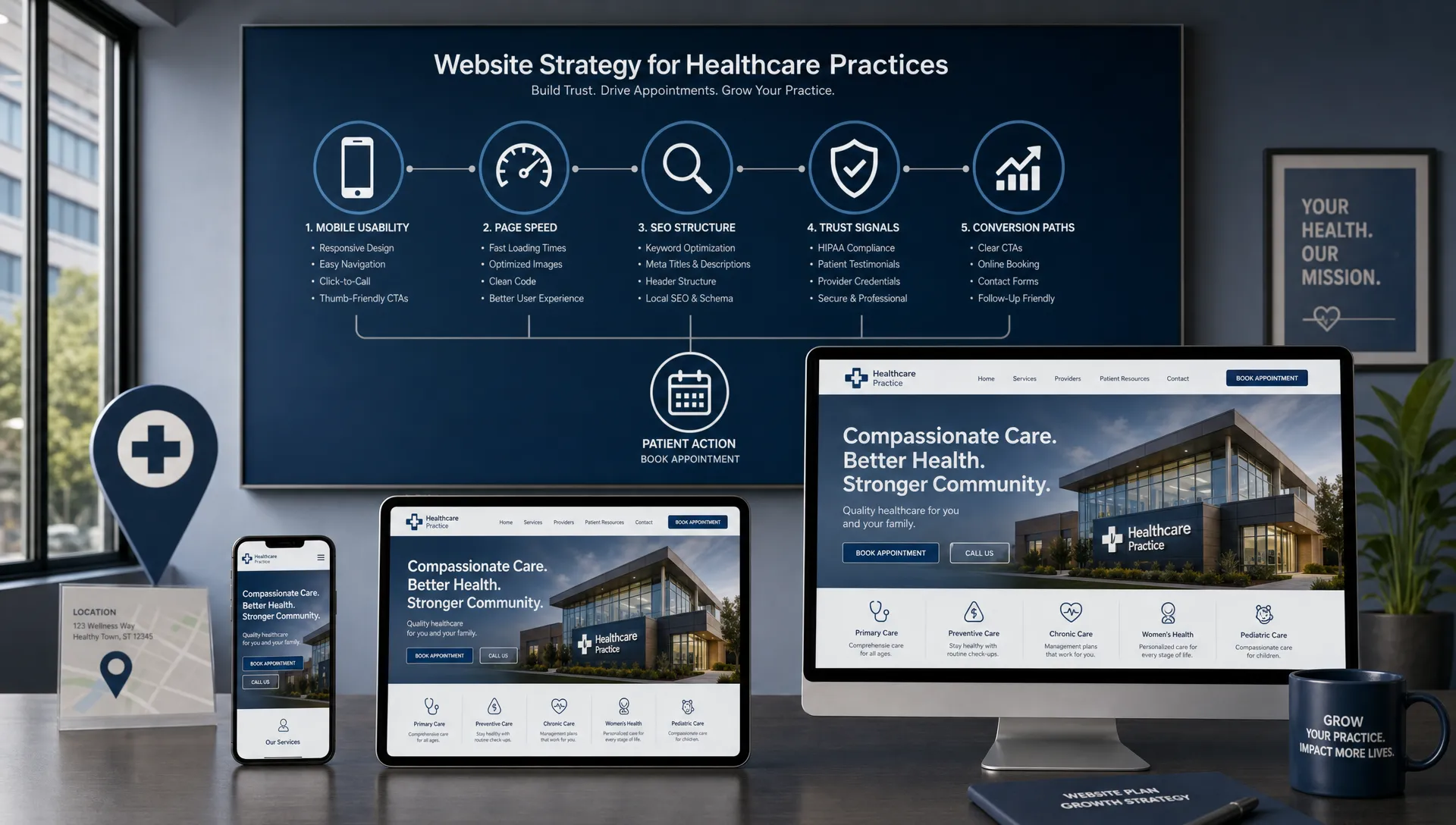
A responsive website is no longer a nice-to-have for healthcare practices. It is the front door many patients use before they ever call, book, or walk in. For dentists, orthodontists, optometrists, chiropractors, pain physicians, physical therapists, and specialty clinics, the question is not whether your website works on mobile. The real question is whether it helps the right patients take the next step.
A responsive web design company should deliver more than a layout that shrinks to fit a phone screen. It should deliver a patient acquisition asset: fast, clear, trustworthy, searchable, measurable, and easy to use across devices.
That distinction matters. A site can technically be responsive and still lose patients because the call button is buried, forms are awkward, pages load slowly, service content is thin, or the mobile experience feels confusing. The right partner should prevent those problems before launch.
Responsive design is a business outcome, not just a design feature
Responsive web design means the website adapts to different screen sizes and device types. But for a healthcare practice, that definition is incomplete. A strong responsive site should adapt to patient behavior, too.
A parent looking for a pediatric dentist may be searching from a phone in a parking lot. A patient comparing LASIK providers may browse on desktop at night, then call from mobile the next day. Someone in pain may search for a chiropractor or pain clinic and make a decision within minutes. Each scenario requires a site that presents the right information quickly and makes conversion easy.
Google also treats mobile seriously. Google Search Central explains mobile-first indexing, meaning Google primarily uses the mobile version of a page for indexing and ranking. If your mobile site hides content, loads slowly, or creates a poor user experience, your visibility and conversions can suffer.
A capable responsive web design company should understand that mobile performance, SEO structure, patient trust, and appointment flow all work together.
Strategy should come before mockups
The first deliverable should not be a homepage concept. It should be a clear strategy.
Before designing, your web partner should learn how your practice grows. That includes your highest-value services, target locations, patient types, insurance or payment considerations, referral patterns, and the actions you want visitors to take. A dental implant practice does not need the same site structure as a pediatric optometry clinic. A multi-location orthopedic group has different conversion paths than a single-location chiropractic office.
A strategy phase should clarify:
- Which services need dedicated pages because patients search for them directly.
- Which calls to action matter most, such as calling, requesting an appointment, or submitting a form.
- Which trust signals patients need before contacting the practice.
- Which locations, providers, and specialties should be emphasized.
- How the website will support SEO, paid ads, reviews, and patient follow-up.
This is where healthcare-specific experience becomes valuable. A general designer may focus on aesthetics first. A healthcare-focused partner should connect design decisions to appointment growth, local search visibility, and patient confidence.
If you are comparing vendors more broadly, Louisville Web Lab has a related guide on what to look for in a website design and SEO company, especially for practices that need both visibility and conversions.
The core deliverables a responsive web design company should provide
A serious proposal should describe what the company will actually deliver, not just say the site will be modern, clean, or mobile-friendly. The table below outlines the essentials healthcare practices should expect.
| Deliverable | What it should include | Why it matters for healthcare practices |
|---|---|---|
| Patient-focused strategy | Service priorities, location strategy, conversion goals, patient journey mapping | Aligns the website with booked appointments, not just visual preferences |
| Mobile-first UX | Clear navigation, tap-to-call buttons, readable content, easy forms, fast paths to services | Reduces friction for patients searching from phones |
| Responsive development | Layouts tested across phones, tablets, laptops, and desktop screen sizes | Ensures the site works consistently for real users |
| Speed optimization | Compressed images, clean code, efficient scripts, caching, performance testing | Supports user experience, SEO, and ad landing page performance |
| SEO foundation | Crawlable pages, proper headings, metadata, internal linking, local service structure | Helps search engines understand what the practice offers and where |
| Trust and conversion elements | Reviews, provider bios, credentials, photos, financing or insurance cues, clear CTAs | Gives patients enough confidence to contact the practice |
| Accessibility basics | Color contrast, keyboard usability, form labels, readable type, alt text | Makes the site easier for more patients to use |
| Measurement plan | Call tracking, form tracking, analytics events, conversion reporting | Shows whether the site is producing leads and appointment opportunities |
| Launch and QA | Browser testing, device testing, redirects, form testing, tracking validation | Prevents avoidable errors that can cost leads after launch |
| Post-launch improvement | Performance reviews, content updates, SEO refinement, conversion testing | Keeps the website improving after it goes live |
These deliverables should be visible in the scope of work. If they are missing, you may be buying a brochure site instead of a growth-focused website.
Mobile user experience should remove appointment friction
Mobile users are often impatient because they are trying to solve a specific problem. They want to know if you treat their condition, whether you are nearby, if you seem trustworthy, and how to contact you.
A responsive web design company should design mobile pages around those decisions. Your phone number should be easy to tap. Appointment requests should not require excessive typing. Directions and location details should be simple to find. Service pages should answer the most urgent patient questions near the top, without forcing visitors to scroll through vague branding copy.
For healthcare practices, the mobile experience should also account for emotional context. Patients may be anxious, in pain, embarrassed about a dental issue, or worried about a diagnosis. Clear content and calm design reduce uncertainty. Confusing navigation increases it.
Strong mobile UX usually includes concise page introductions, obvious next steps, legible font sizes, fast-loading images, and calls to action placed where they are helpful rather than intrusive. Sticky call buttons can work well when implemented carefully, but they should not cover important content or make the site feel aggressive.
For more tactical examples, see Louisville Web Lab’s guide to responsive web design tips that help practices book more patients.
Speed and technical quality should be built in
Patients notice slow websites, even if they do not describe the problem in technical terms. A slow site feels outdated, untrustworthy, and frustrating. On mobile, slow load times can cause visitors to abandon the page before they ever see your services or call button.
A responsive web design company should optimize performance from the start, not treat speed as a cleanup task after launch. That means using appropriately sized images, avoiding unnecessary plugins, minimizing heavy scripts, and testing pages on real mobile connections where possible.
Google’s Core Web Vitals documentation explains important user experience metrics such as loading performance, responsiveness, and visual stability. While these metrics are not the only factors that matter, they are useful indicators of whether a website feels smooth and reliable.
For practices running Google Ads, speed is even more important. If paid traffic lands on a slow mobile page, every wasted click costs money. A responsive design partner should understand how website performance affects both organic visibility and paid campaign efficiency.
SEO structure should support services, locations, and patient intent
Responsive design and SEO are closely connected, but they are not the same thing. A website can work on mobile and still fail to rank because the content structure is weak.
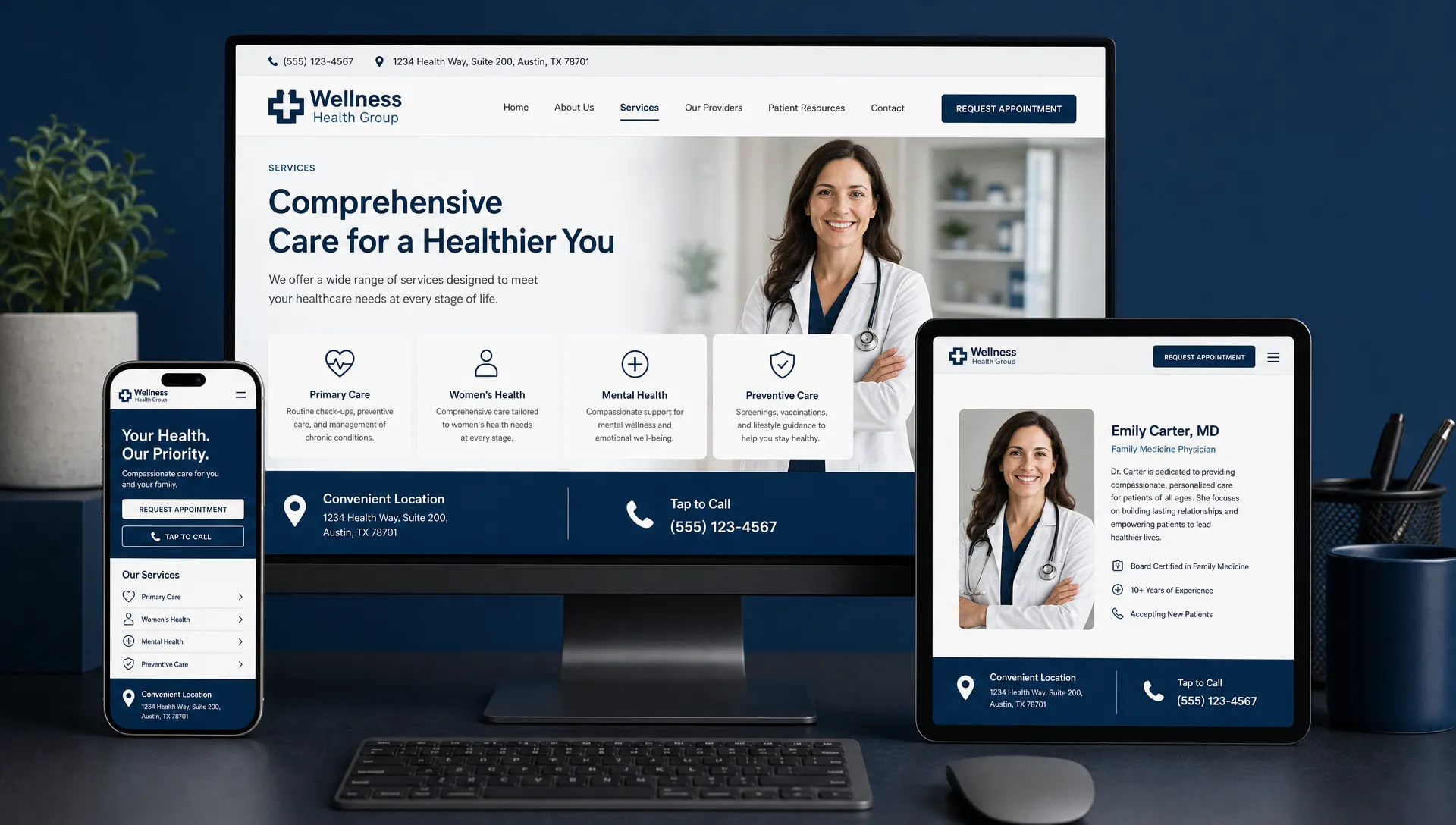
For healthcare practices, SEO structure should usually include clear service pages, location-specific information where appropriate, provider or team content, review integration, internal links, and metadata that accurately describes each page. The goal is to help patients and search engines understand exactly what the practice offers.
For example, a general dentistry site may need separate pages for dental cleanings, crowns, emergency dentistry, dental implants, and cosmetic services. An optometry clinic may need pages for eye exams, dry eye treatment, contact lenses, pediatric eye care, and specialty testing. A pain clinic may need pages for back pain, neck pain, joint pain, regenerative medicine, and interventional procedures.
The structure should be based on real patient demand, not just internal categories. Patients rarely search the way practices organize their services internally. A good responsive web design company should bridge that gap with patient-friendly content and logical navigation.
This also matters as search evolves. AI-assisted search experiences, map results, and traditional organic listings all rely on clear, well-structured information. Your website should make services, locations, providers, and patient next steps easy to understand.
Trust signals should be visible without overwhelming the page
Healthcare decisions require trust. A responsive website should make credibility easy to evaluate on every device.
Trust signals may include provider credentials, professional photography, patient reviews, before-and-after galleries where appropriate and compliant, affiliations, technology used in the practice, years of experience, accepted insurance details, financing options, and clear explanations of what to expect. Not every practice needs all of these elements, but every practice needs some proof that helps patients feel safe taking the next step.
The key is placement. A five-star review buried at the bottom of a desktop page may never be seen on mobile. A provider bio hidden three clicks deep may not support a patient who is deciding whether to request a consultation. Responsive design should bring credibility into the patient journey at the right moments.
For a dental implant page, that might mean showing experience, treatment steps, financing cues, and consultation options. For a pediatric clinic, it may mean warm photos, parent-friendly language, and reassurance about the first visit. For a pain management practice, it may mean clear explanations, referral information, and condition-specific expertise.
Accessibility should be part of quality, not an afterthought
Accessibility is not just a legal or technical topic. It is a patient experience topic. Healthcare websites often serve older adults, people with visual limitations, patients using assistive technology, and visitors under stress. Accessible design helps all of them.
A responsive web design company should pay attention to contrast, font size, link clarity, form labels, keyboard navigation, descriptive alt text, and error messages that are easy to understand. The W3C Web Content Accessibility Guidelines provide a widely used framework for making web content more accessible.
Accessibility also improves general usability. High-contrast buttons are easier to see outdoors on a phone. Clear form labels reduce mistakes. Descriptive headings help mobile users scan quickly. In healthcare, these small details can make the difference between a patient completing a request and giving up.
No agency should casually promise legal compliance without a proper review, but accessibility-informed design should be part of the build process.
Measurement should connect the website to patient growth
A responsive website should not launch into a black box. Your practice should know whether it is generating calls, form submissions, appointment requests, and other meaningful actions.
A good responsive web design company should define conversions before launch and configure tracking accordingly. This may include phone call clicks, form completions, appointment button clicks, landing page conversions, and traffic sources. Reporting should separate vanity metrics from business metrics. More traffic is useful only if it helps produce qualified patient opportunities.
Healthcare practices also need to be thoughtful about privacy. Marketing forms and analytics setups should avoid collecting unnecessary sensitive information, and practices should work with appropriate compliance advisors when handling patient data. Your agency should be careful, transparent, and practical about measurement rather than installing every tracking script available.
Measurement also creates a feedback loop. If mobile users visit an emergency dentistry page but rarely call, the issue may be the offer, page speed, call placement, or content clarity. If paid ad traffic converts on one landing page but not another, the design can be improved with evidence instead of opinions.
The handoff should give your practice control
A website launch is not the end of the relationship, but your practice should still understand what it owns and how the site works. A professional handoff should include training, documentation, access credentials, and clear responsibilities for future updates.
At minimum, your web partner should explain how to update basic content, what happens when staff or services change, who manages hosting, who monitors forms, and how technical issues are handled. If the website is built in a content management system, the editing experience should be realistic for your team. If the agency manages updates for you, the support process should be clear.
The handoff should also include a launch checklist. Redirects should be tested if URLs changed. Forms should be submitted and verified. Phone links should work on mobile. Analytics and conversion tracking should be checked. Major browsers and screen sizes should be reviewed. Search engines should be able to crawl the site.
A beautiful site with broken forms is not a successful launch.
Red flags when hiring a responsive web design company
Some agencies use the term responsive as a checkbox. Healthcare practices should look deeper. If a proposal is vague, ask what will actually be tested, built, measured, and improved.
Watch for these red flags:
- The company only shows desktop mockups and treats mobile as a resized version.
- The proposal does not mention page speed, SEO structure, accessibility, or conversion tracking.
- Service pages are generic and not built around patient search intent.
- The design hides phone numbers, locations, reviews, or appointment options on mobile.
- The agency cannot explain how the website will support local SEO or Google Ads.
- Forms ask for too much information before a patient has built trust.
- There is no launch QA process or post-launch improvement plan.
The right partner should be able to explain how design decisions affect real practice outcomes. If the conversation stays at the level of colors, fonts, and templates, the project may not produce the growth you expect.
How to evaluate proposals before you sign
When reviewing proposals, compare the thinking behind the work, not just the price. A lower-cost website can become expensive if it fails to rank, loads slowly, or needs to be rebuilt within a year.
Ask each company how they approach mobile-first design, local SEO, patient conversion, content planning, and tracking. Ask whether they test on real devices. Ask what happens after launch. Ask who writes or edits the content. Ask how they will structure pages for your most important services and locations.
You should also ask for examples relevant to healthcare or local service businesses. A restaurant website, ecommerce brand, or SaaS landing page may show design talent, but healthcare practices have different trust requirements, compliance considerations, and conversion paths.
If you want a broader breakdown of the pieces that support a strong practice website, Louisville Web Lab’s article on website design services every healthcare practice needs can help you compare scopes more confidently.
Frequently Asked Questions
What should a responsive web design company deliver first? The first deliverable should be strategy. Before design begins, the company should understand your services, patients, locations, conversion goals, and growth priorities so the website supports real appointment opportunities.
Is responsive design the same as mobile-friendly design? They are related, but not identical. Responsive design adapts layouts to different screens, while a truly mobile-friendly healthcare website also prioritizes speed, tap-friendly actions, readable content, simple forms, and clear patient next steps.
How does responsive web design affect SEO? Responsive design can support SEO by improving mobile usability, keeping content consistent across devices, reducing technical issues, and helping search engines crawl and understand your pages. It still needs strong content, site structure, and local optimization.
Should a healthcare website include online forms? Forms can be useful, but they should be short, clear, and privacy-conscious. Practices should avoid requesting unnecessary sensitive information through marketing forms and should consult appropriate compliance guidance for patient data handling.
How often should a responsive healthcare website be updated? The site should be reviewed regularly for content accuracy, speed, broken links, form performance, SEO opportunities, and conversion trends. Service changes, provider updates, new locations, and campaign data should all trigger updates.
Build a responsive website that helps patients take action
A responsive web design company should deliver more than a site that looks good on a phone. It should deliver strategy, speed, SEO structure, accessibility, trust, measurement, and a clear path from search to appointment.
Louisville Web Lab helps healthcare practices turn search visibility into qualified leads and booked appointment opportunities through websites, SEO, Google Ads, and patient acquisition systems. If your practice needs a website built around growth instead of guesswork, schedule a diagnostic call with Louisville Web Lab.