
A website is no longer a digital brochure for a healthcare practice. In 2026, your site is part front desk, part reputation engine, part local search asset, and part patient acquisition system. That means the right web development agency should deliver far more than attractive pages and a contact form.
For dentists, orthodontists, optometrists, chiropractors, pain physicians, physical therapists, and specialty clinics, the standard is higher than it used to be. Patients compare providers quickly, often on mobile, often while in pain, and often after seeing multiple competitors in Google search results. Your website has to answer their questions, reduce uncertainty, build trust, and make the next step obvious.
Here is what a serious web development partner should be responsible for in 2026, especially if your practice depends on local visibility and booked appointments.
Strategy before design or code
A strong agency should not begin by asking what colors you like. It should begin by understanding how your practice grows.
Before wireframes, page layouts, or platform choices, the agency should clarify your highest-value services, ideal patient types, service area, competitive landscape, referral patterns, and appointment goals. A cosmetic dentist, pediatric dental office, cataract surgeon, and pain management clinic may all need excellent websites, but they do not need the same structure, copy, calls to action, or conversion path.
The discovery process should answer questions like:
- Which services produce the best clinical and business fit?
- What conditions or treatments do patients search for before calling?
- Which locations, suburbs, or neighborhoods matter most?
- What objections stop patients from booking?
- What proof points help patients feel safe choosing the practice?
Without this strategy, a new website can look modern but fail commercially. In healthcare, that usually means unclear service pages, weak provider positioning, poor local SEO structure, and call-to-action buttons that do not match how patients actually make decisions.
If you are comparing partners locally, Louisville Web Lab’s guide to how healthcare practices should choose web design services goes deeper into the business criteria that matter before design begins.
A patient-centered website architecture
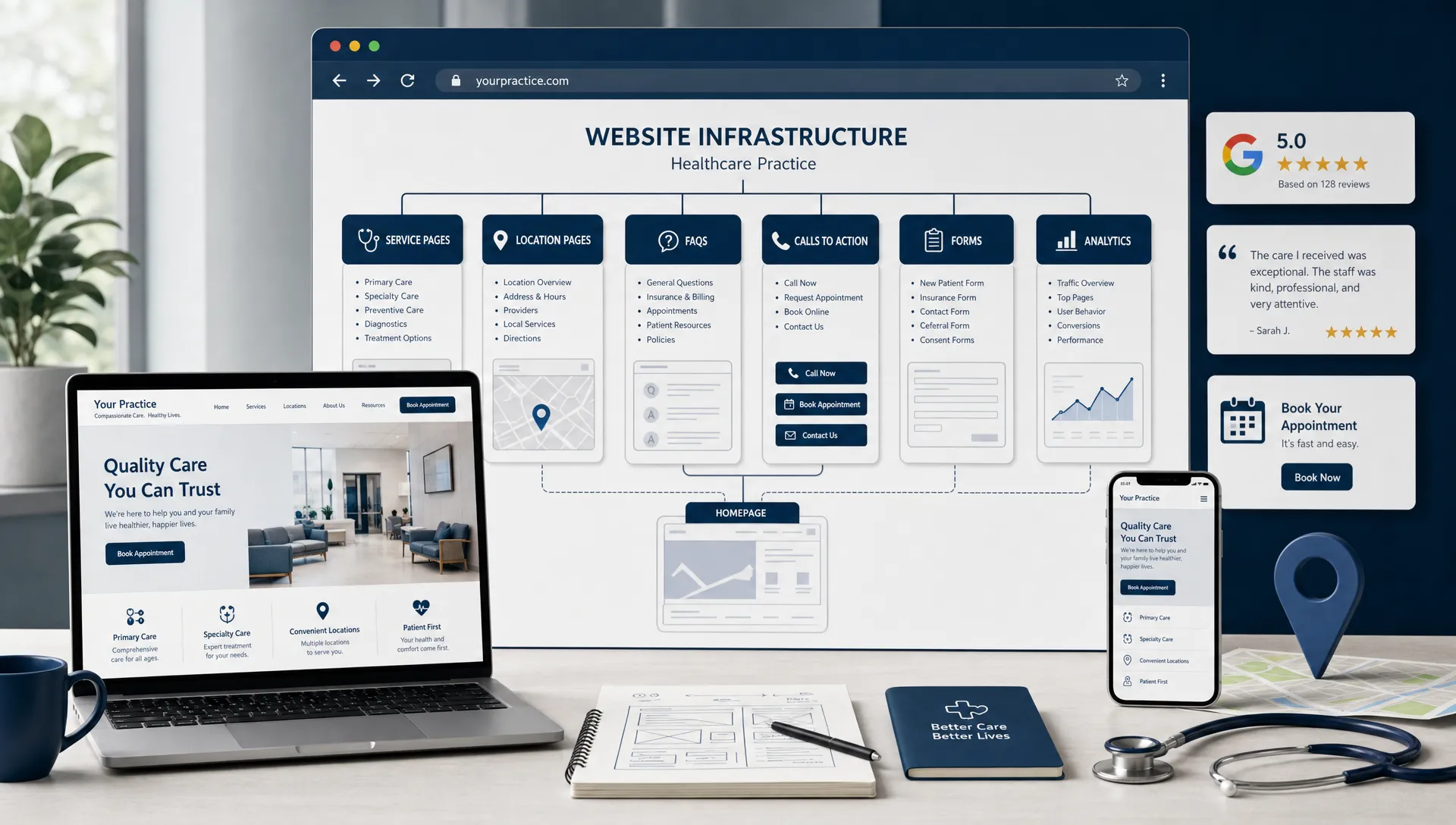
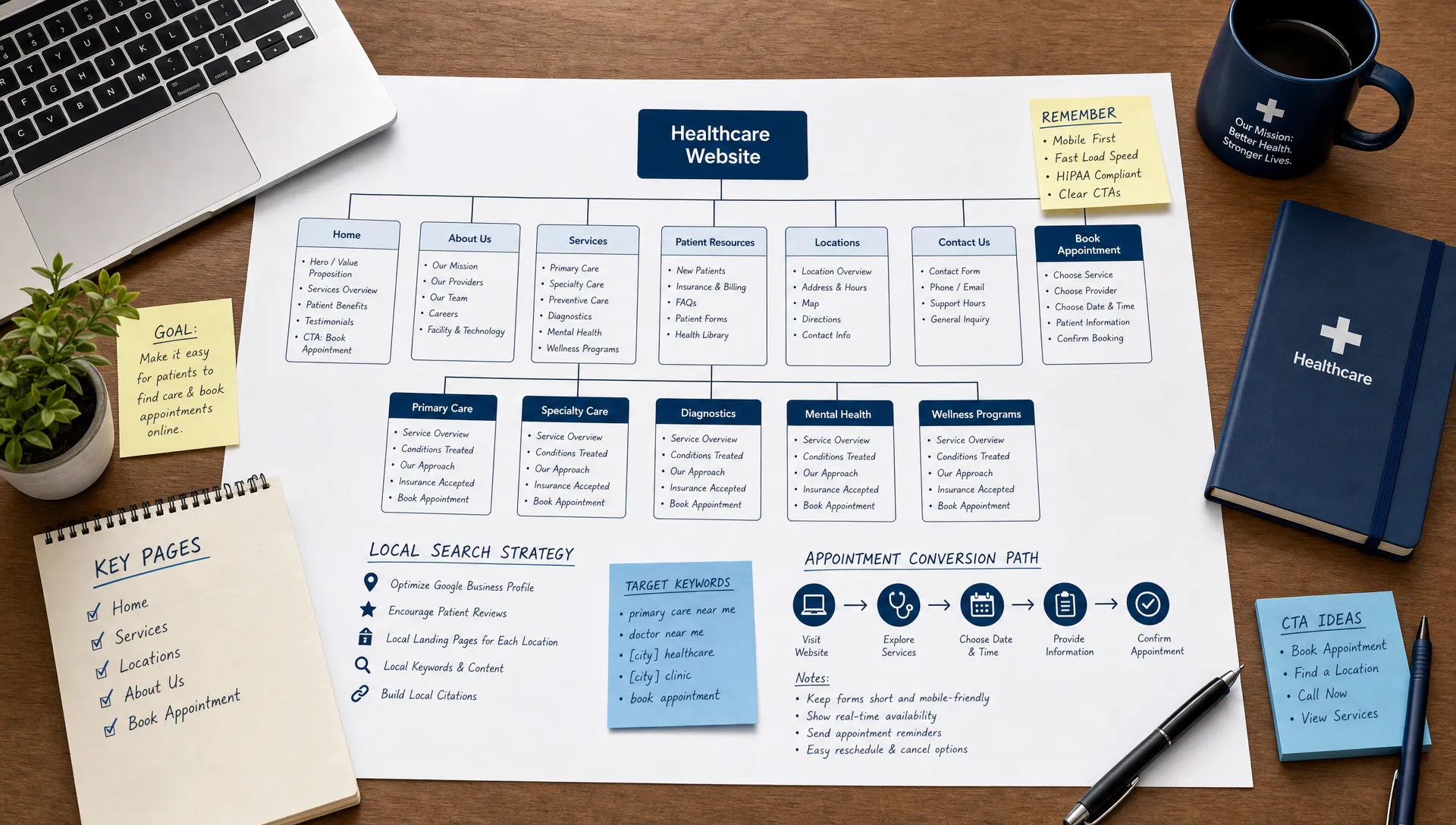
In 2026, a web development agency should deliver a clear information architecture, not just a collection of pages. Patients should be able to understand who you help, what you treat, where you are located, and how to book within seconds.
For a healthcare practice, the core structure often includes home, about, providers, services, conditions, location pages, insurance or payment information, reviews or testimonials where appropriate, FAQs, and conversion-focused contact or appointment pages. The exact structure depends on the practice type, but the principle is consistent: each page should have a job.
A good agency should also understand the difference between a treatment page and a condition page. For example, an orthopedic or pain clinic may need pages for “knee pain,” “sciatica,” and “shoulder pain,” as well as pages for specific treatments. A dental implant specialist may need educational pages for missing teeth, implant dentures, single-tooth implants, and full-arch options. These pages help patients find relevant answers and help search engines understand the practice’s expertise.
The agency should map pages around patient intent, not internal office language. Patients may not search for the same terms clinicians use. A smart site structure bridges that gap without oversimplifying the clinical reality.
Fast, stable, mobile-first performance
Website speed is not just a technical preference. It affects user experience, ad performance, SEO, and patient trust. If a page takes too long to load, many visitors will leave before they ever see your phone number.
Google’s documentation on Core Web Vitals highlights performance signals such as loading speed, interactivity, and visual stability. A qualified agency should know how to build for these metrics from the beginning rather than trying to fix them after launch.
For healthcare practices, mobile performance is especially important. Many patients search from a phone while comparing offices nearby. If your site has oversized images, delayed buttons, shifting layouts, or slow third-party scripts, you are creating friction at the exact moment someone might be ready to call.
A 2026-ready agency should deliver:
- Responsive layouts that work cleanly on modern phone sizes
- Fast-loading service and location pages
- Optimized images and lightweight code
- Clear tap targets for phone calls, appointment requests, and directions
- Stable pages that do not jump as they load
This is where development quality matters. A visually appealing design built on bloated code can quietly cost a practice leads every month.
Conversion paths built around real patient behavior
A modern healthcare website must make it easy for visitors to take the next step. That does not mean covering every page with aggressive popups. It means designing around the natural decision points of a patient.
Someone researching Invisalign may want before-and-after examples, financing information, and a consultation button. Someone looking for emergency dental care may need a phone number immediately. A dry eye patient may need to understand symptoms, treatment options, and whether the clinic handles their specific concern. A pain management patient may need reassurance about diagnosis, treatment planning, and next steps.
The best conversion paths are specific to the service and the level of urgency. A web development agency should help determine where to use click-to-call, online scheduling, forms, downloadable resources, live chat integrations, or landing pages. It should also ensure tracking is in place so the practice can understand which paths are producing calls, forms, and appointments.
For a practical comparison of how design choices influence leads, see Louisville Web Lab’s article on website design trends Louisville buyers respond to.
Search-ready development from day one
SEO cannot be treated as an afterthought. In 2026, web development and search visibility are too connected to separate completely.
A capable agency should build the site with clean crawlable structure, indexable pages, logical internal linking, optimized metadata, schema markup where appropriate, and service-area relevance. This is especially important for local healthcare practices that rely on Google Search and Google Business Profile visibility.
The agency should understand how local SEO works across your website and your broader digital presence. A location page is not just an address block. It should help patients understand the practice’s proximity, services, providers, parking or access details when relevant, and local context. Service pages should not be generic. They should reflect the procedures, conditions, patient questions, and differentiators that matter to your audience.
A website that is beautiful but invisible in search creates a dependency on paid ads. Paid media can be valuable, but organic visibility gives a practice more durable patient acquisition over time.
| 2026 deliverable | Why it matters for healthcare practices |
|---|---|
| Clear service page structure | Helps patients and search engines understand what the practice offers |
| Mobile-first performance | Reduces friction for nearby patients searching on phones |
| Local SEO foundations | Supports visibility in service areas and competitive local searches |
| Conversion tracking | Shows which pages and campaigns generate real inquiries |
| Accessible design | Improves usability and reduces avoidable barriers for patients |
| Secure forms and privacy-aware workflows | Protects patient trust and supports responsible lead handling |
Accessibility and usability as baseline requirements
Accessibility should be a standard part of professional web development. The Web Content Accessibility Guidelines provide a widely used framework for making websites more usable for people with disabilities.
For healthcare organizations, accessibility is not only a technical issue. It is part of patient experience. Visitors may have low vision, mobility limitations, cognitive challenges, temporary injuries, or difficulty using small mobile controls. If your website is hard to read, hard to navigate, or incompatible with assistive technology, it may prevent people from getting care.
A web development agency should account for readable typography, color contrast, keyboard navigation, descriptive link text, form labels, alternative text for meaningful images, and logical heading structure. These details also tend to improve the experience for everyone, not only people using assistive technologies.
Accessibility should be considered during design, development, content entry, and quality assurance. It is much harder to retrofit later.
Security, privacy, and responsible data handling
Healthcare websites often collect sensitive information, even when they are not full patient portals. A simple appointment request form can include names, phone numbers, symptoms, preferred appointment times, and other personal details. That means security and privacy-aware implementation matter.
A responsible agency should use secure hosting practices, SSL, reputable form handling, spam protection, role-based access where appropriate, and careful management of third-party tools. It should also be clear about what happens to form submissions and whether the website is integrated with scheduling, CRM, or patient communication systems.
Not every website form is automatically HIPAA-compliant simply because it appears on a healthcare site. The U.S. Department of Health and Human Services provides HIPAA guidance through the HHS Office for Civil Rights, but the correct technical and legal approach depends on the practice, vendors, data collected, and workflows. Your agency should be willing to discuss privacy implications and coordinate with your compliance advisors when needed.
This is one of the biggest differences between a generalist website vendor and a partner familiar with healthcare marketing. Patient trust can be damaged quickly by careless forms, unclear privacy practices, or overuse of tracking tools in sensitive contexts.
Content that builds trust, not filler
A web development agency should not treat content as decoration. Copywriting, page structure, and trust signals shape whether a visitor feels confident enough to contact the practice.
Healthcare content needs to be accurate, understandable, and specific. Patients want to know what a condition means, what treatment options may involve, who will provide care, whether the practice commonly handles their situation, and what the next step looks like. Thin, generic copy rarely answers those questions.
Trust-building content may include provider credentials, treatment philosophy, patient experience details, technology explanations, financing or insurance information, reviews where allowed and appropriate, and clear FAQs. For specialty practices, it may also include educational content that helps patients understand when to seek evaluation.
The goal is not to overwhelm readers. The goal is to reduce anxiety and help them make a confident decision.
Analytics and measurement that connect to growth
A website project should not end with “your site is live.” In 2026, a web development agency should help define how performance will be measured after launch.
At minimum, practices should understand traffic sources, top landing pages, form submissions, phone calls where call tracking is used, appointment request behavior, and conversion rates by page or campaign. For practices running Google Ads, analytics and landing page performance become even more important because wasted clicks can become expensive quickly.
Measurement should be set up with practical business questions in mind. Which services are generating inquiries? Which pages get traffic but fail to convert? Which locations need stronger visibility? Are visitors using online scheduling or calling instead? Are paid campaigns sending traffic to pages that match patient intent?
The right agency should make this data understandable. A monthly report full of vanity metrics is less useful than a focused discussion about what is driving booked appointments and what needs improvement.
Post-launch support and iteration
Healthcare marketing changes. Competitors update their websites. Search results shift. Services expand. Providers join or leave. Reviews grow. Insurance participation changes. New treatments become priorities. A website needs ongoing attention.
A 2026-ready agency should have a clear plan for post-launch updates, maintenance, technical monitoring, content improvements, conversion testing, and SEO iteration. That does not mean every practice needs a large monthly engagement, but it does mean the site should not be abandoned after launch.
Ask what happens after the first 30, 60, and 90 days. Ask who handles edits. Ask how technical issues are monitored. Ask whether new service pages can be added without rebuilding the site. Ask how performance, rankings, and conversions will be reviewed.
If you are evaluating agencies, Louisville Web Lab’s buyer’s guide to the best web design companies in Louisville can help you compare options with a more practical lens.
What to ask before hiring a web development agency
The best way to evaluate an agency is to ask about outcomes, process, and accountability. A polished portfolio is useful, but it does not tell the whole story.
Strong questions include:
- How do you decide what pages our healthcare website needs?
- How will the site support local SEO and Google Business Profile performance?
- What conversion actions will you track after launch?
- How do you handle mobile speed and Core Web Vitals?
- What accessibility standards do you build toward?
- How do you approach privacy and form submissions for healthcare practices?
- What happens after the website goes live?
Listen for specific answers. If every response is about design style, templates, or vague “SEO-friendly” claims, the agency may not be equipped to build a website that supports patient acquisition.
The 2026 standard: a website that works like infrastructure
A healthcare website should be treated as growth infrastructure. It should support search visibility, paid advertising, reputation, patient education, appointment conversion, and operational efficiency. It should also be easy for your team to keep accurate and useful over time.
The right web development agency brings together strategy, design, development, SEO, content, tracking, and healthcare-specific judgment. The result is not just a nicer website. It is a digital front door that helps the right patients find you, trust you, and take action.
For practices in competitive markets, that distinction matters. A website that merely exists online is easy to ignore. A website built around patient intent, local search, and measurable conversion can become one of the most important assets in the practice.
Frequently Asked Questions
What should a web development agency include in a healthcare website project? A complete project should include strategy, site architecture, design, development, mobile optimization, SEO foundations, accessibility, secure forms, analytics, and post-launch support. For healthcare practices, it should also account for patient trust, service-specific conversion paths, and local visibility.
How is a healthcare web development agency different from a general website agency? A healthcare-focused agency is more likely to understand patient behavior, provider credibility, local search competition, sensitive data concerns, and the need to turn website traffic into appointment requests. General agencies may create attractive sites but miss critical patient acquisition details.
Should SEO be part of web development in 2026? Yes. Technical SEO, page structure, internal linking, metadata, schema, site speed, and content organization should be built into the website from the start. Adding SEO after launch often means fixing avoidable structural problems.
How do I know if my current website is underperforming? Common signs include low organic visibility, weak mobile performance, few appointment requests, high ad spend with poor conversion, unclear service pages, outdated provider information, and no reliable tracking for calls or forms.
How often should a healthcare practice update its website? Most practices should review key pages, performance, and conversion data at least quarterly. Larger redesigns may happen every few years, but content, SEO, security, and usability improvements should be ongoing.
Ready to evaluate your website like a growth asset?
If your practice website looks fine but is not producing the visibility, calls, or appointment requests you expect, it may be time for a deeper diagnostic. Louisville Web Lab helps healthcare practices connect websites, SEO, Google Ads, and automation into patient acquisition systems.
You can start by booking a diagnostic strategy call with Louisville Web Lab to identify what your website should be doing next and where the biggest opportunities are for measurable growth.