
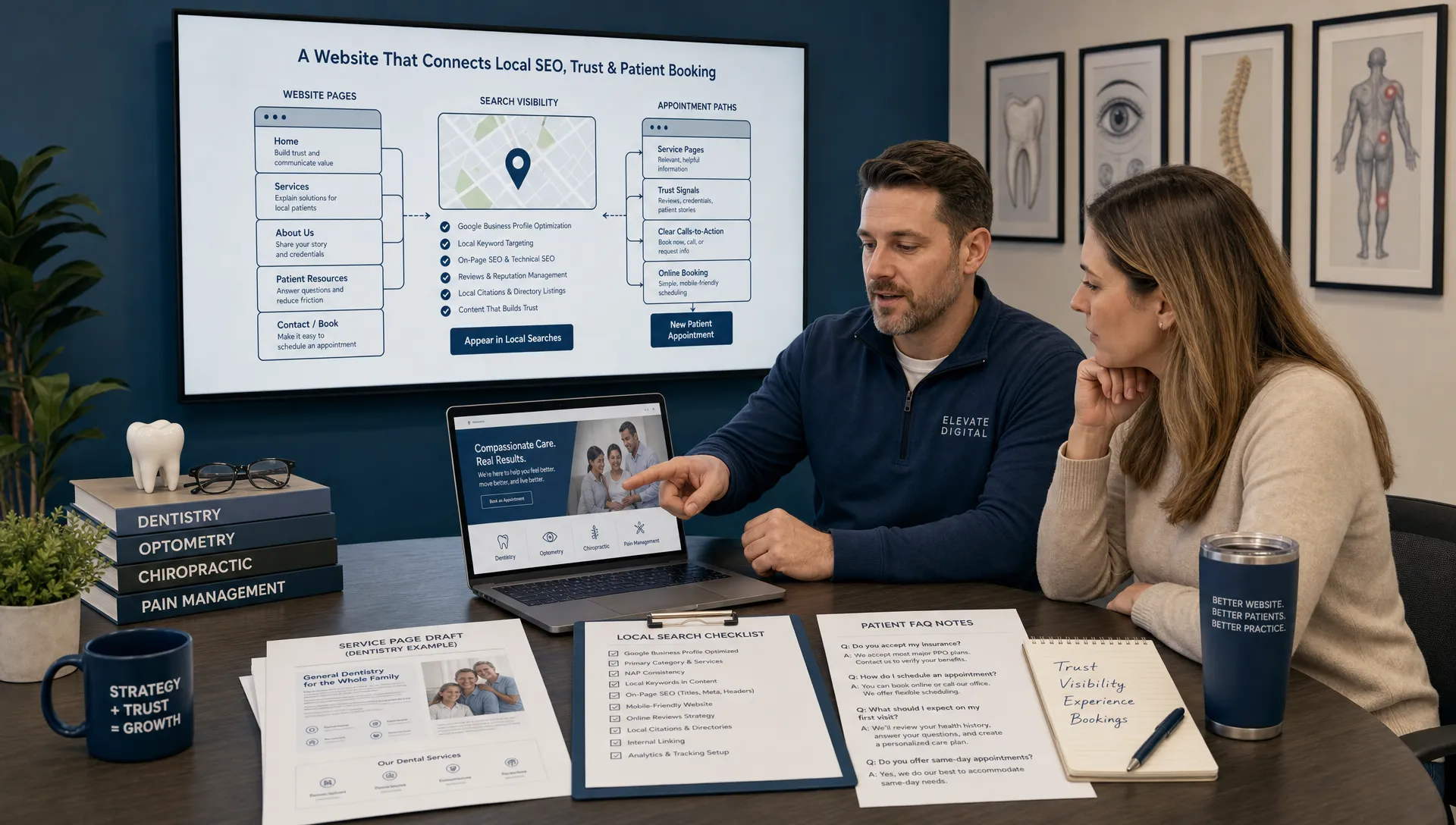
Choosing a website partner is not a cosmetic decision for a healthcare practice. Your site is often the first place a prospective patient decides whether you feel credible, convenient, and safe enough to call.
If you searched for web design services near me, you are probably trying to solve a practical problem: your current website looks dated, does not rank well, loads slowly, or is not turning visitors into appointments. The right provider should help with all of that, not just deliver a nicer homepage.
For dentists, orthodontists, optometrists, pain physicians, and other healthcare practices, the best web design services are built around one outcome: helping the right patients take the next step with confidence.
Start with the business outcome, not the design style
Before comparing portfolios, define what your website needs to accomplish. A cosmetic dentistry practice may need to attract high-value smile makeover consults. An optometry clinic may need to increase dry eye evaluations or annual eye exams. A pain management group may need to help patients understand treatment options before they request an appointment.
That clarity changes everything. A website built to “look modern” is different from a website built to support local search, educate patients, earn trust, and convert mobile visitors into calls, forms, or online bookings.
A strong web design partner should ask questions like:
- Which services are most profitable or strategically important?
- Which locations, cities, or neighborhoods matter most?
- What symptoms, conditions, or treatment terms do patients search before they find you?
- What objections stop people from booking?
- How will phone calls, forms, online scheduling, and ad campaigns be tracked?
If a provider jumps straight to colors, fonts, and templates without understanding your patient acquisition goals, that is a warning sign.
Local matters, but “near me” should not be the only filter
There is value in choosing a provider who understands your market. A local agency may know how patients compare healthcare options in your area, how competitive local search is, and what nearby practices are doing well online.
But proximity alone does not make a web design company the right fit. A nearby generalist who builds websites for restaurants, contractors, and retail stores may not understand healthcare conversion, service-line SEO, review signals, provider bios, or the trust concerns patients bring to medical and dental decisions.
When evaluating web design services near me, use location as one factor, not the deciding factor. The stronger question is: can this team build a website that helps patients find, trust, and contact my practice?
Some practices also compare niche agencies with broader managed marketing options. For healthcare, however, be sure any model you consider can handle patient trust, local visibility, and appointment-focused conversion.
The 7 criteria that matter most when choosing web design services
The best web design services combine strategy, content, design, SEO, technical execution, and measurement. Use the criteria below to compare providers more objectively.
| Evaluation area | Why it matters for healthcare practices | Questions to ask |
|---|---|---|
| Healthcare experience | Patient decisions involve trust, risk, insurance questions, symptoms, and provider credibility. | Have you built websites for practices like ours? What patient journey did you design for? |
| Local SEO planning | Your website should support Google visibility for services, providers, and locations. | How will you structure service pages, location pages, metadata, and internal links? |
| Conversion strategy | Traffic has little value if visitors do not call, schedule, or request a consult. | How will the site guide mobile users toward appointments? |
| Content quality | Patients need clear explanations before they feel ready to act. | Who writes the copy, and how do you make it accurate, helpful, and persuasive? |
| Technical performance | Slow, unstable, or confusing websites lose patients and weaken marketing performance. | How do you handle speed, mobile usability, accessibility, forms, and tracking? |
| Reputation signals | Reviews, credentials, before-and-after examples, and provider bios reduce hesitation. | Where will trust-building elements appear on the site? |
| Post-launch support | Websites need updates, testing, SEO improvements, and maintenance after launch. | What happens after the site goes live? |
Notice that “beautiful design” is not missing. It is important, but it should sit inside a larger strategy. A visually polished website that cannot be found, does not explain your services, or hides the appointment button is not doing its job.
Make sure SEO is planned before the site is designed
One of the most expensive mistakes a practice can make is treating SEO as something to “add later.” Search performance is affected by site architecture, page topics, headings, internal links, page speed, mobile experience, and content depth. Those decisions are made during the web design process.
For example, a dental implant specialist should not rely on one generic “Services” page. The site may need dedicated pages for dental implants, full-arch implants, bone grafting, implant consultations, and location-specific searches. An optometry practice may need separate pages for pediatric eye exams, dry eye treatment, myopia management, contact lenses, and emergency eye care.
A web design company that understands SEO will plan the site around how patients search, not just how the practice is organized internally. This is especially important when you are redesigning an existing website. If old URLs are removed without redirects, or if ranking pages are replaced with thin content, your traffic can drop after launch.
If you want a deeper framework for evaluating strategy, tracking, and search visibility, this guide on choosing an SEO and web design company covers many of the same decision points from a broader agency-selection perspective.
Review the portfolio like a patient, not a designer
Most practice owners look at a portfolio and ask, “Does it look good?” That is a fair starting point, but it is not enough. Instead, open the examples on your phone and pretend you are a patient trying to solve a problem quickly.
Can you understand what the practice does within a few seconds? Is the phone number easy to tap? Are services clearly explained? Do provider bios feel credible? Are reviews visible without overwhelming the page? Does the site make the next step obvious?
A good healthcare website should reduce uncertainty. Patients often arrive with concerns about pain, cost, recovery time, insurance, safety, appearance, or whether they are a candidate for care. The site should answer enough of those questions to make contacting the practice feel like the natural next step.
Ask how they approach conversion
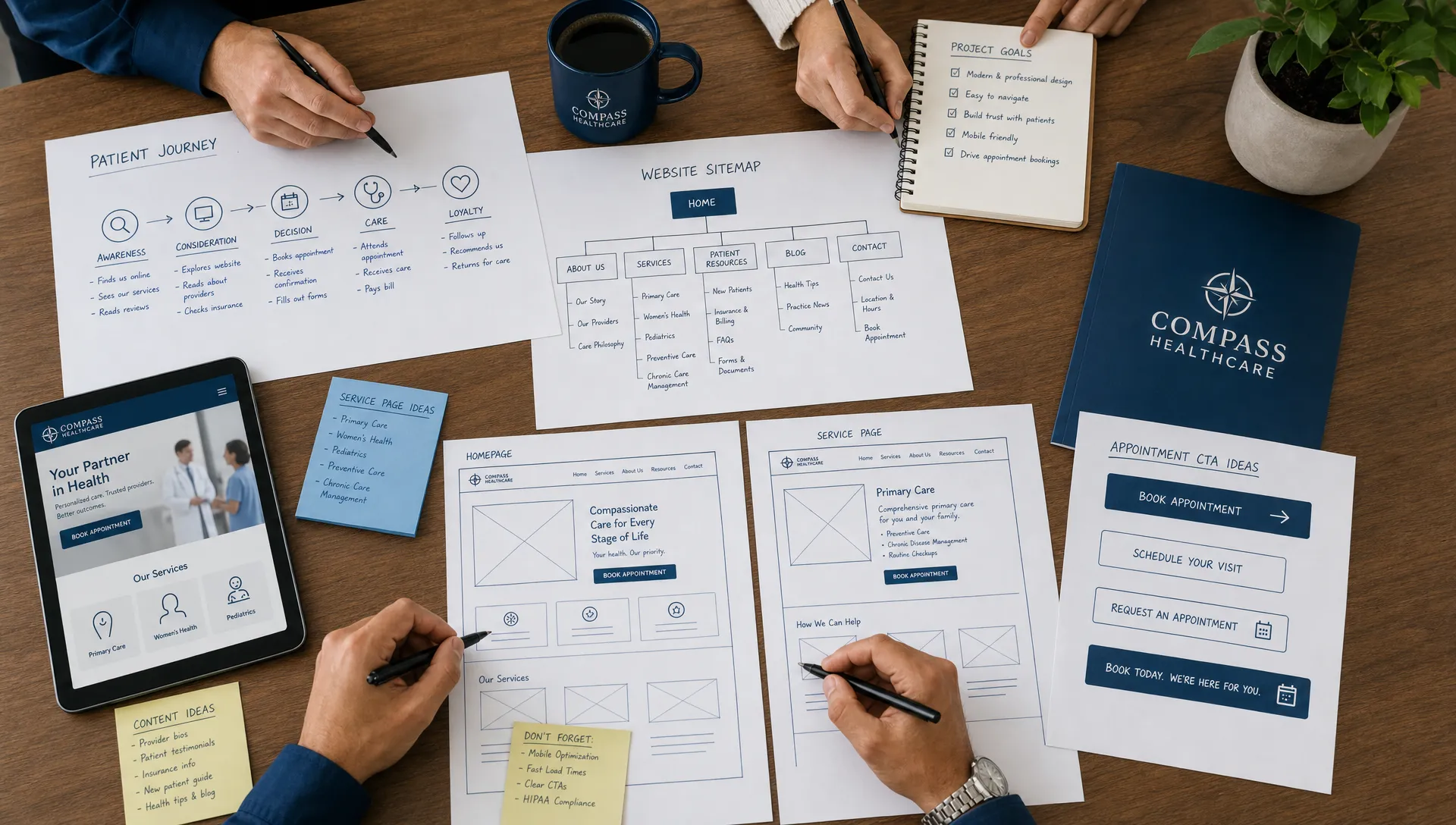
Conversion is not just a “Book Now” button. It is the full path from search intent to patient action. For healthcare practices, conversion strategy often includes clear service pages, strong calls to action, click-to-call buttons, appointment request forms, trust signals, insurance or financing information where appropriate, and location details.
Mobile experience is especially important. Many prospective patients search from their phones between tasks, during lunch breaks, or after discussing symptoms with a family member. If your site loads slowly, uses tiny text, hides the phone number, or forces people through a long form, they may choose another practice.
The right provider should be able to explain how design choices support patient behavior. For instance, a chiropractic website may prioritize same-week appointment calls, while an orthodontic site may focus on consultation requests and parent-friendly education. A pain management website may need more detailed condition pages because patients are comparing treatment options and credibility.
This is where web design and marketing strategy overlap. A website should not only look trustworthy, it should help each patient segment take a specific action.
Clarify what is included in the project
Web design proposals can look similar on the surface while covering very different scopes. One proposal may include strategy, copywriting, SEO planning, redirects, analytics, and launch support. Another may only include visual design and basic development.
Before signing, ask whether the project includes:
- Discovery and competitive review
- Sitemap and page strategy
- Copywriting or copy editing
- Local SEO foundations
- Mobile-first design
- Appointment-focused calls to action
- Secure forms or scheduling integrations
- Analytics, call tracking, or conversion tracking setup
- Redirect planning for existing URLs
- Post-launch support and maintenance options
You do not need every possible service in every project. A small single-location practice may have different needs than a multi-location specialty group. But you should know exactly what is included, what costs extra, and what your team is responsible for providing.
Watch for healthcare-specific red flags
Some web design providers are talented but not a good fit for healthcare. That does not make them bad companies. It simply means they may not understand the risks and nuances of patient acquisition.
| Red flag | Why it can hurt your practice |
|---|---|
| They only talk about the homepage | Most search traffic often enters through service, condition, provider, or location pages. |
| They promise instant rankings | SEO takes planning, quality content, technical execution, and time. |
| They use the same template for every practice | Your positioning, services, market, and patient concerns should shape the site. |
| They ignore tracking | Without measurement, you cannot tell whether the website is generating calls or leads. |
| They do not discuss compliance-sensitive forms | Healthcare websites must be careful with patient information and lead capture workflows. |
| They design before understanding your services | The result may look polished but fail to communicate why patients should choose you. |
Be especially cautious with vague promises. “We build beautiful websites” is not a strategy. “We will help you increase booked appointments for these services in these markets, and here is how we will measure it” is much stronger.
Understand the role of content
Many website projects stall because content is treated as an afterthought. In healthcare, content is not filler. It is how patients decide whether you are qualified, whether their issue is serious, and whether your treatment approach fits their needs.
Strong content should be clear, accurate, and written in language patients actually use. A patient may not search for “temporomandibular joint dysfunction therapy” first. They may search for jaw pain, clicking jaw, headaches from TMJ, or pain when chewing. A good web design partner should know how to bridge clinical accuracy with real-world search behavior.
The same applies to service pages. A page should usually explain who the service is for, common symptoms or goals, what to expect, why the practice is qualified, and how to schedule. The copy does not need to be long for the sake of length, but it does need to be useful.
If your website is expected to support organic search, Google Ads, or local campaigns, content quality becomes even more important. You can learn more about how website design and SEO services work together to turn visibility into patient inquiries.
Compare proposals with a simple scorecard
Once you have narrowed your options, create a scorecard instead of relying on gut feel. This keeps the conversation focused on business outcomes.
Use a 1 to 5 score for each category:
- Healthcare industry understanding
- Local SEO strategy
- Conversion and appointment strategy
- Quality of past work
- Content and messaging support
- Technical and mobile performance plan
- Tracking and reporting setup
- Communication and project process
- Post-launch support
- Overall confidence in strategic fit
The goal is not to choose the cheapest provider. It is to choose the provider most likely to build a website that supports growth. A low-cost website that needs to be rebuilt in a year is often more expensive than doing the strategy correctly the first time.
What the right partner should be able to explain clearly
By the end of your sales conversations, you should understand the provider’s process. You should know how they will learn your practice, plan the site, write or organize content, design the user experience, preserve or improve SEO, launch the site, and measure performance.
They should also be honest about tradeoffs. A brand-new practice may need a leaner website plus Google Ads to generate early patient flow. An established practice with rankings may need a careful redesign that protects organic traffic. A specialty clinic may need deeper educational content and stronger authority signals.
The right web design services will not make every recommendation sound identical. They will adapt the plan to your practice, your market, your goals, and your patients.
Frequently Asked Questions
How do I choose the best web design services near me? Start by looking beyond proximity. Choose a provider that understands your industry, builds for mobile users, plans for local SEO, writes clear content, and measures calls, forms, or appointment requests. For healthcare practices, experience with patient trust and conversion is especially important.
Should my healthcare website be redesigned or just updated? It depends on the condition of your current site. If the structure is weak, the design is outdated, the site is slow, or the content does not support your services, a redesign may be better. If the foundation is strong, targeted updates may be enough.
Do web design services usually include SEO? Some do and some do not. Ask specifically whether SEO strategy, keyword-informed page planning, metadata, redirects, internal linking, and technical setup are included. A website that is designed without SEO planning may struggle to rank after launch.
What should a healthcare practice website focus on first? Focus first on clarity, trust, and action. Patients should quickly understand who you help, what services you provide, where you are located, why they can trust you, and how to schedule or request an appointment.
How long does it take to see results from a new website? Conversion improvements can happen soon after launch if traffic already exists. SEO gains usually take longer because search engines need time to crawl, evaluate, and rank the new or improved pages. The timeline depends on your market, competition, content quality, and marketing plan.
Ready to choose a website partner with confidence?
Your website should be more than a digital brochure. It should help patients find your practice, understand your services, trust your team, and take the next step toward care.
Louisville Web Lab helps healthcare practices connect website design with SEO, Google Ads, automation, reputation, and patient acquisition strategy. If you want a clearer path from search visibility to booked appointments, schedule a diagnostic conversation with Louisville Web Lab.