

Choosing an SEO and web design company is not just a branding decision. For a healthcare practice, it affects how easily patients find you, whether they trust you, and how often a website visit becomes a booked appointment.
A beautiful website can still underperform if it is slow, hard to navigate, missing treatment pages, or invisible in Google Maps. A strong SEO campaign can also stall if the website cannot convert traffic into calls, forms, online scheduling clicks, or qualified leads. The best partner understands both sides of the equation: search visibility and patient experience.
If you run a dental, orthodontic, optometry, chiropractic, pain management, physical therapy, primary care, or specialty practice, this guide will help you evaluate an SEO and web design company with confidence.
Why SEO and web design should be evaluated together
Many practices treat web design and SEO as separate projects. First they redesign the website, then months later they hire someone to optimize it. That sequence often creates expensive rework.
SEO affects site structure, page topics, internal links, speed, local landing pages, schema, content priorities, and technical crawlability. Web design affects trust, readability, mobile usability, calls to action, accessibility, and conversion rate. If these decisions are made in isolation, the site may look professional but fail to rank, or rank well but fail to turn traffic into appointments.
For healthcare practices, the connection is even more important because patients are making high-trust decisions. Someone searching for a dental implant specialist, pediatric dentist, LASIK consultation, chiropractor, or pain physician is not just browsing. They are comparing credibility, convenience, reviews, insurance or financing information, clinical expertise, and whether the practice feels like the right fit.
That is why SEO web design services outperform pretty sites when the goal is measurable patient growth, not just a refreshed look.
Start by defining the outcome you actually want
Before you compare agencies, define what success should look like. A vague goal like getting a better website gives the agency too much room to focus on aesthetics without tying the work to growth.
A better goal might be increasing qualified implant consultations, growing new patient exams, attracting more dry eye patients, improving visibility for a specific city, or reducing dependence on referrals. The more specific your objective, the easier it is to choose the right partner.
| Practice goal | What the SEO and web design company should prioritize |
|---|---|
| More new patient appointments | Local SEO, service pages, mobile calls to action, review visibility, conversion tracking |
| More high-value procedures | Treatment-specific landing pages, trust signals, before-and-after policies, financing messaging, educational content |
| More visibility in nearby cities | Location strategy, Google Business Profile optimization, local content, internal linking |
| Better lead quality | Clear service positioning, qualification-focused forms, conversion copy, campaign segmentation |
| Lower ad waste | Landing pages, call tracking, Google Ads alignment, keyword intent analysis |
| Better reputation leverage | Review strategy, testimonial placement, provider credibility, patient experience signals |
A good SEO and web design company will ask about your services, margins, capacity, payer mix, ideal patients, local competition, and current patient acquisition sources before recommending a scope.
Look for healthcare-specific marketing understanding
A generalist agency may build attractive websites, but healthcare marketing has unique requirements. The buyer journey is different from retail, home services, or restaurants. Patients need reassurance, not hype. They want clear information, not jargon. They need a frictionless path to contact the practice, especially on mobile.
For example, a dental implant page may need to address candidacy, cost concerns, sedation, bone grafting, financing, trust, and consultation scheduling. An optometry website may need to separate routine exams from dry eye, myopia management, specialty lenses, and medical eye care. A pain management or chiropractic site may need to explain conditions, treatment options, referral relationships, and insurance expectations without making unsupported medical claims.
When interviewing agencies, ask how they approach healthcare content, patient intent, local SEO, review generation, call tracking, and compliance-aware messaging. They do not need to be clinicians, but they should understand how patients search and decide.
If you are comparing firms in the local market, this guide on how to choose a healthcare marketing agency in Louisville can help you evaluate healthcare-specific fit beyond a standard portfolio review.
Evaluate the company’s SEO foundation, not just its design portfolio
A portfolio shows you visual style, but it does not prove SEO competence. Many impressive websites are missing the foundations needed to rank.
Ask whether the company plans site architecture around search intent. A healthcare website should usually have focused pages for core services, providers, locations, patient resources, and conditions or treatments where appropriate. Pages should not be so thin that they fail to answer patient questions, but they also should not be stuffed with keywords or generic filler.
The company should be able to explain how it handles:
- Keyword and search intent research for your actual services and city
- Website architecture for service, location, and provider pages
- Technical SEO basics such as crawlability, redirects, speed, metadata, and indexation
- Local SEO signals connected to your Google Business Profile and practice locations
- Conversion paths such as phone calls, forms, online scheduling, and lead capture
- Measurement through analytics, call tracking, and form tracking
If an agency cannot explain how design decisions support rankings and conversions, it may be a web design vendor rather than a growth partner.
Check whether the site will be built for patient conversion
Traffic is valuable only if the website helps patients take the next step. A strong healthcare website makes it obvious what the practice does, who it helps, where it is located, why patients should trust it, and how to schedule.
Patient conversion is not about aggressive popups or pushy copy. It is about reducing uncertainty. Patients should not have to hunt for the phone number, appointment button, location, provider information, accepted insurance notes, or treatment details. On mobile, the path from landing page to call should be especially clear.
Conversion-focused healthcare web design typically includes strong above-the-fold messaging, visible contact options, service-specific calls to action, trust badges where appropriate, provider credibility, patient reviews, concise forms, and pages that answer common objections. The design should also make content easy to scan, because many patients compare multiple practices before contacting one.
For a deeper look at the connection between visibility and booked appointments, Louisville Web Lab explains how website design and SEO services drive more bookings for healthcare practices.
Review the portfolio for clarity, not just style
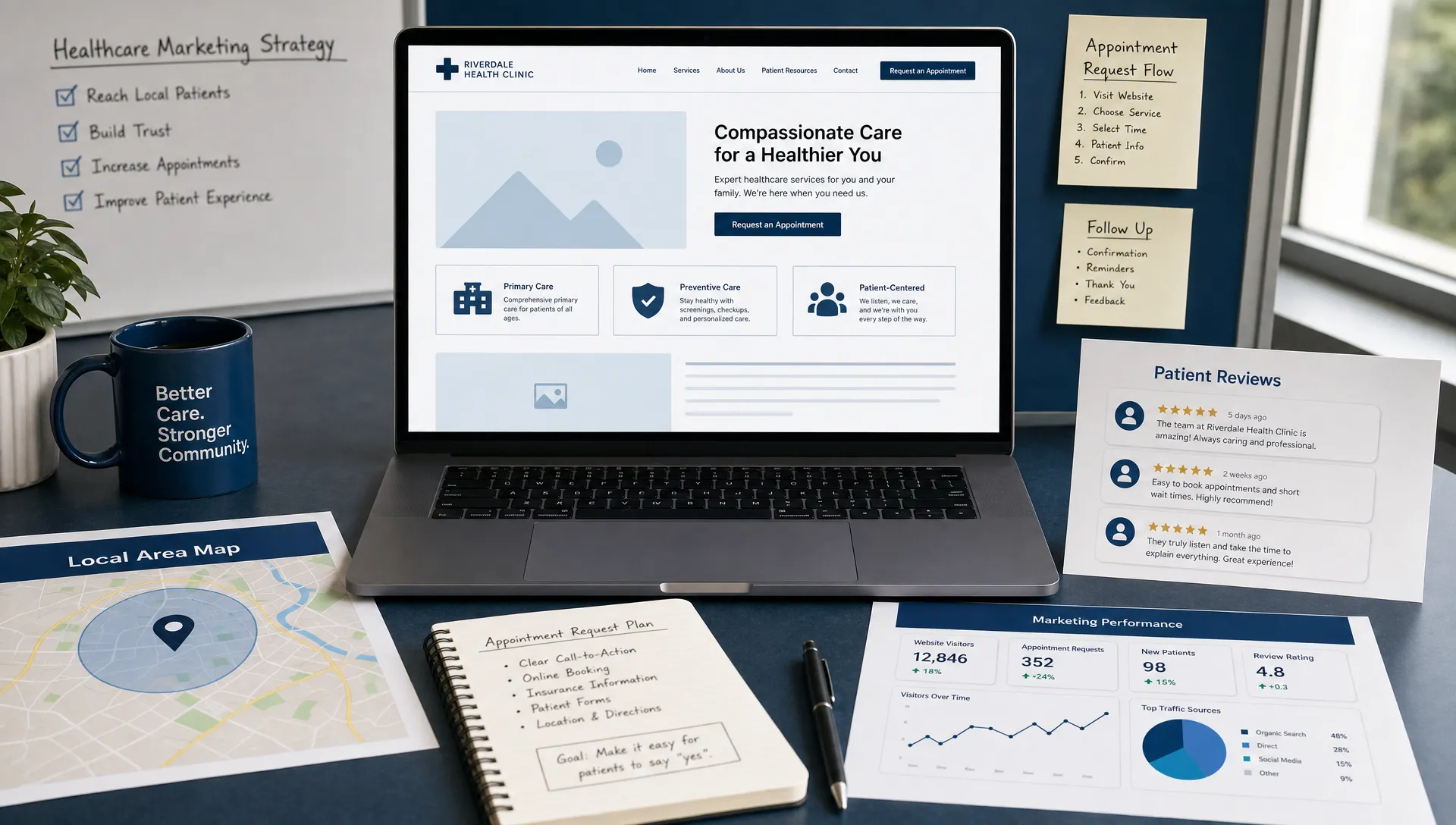
When reviewing an agency’s past work, do not ask only whether the websites look modern. Ask whether you can understand the business within a few seconds. Can you tell who the site is for, what problem it solves, what makes the provider different, and what action the visitor should take next?
This principle applies across industries. Your healthcare website should create that same sense of clarity, even if the tone is more clinical, practical, and trust-driven.
When reviewing healthcare examples, look for evidence that the agency can communicate complex services simply. A patient should not need a medical background to understand your treatment options. The site should educate without overwhelming, build trust without exaggeration, and guide the visitor toward a clear next step.
Ask how local SEO will be handled
For most healthcare practices, local SEO is one of the highest-impact parts of the strategy. Patients often search with location-based intent, even when they do not type the city name. Google uses proximity, relevance, prominence, reviews, website signals, and business profile data to decide which practices appear in local results.
An SEO and web design company should understand how the website and Google Business Profile work together. Your service pages, location pages, internal linking, contact information, reviews, categories, photos, and content all support your local presence.
Ask how the company approaches:
- Google Business Profile optimization and category strategy
- Consistent practice name, address, and phone information
- Review generation and response workflows
- Location page strategy for multi-location practices
- Local service content for high-intent patient searches
- Tracking calls and direction requests from local visibility
Be cautious if an agency talks only about ranking your website but ignores Maps, reviews, and local intent. For healthcare practices, the local pack is often where the patient decision starts.
Demand transparent measurement and reporting
A professional SEO and web design company should define how performance will be measured before work begins. For healthcare practices, rankings alone are not enough. Rankings can be useful indicators, but the business outcome is patient acquisition.
Your reporting should connect marketing activity to actions such as phone calls, form submissions, online scheduling clicks, direction requests, and high-value service inquiries. If you run Google Ads, the company should distinguish paid leads from organic leads. If you have multiple locations, reports should separate performance by location when possible.
| Metric | Why it matters | What to watch for |
|---|---|---|
| Organic traffic by service page | Shows whether SEO content is attracting relevant visitors | Traffic that grows but does not match your target services |
| Phone calls | Often the most valuable healthcare conversion | No call tracking or no call quality review |
| Form submissions | Captures appointment requests and inquiries | Spam leads or forms with too many required fields |
| Google Business Profile actions | Shows local visibility and patient intent | No separation between branded and discovery searches |
| Rankings for priority services | Helps monitor competitive movement | Reporting only vanity keywords with low patient intent |
| Conversion rate | Shows whether the website turns visits into action | High traffic with poor calls or bookings |
Also ask who owns your data. Your practice should have access to analytics, call tracking, ad accounts, website logins, domain registration, and Google Business Profile ownership. If an agency refuses access or keeps everything under its own account, that is a serious red flag.
Understand the proposed process
A reliable company should have a clear process, but not a one-size-fits-all template. The best process starts with discovery and strategy, then moves into structure, content, design, development, launch, optimization, and reporting.
For a healthcare practice, discovery should include your services, providers, locations, competitive landscape, patient types, current website performance, call handling, reviews, and growth priorities. The agency should review what is already working before replacing it.
A typical process may include strategy, SEO research, sitemap planning, copywriting, wireframing, design, development, analytics setup, launch quality assurance, local SEO updates, and ongoing optimization. The exact scope will depend on your practice size, market, competition, and goals.
Be wary of companies that jump directly into design mockups without understanding your patient acquisition strategy. Design should express the strategy, not substitute for it.
Compare proposals by substance, not page count
Proposals can be difficult to compare because every company packages services differently. One proposal may include a website build, basic SEO setup, and monthly optimization. Another may separate design, development, copywriting, local SEO, technical SEO, content, ads, automation, and reporting.
Do not choose based only on the cheapest monthly fee or the largest list of deliverables. Instead, look for strategic alignment. A proposal should explain what will be done, why it matters, what is included, what is not included, how success will be measured, and what your team is responsible for.
A strong proposal should clarify:
- Website scope, including page types, copywriting, development, and launch support
- SEO scope, including technical work, local SEO, content, and ongoing optimization
- Conversion strategy, including calls to action, forms, tracking, and landing pages
- Reporting cadence, metrics, and access to performance data
- Ownership of website assets, accounts, content, and domain access
- Timeline, communication rhythm, approvals, and responsibilities
If the proposal is mostly buzzwords, vague promises, or package names without detail, ask for clarification before signing.
Watch for common red flags
Some warning signs are obvious, such as guaranteed number one rankings. Others are more subtle. The biggest risk is hiring a company that makes your website look better while leaving the underlying growth engine weak.
Be cautious if you see any of these red flags:
- They guarantee top rankings by a specific date
- They do not ask about your ideal patients or most profitable services
- They cannot explain how SEO will influence the website structure
- They focus only on homepage design and ignore service pages
- They do not discuss Google Business Profile or reviews
- They use generic healthcare copy that could apply to any practice
- They avoid questions about tracking, ownership, or reporting
- They push a long contract before completing a meaningful strategy discussion
- They do not explain what happens after launch
No agency can control every variable in search, especially in competitive healthcare markets. A trustworthy partner will be confident in its process, but honest about timelines, competition, and what it can measure.
Ask the right questions on the sales call
The discovery or sales call is your best chance to separate a polished pitch from a capable partner. Listen for specificity. A good company will not just say it can improve SEO. It will explain where the opportunities likely are and what needs to be investigated.
| Question to ask | What a strong answer should include |
|---|---|
| How will you decide which pages our website needs? | Search intent, services, locations, competition, patient questions, and conversion goals |
| How do you approach healthcare content? | Patient-friendly education, accuracy, trust, compliance awareness, and service differentiation |
| What happens to our current rankings during a redesign? | Redirect planning, content preservation, technical QA, and post-launch monitoring |
| How do you measure booked appointment opportunities? | Call tracking, form tracking, scheduling clicks, source attribution, and lead quality review |
| How do you handle local SEO? | Google Business Profile, reviews, local pages, citations, and location-specific strategy |
| Who owns the website and data? | Clear practice ownership or clearly stated hosting and licensing terms |
| What will we see each month? | Action items completed, performance trends, insights, and next priorities |
The best answers will be clear enough that you understand the strategy, even if you are not an SEO expert.
Decide whether you need a generalist or a healthcare-focused partner
A generalist may be enough for a simple brochure site, especially if you are not relying on search to grow. But if your practice depends on local visibility, high-value treatments, competitive service lines, or multi-location growth, a healthcare-focused partner is usually the safer choice.
Healthcare marketing requires a balance of patient psychology, local SEO, conversion design, reputation strategy, and service-line positioning. The agency should understand that a new patient exam, Invisalign consultation, cataract evaluation, dry eye visit, chiropractic care plan, or pain management consultation may require different messaging and conversion paths.
This does not mean every page should be overly complex. It means the company should know when simplicity is useful and when a service needs deeper education to build trust.
Use a simple scorecard before you choose
When several agencies seem qualified, use a scorecard to make the decision less emotional. Rate each company from one to five in the categories below, then compare the totals and the quality of your conversations.
| Category | Score from 1 to 5 |
|---|---|
| Healthcare or patient acquisition experience | |
| SEO strategy and technical knowledge | |
| Conversion-focused web design approach | |
| Local SEO and Google Business Profile knowledge | |
| Quality of portfolio and messaging clarity | |
| Reporting and tracking transparency | |
| Ownership terms and account access | |
| Communication and strategic thinking | |
| Fit with your practice goals |
The right SEO and web design company should make you feel more clear, not more confused. You should leave the process understanding what will be built, why it matters, how it will be measured, and how it supports patient growth.
Frequently Asked Questions
How do I know if an SEO and web design company is legitimate? Look for clear strategy, transparent reporting, real examples, ownership clarity, and an ability to explain how SEO, design, content, and conversion work together. Avoid companies that guarantee rankings or cannot explain their process.
Should I redesign my website before starting SEO? Not always. If your current site has technical problems, weak conversion paths, or poor service structure, redesigning and SEO planning together may be best. If the site is solid, targeted SEO improvements may come first.
How long does SEO take for a healthcare practice? Timelines vary by competition, location, website condition, service line, and authority. Some improvements can happen quickly after technical fixes or local SEO updates, but sustainable organic growth often takes months of consistent work.
Is local SEO different from regular SEO? Yes. Local SEO focuses on visibility in a specific service area, including Google Business Profile, reviews, proximity, location pages, and local relevance. For most healthcare practices, local SEO is central to patient acquisition.
What should a healthcare website include? Most practices need clear service pages, provider information, location details, reviews, contact options, mobile-friendly design, patient resources, trust signals, and conversion tracking. The exact structure should match your services and growth goals.
Choose a partner built for patient growth
The best SEO and web design company is not simply the one with the nicest mockups or the lowest monthly fee. It is the one that can connect strategy, search visibility, patient trust, conversion, and measurement into a system that supports real practice growth.
Louisville Web Lab specializes in healthcare marketing for dental, orthodontic, vision, chiropractic, pain, physical therapy, primary care, and specialty practices. If you want a website and SEO strategy built around booked appointments, qualified leads, and measurable growth, a diagnostic strategy call can help identify the biggest opportunities in your current patient acquisition system.