
Your website is often the first conversation a patient has with your practice. Before someone calls your front desk, schedules a consultation, or chooses a second opinion, they are scanning your site for signs of trust: Do you treat my condition? Are you nearby? Do you take people like me seriously? Can I book without friction?
That means hiring a website designer for a healthcare practice is not the same as hiring someone to make a pretty homepage. The right partner needs to understand patient intent, local search, conversion paths, reputation signals, accessibility, privacy risk, and the practical realities of running a busy clinic.
If you are a dentist, orthodontist, optometrist, chiropractor, physical therapist, pain physician, or specialty provider, use the guide below to evaluate website designers with the same discipline you would use when hiring for any critical growth role.
Start With the Business Outcome, Not the Design Style
Before you interview a website designer, define what the website needs to accomplish for the practice. A modern healthcare website usually has to do more than explain who you are. It should help the right patients take the next step.
For most practices, that means improving outcomes such as:
- More qualified phone calls and appointment requests
- Better visibility for high-value local services
- Stronger trust with new patients before they contact you
- Clearer explanations of treatments, insurance, financing, or referral paths
- Lower friction on mobile devices
- Better tracking of where inquiries come from
A designer who starts only with colors, fonts, and page layouts may miss the bigger point. A strong healthcare website should connect brand, search visibility, patient education, and conversion strategy. If you are still clarifying which website components matter most, Louisville Web Lab’s guide to website design services every healthcare practice needs is a helpful companion before you request proposals.
Why Healthcare Websites Are a Different Kind of Project
Healthcare decisions involve anxiety, urgency, trust, money, and sometimes embarrassment. A patient searching for “emergency dentist near me,” “dry eye treatment,” “sciatica doctor,” or “Invisalign for teens” is not browsing casually. They want clear answers and reassurance.
A healthcare website designer should understand how patients evaluate providers online. That includes visible credentials, before-and-after considerations where appropriate, review strategy, location clarity, service-specific pages, and calls to action that match the patient’s readiness.
Healthcare websites also require more care around privacy and compliance-sensitive workflows. Your designer should not casually promise a “HIPAA-compliant website” without discussing forms, analytics, tracking scripts, hosting, patient communication tools, and who is responsible for each system. The U.S. Department of Health and Human Services has published guidance on HIPAA and online tracking technologies, which is worth reviewing with your legal or compliance advisors before you add marketing tools to a healthcare website.
Accessibility matters too. Many patients rely on mobile devices, screen readers, keyboard navigation, captions, readable contrast, and clear page structure. A designer does not need to turn every meeting into a legal discussion, but they should be familiar with accessibility best practices such as the Web Content Accessibility Guidelines.
Decide What Kind of Website Designer You Actually Need
The phrase “website designer” can mean several different things. Some designers focus on visual layouts. Others build sites in a CMS. Some agencies combine design with SEO, paid ads, content, automation, and reporting.
For a healthcare practice, the right fit depends on your growth goals, internal capacity, and how much strategy you already have.
| Option | Best fit | Watch out for |
|---|---|---|
| Freelance visual designer | You already have strategy, copy, SEO direction, and development support | May not handle local SEO, content, conversion tracking, or long-term maintenance |
| General web design agency | You need a professional site and a structured build process | May lack healthcare-specific patient acquisition experience |
| Healthcare marketing agency | You want the website tied to SEO, ads, reviews, automation, and booked appointments | May require more strategic collaboration and clearer growth goals upfront |
| Template website provider | You need a simple, lower-complexity web presence quickly | May limit differentiation, advanced SEO, conversion testing, or ownership flexibility |
A smaller practice with a limited service mix may not need a large custom build. A multi-location dental group, surgical clinic, or specialty practice competing for high-value procedures likely needs deeper strategy. The key is matching the designer’s capability to the business problem, not just the look of the final site.
What to Evaluate Before You Hire
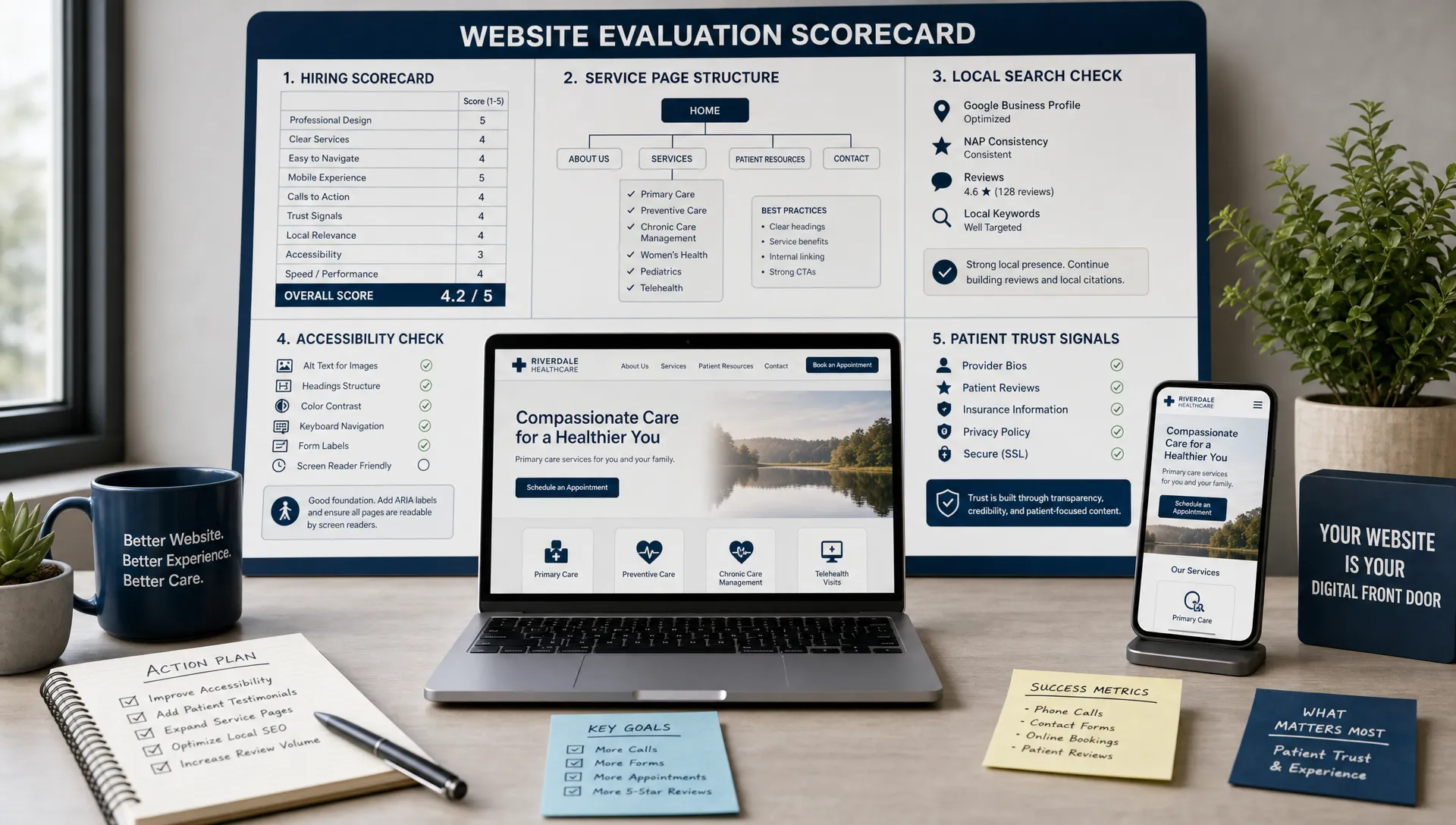
A good proposal should make it easy to understand what the designer will do, why it matters, and how the work supports patient growth. Use the criteria below as a practical scorecard.
| Evaluation area | What to look for | Why it matters |
|---|---|---|
| Healthcare understanding | They ask about patients, services, referrals, insurance, location, reviews, and clinical differentiators | Healthcare buyers need reassurance and clarity before they book |
| Local SEO strategy | They plan pages around services, locations, search intent, and Google Business Profile support | Search visibility drives many new patient inquiries |
| Conversion strategy | They discuss calls, forms, scheduling, landing pages, trust signals, and mobile paths | Traffic is only useful if it turns into appointments |
| Content quality | They can help explain services in patient-friendly language without overpromising outcomes | Clear education builds trust and reduces front-desk friction |
| Technical performance | They address speed, mobile responsiveness, crawlability, security basics, and analytics | Poor technical foundations can limit both rankings and conversions |
| Accessibility | They understand readable contrast, headings, form labels, keyboard navigation, and alt text | Accessible sites serve more patients and reduce usability barriers |
| Ownership and portability | You know who owns the domain, content, design assets, CMS, and analytics accounts | Your practice should not be locked out of its own growth assets |
| Post-launch support | They offer or coordinate maintenance, updates, backups, tracking checks, and page improvements | Websites need ongoing care after launch |
If a designer cannot explain how the website will help patients find you, trust you, and contact you, keep looking.
Questions to Ask a Website Designer in the Interview
You do not need a 30-page RFP to make a smart hire. You do need direct questions that reveal whether the designer thinks like a growth partner or only a production vendor.
Ask questions such as:
- How do you learn about our ideal patients and highest-priority services before designing?
- What role does local SEO play in your website process?
- How do you decide which pages a healthcare practice needs?
- What do you recommend for mobile appointment requests and phone call tracking?
- How do you handle healthcare content accuracy and patient-friendly language?
- What accessibility standards or best practices do you follow?
- Who owns the website, domain, content, analytics, and creative assets after launch?
- What happens after the site goes live?
Listen carefully to the answers. Strong partners will ask follow-up questions about your procedures, margins, capacity, competition, front-desk process, and current lead quality. Weak partners will move straight to design preferences without understanding the business.
Review the Portfolio Like a Practice Owner
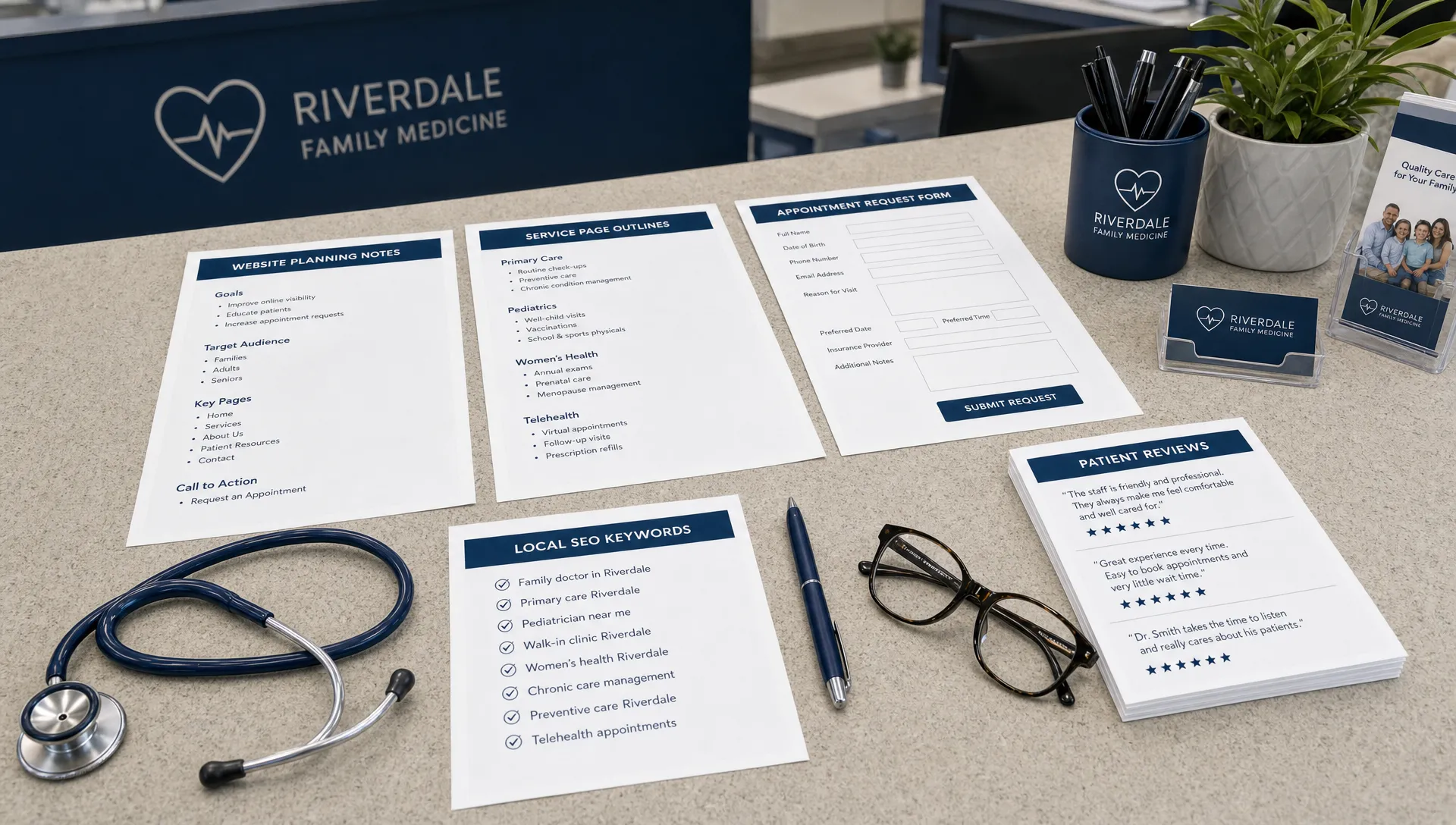
A beautiful portfolio is not enough. When you review examples, look for evidence that the designer can create a website that supports decision-making.
Open portfolio sites on your phone first. Most healthcare searches happen in moments of need, often on mobile. If the phone number is hard to find, the text is tiny, the pages load slowly, or the appointment path feels confusing, patients may leave before they ever learn why your practice is different.
Then review service pages. Do they answer real patient questions? Do they explain conditions, treatments, candidacy, recovery, cost considerations, or next steps in plain language? Do they show location relevance? Do they include trust signals near decision points?
It can also be useful to study strong local service websites outside healthcare, because many trust-building mechanics are similar. Your practice needs the healthcare version of that same clarity: what you do, where you do it, why patients should trust you, and how to take the next step.
Make Sure SEO Is Built Into the Website, Not Added Later
One common hiring mistake is treating SEO as something that happens after the design is finished. For healthcare practices, search strategy should influence the site structure from the beginning.
A designer who understands healthcare SEO should be able to discuss:
- Which service pages deserve their own URLs
- How location pages should be handled for multi-location practices
- How page titles, headings, internal links, and FAQs support search intent
- How Google Business Profile and website content work together
- How to avoid thin, duplicate, or overly generic service pages
- How to prepare content for both traditional search and AI-assisted search experiences
This does not mean every website designer must personally manage SEO campaigns. But if organic visibility is part of your growth plan, the website cannot be built in a vacuum. If you need design and SEO working together from day one, it may help to review what to consider when choosing an SEO and web design company.
Clarify Copywriting and Clinical Review Responsibilities
Many website projects stall because no one knows who is writing the content. Healthcare copy is especially important because it must be understandable, accurate, and conversion-focused.
Before you hire, clarify whether the designer provides copywriting, expects your team to write, or brings in a content specialist. Also decide how clinical review will happen. A marketer can make content clearer, but your providers or approved clinical reviewers should confirm accuracy for services, risks, outcomes, credentials, and claims.
Be cautious with generic AI-written service pages that sound polished but say very little. Patients can feel when content is vague. Search engines also have less reason to rank pages that do not add unique value. Your content should reflect your actual providers, patient experience, technology, treatment philosophy, and local market.
Understand the Contract Before You Pay a Deposit
The contract is where many website problems begin or get prevented. A good agreement should make responsibilities clear and reduce surprises.
At minimum, clarify:
- Project scope, including page count, templates, copywriting, photography, forms, integrations, and revisions
- Timeline assumptions and what your team must provide to keep the project moving
- Ownership of domain, website files, CMS access, design assets, content, analytics, and call tracking accounts
- Hosting, security updates, backups, and maintenance responsibilities
- Whether SEO setup, redirects, metadata, schema, and analytics configuration are included
- What happens if either party ends the relationship
Do not assume you own everything just because you paid for the website. Ask directly. Your practice should control its domain, core accounts, and data wherever possible.
Plan for Launch and Post-Launch Maintenance
A website launch is not the finish line. It is the point where real patient behavior starts giving you feedback.
After launch, your team should verify forms, phone numbers, appointment links, tracking, thank-you pages, location information, mobile usability, page speed, and redirects from old URLs. If your old website had SEO value, mishandled redirects can create avoidable traffic drops.
You should also know who will handle updates. Healthcare websites need ongoing content edits, provider changes, service updates, compliance-sensitive form reviews, plugin or CMS updates, performance checks, and security monitoring. If your practice does not have an internal web manager, ask your designer about ongoing support. Louisville Web Lab’s article on website maintenance services for healthcare practices covers the key areas to think through before launch.
Red Flags When Hiring a Website Designer
Some warning signs are obvious, such as poor communication or vague pricing. Others are more subtle.
Be cautious if a website designer:
- Talks about design style but not patient acquisition
- Cannot explain how local SEO will be handled
- Uses the same generic content structure for every practice
- Guarantees rankings without understanding your market
- Ignores mobile conversion paths
- Avoids questions about ownership, analytics, or tracking
- Promises HIPAA compliance too casually
- Has no plan for post-launch support
The right designer should make you feel more informed, not more confused. They should be able to explain tradeoffs in plain language and connect recommendations to your goals.
A Simple Hiring Scorecard for Healthcare Practices
When you are comparing proposals, score each candidate on the areas that matter most to growth. This keeps the decision from becoming purely subjective.
| Category | Low score | Strong score |
|---|---|---|
| Strategy | Focuses mainly on visuals | Connects design to services, patients, search, and bookings |
| Healthcare fit | Little understanding of patient trust factors | Understands healthcare decisions, privacy concerns, and service education |
| SEO foundation | Mentions basic keywords only | Plans structure, service pages, locations, metadata, internal links, and tracking |
| Conversion | Adds a contact form | Designs clear phone, form, scheduling, and landing page paths |
| Communication | Vague process and unclear responsibilities | Provides milestones, deliverables, feedback points, and launch expectations |
| Ownership | Unclear account and asset control | Clearly defines what the practice owns and can access |
| Long-term support | No maintenance plan | Offers or coordinates updates, monitoring, and improvement after launch |
A slightly more expensive partner may be the better investment if they reduce wasted ad spend, protect SEO equity, improve conversion rates, and help your front desk receive better inquiries.
Frequently Asked Questions
How much healthcare experience should a website designer have? They do not need to have worked in your exact specialty, but they should understand patient trust, local search, conversion paths, accessibility, privacy-sensitive forms, and healthcare content review. Specialty experience is especially helpful for competitive services like implants, orthodontics, LASIK, pain management, and regenerative medicine.
Should I hire a local website designer or a healthcare-specific agency? Local knowledge can help, especially for competitive city-level SEO. Healthcare-specific experience can be even more valuable if your site needs to generate patient inquiries, support ads, improve rankings, and integrate with your broader marketing system. The best choice is the partner who understands your market and your patient acquisition goals.
What should I prepare before contacting a website designer? Prepare your priority services, ideal patient types, locations served, competitor examples, current website pain points, brand assets, provider bios, reviews, photos, and any access details for your domain, hosting, analytics, Google Business Profile, or scheduling tools.
Do healthcare websites need SEO during the design phase? Yes. SEO should influence navigation, page structure, service pages, location content, metadata, internal links, and redirects. Adding SEO after launch often means reworking decisions that should have been made earlier.
Who should own the website after it is built? Your practice should typically control the domain, website access, content, analytics, and key marketing accounts. Some tools may be licensed by the agency or platform, but ownership and access should be clearly explained before you sign.
Ready to Hire With More Confidence?
Hiring a website designer for a healthcare practice is really about hiring a partner to improve patient trust, search visibility, and appointment flow. The best website is not just attractive. It helps the right patients understand your services, believe in your expertise, and take action.
If your practice wants a website tied to SEO, Google Ads, conversion landing pages, reviews, automation, and measurable patient acquisition, Louisville Web Lab can help you evaluate the right next step. Book a diagnostic strategy call and get a clearer plan before you invest in your next website.