
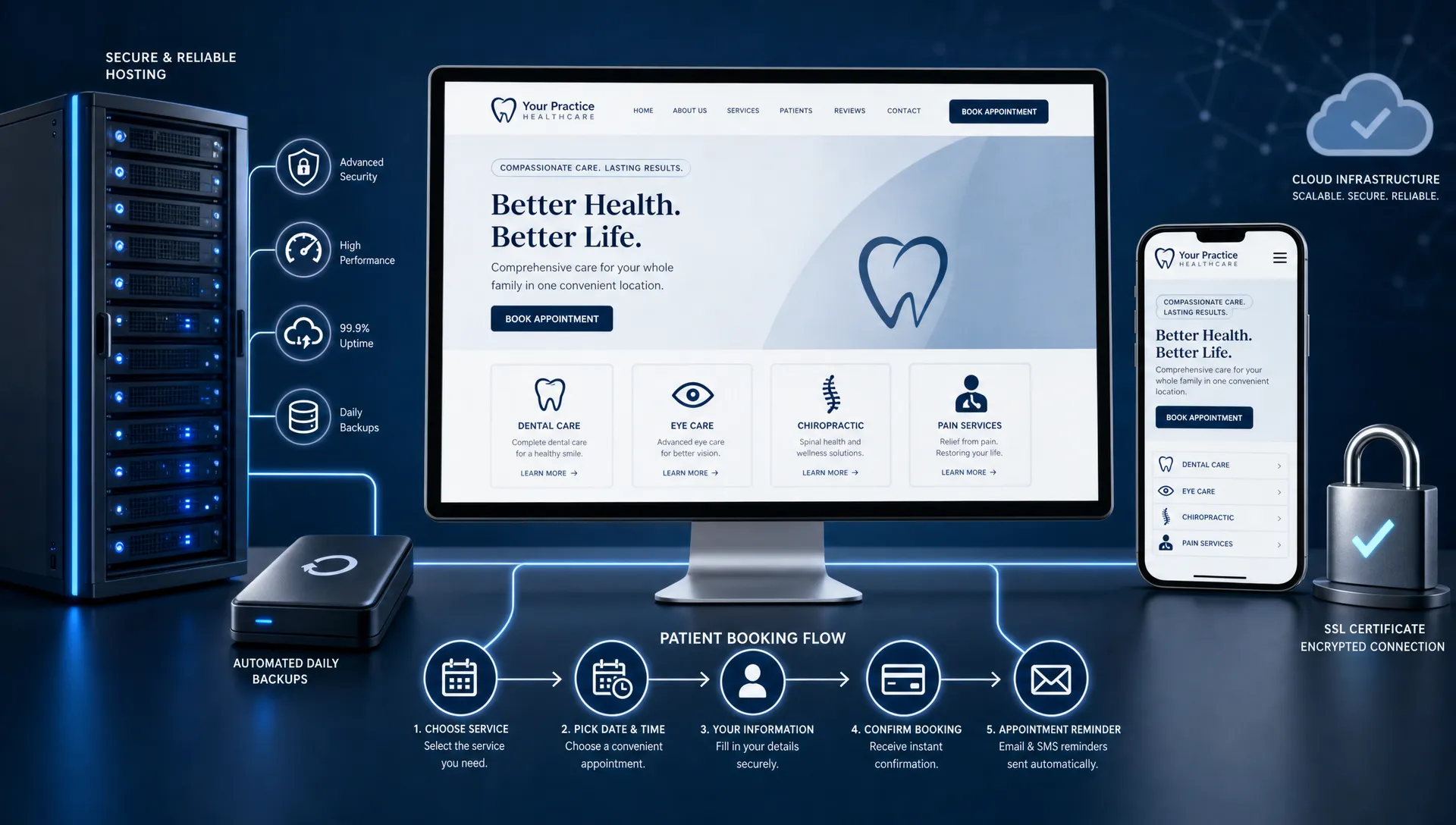
For healthcare practices, a website is not just a digital brochure. It is often the first place a prospective patient checks your credibility, compares your services, decides whether you feel trustworthy, and chooses whether to call, book, or keep searching.
That is why website design and hosting should be discussed together. Design shapes what patients see and how they navigate. Hosting affects whether the site loads quickly, stays online, remains secure, and supports ongoing marketing. If one is strong and the other is weak, the patient experience suffers.
For dentists, orthodontists, optometrists, pain physicians, and specialty practices, the right setup should make your website easier to find, easier to use, and easier to convert into appointments. Here is what your practice should expect before, during, and after a website design and hosting project.
Website design and hosting should start with patient acquisition goals
A healthcare website should begin with the outcomes your practice needs, not with colors, templates, or plugin choices.
Before design begins, your web partner should ask questions like:
- Which services are most profitable or strategically important?
- Which locations, providers, and treatment categories need visibility in search?
- What types of patients are you trying to attract?
- How do new patients currently book, call, or submit inquiries?
- What questions or objections do patients commonly have before scheduling?
- Which marketing channels will support the site, such as SEO, Google Ads, reviews, or referral campaigns?
A cosmetic dentist may need high-trust treatment pages with before-and-after proof, financing language, and consultation calls to action. An optometry practice may need strong local visibility for eye exams, contact lenses, dry eye, or eyewear. A pain management clinic may need condition-based pages for back pain, neuropathy, sciatica, or joint pain, while also making referral pathways clear.
In other words, your website should be built around patient behavior. Searchers do not usually arrive thinking, “I need a modern healthcare website.” They arrive thinking, “Who can fix my tooth pain?”, “Where can I get LASIK near me?”, “Is this chiropractor reputable?”, or “Can this clinic help my knee pain?”
The design and hosting plan should support those moments.
What the design phase should include
The design phase should be more than a homepage mockup. A practice website needs strategic structure, clear messaging, conversion paths, and technical planning before it goes live.
At a minimum, expect your web partner to map the core pages your site needs. These often include your homepage, service pages, provider bios, location pages, contact page, insurance or financing information, patient resources, reviews or testimonials, and clear appointment pathways.
For healthcare practices, service pages deserve special attention. A generic “services” page that lists everything in one place rarely performs as well as dedicated pages for high-intent searches. A dental implant page, Invisalign page, dry eye page, cataract surgery page, chiropractic adjustment page, or physical therapy page can speak directly to the patient’s problem and give search engines a clearer topic to index.
Good design should also make trust easy to recognize. That may include provider credentials, real office photography, patient-friendly explanations, review signals, treatment process details, payment information where appropriate, and visible contact options.
Cosmetic dentistry is a helpful example because patients often compare treatments, pricing, results, payment options, and consultation availability before reaching out.
If your practice is still deciding what belongs in the project scope, Louisville Web Lab’s guide to website design services every healthcare practice needs offers a deeper look at the components that support patient acquisition.
What hosting actually means for a practice website
Hosting is the environment where your website lives. It influences speed, uptime, backups, security, software updates, and how quickly technical issues can be resolved. It is not glamorous, but it matters every day.
A beautifully designed site that loads slowly, goes offline, breaks after updates, or creates security concerns can cost your practice real opportunities. Patients will not wait long for a page to load. They will not trust a broken form. They may not call if your mobile site is clunky or your location page does not work correctly.
Your hosting discussion should cover both infrastructure and support. Infrastructure is the server, software stack, SSL certificate, caching, content delivery, and technical environment. Support is the human side, including who monitors the site, who fixes problems, how fast they respond, and what is included in the agreement.
| Hosting area | What your practice should expect | Why it matters |
|---|---|---|
| Speed and performance | A setup optimized for fast loading on mobile and desktop | Patients often search from phones and may leave slow sites quickly |
| SSL certificate | Secure HTTPS browsing across the site | Patients expect privacy and browsers flag unsecured websites |
| Backups | Regular backups with a clear restore process | A broken site should not become a long-term outage |
| Uptime monitoring | Alerts when the site becomes unavailable | Missed downtime can mean missed calls and appointment requests |
| Security updates | Ongoing updates for the CMS, theme, and approved plugins | Outdated software increases risk and instability |
| Support process | Clear instructions for requesting changes or reporting issues | Staff should know who to contact and what response time to expect |
| Scalability | Hosting that can handle marketing campaigns and traffic spikes | Paid ads, SEO growth, or media exposure can increase visits |
Not every hosting plan includes all of these by default. That is why practices should ask for a plain-English breakdown of what is included, what costs extra, and what the agency or host is responsible for after launch.
Privacy, security, and compliance expectations
Healthcare websites must be handled with more care than typical small business sites. Your site may collect appointment requests, patient questions, phone call data, or form submissions. Depending on what is collected and how it is transmitted, stored, or accessed, compliance considerations may apply.
Your web partner should not casually treat healthcare forms like standard contact forms. A practice should understand whether the website is collecting protected health information, whether third-party tools are involved, and whether appropriate agreements or safeguards are needed. This is especially important for forms, chat tools, call tracking, analytics, online booking integrations, and marketing automation.
A practical expectation is simple: your website team should be willing to discuss privacy-aware implementation and should not pressure your staff to collect unnecessary sensitive information through unsecured tools. They should also make clear where their technical guidance ends and where your legal or compliance counsel should be involved.
Accessibility should also be part of the conversation. Patients may use screen readers, keyboard navigation, magnification, voice tools, or mobile assistive features. Clear page structure, readable fonts, descriptive buttons, color contrast, alt text, and logical forms all contribute to a better experience.

Ownership and access should be clear before launch
One of the biggest mistakes practices make is assuming they own and control everything simply because they paid for the project. Before signing a website design and hosting agreement, clarify ownership and access in writing.
Your practice should know who owns the domain name, website content, design files, photography, analytics accounts, ad accounts, hosting account, and CMS login. You should also know what happens if you change vendors later.
This does not mean every agency must work the same way. Some provide fully managed websites. Some build on open platforms. Some include hosting in a monthly plan. Others hand off the finished site. What matters is that the arrangement is transparent.
Ask specifically about:
- Domain registrar access
- Admin-level CMS access
- Google Analytics and Google Search Console ownership
- Google Business Profile access
- Website content rights
- Custom code or template licensing
- Exit process if the relationship ends
- Backup availability if you move hosting
A reputable partner should be able to explain this without being defensive. If the answers are vague, slow, or confusing, that is a warning sign.
What practices should expect during the project timeline
Every website project has variables, including the number of pages, content needs, photography, approvals, integrations, and compliance requirements. Still, the process should feel organized.
A typical healthcare website project should include discovery, site architecture, content planning, design, development, review, testing, launch, and post-launch support. Your practice should know what is needed from your team at each stage.
Content is often the biggest bottleneck. Provider bios, service descriptions, insurance details, financing language, location information, photos, and patient instructions all take time to gather. If your agency writes or edits content, expect to review it for clinical accuracy and brand voice. If your team provides the content, expect your web partner to advise on structure and search intent.
Testing should happen before launch, not after patients start using the site. This includes mobile testing, form testing, phone link testing, page speed checks, basic SEO checks, browser testing, and review of tracking setup.
Launch should also be coordinated carefully. DNS changes, redirects from old URLs, form notifications, analytics, conversion tracking, and indexability all need attention. A rushed launch can cause avoidable problems, especially if an existing website already receives search traffic.
Website design and hosting costs: what affects the quote
There is no single universal price for healthcare website design and hosting because scope varies. A small practice with one location and a handful of services has different needs than a multi-location specialty group running SEO, Google Ads, landing pages, call tracking, and automation.
Instead of focusing only on the lowest quote, evaluate what is included and what the website is expected to accomplish.
| Cost factor | Why it changes the scope |
|---|---|
| Number of pages | More locations, services, providers, and conditions require more planning and content |
| Content creation | Strategy, copywriting, editing, and clinical review take time |
| Custom design needs | A custom interface requires more work than a basic template setup |
| SEO setup | Local SEO structure, metadata, redirects, schema, and indexation planning add value |
| Integrations | Online booking, forms, CRM tools, call tracking, and automation require setup and testing |
| Hosting requirements | Higher performance, staging environments, backups, and support can affect monthly cost |
| Ongoing maintenance | Updates, security checks, reporting, and content changes may be part of a monthly plan |
A cheaper website may be acceptable if the practice only needs a simple online presence. But if the goal is to compete in local search, convert paid ad traffic, support patient acquisition, and protect the practice’s reputation, the website needs a more complete strategy.
Post-launch support is not optional
The launch date is not the finish line. It is the point where the website begins operating in the real world.
After launch, your practice should expect ongoing attention to software updates, backups, security, speed, broken links, content accuracy, SEO performance, forms, tracking, and conversion paths. Healthcare information changes, providers join or leave, hours shift, services evolve, promotions end, and patient expectations move quickly.
This is especially important if your website supports paid advertising or SEO. A landing page that breaks during a Google Ads campaign can waste spend. A contact form that stops sending notifications can quietly cost appointments. A slow service page can weaken conversion rates.
For a more detailed breakdown of what happens after launch, Louisville Web Lab’s article on website maintenance services every healthcare practice should have explains the ongoing support areas practices should not ignore.
Red flags in website design and hosting proposals
A proposal does not need to be long to be good, but it should be clear. If you are comparing vendors, watch for signs that the project may become frustrating later.
| Red flag | Why it is a problem |
|---|---|
| No discussion of patient acquisition | The site may look nice but fail to generate calls or inquiries |
| Vague hosting details | You may not know who handles backups, security, or downtime |
| No ownership clarity | Moving vendors later may become difficult |
| No SEO migration plan | Redesigns can damage existing rankings if redirects and structure are ignored |
| No mobile conversion strategy | Many healthcare searches happen on phones |
| No form or tracking testing | You may not know whether leads are being captured correctly |
| No post-launch support | Small issues can become expensive or go unnoticed |
If you are still evaluating potential partners, this guide on how to hire a website designer for a healthcare practice can help you ask better questions before committing.
What a strong website design and hosting partner should be able to explain
The best partner is not always the one with the flashiest portfolio. For healthcare practices, the better question is whether the partner understands how design, hosting, search visibility, and patient conversion work together.
They should be able to explain how the site will help patients find the right service, trust the practice, and take action. They should understand local SEO basics, Google Business Profile alignment, page speed, mobile usability, privacy-aware forms, content strategy, and conversion tracking.
They should also be honest about tradeoffs. For example, a video-heavy homepage may look impressive but slow down mobile performance if not handled correctly. A third-party widget may add convenience but require privacy review. A beautiful animation may not be worth it if it distracts from the appointment button.
For healthcare practices, the goal is not simply to have a modern website. The goal is to have a reliable digital front door that supports growth.
Frequently Asked Questions
What is included in website design and hosting? Website design usually includes strategy, page structure, visual design, content layout, mobile responsiveness, and conversion paths. Hosting includes the technical environment that keeps the site online, secure, fast, backed up, and maintainable.
Should a healthcare practice buy hosting separately from website design? It depends on your team’s technical comfort and the vendor’s offering. Bundled design and hosting can simplify support, but only if ownership, access, backups, security, and exit terms are clear.
How often should a practice website be updated after launch? The technical side should be monitored continuously and reviewed regularly. Content should be updated whenever providers, hours, services, insurance details, promotions, or patient instructions change.
Does hosting affect SEO? Yes, indirectly. Hosting can affect speed, uptime, mobile performance, security, and user experience. These factors can influence how patients interact with your site and how well your SEO work performs.
What should practices ask before signing a website proposal? Ask what is included, who owns the website assets, how hosting is managed, what security and backups are provided, how forms are handled, what happens after launch, and how success will be measured.
Turn your website into a patient acquisition asset
Your website should do more than exist. It should help patients understand your services, trust your team, and take the next step with confidence. The hosting behind it should keep that experience fast, secure, stable, and easy to support.
Louisville Web Lab helps healthcare practices connect website design, SEO, Google Ads, automation, and patient acquisition strategy so their online presence supports measurable growth. If your current website feels outdated, slow, hard to manage, or disconnected from new patient goals, it may be time for a deeper review.
Schedule a diagnostic strategy call with Louisville Web Lab to identify what your practice website needs next.