
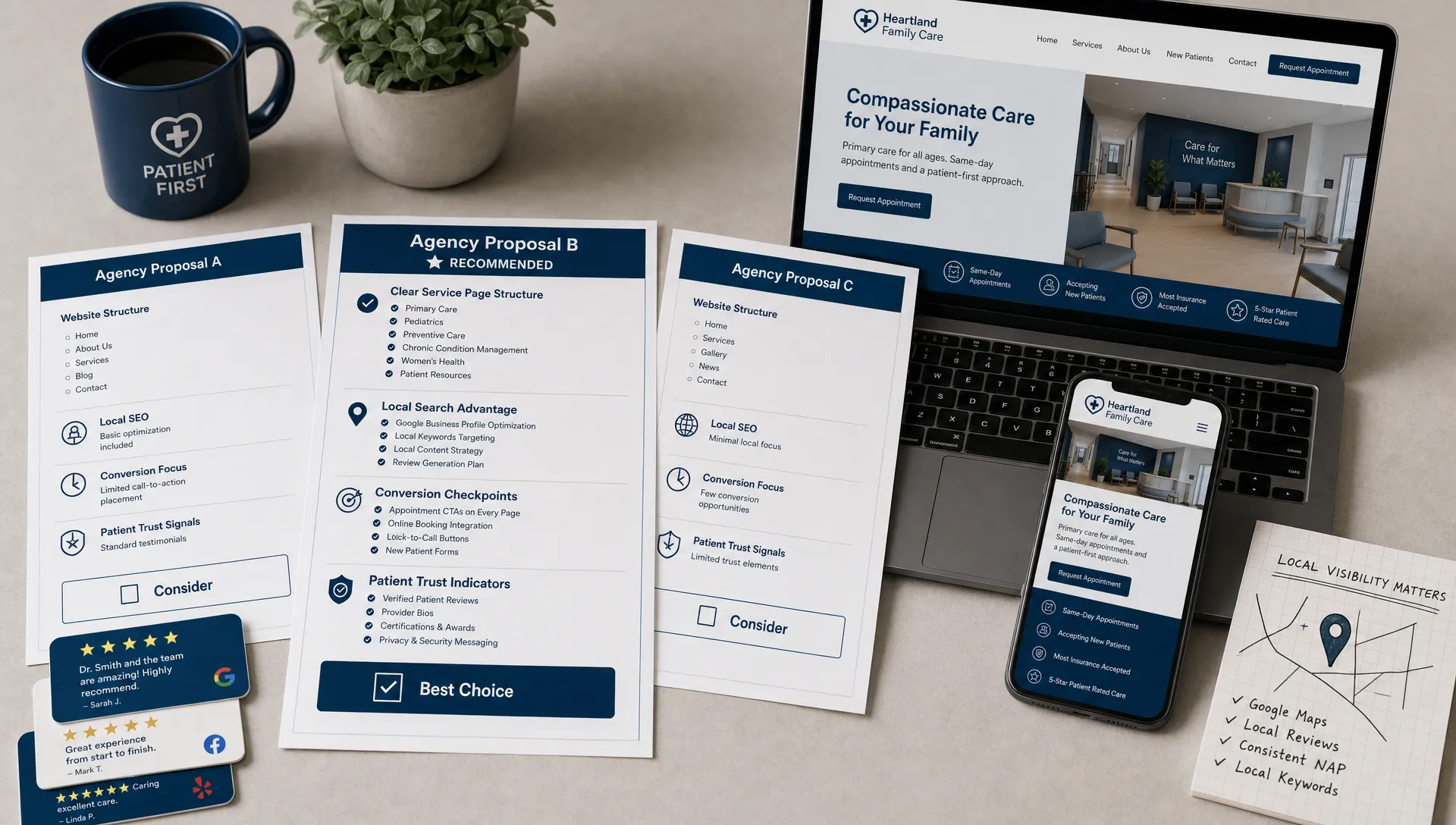
When you search for website design agencies near me, the results can feel interchangeable. Everyone has polished screenshots. Everyone says they build “modern” websites. Everyone promises better results.
For healthcare practices, the decision is more serious. A website for a dental office, optometry clinic, chiropractic practice, pain physician, or physical therapy group is not just a digital brochure. It has to help anxious patients understand their options, trust your providers, find the right service, and take the next step toward an appointment.
The best way to compare local website design agencies is to stop judging only by appearance and start evaluating how each agency thinks about patient acquisition, local search, conversion, and long-term growth.
Start by Defining What Your Website Needs to Do
Before you compare agencies, get clear on the business outcome you want. A beautiful website that does not generate calls, form submissions, or scheduled visits is not a growth asset. It is an expense.
For a healthcare practice, a strong website should usually help with several goals at once. It should make your practice easy to find in local search, clearly explain your services, build trust quickly, and make appointment requests simple on mobile devices. It should also support your broader marketing, including Google Ads, local SEO, reputation building, and patient follow-up.
This is where many agency comparisons go wrong. Practice owners often ask, “Which agency makes the nicest websites?” A better question is, “Which agency understands how patients choose a provider in my specialty and my local market?”
If you want a deeper breakdown of this mindset, Louisville Web Lab has written about what a great website design company does differently, especially for practices where trust and appointment conversion matter.
Build a Shortlist Without Relying Only on Google Rankings
Searching for local agencies is a good starting point, but it should not be your only filter. The agencies that rank well for broad searches may be good at their own SEO, but that does not automatically mean they are the best fit for a healthcare practice.
Build your shortlist from a few sources. Search locally, ask other healthcare practice owners, look at websites of successful practices in nearby markets, and review agencies that specialize in service-based businesses. If you are in dentistry, vision care, pain management, chiropractic, orthopedics, or physical therapy, pay attention to whether the agency has experience translating clinical services into patient-friendly content.
A good shortlist usually includes three to five agencies. More than that can make the process noisy. Fewer than that may not give you enough perspective on pricing, process, and strategic fit.
Compare Agencies Using Healthcare-Specific Criteria
A local restaurant, law firm, and dental implant practice all need different website strategies. Your comparison should reflect the reality of healthcare marketing, not generic design standards.
Use the table below to evaluate each agency more objectively.
| Comparison factor | Strong signal | Red flag |
|---|---|---|
| Healthcare understanding | They ask about your specialties, patient types, insurance or payment considerations, and appointment goals | They only ask what colors and pages you want |
| Local SEO strategy | They discuss service pages, city relevance, Google Business Profile support, reviews, and technical SEO | They treat SEO as an optional add-on after launch |
| Conversion planning | They map calls-to-action, phone visibility, forms, landing pages, and mobile behavior | They focus mostly on homepage visuals |
| Content quality | They can turn clinical services into clear patient-centered messaging | They expect you to write all content without guidance |
| Technical performance | They discuss speed, mobile usability, accessibility basics, analytics, and security | They cannot explain how the site will perform after launch |
| Ownership and support | They clarify who owns the website, content, domain, hosting, and accounts | They are vague about access, contracts, or cancellation |
The agency that wins on this scorecard may not be the cheapest or flashiest. That is usually a good thing. In healthcare, clarity, trust, and findability often matter more than visual trends.
Review Portfolios Like a Patient, Not a Designer
Most agency portfolios are designed to impress business owners. Your job is to review them like a prospective patient.
Open a few live websites the agency has built. Do not just look at the homepage. Check service pages, provider bios, contact pages, and mobile menus. Ask yourself whether a patient could quickly answer basic questions: What does this practice do? Where is it located? Who does it help? Why should someone trust it? What should the patient do next?
Look for proof that the agency can design around a specific decision journey. A healthcare website faces a similar challenge in a different field. It must guide people through an important, sometimes stressful decision with clear information and credible next steps.
For healthcare practices, also look at how the agency handles sensitive or high-intent services. A dental implant page, dry eye treatment page, LASIK consultation page, back pain page, or regenerative medicine page should not read like a generic brochure. It should explain the problem, treatment options, candidacy, expected next steps, and how to book a consultation.

Ask Better Questions During the Sales Call
The sales call tells you a lot. A design-focused vendor may jump quickly into templates, colors, and launch dates. A strategic agency will ask about your market, competition, service mix, patient acquisition goals, and current website performance.
Use the call to learn how they think. Good questions include:
- How would you structure service pages for our highest-value treatments?
- What local SEO elements are included in the website build?
- How do you decide what should appear above the fold on mobile?
- How do you track calls, forms, and appointment requests after launch?
- What do you need from our team to write accurate healthcare content?
- How do you handle website ownership, hosting, editing access, and future support?
- What happens after launch if traffic or conversions do not improve?
Listen for specifics. If every answer sounds like “we customize everything” but the agency cannot explain the process, keep digging. Strategy should be understandable before you sign a contract.
Evaluate SEO and Website Design Together
One of the biggest mistakes practices make is hiring one company for design and thinking about SEO later. For local healthcare, website structure and SEO are deeply connected.
Your service pages, headings, internal links, location signals, page speed, schema markup, and content depth all affect how well the site can perform in search. If an agency redesigns your website without protecting existing rankings or planning new search opportunities, you may end up with a prettier site that gets fewer qualified visitors.
This is especially important if you rely on local searches like “dentist near me,” “orthodontist in Louisville,” “chiropractor near me,” “dry eye doctor,” or “pain management clinic.” Your website needs to support those searches with relevant, helpful pages rather than a thin list of services.
If SEO is a major reason for your redesign, compare agencies using the same lens you would use for a website design and SEO company. The right partner should be able to explain how design decisions affect rankings, user behavior, and patient inquiries.
Understand Pricing Beyond the Initial Quote
Website design pricing can vary widely, and the cheapest quote is rarely the safest choice. The problem is not just that low-cost websites may look generic. It is that missing strategy often costs more later through poor rankings, weak conversion, confusing messaging, or expensive rebuilds.
When comparing proposals, look beyond the headline number. Ask what is included and what is not. Content writing, SEO setup, analytics, call tracking, landing pages, accessibility improvements, hosting, maintenance, revisions, and post-launch support can all affect the real cost.
A more expensive proposal may be a better value if it includes strategy, content, SEO foundations, conversion planning, and launch support. A lower-cost proposal may still work if you already have strong content, clear branding, and an internal marketing team. The right choice depends on what your practice actually needs.
Here is a practical way to compare value:
| Proposal area | Why it matters for healthcare practices |
|---|---|
| Strategy | Prevents the site from becoming a generic brochure |
| Content | Helps patients understand services and trust your expertise |
| Local SEO | Supports visibility in your city and surrounding areas |
| Conversion design | Turns website visits into calls and appointment requests |
| Tracking | Shows which pages and campaigns drive real leads |
| Support | Keeps the site updated after launch |
Do not be afraid to ask agencies to explain the difference between their quote and a competitor’s. A confident agency should be able to clarify tradeoffs without attacking the other company.
Check for Healthcare Compliance Awareness
Your web design agency does not replace your legal or compliance advisors, but it should understand that healthcare websites require extra care. Patient information, forms, tracking tools, chat features, testimonials, before-and-after galleries, and advertising claims all deserve thoughtful handling.
Ask how the agency approaches privacy, form submissions, analytics tools, and third-party integrations. If your website collects protected health information, you need to be especially careful about the tools involved and the agreements required. The agency should be willing to work within your compliance requirements rather than brushing them aside.
Also review how they handle claims. Healthcare marketing should be persuasive, but it should not overpromise outcomes. Strong agencies know how to communicate value while keeping language responsible and patient-centered.
Look for a Clear Post-Launch Growth Plan
A website launch is not the finish line. It is the starting point for measurement and improvement.
After launch, your agency should help you understand what is happening. Are more people calling? Which service pages get the most visits? Are Google Ads visitors converting? Are mobile users finding the appointment button? Are patients dropping off on long forms? These questions matter more than vague reports about impressions or design awards.
For practices investing in SEO, Google Ads, or patient automation, the website should keep improving over time. That might mean adding new service pages, testing landing pages, improving calls-to-action, strengthening internal links, updating provider bios, or building content around common patient questions.
A local agency that disappears after launch may be fine for a simple brochure site. For a growth-focused healthcare practice, ongoing support is usually more valuable.
Use a Simple Agency Scorecard
Once you have proposals, score each agency with a consistent framework. This keeps the decision grounded and reduces the influence of personal preference.
| Category | Suggested weight |
|---|---|
| Healthcare or service-business experience | 20% |
| Local SEO and search strategy | 20% |
| Conversion and appointment strategy | 20% |
| Portfolio quality and content clarity | 15% |
| Technical process and ownership terms | 15% |
| Communication and long-term support | 10% |
You can adjust the weights based on your situation. A brand-new practice may prioritize speed, positioning, and launch support. An established practice with strong traffic may prioritize SEO migration, conversion rate improvement, and content depth. A multi-location group may need stronger location-page strategy and reporting.
The point is to compare agencies based on what will actually grow the practice, not just which presentation felt most exciting.
Common Red Flags to Watch For
Some warning signs are obvious, such as poor communication or outdated portfolio work. Others are easier to miss.
Be cautious if an agency promises first-page rankings without reviewing your market, competitors, or current website. Be cautious if they cannot explain how they will write accurate service content. Be cautious if they want to own your domain or make it difficult for you to leave. Be cautious if they treat mobile design as a secondary step, since many patients will visit your site from a phone.
Another major red flag is a proposal that separates design, SEO, and conversion into disconnected pieces. Patients do not experience your website in pieces. They search, click, scan, compare, and decide. Your agency should understand that full journey.
Frequently Asked Questions
How many website design agencies should I compare? Most practices should compare three to five agencies. That gives you enough variety in strategy, pricing, and process without making the decision overwhelming.
Should I choose a local agency or a healthcare specialist? Ideally, choose both if possible. A local agency may understand your market, while a healthcare-focused agency understands patient behavior, service pages, trust signals, and appointment conversion. If you must prioritize one, choose the agency that best understands your growth goals.
What should I ask before hiring a website design agency? Ask how they approach local SEO, content, conversion tracking, mobile usability, website ownership, compliance-sensitive tools, and post-launch support. Their answers should be specific to your practice, not generic.
Is the cheapest website design proposal a bad choice? Not always, but it can be risky if it leaves out strategy, content, SEO, or tracking. A low-cost site that fails to generate patients may cost more in the long run than a stronger build.
How do I know if an agency understands healthcare marketing? Look for patient-centered messaging, clear service-page strategy, responsible claims, local search knowledge, and an understanding of how people choose providers. They should ask about appointment goals, not just design preferences.
Turn Your Website Comparison Into a Growth Decision
Comparing website design agencies in your area is not just about finding someone who can build pages. It is about choosing a partner who can help your practice earn trust, rank locally, and turn visitors into booked appointments.
If you are a dental, vision, chiropractic, pain, physical therapy, primary care, or specialty practice, Louisville Web Lab helps connect website design with SEO, ads, automation, and patient acquisition strategy. You can start by reviewing how to choose the right web design services, or visit Louisville Web Lab to book a diagnostic strategy call for your practice.