
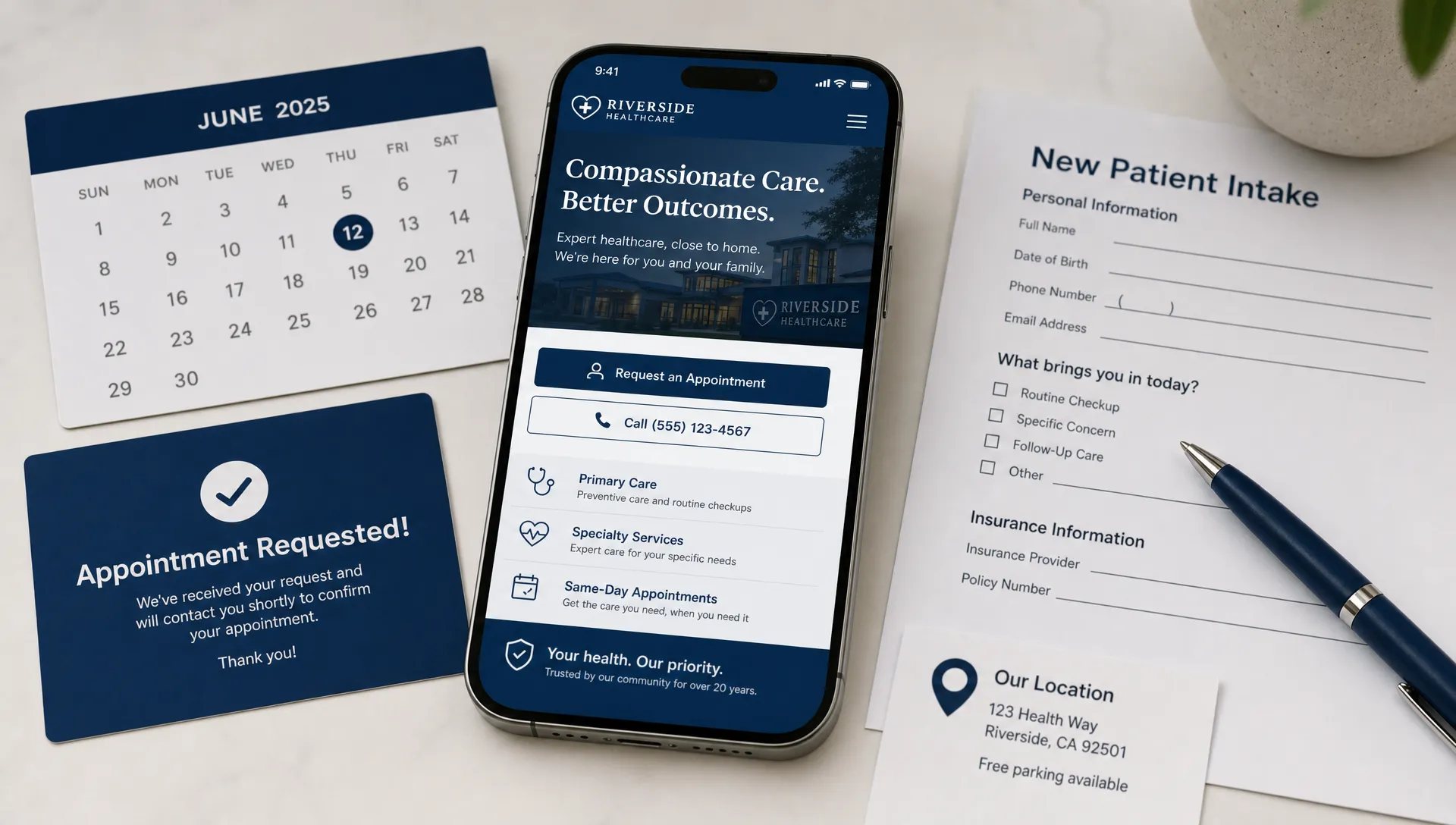
A healthcare ad click is not the finish line. It is the moment a prospective patient has raised a hand and said, “This might be the provider I need.” What happens next determines whether your ad spend becomes a booked visit, a missed call, or another anonymous visitor who disappears.
That is why healthcare landing pages matter. A strong landing page gives one type of patient one clear next step. It connects the promise in the ad to the action your practice wants, such as calling the office, requesting an appointment, booking a consultation, or submitting a short form.
For practices comparing healthcare landing page optimization services in Louisville, KY, the goal should not be a prettier page. The goal should be a measurable patient acquisition system that improves lead quality, reduces wasted ad spend, and helps your front desk convert more inquiries into scheduled visits.
Why sending ad clicks to your homepage often wastes budget
Your homepage has an important job. It introduces your practice, explains who you serve, builds credibility, and helps visitors navigate to many different areas of your website. That makes it useful for organic traffic, referrals, returning patients, and people still learning about your brand.
Paid ad traffic is different. Someone who searches for “same day dentist near me,” “Invisalign consultation Louisville,” “dry eye specialist,” or “physical therapy for knee pain” is usually looking for a specific solution. If that click lands on a broad homepage, the visitor has to hunt for the right service, confirm whether you treat their issue, find the phone number, understand the next step, and decide whether to trust you.
Every extra decision creates friction. In healthcare, friction is expensive because patients are often stressed, skeptical, comparing multiple providers, or calling from a mobile phone between other responsibilities.
Google also cares about landing page relevance. According to Google Ads Help on landing page experience, landing pages should be useful, relevant, transparent, and easy to navigate. A landing page that closely matches the ad and search intent can support better campaign performance because it gives patients what they expected after the click.
A strong homepage still matters, especially for long-term trust and local visibility. If you want the bigger picture on how your website and search presence work together, Louisville Web Lab has also covered how website design and SEO services drive more bookings. Landing pages are more focused. They are built for conversion from a specific campaign.
What a healthcare landing page must do in the first few seconds
Most visitors do not read a landing page from top to bottom. They scan. They decide quickly whether they are in the right place, whether the provider looks credible, and whether the next step feels easy enough to take.
A conversion-focused healthcare landing page should immediately answer five questions:
- What condition, service, or appointment type is this page about?
- Is this practice relevant to my location, insurance situation, urgency, or needs?
- Why should I trust this provider with my health, comfort, vision, smile, or mobility?
- What happens if I call or request an appointment?
- Can I take the next step quickly from my phone?
That last point is critical. Many healthcare ad clicks come from mobile users who want fast answers. A small phone number, a long form, slow load time, vague headlines, or buried appointment button can turn high-intent traffic into lost opportunity.
The best healthcare landing pages reduce uncertainty. They do not overwhelm patients with every credential, service, and technology your practice offers. Instead, they present the most relevant proof, explain the appointment path, and make booking feel safe and simple.
Match the page to the patient intent behind the ad
Landing page optimization starts before the page is designed. It starts with understanding why the patient clicked.
Someone searching for emergency dental care has a different mindset than someone researching dental implants. A parent looking for pediatric orthodontics has different concerns than a person comparing LASIK providers. A patient researching pain management may need confidence that the practice understands their symptoms, while a physical therapy patient may be looking for convenient scheduling and a clear recovery plan.
| Ad intent | Patient mindset | Landing page focus |
|---|---|---|
| Urgent care need | “I need help soon.” | Fast calling, availability cues, location clarity, simple next step |
| Elective consultation | “Is this worth it?” | Benefits, candidacy, trust signals, financing or insurance guidance when applicable |
| Condition-specific search | “Do they treat my problem?” | Symptom relevance, service explanation, provider credibility, appointment expectations |
| Second opinion search | “Can I trust them?” | Reviews, credentials, patient-friendly process, reassurance |
| Branded search | “I already know the practice.” | Direct booking, phone number, hours, location, minimal distractions |
This is why a single generic landing page rarely performs well across every campaign. The ad, keyword, landing page headline, call to action, form, and follow-up process should all line up around the same patient intent.
If the campaign setup is weak, even a good landing page may struggle. Practices running search campaigns should make sure the keyword strategy, match types, locations, and conversion tracking are built correctly. For more on that foundation, see Louisville Web Lab’s guide to setting up Google Ads for better healthcare leads.
The anatomy of a landing page that books visits
A healthcare landing page does not need to be complicated. In fact, complicated pages often convert worse because patients are not trying to admire the design. They are trying to decide if they should contact your office.
A specific headline
The headline should mirror the patient’s reason for clicking. “Schedule a Dental Implant Consultation in Louisville” is stronger than “Welcome to Our Practice” because it confirms relevance immediately. For an optometry campaign, “Book a Dry Eye Evaluation” gives the visitor a clear service match. For a chiropractic or physical therapy campaign, “Get Help for Back Pain With a Local Care Team” can connect the page to the concern behind the search.
A primary call to action
The page should have one main action. Usually, that action is “Call Now,” “Request an Appointment,” “Book a Consultation,” or “Schedule an Evaluation.” Secondary options can exist, but they should not compete with the main goal.
For many healthcare practices, phone calls remain high value because a trained coordinator can answer questions, check availability, and move the patient into the schedule. Forms can also work well, especially after hours or for elective consultations, but they should be short enough to complete quickly.
Trust signals near the decision point
Patients want proof before they share information or call. Trust signals can include review ratings, provider credentials, years in practice, accepted insurance notes, before-and-after galleries when appropriate, association memberships, location familiarity, and clear privacy language.
Avoid exaggerated medical claims. A landing page can be persuasive without promising outcomes. In healthcare, credibility often comes from clarity, restraint, and specificity.
A simple explanation of what happens next
Uncertainty kills conversions. If patients do not know whether the form goes to a real person, whether they will receive a call, or what the appointment includes, they may postpone the decision.
A brief “What to expect” section can help. For example, a dental implant page might explain that the team will review the request, confirm appointment options, and discuss the consultation process. A physical therapy page might explain that the first visit includes an evaluation and a personalized plan. Keep it plain and nontechnical.
Mobile-first design
A landing page that looks polished on desktop can still lose patients on mobile. Buttons should be easy to tap. Forms should use large fields. Phone numbers should be click-to-call. The page should load quickly and keep the most important information visible without endless scrolling.
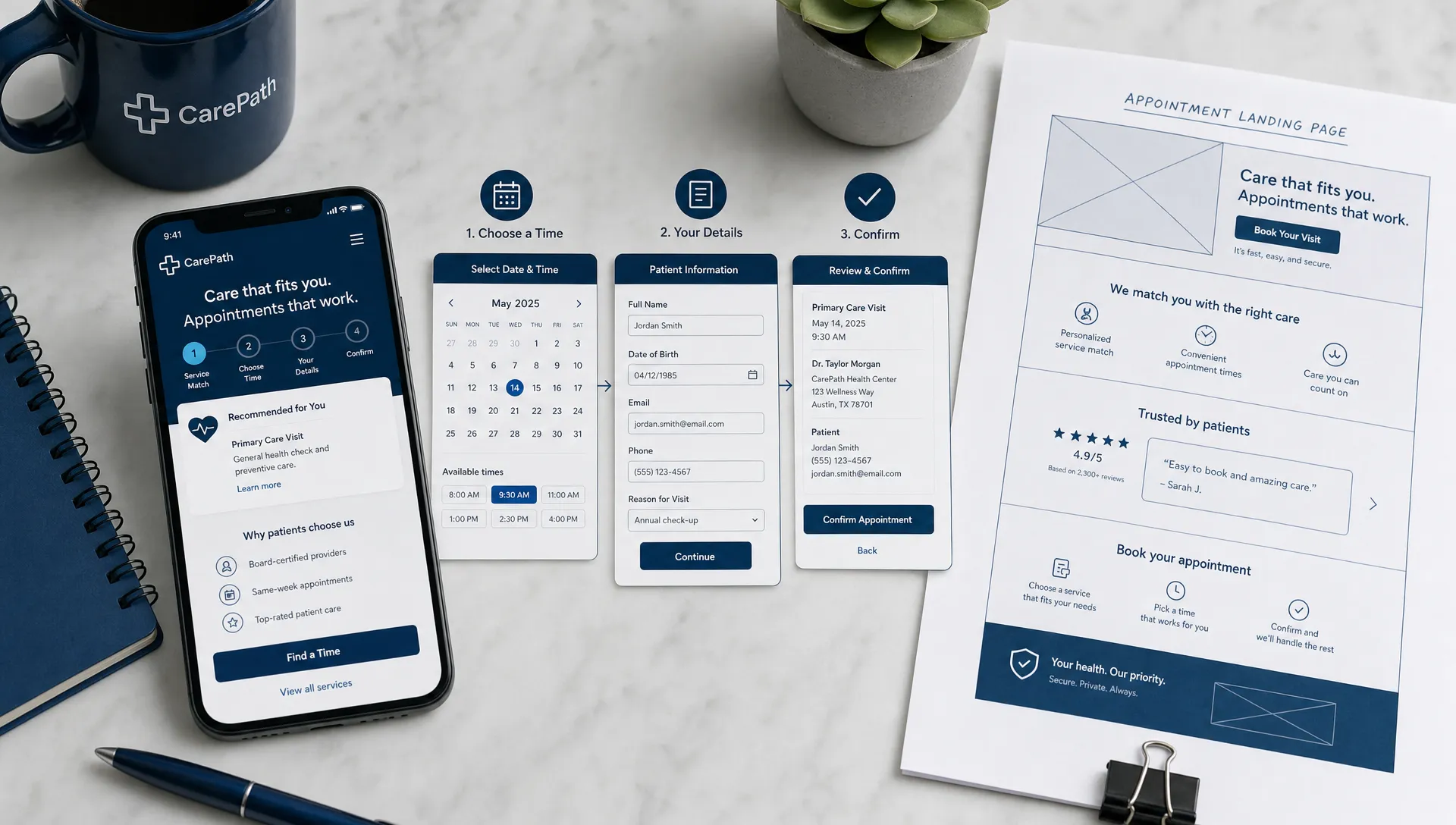
Turn forms and phone calls into real appointments
A landing page conversion is not always a booked visit. A form submission, call, or chat inquiry is only valuable if the practice responds quickly and guides the patient into the schedule.
This is where many healthcare campaigns leak revenue. The ads may be generating legitimate interest, but the process after the click is too slow or inconsistent. A patient requests an appointment at 8:30 p.m. and does not hear back until the next afternoon. A missed call does not receive a callback. A form asks for too much information. A coordinator leaves a voicemail but does not follow up again.
Landing page optimization should include the handoff after the conversion. That may involve call tracking, form routing, confirmation messages, missed call workflows, appointment request alerts, and clear internal expectations for response time.
A useful question for every campaign is simple: “If a motivated patient contacts us right now, what happens in the next 10 minutes?”
If the answer is unclear, the landing page is only solving part of the problem.
Measure booked visits, not just clicks and leads
Healthcare marketing reports often overemphasize clicks, impressions, and cost per lead. Those numbers matter, but they do not tell the full story. A campaign with cheaper leads can still be unprofitable if those leads are poor fit, difficult to reach, or unlikely to book.
A better landing page optimization process tracks the full path from click to scheduled appointment.
| Metric | What it tells you | Why it matters |
|---|---|---|
| Landing page conversion rate | How many visitors call or submit a form | Shows whether the page is persuasive and easy to use |
| Call answer rate | How many calls reach the office | Reveals front desk and scheduling capacity issues |
| Lead to booked visit rate | How many inquiries become appointments | Connects marketing performance to schedule growth |
| Cost per booked visit | Ad spend divided by scheduled visits | Helps compare campaign profitability |
| No-show or cancellation patterns | Whether booked patients actually arrive | Helps evaluate lead quality and follow-up effectiveness |
This is also where testing matters. Instead of redesigning a landing page based on opinion, test the parts most likely to influence appointments. That may include the headline, call to action, form length, review placement, phone number visibility, location copy, or the explanation of what happens after the request.
Small changes can reveal important patient behavior. For example, a pain management page may get more completed forms when the first step is described as a consultation request rather than a treatment promise. An orthodontic page may perform better when the financing or consultation information is easier to find. An eye care page may need clearer separation between routine exams and medical eye care.
Keep privacy, compliance, and patient trust at the center
Healthcare landing pages must balance conversion with responsibility. The goal is to make it easy for patients to contact the practice, not to pressure them into sharing unnecessary health information.
Forms should request only what the practice needs to respond. Avoid asking for sensitive details unless there is a clear operational reason and the technology is configured appropriately. If landing page tools, analytics tools, call tracking, or form systems may handle protected health information, practices should evaluate privacy, security, and business associate requirements with qualified counsel or compliance advisors.
The U.S. Department of Health and Human Services provides guidance on HIPAA and marketing, which is worth understanding when promoting healthcare services. Ad platforms also have policies around healthcare claims, personalization, and sensitive interest categories.
Patient trust is not only a legal concern. It is a conversion factor. Clear privacy language, accurate claims, realistic expectations, and professional design all make the patient feel safer taking the next step.
Common landing page mistakes healthcare practices should fix first
Some landing page problems are easy to spot once you view the page like a patient instead of a practice owner.
- The page headline does not match the ad the patient clicked.
- The phone number is hard to find on mobile.
- The form is too long for a first contact.
- The page talks about the practice before it addresses the patient’s problem.
- Reviews and trust signals are buried near the bottom.
- The call to action changes too many times across the page.
- The page loads slowly or has layout shifts on mobile.
- There is no clear follow-up process after a form submission.
Fixing these issues can improve more than conversion rate. It can also improve lead quality because the page sets clearer expectations before the patient contacts the office.
For practices running retargeting campaigns, the landing page experience also affects what happens after someone leaves without booking. A patient who visited a focused page about a consultation or condition can be brought back with more relevant messaging. Louisville Web Lab explains this in more detail in its article on Google retargeting ads that bring back ready-to-book leads.
Frequently Asked Questions
What is a healthcare landing page? A healthcare landing page is a focused web page built for a specific campaign, service, condition, or appointment type. Its job is to turn visitors from ads or other traffic sources into calls, form submissions, consultation requests, or booked visits.
How is a landing page different from a regular service page? A service page is usually part of the main website and may support SEO, education, and navigation. A landing page is usually more focused on one campaign goal, with fewer distractions and a clearer conversion path.
Do healthcare landing pages need to be HIPAA compliant? The page itself should be designed with privacy in mind, and any tools that collect, store, transmit, or process protected health information need proper safeguards. Practices should review their forms, analytics, call tracking, and automation tools with qualified compliance guidance.
What should a healthcare landing page include? It should include a clear headline, service-specific copy, a strong call to action, click-to-call access, a short form, trust signals, location relevance, appointment expectations, and mobile-friendly design.
How do you know if a landing page is working? Track more than clicks. Measure form submissions, calls, booked appointments, cost per booked visit, call answer rate, and lead quality. The best landing pages are judged by scheduled patient opportunities, not just traffic.
Turn more ad clicks into scheduled patients
If your healthcare practice is paying for clicks, your landing page should be built to convert them into booked visits. That requires more than attractive design. It requires message match, patient trust, mobile usability, tracking, follow-up, and a clear path from interest to appointment.
Louisville Web Lab helps healthcare practices connect SEO, Google Ads, websites, and automation into patient acquisition systems. If you want to see where your ad traffic is leaking and how your landing pages could convert more patients, start with a diagnostic strategy call with Louisville Web Lab.