
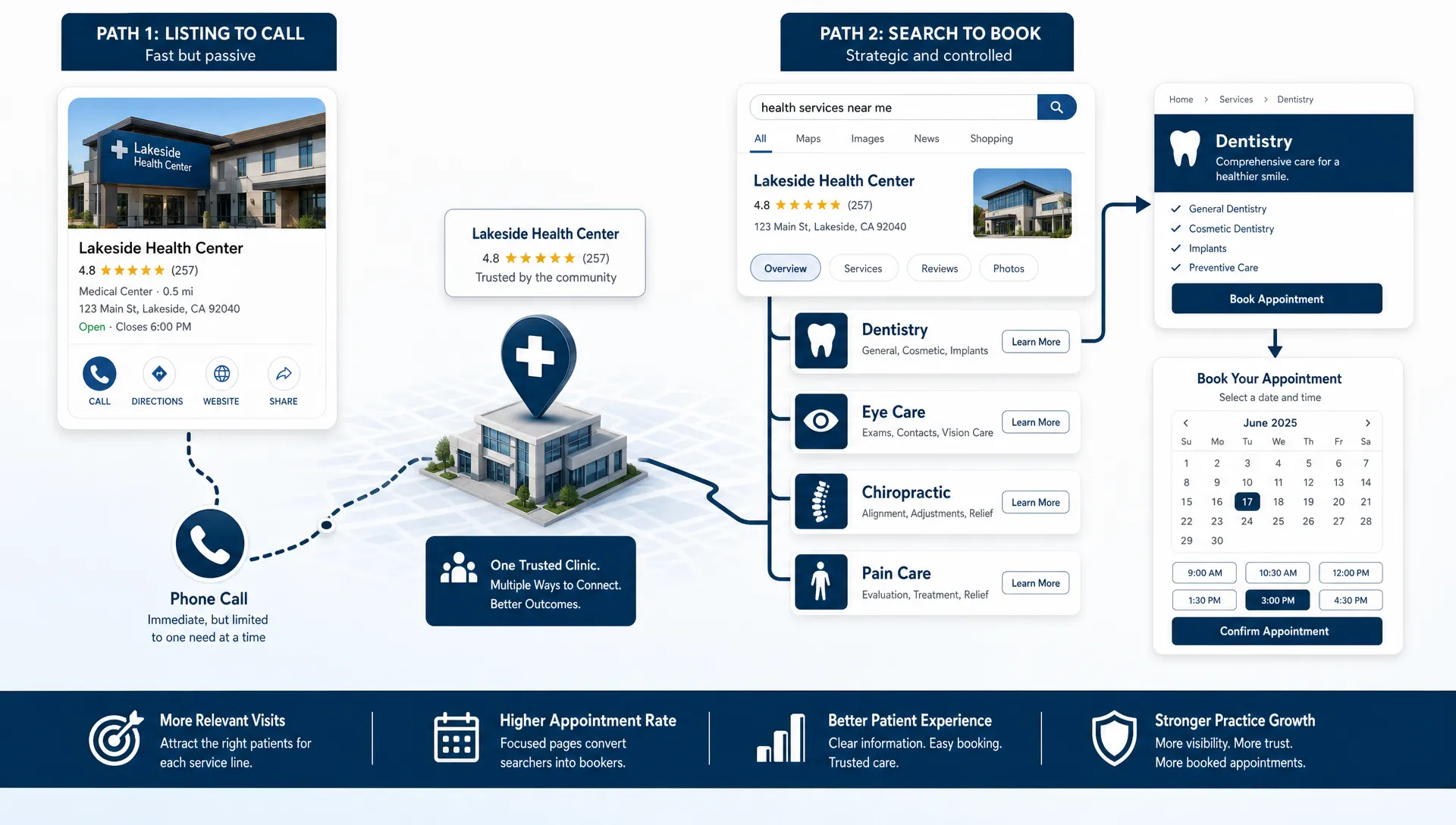
For a dentist, optometrist, chiropractor, physical therapist, pain clinic, or specialty practice, the question is not whether Google can generate local demand. It can. The harder question is which paid channel should get your budget first: Google Local Services Ads or traditional Google Ads.
The difference matters because these channels create different types of leads. One can put your clinic in front of ready-to-call patients with minimal friction. The other gives you more control over search intent, landing pages, service-line messaging, and appointment tracking.
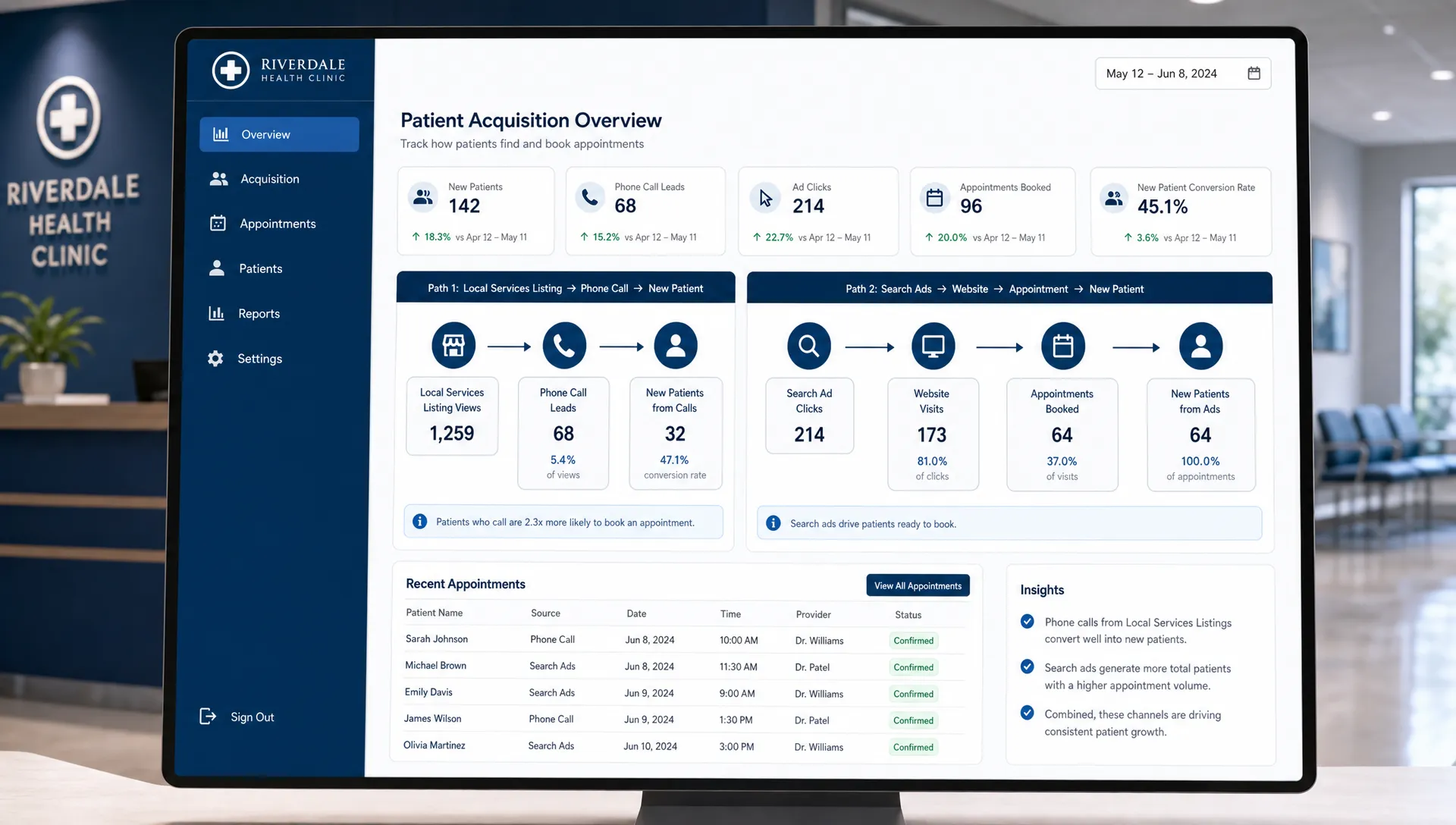
If you judge both channels by clicks alone, you will make the wrong call. Local clinics should compare them based on qualified leads, booked appointments, kept appointments, and the economics of each service line.
Short answer: Local Services Ads capture calls, Google Ads controls the journey
Google Local Services Ads are usually strongest when an eligible clinic wants direct phone or message leads from nearby patients who are ready to choose a provider. Traditional Google Ads, especially Search campaigns, are stronger when the clinic needs precise keyword targeting, service-specific landing pages, and more control over the path from search to appointment.
For many practices, the best answer is not either-or. It is a structured test where Local Services Ads handle high-intent local requests and Google Ads handle service-line growth, competitive searches, and higher-consideration procedures.
The key is to avoid treating both as the same product. Local Services Ads are closer to a verified local lead source. Google Ads is a flexible advertising platform that can be built around specific patient intent.
What Google Local Services Ads are
When people say Google local services in a clinic marketing conversation, they are usually talking about Local Services Ads. These are paid listings that can appear prominently for eligible local service searches. According to Google Local Services Ads documentation, advertisers pay for leads related to their business rather than paying for every click.
A Local Services Ad may show your clinic name, reviews, hours, service area, and a verification badge when applicable. The patient can often call or message from the ad without visiting your website.
That is the main advantage: less friction. A patient searching for an emergency dentist, eye exam, chiropractor near me, or physical therapy clinic may not want to read five pages before contacting someone. They want availability, trust signals, proximity, and a fast response.
The tradeoff is control. You do not have the same level of keyword, ad copy, landing page, and audience control that you get inside a standard Google Ads Search campaign. Eligibility also varies by category and location, so not every clinic type or market can use Local Services Ads in the same way.
What traditional Google Ads are
Google Ads is the broader advertising platform. In this comparison, the most relevant format is Google Search Ads, where your clinic bids on searches and sends users to a website page, landing page, or call action.
For healthcare practices, Search Ads can be structured around services, conditions, locations, and patient intent. A dental implant campaign can be separated from a teeth whitening campaign. A dry eye campaign can be separated from a routine eye exam campaign. A pain management practice can build different campaigns for sciatica, knee pain, back pain, or regenerative medicine consultations.
That structure matters because not every lead has the same value or urgency. A patient searching for a same-day tooth extraction behaves differently from someone researching Invisalign, LASIK, dental implants, cataract surgery, or chronic pain treatment.
Healthcare advertisers also need policy awareness. Google has specific healthcare and medicines advertising policies, and clinics should make sure their ad copy, landing pages, tracking, and remarketing practices comply with applicable rules.
For a deeper breakdown of the Search Ads side, Louisville Web Lab has a guide on what works in Google Search Ads for healthcare practices.
Google Local Services vs Google Ads: side-by-side comparison
| Factor | Google Local Services Ads | Google Ads Search campaigns |
|---|---|---|
| Primary billing model | Pay per lead, depending on eligible lead types | Pay per click, with cost depending on keywords and competition |
| Best fit | Ready-to-call local patients | Service-line growth, procedure demand, competitive searches, and landing page funnels |
| User path | Patient contacts the clinic directly from the ad | Patient clicks an ad, visits a page, then calls or submits a form |
| Control over keywords | More limited | High control through keywords, match types, negatives, and search terms |
| Control over messaging | More limited profile-based messaging | Strong control over ad copy, extensions, landing page content, and calls to action |
| Role of reviews | Very important because reviews are visible in the listing | Important, but often supported through landing page trust signals and reputation assets |
| Setup requirements | Category and location eligibility, verification, and profile completion | Google Ads account setup, campaign structure, tracking, landing pages, and policy compliance |
| Tracking focus | Lead quality, call quality, booking rate, responsiveness | Cost per qualified lead, conversion rate, booked appointments, and service-line ROI |
| Common weakness | Lower context before the call and less lead-routing control | Wasted spend if keywords, locations, landing pages, or tracking are poorly built |
When Google Local Services Ads make sense for a clinic
Local Services Ads can be a strong fit when the patient is already near the point of choosing a provider. This is especially true for searches where convenience, availability, reviews, and proximity are more important than long-form education.
They tend to work best when several conditions are true:
- Your clinic category is eligible in your market.
- Your Google reviews are strong, recent, and competitive.
- Your team answers calls quickly during advertised hours.
- Your services match direct local demand.
- Your front desk can qualify leads without creating friction.
For example, a general dental office with strong reviews may benefit from Local Services Ads for same-week appointments or emergency dental needs. A chiropractic clinic may use them to capture local patients looking for quick access to care. An optometry practice may benefit when patients are searching for an eye doctor nearby and are ready to schedule.
The biggest operational issue is responsiveness. If the clinic misses calls, delays follow-up, or routes leads to voicemail, Local Services Ads can underperform even when the ad placement is strong. The channel rewards clinics that can turn contact into a scheduled visit quickly.
When Google Ads makes more sense
Google Ads usually wins when the patient needs more context before booking. This is common in higher-value, elective, specialty, or multi-step care decisions.
A patient considering dental implants may want to understand candidacy, technology, financing options, provider experience, and consultation details. A LASIK patient may compare surgeons, pricing factors, and recovery expectations. A pain patient may want to know whether the clinic treats a specific condition, accepts certain cases, or offers non-surgical options.
Search Ads let you build that journey. You can send each campaign to a focused landing page, match ad copy to the search, add call assets, test forms, use negative keywords, and measure which services turn into actual appointments.
This is also why Google Ads is often a better fit for multi-location or multi-specialty practices. You can separate budget by office, specialty, procedure, and intent instead of pushing all demand through one broad lead source.
How lead quality changes by clinic type
The right choice depends heavily on the economics and urgency of the service. A low-friction local appointment behaves differently from a high-consideration consultation.
| Clinic type or service line | Local Services Ads fit | Google Ads fit | Practical decision |
|---|---|---|---|
| General dentistry | Strong if eligible, especially for local and urgent searches | Strong for new patient exams, emergency dentistry, implants, and cosmetic services | Use Local Services Ads for direct calls and Search Ads for service-specific growth |
| Orthodontics | Useful for local consultation intent if eligible | Strong for Invisalign, braces, and parent-focused research searches | Google Ads often needs landing pages that explain options and next steps |
| Optometry and eye care | Strong for eye doctor near me and appointment-driven searches if eligible | Strong for dry eye, LASIK, cataract, and specialty vision services | Match the channel to urgency and complexity |
| Chiropractic and physical therapy | Strong for local access and pain-related appointment searches if eligible | Strong for condition-specific campaigns like sciatica, back pain, sports injury, and post-surgical rehab | Use call-focused ads only if the front desk can respond quickly |
| Pain management and orthopedics | Useful for local provider searches if eligible | Often stronger for high-intent condition and treatment searches | Google Ads usually provides better control over qualification and education |
| Cosmetic, elective, or specialty procedures | Limited if the patient needs more research | Strong for procedure-specific landing pages and consultation funnels | Prioritize Google Ads when trust-building and prequalification matter |
The hidden variable: your front desk
Paid media performance is not only a marketing issue. It is also an operations issue.
Local Services Ads may generate calls quickly, but a call is not the same as a booked appointment. Google Ads may generate form submissions and phone calls, but a lead is not valuable if follow-up is slow or the team cannot answer common questions.
Before scaling either channel, review how your clinic handles these moments:
- How many ad-driven calls are answered live?
- How many calls are missed during lunch, after hours, or busy clinic periods?
- How often does the team ask how the patient found the practice?
- How many leads are existing patients, vendors, wrong-service inquiries, or insurance-only questions?
- How many scheduled appointments actually show up?
This is where many clinics misread performance. A channel may look expensive because the lead handling is weak. Another may look efficient because it generates cheap inquiries, even if very few convert into care.
Clinics should also treat call tracking, form tracking, CRM notes, and automation with privacy in mind. This article is not legal advice, but healthcare practices should understand their obligations under the HHS HIPAA Privacy Rule and avoid putting protected health information into tools or workflows that are not appropriate for it.
Cost comparison: do not compare cost per lead to cost per click
A common mistake is saying Local Services Ads are better because they charge per lead while Google Ads charges per click. That is too simple.
A cheap lead that does not book is expensive. A high-cost click that becomes a high-value consultation may be profitable. A phone call from someone outside your ideal service mix may be less valuable than a form submission from a patient ready for a specific procedure.
The better comparison is downstream:
- Cost per qualified lead
- Call answer rate
- Appointment booking rate
- Cost per booked appointment
- Kept appointment rate
- New patient value by service line
A simple formula can help: cost per booked new patient equals ad spend divided by booked new patients from that channel. For a more conservative view, calculate cost per kept appointment instead.
This is the reason clinics should build campaigns around booked appointments, not surface-level activity. Louisville Web Lab covers this in more detail in its guide on how to build a Google Ads campaign that books patients.
A practical decision framework for 2026
Search behavior keeps changing, but the decision logic is still straightforward. Choose the channel that best matches patient intent, service economics, and your team’s ability to convert demand.
| Situation | Best starting point | Why |
|---|---|---|
| You are eligible for Local Services Ads, have strong reviews, and want phone calls fast | Local Services Ads | The format reduces friction for ready-to-call local patients |
| You need to grow a specific procedure or specialty service | Google Ads | Search campaigns can isolate intent and send patients to focused landing pages |
| You operate multiple locations or specialties | Google Ads first, then selective Local Services Ads | Campaign structure and budget control are usually more important |
| You have weak call answering or limited front desk capacity | Google Ads with forms and controlled routing | You can design a more manageable conversion path |
| You have strong operations and want to dominate local paid visibility | Both | Each channel can cover different parts of high-intent search demand |
If you are comparing more than these two options, this broader guide to Google advertising services every practice should compare can help you understand where Search Ads, Local Services Ads, landing pages, and other campaign types fit.
How to test both channels without wasting budget
A clean test is better than guessing. The goal is not to prove that one platform is universally better. The goal is to identify which one produces the right appointments for your clinic at an acceptable acquisition cost.
- Choose the service lines first: Do not run broad campaigns for every service at once. Pick the services that matter most to growth and have clear patient demand.
- Confirm Local Services Ads eligibility: Check whether your clinic category and location are eligible, then complete the required verification and profile steps.
- Build Google Ads around intent: Separate campaigns by service, location, and urgency so reporting does not blur high-value searches with low-value ones.
- Use dedicated tracking: Track calls, forms, booked appointments, and kept appointments by channel without collecting unnecessary sensitive information.
- Review lead quality weekly: Look beyond volume. Label leads as qualified, unqualified, existing patient, wrong service, missed call, or booked.
- Adjust based on appointments: Shift budget toward the channel and service line producing better booked appointments, not just cheaper leads.
- Give the test enough time: A few days of data is rarely enough. Most clinics need several weeks of clean tracking before making a confident decision.
Common mistakes clinics should avoid
The fastest way to waste budget is to launch ads before the practice is ready to convert leads. This is true for both Local Services Ads and Google Ads.
Common mistakes include sending Search Ads to a generic homepage, advertising services the clinic does not want to prioritize, ignoring negative keywords, failing to answer Local Services calls, judging performance by clicks instead of appointments, and mixing all locations or specialties into one reporting bucket.
Another mistake is underestimating reviews. Local Services Ads lean heavily on visible trust signals, and Google Ads landing pages also perform better when they reflect a credible practice. Reputation, speed to lead, and conversion-focused pages are not separate from paid media. They are part of the system.
So, which is better for local clinics?
Google Local Services Ads are often better for direct, high-intent, local phone leads when the category is eligible and the clinic can respond quickly. Google Ads is often better for service-line strategy, patient education, specialty care, and measurable appointment funnels.
For a local clinic, the smartest approach is usually to define the job of each channel. Let Local Services Ads compete for ready-to-call local demand. Let Google Ads build controlled campaigns for the services you want to grow. Then judge both by booked and kept appointments.
That is how a practice moves from buying visibility to building a patient acquisition system.
Frequently Asked Questions
Are Google Local Services Ads better than Google Ads for clinics? They can be better for direct local calls, especially when the clinic is eligible, has strong reviews, and answers quickly. Google Ads is usually better when you need more control over keywords, landing pages, service-line targeting, and appointment tracking.
Can healthcare clinics use Google Local Services Ads? Some healthcare-related categories may be eligible depending on the market and Google’s current requirements. Eligibility, verification, and available features can vary by category and location, so clinics should confirm directly in Google’s Local Services Ads setup process.
Do Local Services Ads replace a Google Business Profile or local SEO? No. Local Services Ads are paid placements. Your Google Business Profile, reviews, website, and local SEO still influence patient trust and long-term visibility. Paid ads work best when the rest of the local presence is strong.
Is pay per lead cheaper than pay per click? Not always. Pay per lead can look simpler, but the real metric is cost per booked appointment or cost per kept appointment. A higher-cost Google Ads click can outperform a lower-cost Local Services lead if it brings in a better-fit patient.
Should a new clinic start with Local Services Ads or Google Ads? If the clinic is eligible for Local Services Ads, has enough reviews, and can answer calls quickly, Local Services Ads may be a useful early test. If the clinic needs to promote specific services, educate patients, or control budget by service line, Google Ads may be the better starting point.
Need help choosing the right Google strategy for your clinic?
If you are not sure whether Local Services Ads, Google Ads, or both should come first, the answer should come from your market, service mix, reviews, call handling, and appointment economics.
Louisville Web Lab helps healthcare practices grow through SEO, Google Ads, websites, automation, reputation, and patient acquisition systems. If you want a practical plan for turning local search visibility into booked appointments, book a diagnostic strategy call and get a clearer path forward.