

Choosing Google advertising services for a healthcare practice is not the same as choosing them for an ecommerce store, restaurant, or software company. A dental implant case, LASIK consult, physical therapy evaluation, pain management referral, or orthodontic new patient exam all have different levels of urgency, patient education, insurance complexity, and conversion friction.
That is why the best question is not, “Should we run Google Ads?” It is, “Which Google advertising services match our practice goals, budget, market, and ability to convert new patient demand into booked appointments?”
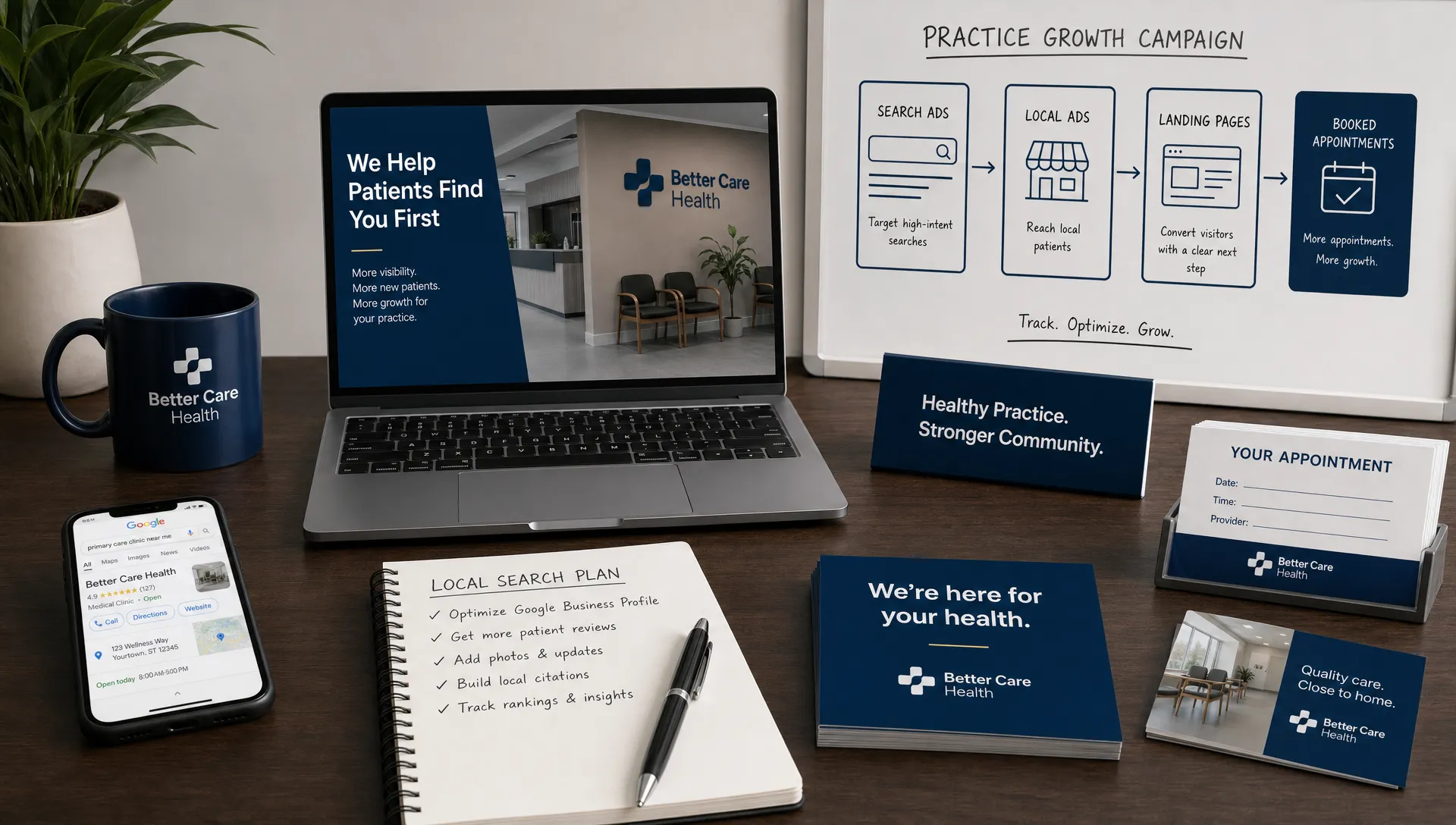
For most practices, the right answer is not one service. It is a focused mix of high-intent search campaigns, local visibility, conversion-focused landing pages, call tracking, reporting, and ongoing optimization. This guide breaks down the major services to compare before you hire an agency, freelancer, or in-house marketer.
What counts as Google advertising services?
When practice owners hear “Google Ads,” they often think only of the text ads at the top of search results. Those are important, but they are only one part of a complete patient acquisition system.
Google advertising services can include:
- Google Search Ads strategy and management
- Local Services Ads, when available for your category and market
- Performance Max campaigns
- Display, YouTube, and Demand Gen campaigns
- Remarketing strategy
- Landing page design and conversion optimization
- Call tracking and form tracking
- HIPAA-aware analytics setup and reporting
- Google Business Profile and local search alignment
- Budget planning, testing, and ongoing optimization
The service you choose should depend on your growth objective. A new dental office trying to fill hygiene openings needs a different setup than an established oral surgery practice pursuing implant consults. A chiropractor with same-week availability has a different ad strategy than a cataract surgeon with a longer decision cycle.
Here is a simple way to compare the main options.
| Google advertising service | Best fit | Main risk if misused | What to compare before buying |
|---|---|---|---|
| Search Ads | High-intent patients actively looking for care | Paying for broad, low-quality clicks | Keyword intent, match types, negatives, location targeting, conversion tracking |
| Local Services Ads | Eligible local service categories where phone leads matter | Assuming every lead is qualified | Category availability, lead dispute process, call handling, coverage area |
| Performance Max | Multi-channel reach and conversion testing | Losing visibility into search terms and placements | Asset quality, conversion goals, exclusions, budget controls |
| Display and YouTube | Awareness, education, and remarketing | Spending before demand is proven | Audience strategy, creative quality, frequency, measurement |
| Remarketing | Re-engaging past site visitors | Privacy and compliance mistakes | Consent, audience setup, exclusions, policy compliance |
| Landing pages | Turning ad clicks into calls and forms | Sending paid traffic to generic pages | Page speed, mobile experience, trust signals, call-to-action clarity |
| Tracking and reporting | Measuring booked appointment value | Optimizing for clicks instead of patients | Call tracking, form tracking, lead quality review, appointment attribution |
1. Google Search Ads management
For most healthcare practices, Google Search Ads are the first service to compare because they capture existing demand. The patient is already searching for something specific, such as “emergency dentist near me,” “orthodontist for teens,” “dry eye treatment,” “chiropractor near me,” or “pain management doctor.”
That intent matters. Search Ads can put your practice in front of people who are closer to scheduling than someone passively scrolling social media. But Search Ads also get expensive quickly when campaigns are built around vague keywords, overly broad match types, or weak landing pages.
A strong Search Ads service should include specialty-specific campaign structure. For example, a dental practice should not lump implants, emergency dentistry, Invisalign, veneers, and general dentistry into one campaign with one budget. A physical therapy clinic should separate post-surgical rehab, sports injuries, back pain, and general PT when those services have different margins and lead quality.
Good Search Ads management should also include negative keyword work. Without it, your practice may pay for searches related to jobs, school programs, free advice, DIY remedies, unrelated medical terms, or services you do not provide.
If you want a deeper breakdown of what makes healthcare search campaigns perform, Louisville Web Lab has a separate guide on Google Search Ads for healthcare practices.
When comparing providers, ask how they define a conversion. A click is not a conversion. An impression is not a conversion. Even a form submission may not be a good conversion if the person is outside your service area, looking for Medicaid when you do not accept it, or requesting a treatment you do not offer.
The stronger benchmark is qualified patient demand: calls, forms, bookings, and the service lines those leads came from.
2. Local Services Ads
Local Services Ads can be useful for some practices, but they should be compared carefully. These ads are designed to connect local searchers with service providers, often through phone calls or message leads. According to Google’s Local Services Ads documentation, businesses can use them to receive leads from people searching for services in their area, with billing based on valid leads rather than traditional clicks.
The key phrase is “when available.” Eligibility, categories, screening requirements, and ad formats can vary by industry and location. Before you assume Local Services Ads belong in your plan, confirm whether they are available for your specialty, city, and service category.
Local Services Ads can work well when:
- The patient need is local and immediate
- Phone calls are a strong conversion path
- Your front desk can answer quickly
- Your service area is clearly defined
- Your reviews and reputation are competitive
They are less useful when the service requires extensive education, referrals, financing conversations, or multi-step consults before booking.
The mistake many practices make is comparing Local Services Ads and Search Ads as if one must replace the other. In reality, they often serve different purposes. Local Services Ads may capture high-visibility local calls. Search Ads offer more control over keywords, landing pages, ad copy, and service-line segmentation.
If your phones are not being answered consistently, fix that before expanding spend. Paying for more calls will not help if new patient opportunities are lost at the front desk.
3. Performance Max campaigns
Performance Max is Google’s campaign type that can run across multiple Google properties, including Search, Display, YouTube, Gmail, Discover, and Maps inventory, depending on setup and eligibility. It can be powerful, but it requires careful conversion tracking and asset management.
For healthcare practices, Performance Max is usually not the first service to buy if you have no tracking, no landing pages, and no proven conversion data. The algorithm needs reliable signals. If your account tells Google that every low-quality form fill is valuable, the campaign may optimize toward more of those same weak leads.
Performance Max may make sense when your practice already has:
- Clear conversion actions
- Strong landing pages
- Enough budget for testing
- High-quality creative assets
- Defined service lines and geographic limits
- A process for reviewing lead quality
A common example is an elective service line with a longer decision journey, such as implants, LASIK, cosmetic dentistry, regenerative medicine, or specialty pain treatments. In these cases, Performance Max may support broader visibility while Search Ads capture the highest-intent queries.
The service to compare is not just “can you launch Performance Max?” Almost anyone can launch it. The better question is whether the provider can control inputs, review outputs, and prevent the campaign from chasing cheap but unqualified conversions.
4. Display, YouTube, and Demand Gen campaigns
Display, YouTube, and Demand Gen campaigns are often sold as a way to “build awareness.” That can be valuable, but awareness is only useful when it supports a clear patient journey.
For example, an orthodontist may use video or display creative to educate parents about early evaluation. A cataract or LASIK provider may use visual campaigns to stay visible while patients compare options. A pain management clinic may promote educational content for people who have tried conservative treatment and are looking for next steps.
These channels are usually weaker for immediate appointment capture than Search Ads because the patient is not always actively searching at that moment. They can still play a role, especially when paired with remarketing and strong landing pages.
The main thing to compare is whether the provider understands the difference between demand capture and demand creation. Search Ads capture demand. Display and YouTube often create or nurture demand. If your appointment schedule is empty this week, awareness campaigns may not be the fastest fix. If your practice is building a premium elective service line over the next six months, they may be useful.
5. Landing page and website conversion services
One of the most overlooked Google advertising services is not inside Google Ads at all. It is the page patients land on after they click.
Sending paid traffic to a generic homepage usually lowers conversion rates because the patient has to hunt for the relevant service, proof, location details, insurance information, and scheduling option. A better landing page matches the search intent directly.
For example, a dental implant ad should lead to a dental implant page, not a general dentistry homepage. A dry eye ad should lead to a dry eye page. A sports injury physical therapy ad should lead to a page that speaks to active patients, recovery goals, and appointment availability.
Strong landing pages usually include:
- A clear service-specific headline
- Location and service area clarity
- Phone number and request form above the fold
- Provider trust signals
- Reviews or reputation proof, when permitted
- Insurance, financing, or payment guidance when relevant
- Fast mobile loading
- A simple next step to book or request an appointment
For healthcare practices, landing pages also need to be accurate, ethical, and compliant. Avoid exaggerated claims, before-and-after promises that violate platform policies, or medical language that could mislead patients. Your ads and landing pages should work together to help the right patient take the right next step.
6. Call tracking, form tracking, and conversion quality review
If a Google Ads provider cannot tell you which campaigns produced qualified calls, form submissions, and booked appointments, you are not really comparing performance. You are comparing surface-level activity.
Healthcare marketing has a tracking challenge because patients often convert by phone. A campaign may look weak if you only count forms, while the best leads are calling the office. On the other hand, a campaign may look strong if it generates many calls, but those calls are from existing patients, vendors, job seekers, or people looking for services you do not provide.
A good tracking service should help separate signal from noise. That may include call tracking numbers, form source tracking, call duration data, lead source fields, and periodic call quality reviews. Practices should also track whether leads become appointments, not just whether they contacted the office.
Privacy matters. Healthcare practices should be cautious with tracking technologies, especially when patient information may be involved. The U.S. Department of Health and Human Services has issued guidance on HIPAA and online tracking technologies, and Google also maintains policies for healthcare and medicines advertising. Your practice should involve appropriate legal and compliance guidance when setting up analytics, remarketing, call recording, or patient data workflows.
The goal is not to collect everything. The goal is to collect the right data safely enough to make better marketing decisions.
7. Budget planning and cost control
A Google advertising service should include budget planning, not just campaign setup. Practices often ask, “How much should we spend?” The better question is, “How much should we spend to generate enough qualified opportunities for a specific service line?”
A focused chiropractic campaign in a smaller market may need less investment than a campaign for competitive implant, LASIK, or pain management searches in a larger city. The right budget varies by specialty, competition, location, landing page quality, and how well the practice converts leads into appointments.
Budget planning should account for:
- Monthly ad spend
- Management fees
- Landing page development
- Call tracking or analytics tools
- Creative production, if needed
- Time required to test and optimize
- Staff capacity to answer and follow up with leads
If you want a more detailed cost framework, review this guide to Google Ads cost for healthcare practices in 2026.
The cheapest Google Ads provider is not always the least expensive option. Poor setup can waste budget on irrelevant clicks, weak leads, and untracked calls. A more disciplined campaign may cost more to manage but produce a lower cost per booked appointment.
8. Reporting that connects ads to appointments
Many Google advertising reports are too shallow for practice owners. They show clicks, impressions, click-through rate, and average cost per click. Those metrics matter, but they do not answer the business question: did this campaign help us book the right patients?
A better report should show performance by campaign, service line, location, device, and conversion type. It should explain what changed, what was learned, and what will happen next.
| Report metric | Why it matters | What to watch |
|---|---|---|
| Cost per lead | Shows acquisition efficiency | Can be misleading if lead quality is low |
| Qualified lead rate | Shows whether inquiries match the practice | Requires review of calls and forms |
| Cost per booked appointment | Connects ads to schedule growth | Requires front desk or CRM feedback |
| Impression share | Shows visibility in competitive auctions | Can be expensive to maximize blindly |
| Search terms | Reveals what patients actually searched | Must be reviewed for irrelevant queries |
| Missed calls | Shows operational leakage | Marketing cannot fix unanswered phones alone |
Reporting should create decisions. If emergency dental leads are strong but cosmetic dentistry leads are weak, shift budget. If mobile traffic converts but the page loads slowly, fix the page. If calls are coming after hours, adjust scheduling, call handling, or automation.
9. Front desk and follow-up support
Google Ads can create demand, but your team still has to convert that demand. This is where many practices lose money without realizing it.
A patient who clicks an ad is often comparing multiple providers. If they call and reach voicemail, wait two days for a reply, or get a rushed answer about pricing, they may book elsewhere. For urgent or high-intent searches, speed matters.
When comparing Google advertising services, ask whether the provider looks at the full patient acquisition path. That does not mean every ad agency should run your front desk. It means they should understand that ad performance depends on call handling, follow-up, scheduling friction, and patient communication.
A practical Google Ads review should include questions like:
- Are calls being answered during advertised hours?
- Are new patient forms easy to complete on mobile?
- Are missed calls followed up quickly?
- Are leads tagged by source and service line?
- Does the team know which campaigns are driving demand?
This is especially important for practices using ads to promote high-value services. The difference between a missed implant consult and a booked implant consult can justify major changes in follow-up process.
How to compare providers before you sign
The best Google advertising services are not defined by a platform certification alone. Certifications can be useful, but they do not prove that a provider understands healthcare demand, patient intent, compliance concerns, or appointment economics.
Compare providers based on how they think, not just what they promise.
| Provider signal | Weak answer | Stronger answer |
|---|---|---|
| Strategy | “We will get you more clicks.” | “We will focus on qualified patient demand by service line.” |
| Tracking | “We track form fills.” | “We track calls, forms, lead quality, and booked appointments where possible.” |
| Keywords | “We use Google’s recommendations.” | “We segment by intent, specialty, geography, and negative keywords.” |
| Landing pages | “Your homepage is fine.” | “Each major service line needs a page aligned with the ad and patient intent.” |
| Reporting | “You will get a dashboard.” | “You will get insights, decisions, and next steps tied to growth goals.” |
| Compliance | “We do this for everyone.” | “We avoid sensitive data misuse and align tracking with healthcare privacy needs.” |
You should also clarify ownership. Your practice should know who owns the Google Ads account, landing pages, tracking assets, and reporting data. If you leave a provider, you should not lose access to your account history or conversion data.
Which Google advertising services should most practices start with?
For many healthcare practices, the best starting point is a focused Search Ads campaign for one or two priority service lines, supported by a conversion-focused landing page, call tracking, form tracking, and a simple lead quality review process.
That foundation gives you clean data. Once you know which keywords, services, locations, and landing pages produce qualified inquiries, you can expand into Local Services Ads, Performance Max, remarketing, Display, or YouTube with more confidence.
If you skip the foundation and jump straight into every Google channel at once, you may spend more while learning less.
A strong starting framework looks like this:
| Practice situation | Best first move |
|---|---|
| New practice needs patients quickly | Search Ads for high-intent services plus call tracking |
| Established practice wants more elective cases | Search Ads plus dedicated landing pages and remarketing |
| Multi-location group needs service-line growth | Segmented campaigns by location and specialty |
| Practice has traffic but few leads | Landing page and conversion tracking audit before more spend |
| Practice gets leads but few appointments | Call handling and follow-up review |
The right plan depends on your specialty, market, competition, and operational capacity. But in almost every case, the goal is the same: spend where patient intent is strongest, measure what matters, and improve the path from search to scheduled appointment.
Frequently Asked Questions
What Google advertising services should a healthcare practice compare first? Most practices should compare Search Ads management, landing page creation, call tracking, conversion reporting, and Local Services Ads eligibility. These services are closest to high-intent patient acquisition and make it easier to measure booked appointment potential.
Are Local Services Ads better than Google Search Ads? Not always. Local Services Ads can generate local phone leads in eligible categories, but Search Ads usually provide more control over keywords, ad copy, landing pages, and service-line targeting. Many practices benefit from comparing both rather than choosing one automatically.
Do healthcare practices need landing pages for Google Ads? Yes, in most cases. A dedicated landing page usually matches patient intent better than a generic homepage. It can improve clarity, reduce friction, and help patients call or request an appointment faster.
How much should a practice budget for Google advertising services? Budget depends on specialty, competition, location, service value, and growth goals. Practices should plan for ad spend, management, tracking, and landing page work. The more competitive the service line, the more important campaign quality becomes.
Can healthcare practices use remarketing? Sometimes, but it requires caution. Healthcare advertisers must follow platform policies and privacy rules. Practices should avoid using sensitive health information improperly and should get qualified compliance guidance before building remarketing or tracking workflows.
Compare your Google advertising options with a healthcare-focused strategy
Google Ads can help practices grow, but only when the strategy is built around patient intent, appointment quality, and measurable outcomes. The right service mix should help your practice attract better-fit patients, reduce wasted spend, and understand what is actually driving growth.
Louisville Web Lab helps healthcare practices with SEO, Google Ads, websites, automation, and patient acquisition systems. If you want to compare your options before investing more into paid search, book a diagnostic strategy call and get a clearer plan for turning Google visibility into booked appointments.