
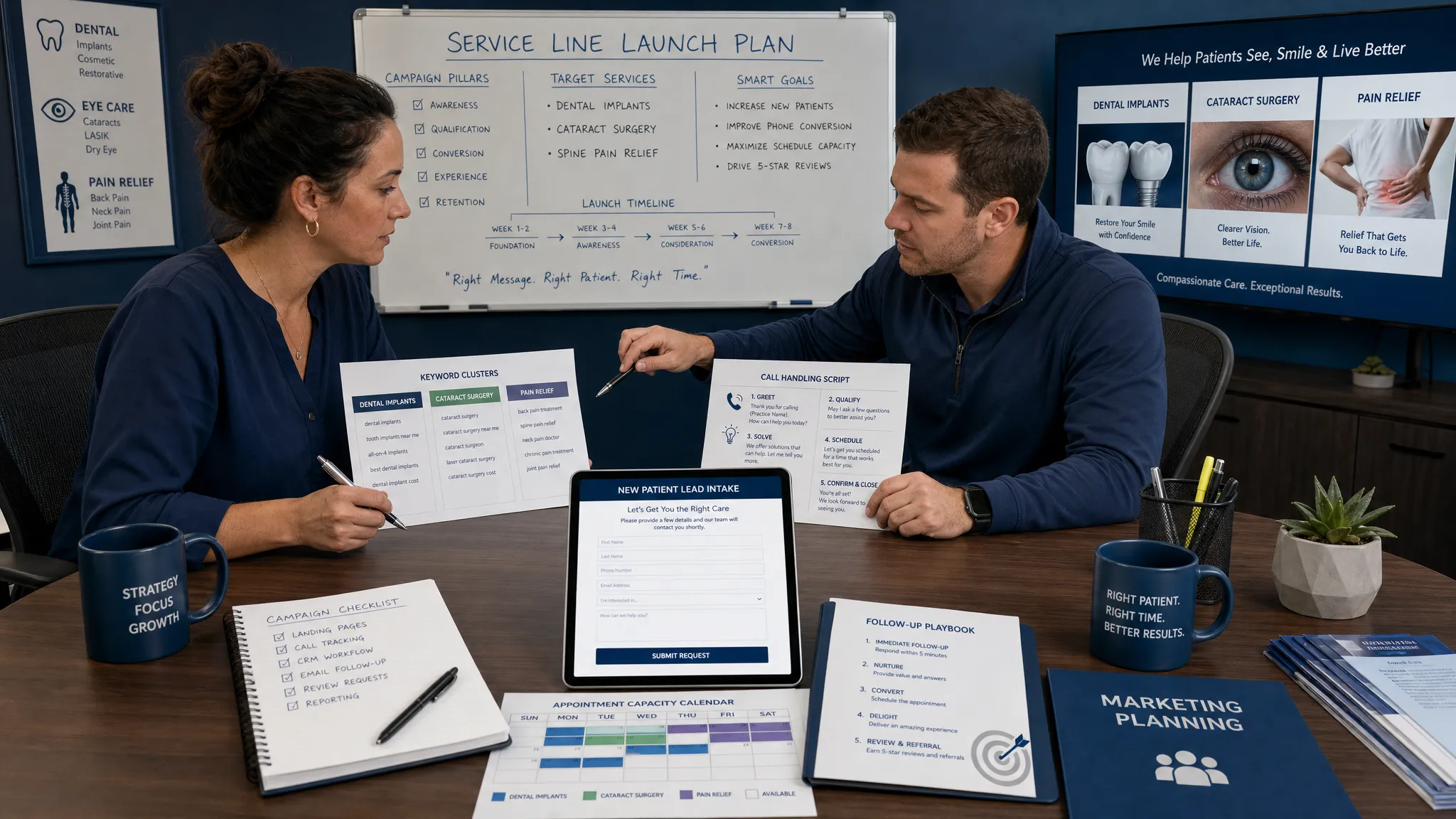
When a practice needs leads now, the instinct is usually to “turn on ads” and wait for the phone to ring. Google PPC can absolutely create fast demand for dentists, orthodontists, optometrists, pain physicians, and other healthcare practices, but speed only helps if the campaign is built to attract the right patient and convert that search into a booked appointment.
The most effective urgent-lead campaigns are not broad, clever, or complicated. They are focused. They put budget behind high-intent searches, send people to a page built for scheduling, and measure real outcomes instead of clicks. If your schedule has holes next week, these tips will help you tighten your Google PPC strategy quickly without wasting money on low-quality traffic.
Define the lead gap before you spend
Before you adjust keywords or increase budget, define the actual gap you need to fill. “We need more leads” is too vague for PPC. A better starting point is: “We need 18 more new patient appointments for dental implants this month” or “We need 10 more dry eye consultations over the next two weeks.”
That distinction matters because every campaign decision changes based on the service line, urgency, margin, insurance situation, and appointment availability. An emergency dentist campaign should not look like an orthodontic consult campaign. A cataract evaluation campaign should not be judged by the same timeline as a routine eye exam campaign. A pain management campaign may need more trust-building and eligibility screening than a simple chiropractic adjustment offer.
Start with three questions:
- Which service line has the most immediate appointment capacity?
- Which patient type is most valuable and realistic to acquire through search?
- What action do you want from the lead: call, form submission, online booking, or consultation request?
Once you know the answer, build around that one priority first. Practices waste a lot of money when they try to advertise every service at once with one shared campaign, one landing page, and one generic message.
Build for high-intent Search first
For practices that need leads quickly, Google Search campaigns are usually the best starting point because they capture people already looking for care. Display, YouTube, Demand Gen, and Performance Max can play a role later, but they often require more time, creative testing, audience refinement, and conversion data.
A fast-response Google PPC campaign should be simple at launch: one service line, one tight geography, a small set of high-intent keywords, and a dedicated landing page. If you are advertising dental implants, do not mix in teeth whitening, emergency dentistry, veneers, and general cleanings. If you are advertising pain management, do not combine back pain, knee pain, neuropathy, regenerative medicine, and sports injuries in one ad group.
The cleaner the structure, the easier it is to see what is working. You can always expand later once the campaign has proven that it can generate qualified calls or form fills.
If you need a broader setup walkthrough, Louisville Web Lab has a separate guide on setting up Google Ads for better healthcare leads that covers campaign structure, targeting, ad copy, and landing pages in more detail.
Choose bottom-of-funnel keywords first
When the goal is immediate leads, start with searches that show clear intent to book, call, compare providers, or solve a near-term problem. Educational searches can be useful for SEO and retargeting, but they often burn PPC budget when a practice needs appointments now.
Here is how keyword intent can vary by specialty:
| Specialty | Higher-intent searches | Lower-intent searches to treat carefully |
|---|---|---|
| Dentistry | “emergency dentist near me,” “dental implant consultation,” “same day dentist” | “what is a dental implant,” “tooth pain home remedy,” “dentist salary” |
| Orthodontics | “Invisalign provider near me,” “braces consultation,” “orthodontist near me” | “how braces work,” “DIY aligners,” “orthodontic assistant jobs” |
| Optometry | “eye exam appointment,” “optometrist near me,” “dry eye clinic” | “eye anatomy,” “free eye test online,” “optometry school” |
| Pain and chiropractic | “back pain doctor near me,” “chiropractor open today,” “pain management clinic” | “back pain stretches,” “massage gun review,” “medical coding jobs” |
| Physical therapy | “physical therapy near me,” “sports injury rehab,” “post surgery physical therapy” | “PT exercises at home,” “physical therapy degree,” “free workout plan” |
Phrase match and exact match are often safer early in urgent campaigns because they give you more control. Broad match can work well when conversion tracking is strong and the account has enough clean data, but it can also pull in irrelevant searches quickly.
Negative keywords are just as important as target keywords. Add obvious exclusions before launch, such as jobs, salary, school, definition, free, PDF, YouTube, template, lawsuit, and unrelated DIY terms. Then review search terms frequently during the first two weeks. A campaign can look busy while quietly paying for the wrong intent.
Target tighter than your full service area
Many practices overestimate how far patients will travel, especially for routine services. A patient may drive farther for oral surgery, LASIK, complex pain care, or specialty treatment, but they are usually less willing to travel across town for a basic exam or general consultation.
If you need leads now, start with the highest-probability geography. That may be a smaller radius around your office, a set of ZIP codes with strong patient value, or specific nearby communities where you already have brand recognition.
Also check the location setting. In most local healthcare campaigns, you generally want to target people who are physically in or regularly in your selected area, not people merely “interested in” that location. Otherwise, you may pay for clicks from patients outside your realistic service area.
Ad scheduling matters too. If your front desk only answers calls from 8 a.m. to 5 p.m., heavy call-focused ad spend at 9 p.m. may create missed opportunities. You can still run forms after hours, but call extensions and call ads should align with real staffing capacity.
Write ads that turn urgency into trust
Healthcare PPC copy has to do two things at once: respond to the patient’s immediate need and build enough trust for them to take the next step. The best ads are specific without overpromising.
Avoid aggressive claims like “cure back pain fast,” “guaranteed dental implant results,” or “best eye doctor in town” unless you can substantiate the claim and it complies with advertising standards. Instead, use plain-language messages that match the searcher’s intent.
For example, a pain management ad might emphasize evaluation, treatment options, and appointment availability. A dental implant ad might emphasize consultation, experienced providers, and clear next steps. An optometry ad might highlight appointment scheduling, accepted vision plans if accurate, and the specific service being searched.
Strong healthcare PPC ads usually include:
- The exact service or condition category the patient searched for
- A location cue, such as the city, neighborhood, or nearby area
- A trust signal, such as provider experience, reviews, or specialty focus if accurate
- A clear call to action, such as “Call Today” or “Request an Appointment”
- A scheduling benefit, such as same-week availability if it is actually true
Do not use urgency if your operations cannot support it. “Call now” is only effective if someone answers. “Same-day appointments” is only safe if the schedule can reliably deliver.
Send traffic to a landing page, not a generic homepage
A patient who searches for “emergency dentist near me” should not land on a homepage that asks them to navigate through a full menu of services. A patient searching for “dry eye treatment” should not have to hunt for the right page. PPC traffic should go to a focused landing page that continues the exact conversation started by the keyword and ad.
A good healthcare PPC landing page should answer the patient’s most immediate questions quickly: What service is available? Where is the practice located? Who provides the care? How do I book? What happens next?
For urgent lead generation, the page should include a phone number near the top, a short form, location details, trust indicators, service-specific copy, and a clear next step. If reviews, financing, insurance participation, provider credentials, or technology are important to the decision, include them only when they are accurate and current.
Your landing page can help by clearly explaining when a professional evaluation is appropriate, what your clinical process looks like, and how your care differs from general self-directed recovery options.
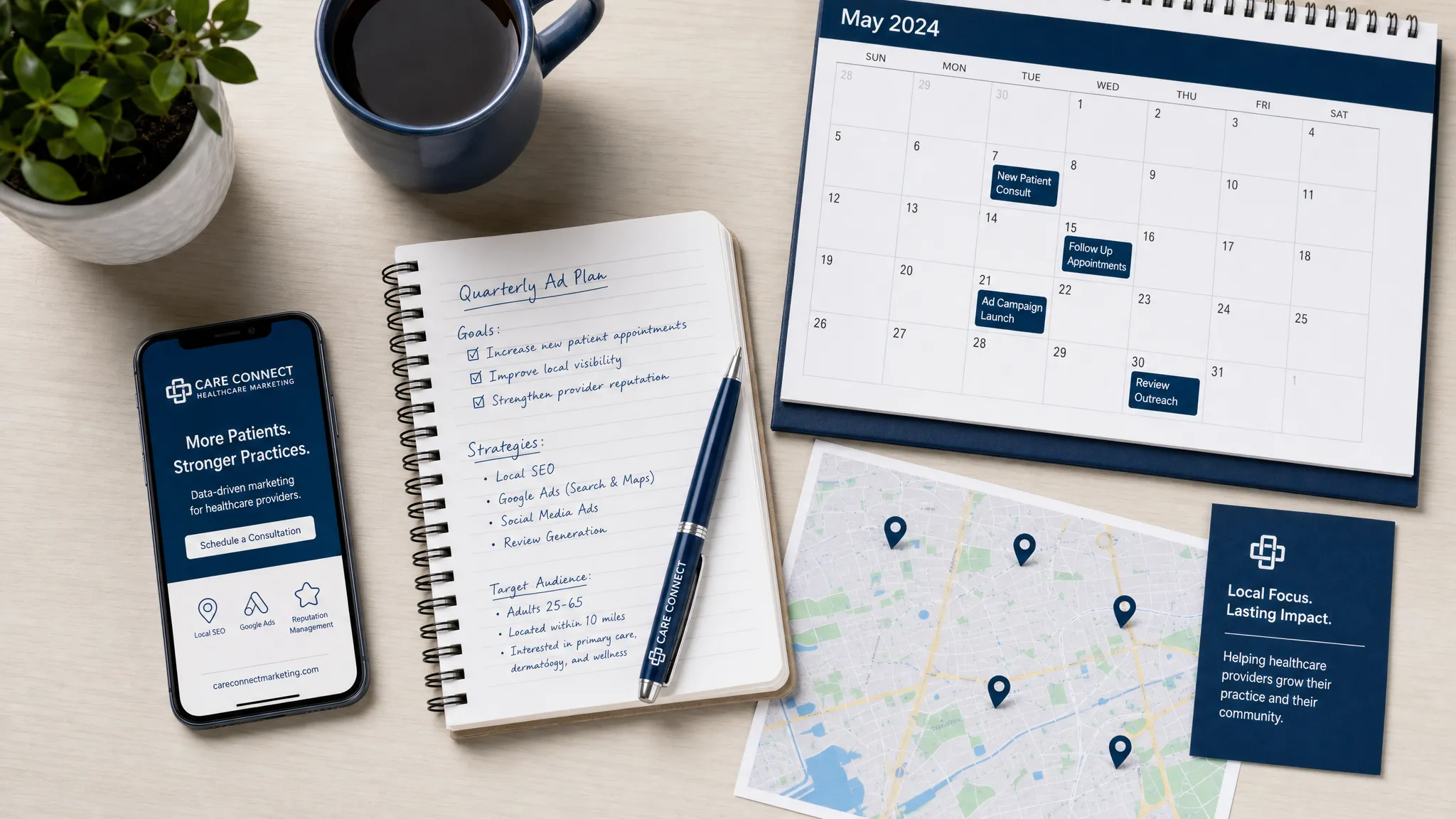
Track calls, forms, and booked appointments
Clicks are not leads, and leads are not always patients. If your Google PPC campaign is judged only by click-through rate or total form submissions, you may scale the wrong traffic.
At minimum, track phone calls from ads, phone calls from landing pages, form submissions, and online booking actions if available. For healthcare campaigns, it is also important to protect patient privacy. Do not pass diagnosis details, symptoms, treatment information, or other sensitive patient information into advertising platforms through URLs, form fields, or conversion names.
The best optimization signal is not “lead submitted.” It is “qualified lead” or “booked appointment.” That may require call tracking, front desk disposition notes, CRM data, or offline conversion imports. Even a simple weekly review can reveal patterns: which keywords produced real appointments, which calls were spam, which landing page forms were unqualified, and which time of day produced the best conversations.
If your team is getting leads but not appointments, listen to call recordings if your compliance process allows it and the proper notices are in place. Sometimes the campaign is not the problem. The issue may be missed calls, slow follow-up, unclear insurance answers, weak scheduling scripts, or forms that sit unanswered for hours.
Budget for enough data, not just visibility
A common mistake is launching with a budget too small to learn anything. If your specialty has competitive cost per click, a very low daily budget may produce only a few clicks per day. That is not enough to identify winning keywords, test ad copy, or generate consistent lead flow.
You do not need to spend recklessly, but you do need enough budget to give the campaign a fair test. The right budget depends on your market, specialty, competition, conversion rate, and patient value. Dental implants, orthodontics, LASIK, pain management, and surgical services often justify a different budget than routine exams or lower-margin services.
When speed matters, budget should be concentrated rather than scattered. It is usually better to spend meaningfully on one high-priority service line than to spread a small budget across five campaigns.
| Situation | Smart PPC move | What to watch |
|---|---|---|
| Schedule has immediate openings | Focus budget on one service with available appointments | Missed calls and form response time |
| High clicks but few leads | Tighten keywords, improve landing page clarity, review search terms | Search intent and page conversion rate |
| Leads are low quality | Add negatives, refine location targeting, adjust ad copy | Qualification rate and booked appointments |
| Cost per lead is rising | Review bids, search terms, device performance, and landing page friction | Cost per booked patient, not just cost per lead |
For a deeper look at budget efficiency, see these practical ways to lower Google Search campaign cost per lead without simply cutting spend and losing volume.
Optimize daily for the first two weeks
Google PPC is not a set-it-and-forget-it channel, especially when a practice needs leads quickly. The first 14 days should be treated like a controlled launch window.
In the first 48 hours, confirm that ads are approved, conversions are firing correctly, phone numbers work, forms send to the right people, and the landing page loads quickly on mobile. Do not wait a week to discover that calls were not being tracked or that the form notification went to the wrong inbox.
During days three through seven, review search terms, add negatives, check location performance, and compare calls versus forms. Look for obvious waste before making major bidding changes. If one ad group is spending but not producing leads, tighten it. If one keyword is generating calls, protect it and consider building around it.
During days eight through fourteen, start making more informed decisions. Shift budget toward the campaigns and ad groups producing qualified leads. Pause wasteful terms. Test a second landing page headline or call to action. Review front desk notes to see whether the leads are turning into appointments.
The goal is not to make constant random changes. The goal is to remove friction and waste as evidence appears.
Make the front desk part of the PPC strategy
Even a well-built campaign can fail if the practice does not handle leads quickly. PPC creates demand in real time. If a patient calls and no one answers, they may call the next practice in the search results. If a form goes unanswered until the next day, the lead may already be booked elsewhere.
For urgent campaigns, define your response process before scaling spend. Who answers PPC calls? Who checks form submissions? How fast should follow-up happen? What should the team say when a patient asks about cost, insurance, appointment availability, or whether the provider treats their condition?
This is where healthcare marketing becomes operational. The ad can create the opportunity, but the practice has to convert it. A small improvement in answer rate or follow-up speed can produce more booked patients without increasing ad spend.
Do not rely on PPC alone forever
Google PPC is one of the fastest ways to generate leads, but it should not be the only growth channel for a healthy practice. Paid search is strongest when it is paired with local SEO, Google Business Profile optimization, reputation building, conversion-focused website pages, and patient reactivation.
Use PPC to fill immediate gaps, test which services have demand, and learn which messages convert. Then use those insights to improve your website, SEO content, review strategy, and patient acquisition systems. The practices that win long term are not just buying clicks. They are building a repeatable path from local search demand to booked appointments.
Frequently Asked Questions
How fast can Google PPC generate leads for a healthcare practice? A campaign can begin generating calls or forms soon after approval, but lead quality depends on targeting, keywords, landing pages, budget, and follow-up. Some practices see activity quickly, while others need several days of optimization before the campaign produces consistent qualified leads.
What is the biggest PPC mistake practices make when they need leads now? The biggest mistake is going too broad. Broad keywords, large service areas, generic ads, and homepage traffic can spend money fast without producing booked appointments. Start narrow, track real conversions, and expand only after the campaign proves itself.
Should healthcare practices use call ads or landing pages? Both can work. Call-focused campaigns are useful when the front desk can answer promptly during business hours. Landing pages are better when patients need more information before booking or when forms and online scheduling are part of the process.
How much should a practice spend on Google PPC? The right budget depends on specialty, competition, geography, cost per click, conversion rate, and the value of a new patient. A campaign should have enough budget to gather data and generate meaningful lead volume, not just occasional clicks.
Can PPC help if my practice also needs SEO? Yes. PPC can create immediate visibility while SEO and local search build over time. The best approach often uses PPC for near-term lead flow and SEO for compounding organic growth.
Need leads now, but do not want to waste the budget?
If your practice needs more qualified calls, forms, and booked appointments, the campaign has to be built around patient intent from the start. Louisville Web Lab helps healthcare practices use SEO, Google Ads, websites, and automation to turn search visibility into measurable growth.
Start with a diagnostic strategy call through Louisville Web Lab and identify where your current lead flow is leaking, what PPC opportunities are realistic, and how to build a system that supports both immediate demand and long-term practice growth.