
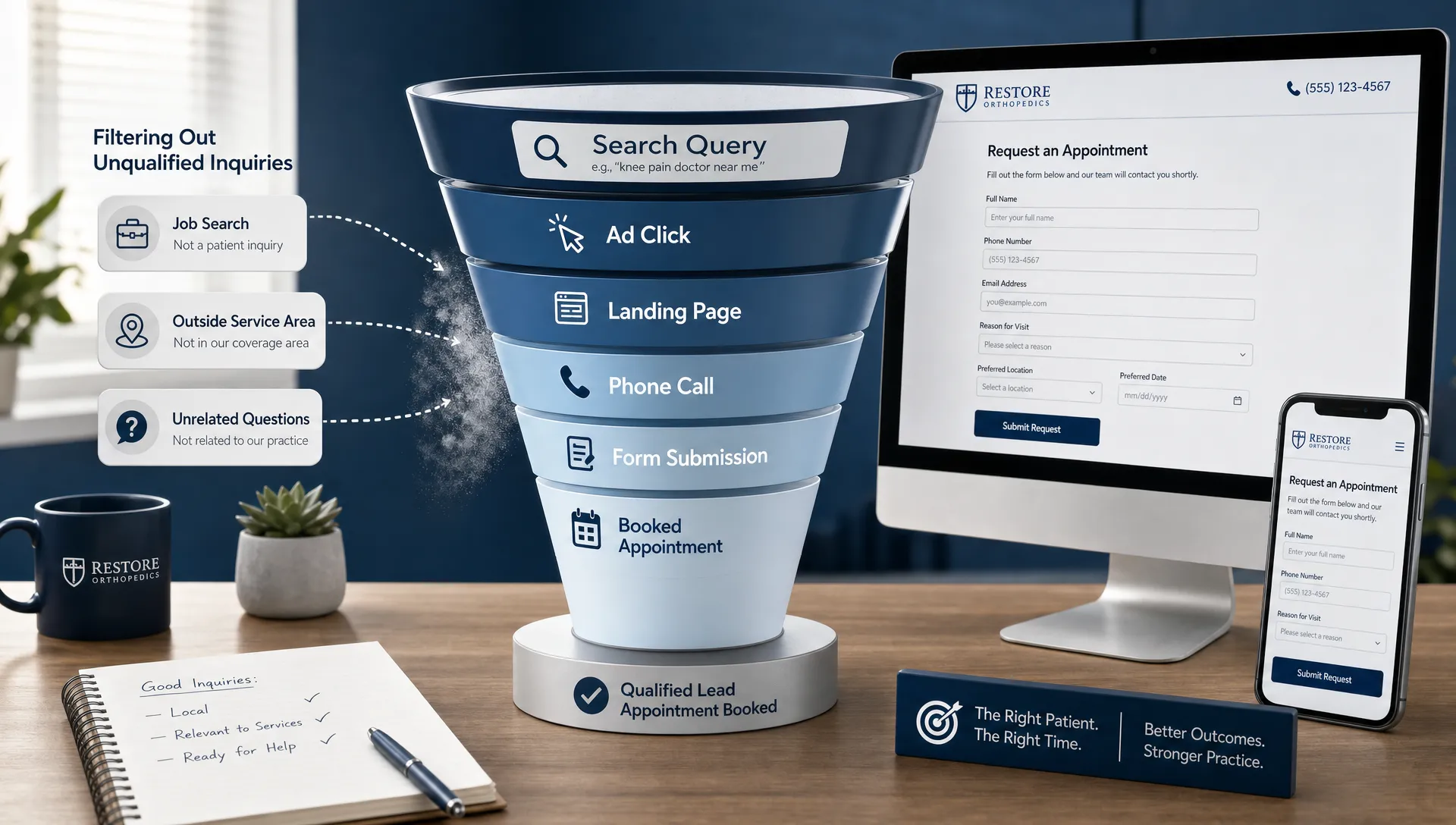
More leads can look like progress until your team spends the day answering calls from people who are outside your service area, looking for a job, asking for free advice, or trying to book a treatment you do not provide. For healthcare practices, lead volume only matters when it turns into qualified appointment opportunities.
A strong Google Ads manager improves lead quality by building a filter at every stage of the patient journey: keywords, targeting, ad copy, landing pages, conversion tracking, bidding, and follow-up. The goal is not just to get cheaper clicks. The goal is to help the practice spend money on searches that are more likely to become booked, appropriate, revenue-producing patients.
In this article, Google Ads manager means the person or agency managing paid search campaigns for your practice, not Google Ad Manager, the publisher ad-serving platform.
What lead quality really means for a healthcare practice
A lead is not automatically valuable because someone clicked a call button or submitted a form. For a dentist, orthodontist, optometrist, chiropractor, pain physician, or physical therapy clinic, a qualified lead usually needs to match several conditions before it is worth pursuing.
Lead quality often comes down to five practical questions:
- Service fit: Is the person looking for a treatment, exam, consultation, or procedure the practice actually provides?
- Geographic fit: Is the patient close enough to realistically schedule and show up?
- Intent fit: Is the searcher ready to book, or are they only researching symptoms, prices, jobs, or school programs?
- Financial fit: Do the payment expectations, insurance requirements, or financing needs match what the practice can support?
- Operational fit: Can the practice respond fast enough, offer the right appointment type, and convert the inquiry into a scheduled visit?
A Google Ads manager improves lead quality by making these filters intentional. Without that structure, Google Ads can generate activity that looks good in a dashboard but creates friction for the front desk.
Start with the conversion you actually want
One of the biggest reasons campaigns attract poor leads is simple: the ad account is optimizing for the wrong action.
If every phone click, two-second call, unqualified form fill, and accidental button tap is counted as a lead, the campaign data becomes noisy. Google Ads then has less useful information to guide bidding and targeting decisions. In automated bidding campaigns, poor conversion data can actively teach the system to find more of the same low-quality behavior.
A Google Ads manager should define conversion actions around meaningful patient intent. For healthcare practices, that may include appointment request submissions, tracked phone calls that last long enough to represent a real conversation, online scheduling completions, or offline conversions imported after a lead becomes a booked appointment.
This does not mean every practice needs complex software on day one. It means the account should distinguish between soft signals and real opportunities. A call lasting three seconds should not carry the same value as a new patient consultation request.
If the foundation is still being built, a clean Google Ads setup for better healthcare leads is usually the first step before advanced optimization can work.
Match campaigns to patient intent, not just services
Many campaigns are built around broad service categories: dentist, eye doctor, chiropractor, pain clinic, physical therapy. Those terms can be useful, but they do not always reveal enough about the patient’s readiness.
A more strategic Google Ads manager separates searches by intent. Someone searching emergency dentist near me may need immediate help. Someone searching dental implants cost may be comparing options and financing. Someone searching dry eye specialist may be looking for a specific clinical solution. Someone searching best chiropractor for sciatica near me may be much closer to booking than someone searching what causes back pain.
This matters because each intent deserves its own message, landing page, and budget expectations. High-intent searches often cost more per click, but they can produce better appointment rates. Low-intent searches may look affordable, but they can flood the practice with weak inquiries.
Here is how a manager turns intent into a lead quality system:
| Campaign element | Low-quality approach | Manager-led approach |
|---|---|---|
| Keywords | Broad service terms grouped together | Segmented by service, urgency, condition, and booking intent |
| Match types | Loose matching with little search term review | Controlled testing with regular query cleanup |
| Ad copy | Generic promise to help everyone | Specific service, location, and appointment expectation |
| Landing page | Homepage or general contact page | Service-specific page that answers patient decision questions |
| Tracking | Counts every interaction as a lead | Tracks calls, forms, booked appointments, and lead outcomes |
| Budget | Spent evenly across all traffic | Shifted toward searches that produce qualified appointments |
Use negative keywords as a quality control layer
Negative keywords are one of the most overlooked tools for improving lead quality. They prevent ads from showing for searches that are unlikely to become patients.
A healthcare Google Ads manager should review search terms regularly and remove irrelevant patterns. Common waste can come from searches related to jobs, salaries, training programs, free advice, academic research, unrelated products, or locations outside the practice area.
For example, an oral surgery practice may not want to pay for searches from people looking for dental assistant jobs. A chiropractic clinic may not want traffic from people searching for chiropractic school. An optometry office promoting medical dry eye care may not want every search related to discount sunglasses.
The key is to remove mismatches without creating unfair or inappropriate exclusions. Healthcare advertisers need to be careful with sensitive categories, patient privacy, and ad policies. A manager should use negative keywords to improve relevance, not to make assumptions about protected characteristics or personal health status.
Write ads that pre-qualify the patient
Good ad copy does more than win clicks. It sets expectations before the patient reaches the website.
A Google Ads manager can improve lead quality by making the ad specific enough to attract the right searcher and discourage the wrong one. For a dental implant campaign, that might mean highlighting implant consultations rather than general dentistry. For an ophthalmology group, it might mean separating cataract evaluations from routine eye exams. For a pain management clinic, it might mean clarifying that the practice offers interventional pain care rather than massage therapy or general wellness services.
The ad should also avoid overpromising. Healthcare ads must be accurate, ethical, and compliant with platform rules. Claims like guaranteed pain relief, instant cures, or risk-free outcomes can create policy problems and attract patients with unrealistic expectations.
A better approach is to use clear, truthful language: request an appointment, schedule a consultation, speak with our team, or find out if this treatment is appropriate for you. These phrases may be less flashy, but they tend to align better with real healthcare decision-making.
Improve landing pages so the right patient keeps moving
Even strong campaigns can produce weak leads if the landing page is vague. Sending paid traffic to a homepage forces the visitor to hunt for answers, and many will either leave or submit an unclear form.
A manager improves lead quality by matching each campaign to a landing page built around one patient decision. A dental implant page should answer different questions than an emergency dentistry page. A LASIK consultation page should not feel the same as a cataract surgery page. A physical therapy page for sports injuries should speak to a different patient journey than a page for post-surgical rehab.
Effective healthcare landing pages usually clarify the service, location, next step, and reason to trust the practice. They also make it easy to call or request an appointment without asking for unnecessary information. A form can include practical fields such as desired service, preferred location, new or existing patient status, and best contact method. It should not ask for sensitive health information unless the practice has the proper privacy and security workflows in place.
Lead quality also improves when paid search is connected to the broader digital presence. For a healthcare practice, the difference is that the strategy must also respect patient privacy, clinical claims, and appointment operations.

Track call quality, not just call volume
Phone calls are still one of the most important conversion actions for healthcare practices. They are also one of the easiest places to misread performance.
A campaign may generate a high number of calls, but how many were new patients? How many were existing patients trying to reschedule? How many were vendors, wrong numbers, or people looking for services the practice does not provide? How many were missed because the front desk was busy?
A Google Ads manager improves lead quality by reviewing call patterns and connecting them to campaign decisions. If one keyword produces many short calls, it may need tighter targeting or a better landing page. If a campaign produces qualified calls but many are missed after 4 p.m., budget may need to shift earlier in the day. If patients repeatedly ask the same question before booking, that answer should appear on the landing page or in the ad messaging.
Call recording and call tracking can be useful, but healthcare practices must handle them carefully. Consent laws vary by state, and patient privacy obligations matter. A manager should help the practice measure call outcomes without exposing unnecessary patient information.
Feed the ad account better outcome data
The most valuable optimization happens after the lead comes in. A front-end conversion tells you someone contacted the practice. It does not tell you whether the person booked, showed up, accepted treatment, or became a good-fit patient.
That is why the best Google Ads managers work with the practice to close the loop. Instead of only reporting clicks, impressions, and cost per lead, they look at downstream metrics that reflect real growth.
| Metric | What it tells you | Why it improves lead quality |
|---|---|---|
| Qualified lead rate | Percentage of leads that match the practice’s criteria | Shows whether traffic is relevant, not just active |
| Booking rate | Percentage of leads that schedule an appointment | Reveals whether campaigns attract ready-to-book patients |
| Cost per booked appointment | Ad spend divided by scheduled visits | More useful than cost per lead alone |
| Show rate | Percentage of booked patients who attend | Helps identify intent and expectation problems |
| Service-line conversion | Which treatments or appointment types convert best | Guides budget toward profitable growth areas |
| Missed call rate | Calls that never reach the team | Separates marketing problems from operational bottlenecks |
This is where many practices discover that the cheapest lead is not the best lead. Suppose Campaign A generates many inexpensive leads, but only a small share become booked appointments. Campaign B generates fewer, more expensive leads, but most become booked appointments. Campaign B can produce the healthier cost per booked appointment despite the higher cost per lead.
Campaign A looks better if you only measure cost per lead. Campaign B is clearly better if you care about appointments.
Adjust bidding and budget around real value
Once the manager has better conversion data, bidding decisions become more strategic. Budget should not automatically go to the campaign with the most leads. It should go to the campaign that produces the best mix of qualified inquiries, booked appointments, and patient value.
For a multi-service healthcare practice, this can change everything. A general exam campaign might produce steady volume, while a specialty consultation campaign produces fewer but more valuable opportunities. An urgent care style campaign may convert quickly, while an elective procedure campaign may require more education and follow-up.
A Google Ads manager can shift spend by service line, location, device, time of day, and search intent. They can also reduce wasted spend by pausing weak keywords, tightening location targeting, improving landing page relevance, or restructuring campaigns that mix too many intents together.
If cost efficiency is a major issue, the best path is not simply to cut bids. It is to reduce waste while protecting the searches that produce real patients. That is the difference between cheap traffic and a strategy that can lower cost per lead without sacrificing lead quality.
Coordinate marketing with front desk follow-up
Lead quality is not only a media buying problem. A strong campaign can still fail if the practice responds too slowly or handles inquiries inconsistently.
A Google Ads manager should pay attention to the handoff between the ad and the appointment. If forms sit unanswered for hours, qualified patients may book somewhere else. If calls go to voicemail during peak search periods, campaign performance will look worse than it really is. If the front desk does not know which offer, service, or landing page the patient saw, the conversation can become confusing.
Simple operational improvements often raise lead quality without increasing spend. These may include faster response times, clear call scripts, better appointment routing, missed call follow-up, and separate workflows for high-value consultations.
For healthcare, this is especially important because patients often contact multiple providers. The practice that responds clearly, quickly, and confidently has a better chance of converting the lead into an appointment.
Review performance on a manager’s cadence
Google Ads is not a set-it-and-forget-it channel. Lead quality changes as competitors enter the auction, patient demand shifts, Google’s matching systems evolve, and the practice’s schedule changes.
A practical management cadence includes weekly search term reviews, regular negative keyword updates, ad testing, location performance checks, call quality review, and landing page improvements. Monthly reviews should connect campaign performance to qualified leads and booked appointments, not just clicks and impressions.
A good manager also knows when not to scale. If lead quality drops as spend increases, the answer may be to improve the funnel before adding budget. More money usually magnifies the current system. If the system attracts poor-fit leads, scaling will create more poor-fit leads.
Signs your practice needs a stronger Google Ads manager
A practice may need better management if the campaign dashboard looks active but the schedule does not improve. This is common when the account was built for traffic volume rather than patient acquisition.
Common warning signs include:
- The account reports many conversions, but the team cannot identify how many became appointments.
- The front desk says most calls are not a fit.
- Search terms include jobs, education, unrelated services, or out-of-area traffic.
- Ads send all traffic to the homepage.
- Campaigns are grouped around broad services instead of specific patient intent.
- Cost per lead looks acceptable, but cost per booked appointment is unknown.
- The practice cannot tell which services, locations, or keywords drive qualified patients.
When these issues appear, the solution is usually not a new ad slogan. It is better campaign architecture, cleaner data, stronger landing pages, and a tighter connection between marketing and operations.
Frequently Asked Questions
What does a Google Ads manager do to improve lead quality? A Google Ads manager improves lead quality by refining keywords, excluding irrelevant searches, writing more specific ads, improving landing pages, tracking meaningful conversions, and optimizing campaigns around qualified leads and booked appointments.
Is a lower cost per lead always better? No. A low cost per lead can be misleading if those leads do not book, show up, or match the services your practice provides. Cost per booked appointment and qualified lead rate are often more useful metrics.
How quickly can lead quality improve? Some improvements, such as negative keyword cleanup or landing page fixes, can help quickly. Bigger improvements usually require enough data to identify patterns across calls, forms, booked appointments, and service lines.
Should healthcare practices use broad match keywords? Broad match can work in some accounts, but it needs strong conversion tracking, negative keywords, and regular search term review. Without those safeguards, it can attract irrelevant traffic and lower lead quality.
How do you measure lead quality in Google Ads? Measure more than clicks and form fills. Track qualified lead rate, booking rate, missed call rate, cost per booked appointment, show rate, and service-line outcomes whenever your systems can support it.
Turn ad spend into better patient opportunities
If your Google Ads campaigns are producing activity but not enough qualified appointments, the issue may not be demand. It may be the way your campaigns define, attract, track, and follow up with leads.
Louisville Web Lab helps healthcare practices connect SEO, Google Ads, websites, and automation into patient acquisition systems built around measurable growth. If you want to understand where your ad spend is leaking and how to improve lead quality, start with a diagnostic strategy call with Louisville Web Lab.