
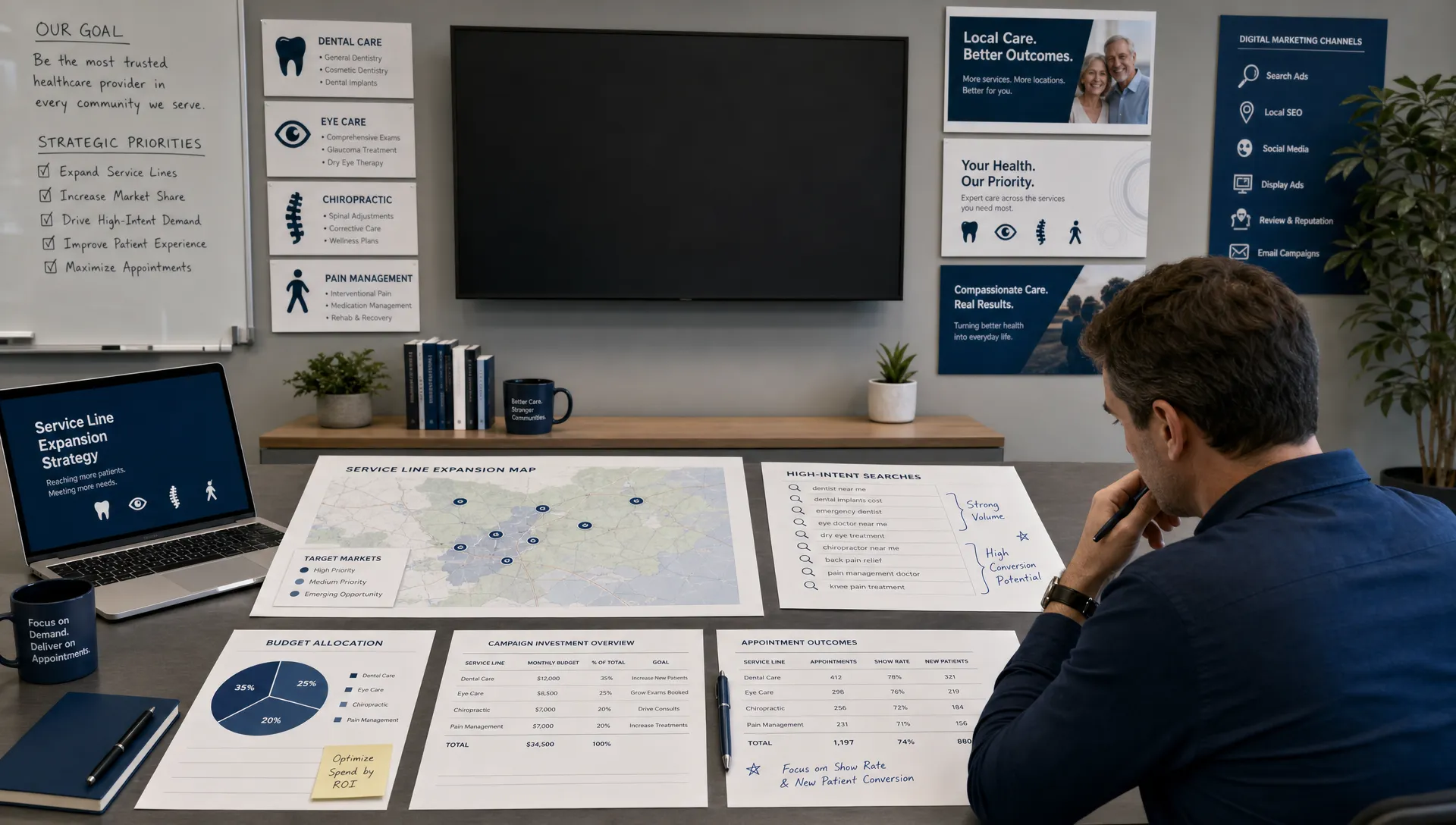
For most healthcare practices, the goal of Google Ads is not more traffic. It is more of the right patients booking the right appointments at the right cost.
That distinction matters. A campaign can generate plenty of clicks and still fail if the people clicking are outside your service area, looking for insurance information you do not provide, searching for low-priority services, or landing on a page that does not make it easy to call or schedule.
A specialized Google Ads marketing agency grows patient volume by building the full path from search intent to booked appointment. The ad is only one part of that system. The strategy also includes service-line selection, local targeting, landing pages, tracking, follow-up, and ongoing budget decisions based on what is actually producing appointments.
For dentists, orthodontists, optometrists, pain physicians, and other healthcare practices, this approach can turn paid search from an expense into a measurable patient acquisition channel.
Patient volume starts with intent, not impressions
Google Ads works best for healthcare when it captures existing demand. In other words, someone is already searching for care, comparing providers, or trying to solve a specific problem.
A patient searching for emergency dentist near me, chiropractor for sciatica, pediatric eye doctor, Invisalign consultation, dry eye treatment, or pain management clinic is not browsing casually. They are usually closer to making a decision than someone scrolling through a social media feed.
A strong agency separates these high-intent searches from broad, low-converting traffic. That means campaigns should not be built around the largest possible audience. They should be built around the searches most likely to turn into qualified calls, form fills, online bookings, or consultation requests.
This is especially important in healthcare because not every lead has the same value. A dental implant consultation, LASIK evaluation, new orthodontic patient, regenerative medicine consult, or chronic pain appointment may require different messaging, budget, intake process, and follow-up than a routine visit.
The first job of the agency is to define what patient volume actually means for the practice. More new patients is a broad goal. More qualified implant consultations within 12 miles of the office is a strategy.
What a Google Ads marketing agency does differently for healthcare
A generalist ad manager may know how to launch campaigns. A healthcare-focused agency needs to understand how patients choose providers, how local competition affects cost, and how practice operations influence results.
For example, a dental practice with open hygiene capacity needs a different campaign structure than an oral surgery practice that wants more implant referrals. An optometry office promoting dry eye services needs a different landing page than an ophthalmology group advertising cataract surgery. A chiropractic clinic may need campaigns segmented by condition, location, and treatment type, while a pain management practice may need careful language around regulated services and patient eligibility.
A healthcare Google Ads strategy usually includes several connected decisions:
- Which service lines should receive budget first
- Which searches show real patient intent
- Which geographic areas are profitable to target
- Which ad messages are compliant, specific, and credible
- Which landing pages are most likely to convert
- Which calls and forms count as qualified opportunities
- Which follow-up steps help convert inquiries into appointments
This is where the agency role becomes more operational than purely technical. The campaign has to match the practice's schedule, staff capacity, services, insurance mix, and growth goals.
If you want a deeper tactical breakdown, Louisville Web Lab has covered how to structure a Google Ads campaign that books patients instead of simply collecting clicks.
The patient growth system behind the ads
The most effective agencies do not treat Google Ads as a standalone channel. They build a patient growth system around it. That system usually has four stages: attract, convert, qualify, and optimize.
| Stage | What the agency improves | Why it affects patient volume |
|---|---|---|
| Attract | Keywords, targeting, ad copy, location settings, budgets | Brings in people actively searching for care in the right market |
| Convert | Landing pages, calls to action, trust signals, mobile experience | Turns more visitors into calls, forms, and bookings |
| Qualify | Call tracking, form routing, intake questions, lead source reporting | Helps the practice identify which inquiries are worth pursuing |
| Optimize | Budget shifts, search term reviews, conversion data, appointment outcomes | Moves spend toward campaigns that produce real appointments |
This matters because patient volume often breaks at the handoff points. The keyword may be right, but the landing page may be confusing. The landing page may convert, but the call may go unanswered. The front desk may answer, but no one may track whether the patient booked.
A good agency looks for the bottleneck. Sometimes the biggest growth opportunity is not a new campaign. It is a faster response time, a cleaner scheduling path, or better alignment between ad copy and what the practice actually wants to fill.
Landing pages turn clicks into appointment opportunities
Healthcare advertising is high trust. A patient is not buying a pair of shoes. They are deciding who to trust with pain, vision, oral health, mobility, or a long-term condition.
That means the landing page has to do more than repeat the ad headline. It should help the patient quickly answer practical questions: Do you treat my problem? Are you near me? Can I schedule easily? Do I understand what happens next? Do you look credible?
Strong healthcare landing pages usually include a clear service focus, visible phone number, simple form, location details, provider or practice credibility, patient-friendly explanations, and calls to action that match the urgency of the search.
Patient education also plays a role. People often research symptoms, treatments, wellness habits, and provider options across multiple sources before making a healthcare decision.
That research behavior is exactly why landing pages need to be clear, reassuring, and specific. The page should meet the patient at their level of awareness and guide them toward the next step without overpromising outcomes or using language that creates compliance concerns.
Tracking should measure booked appointments, not just leads
Many healthcare practices think Google Ads is not working because they only see surface-level metrics. Clicks, impressions, and average cost per click are useful, but they do not tell the whole story.
The better question is simple: which campaigns are creating qualified patient conversations and booked appointments?
To answer that, an agency needs to connect ad performance with real practice outcomes. That may include call tracking, form tracking, online booking data, lead source notes, and regular review of which inquiries became appointments. In healthcare, tracking also needs to be handled carefully, with attention to privacy, platform policies, and the practice's compliance requirements.
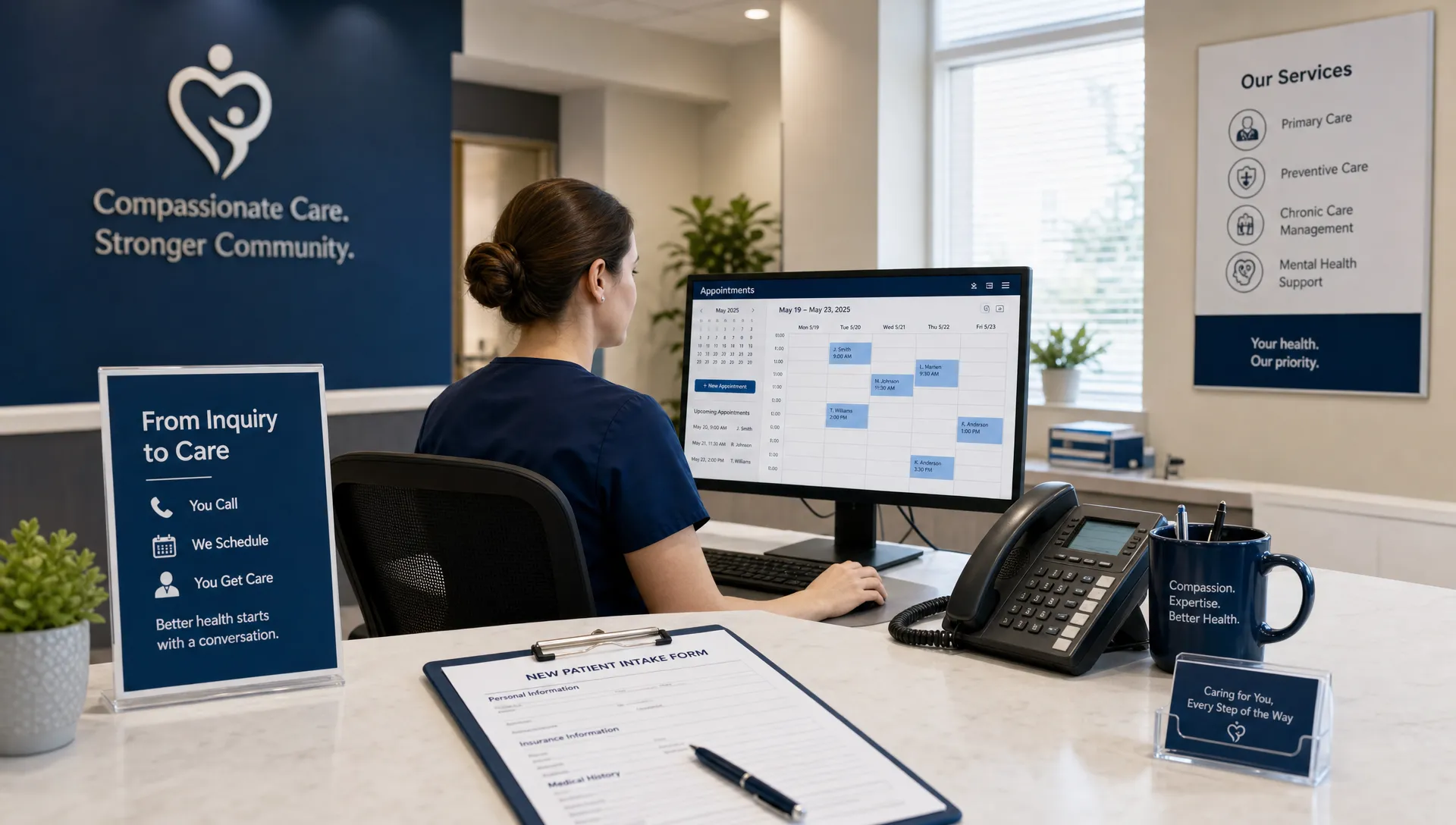
Without appointment-level feedback, optimization becomes guesswork. A campaign could have a low cost per lead but mostly attract poor-fit inquiries. Another campaign could have fewer leads but bring in patients who book higher-value services and show up reliably.
This is why a Google Ads marketing agency should ask about more than media spend. They should ask what happened after the click.
Budget allocation is where patient volume compounds
Healthcare Google Ads costs vary widely by specialty, location, competition, and service line. A dental practice in a competitive metro market may face a very different cost environment than a physical therapy clinic in a smaller suburban area. High-value services often attract more competition, which can increase costs but also justify a more sophisticated campaign.
An agency grows patient volume by using budget intentionally. That may mean starting with one or two priority service lines, proving conversion quality, and then expanding. It may also mean cutting spend from broad searches that look busy but do not produce appointment-ready leads.
Budget decisions should be based on patient acquisition economics, not vanity metrics. If a campaign produces lower-cost leads but few appointments, it may not deserve more budget. If another campaign has a higher cost per lead but consistently books profitable treatment consultations, it may be the better growth engine.
For practices planning media spend, it helps to understand why Google Ads cost for healthcare practices in 2026 depends on more than bids. Landing page quality, conversion rate, competition, tracking, and intake all affect the real cost of acquiring a patient.
The agency should improve both marketing and intake
One of the most overlooked factors in patient volume is what happens when the lead arrives.
If the phone rings during lunch, after hours, or while the front desk is busy, the opportunity may be lost. If forms sit in an inbox for a day, patients may contact another provider. If the scheduling process is unclear, even a qualified inquiry can disappear.
A healthcare-focused agency should help identify these friction points. That does not mean the agency replaces the front desk or practice management system. It means the marketing strategy should account for response time, call quality, routing, follow-up, and the reality of how patients schedule care.
For example, a practice running ads for urgent dental care or acute back pain needs fast call response. A clinic promoting elective procedures may need a more educational follow-up sequence. An orthodontic practice may need to separate parent inquiries from adult clear aligner consultations. An optometry or ophthalmology practice may need different pathways for routine exams, dry eye, LASIK, and cataracts.
Better intake does not just improve conversion rate. It protects ad spend.
What to expect in the first 90 days
Google Ads can move faster than SEO, but a strong patient acquisition program still needs disciplined testing. The first 90 days are usually about building the foundation, collecting signal, and improving the conversion path.
In the first month, the agency should clarify goals, select priority services, set up campaigns, build or refine landing pages, configure tracking, and establish reporting. This period is about launching cleanly rather than spending aggressively without feedback.
In the second month, the focus typically shifts to search term analysis, negative keywords, ad testing, conversion review, and early landing page improvements. The agency should begin identifying which campaigns are attracting serious patients and which are wasting budget.
By the third month, patterns should become clearer. The practice and agency can review lead quality, booked appointments, cost per opportunity, schedule capacity, and expansion options. If tracking is set up correctly, budget can begin shifting toward the campaigns that are most likely to grow patient volume.
No ethical agency should guarantee a specific number of patients without understanding the market, offer, competition, budget, and intake process. But a good agency should be able to explain the plan, show the data, and make decisions based on what is happening in the practice.
How to choose the right agency for patient growth
Choosing a Google Ads marketing agency is not just about finding someone who knows the platform. For healthcare practices, it is about finding a partner who understands patient behavior and can connect marketing activity to appointment outcomes.
Look for an agency that talks about patient intent, conversion paths, call tracking, landing pages, local competition, and follow-up. Be cautious if the conversation centers only on clicks, impressions, or generic campaign setup.
The right partner should be able to answer questions such as:
- Which service lines should we advertise first and why?
- How will you separate high-intent searches from low-quality traffic?
- What will happen when someone clicks the ad?
- How will calls, forms, and booked appointments be tracked?
- How will you decide when to increase, reduce, or reallocate budget?
- What intake issues could limit results even if the campaigns perform well?
The best agencies are also willing to say no. Not every service line is ready for paid search. Not every landing page is strong enough to receive traffic. Not every market can support aggressive growth without operational changes.
That honesty is valuable because sustainable patient volume comes from alignment between marketing, operations, and the patient experience.
Google Ads works best as part of a broader acquisition plan
Paid search can be a powerful growth channel, but it should not carry the entire practice alone. Many patients still compare reviews, visit the website, check maps results, ask for referrals, and search again before scheduling.
That is why Google Ads often performs best when it is connected to local SEO, Google Business Profile optimization, reputation management, website improvements, and patient follow-up systems. Ads can create demand capture today, while organic visibility and reviews build trust over time.
For a fuller view of how paid and organic channels work together, explore these patient acquisition strategies for growing healthcare practices.
When the pieces support each other, Google Ads becomes more than a lead source. It becomes part of a repeatable growth system.
Frequently Asked Questions
How does a Google Ads marketing agency increase patient volume? A strong agency increases patient volume by targeting high-intent searches, improving landing pages, tracking qualified calls and forms, reducing wasted spend, and helping the practice turn inquiries into booked appointments.
Is Google Ads a good fit for every healthcare practice? Google Ads is often a strong fit for practices with clear service lines, local demand, available appointment capacity, and a reliable intake process. It may be less effective if the practice cannot answer calls, follow up quickly, or define which patients it wants to attract.
How long does it take to see results from Google Ads for healthcare? Some practices may see inquiries soon after launch, but reliable optimization usually takes several weeks of data. The first 90 days are typically used to test keywords, refine targeting, improve landing pages, and evaluate lead quality.
What should healthcare practices track besides clicks? Practices should track qualified calls, form submissions, online bookings, booked appointments, cost per qualified opportunity, and which service lines produce valuable patients. Clicks alone do not show whether advertising is growing the practice.
Can Google Ads help specialty practices like orthodontics, pain management, or optometry? Yes, but campaigns should be segmented by service and patient intent. Specialty practices usually need specific messaging, focused landing pages, careful targeting, and tracking that reflects consultation quality rather than general lead volume.
Turn Google Ads into a patient volume system
If your practice is spending on ads but cannot clearly connect that spend to booked appointments, the problem may not be Google Ads itself. It may be the strategy, landing page, tracking, or follow-up system around it.
Louisville Web Lab helps healthcare practices use SEO, Google Ads, websites, and automation to turn search visibility into measurable growth. If you want to understand where patient opportunities are being lost, start with a diagnostic strategy call and look at the full path from search to scheduled appointment.