
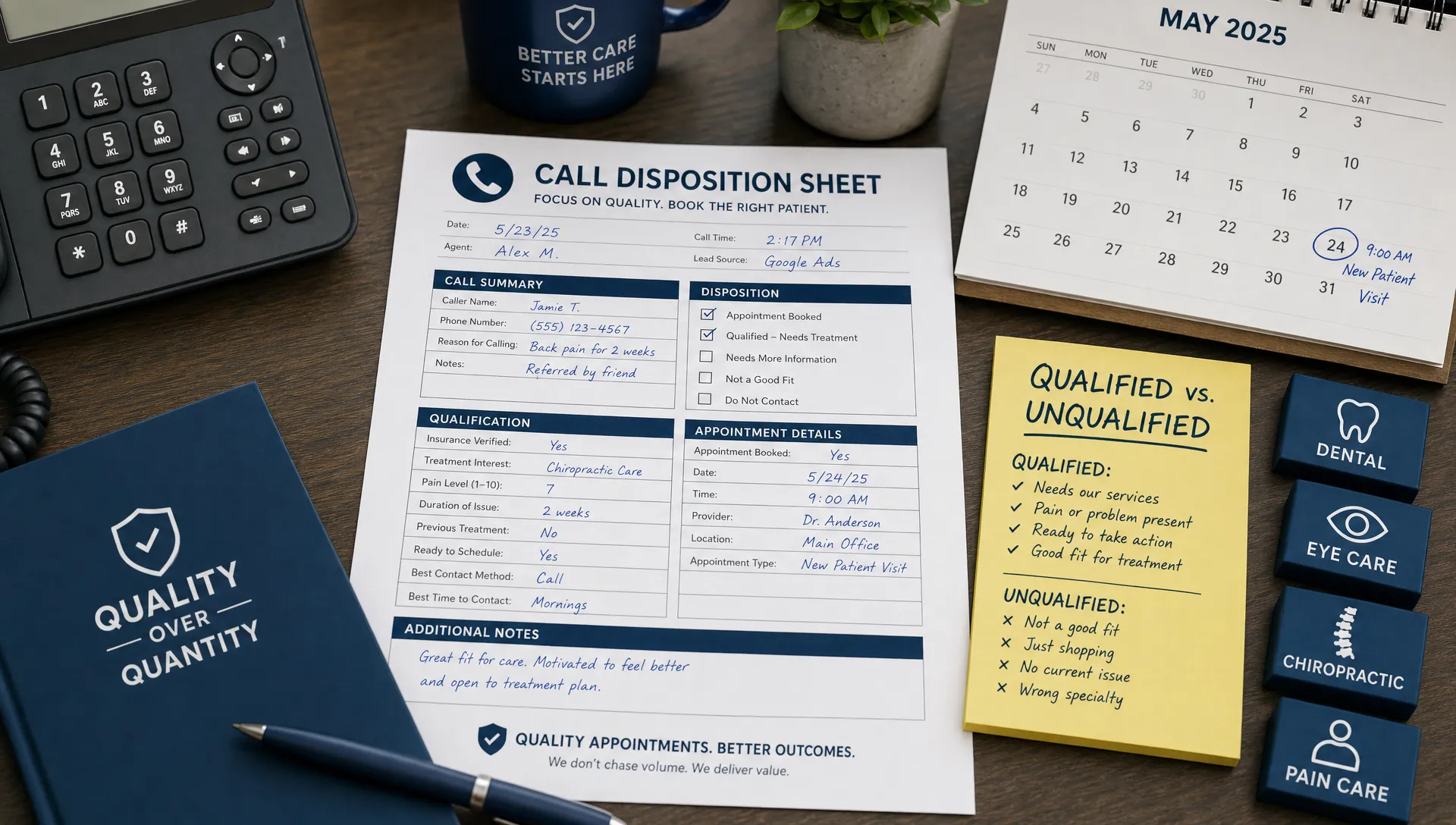
A Louisville healthcare practice can get plenty of Google Ads leads and still feel like the campaign is failing. The phone rings, forms come in, the dashboard shows conversions, but the front desk says the same thing every week: wrong service, wrong location, insurance mismatch, price shoppers or people who never answer the callback.
That is a lead quality problem, not just an ad problem.
For dentists, orthodontists, optometrists, pain physicians and other local practices, improving Google Ads lead quality means optimizing for booked appointments, not cheaper clicks. The goal is to make Google better at finding patients who are nearby, actively looking for the right service and likely to schedule.
If you already have the basics in place and want a broader paid search foundation, this Louisville Google Ads management guide covers local PPC strategy in more detail. This article focuses on the harder question: how do you make the leads better?
Start by defining a quality lead for your practice
Google Ads will optimize toward whatever you tell it matters. If every phone call, form fill or chat is counted equally, the platform has no way to know the difference between a profitable implant consultation and a caller asking if you take an insurance plan you do not accept.
Before changing bids or keywords, define what a qualified lead means inside your practice. For most Louisville healthcare practices, a quality lead has several traits:
- The patient is within a realistic service area
- The inquiry matches a service you want to grow
- The patient is likely to meet your clinical, insurance or payment criteria
- The inquiry can be reached by your scheduling team
- The lead results in a booked appointment or a clear next step
A pediatric dental office, LASIK center and pain management clinic will not use the same definition. That is why lead quality needs to be measured beyond the ad platform. Google Ads can tell you that a form was submitted. Your scheduling data tells you whether that form became a real patient opportunity.
Find where low quality leads are entering the system
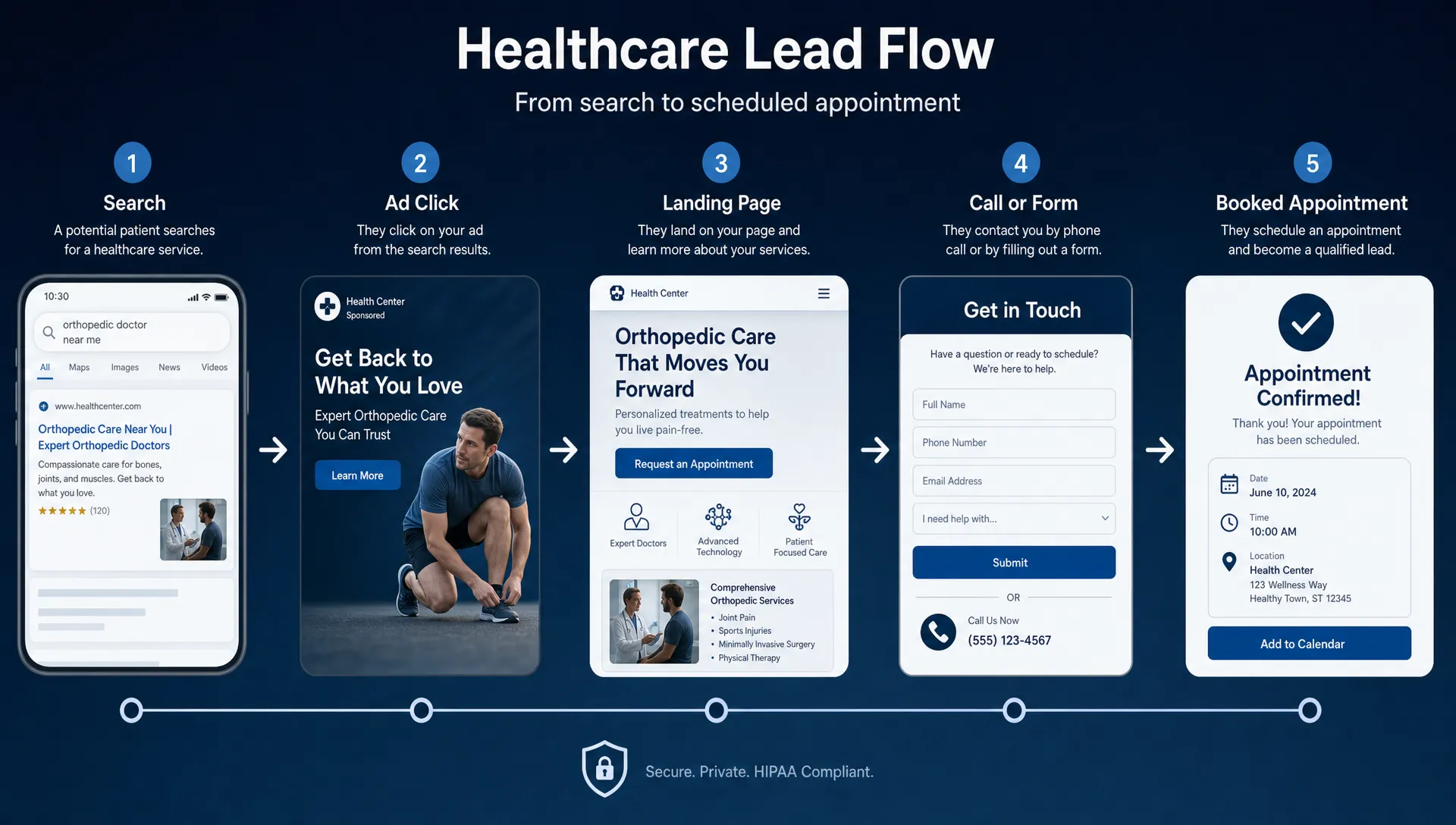
Poor lead quality usually has more than one cause. A campaign may be attracting vague searches, sending people to a generic page, counting short calls as conversions and missing good leads because the office phone is busy. Fixing one piece helps, but the best results usually come from improving the whole path from search to scheduled appointment.
Use this table as a diagnostic starting point:
| Lead quality problem | Likely cause | Practical fix |
|---|---|---|
| Many callers ask for services you do not offer | Keywords are too broad or search terms are not being reviewed | Add negative keywords and separate campaigns by service line |
| Leads come from outside your patient area | Location settings are too loose or targeting includes people only interested in Louisville | Use presence-based location targeting and review ZIP or city performance |
| Forms are incomplete or vague | Landing page asks for too little information or attracts casual inquiries | Add service-specific fields and clearer appointment expectations |
| Calls are counted but do not become appointments | All calls are treated as equal conversions | Track longer calls, booked appointments and lead dispositions |
| Leads are price shopping | Ads and landing pages are not qualifying the service | Clarify consultation type, service scope, financing or insurance basics where appropriate |
| Good leads go cold | Follow-up is too slow or calls are missed during busy hours | Improve call handling, callbacks and scheduling workflows |
This kind of review keeps the practice from blaming Google Ads for problems that happen after the click. It also keeps the team from blaming the front desk for leads that were never qualified in the first place.
Build campaigns around appointment intent, not general interest
Healthcare keywords can look similar on the surface but behave very differently. Someone searching “tooth pain at night” may be researching symptoms. Someone searching “emergency dentist Louisville KY open today” is much closer to booking.
The same pattern applies across specialties:
- “Dry eye symptoms” is more informational than “dry eye doctor Louisville”
- “Back pain exercises” is less appointment-ready than “chiropractor near St Matthews”
- “Dental implants cost” may need careful qualification, while “dental implant consultation Louisville” can indicate stronger intent
- “Knee pain causes” is different from “sports medicine doctor Louisville knee pain”
Campaign structure should reflect these differences. Keep high-intent appointment keywords separate from research-oriented terms so budget, ads and landing pages can match the patient’s stage of decision-making.
For example, a dental practice should not put emergency dentistry, cosmetic veneers, dental implants and routine cleanings in one generic campaign. Each service has different patient intent, economics, scheduling urgency and landing page needs. The same logic applies to ophthalmology procedures, chiropractic care plans, physical therapy evaluations and pain management consultations.
A tighter campaign structure also makes reporting more useful. Instead of asking whether Google Ads is working overall, you can ask which services are producing qualified appointment requests at an acceptable cost.
Use keyword match types carefully in healthcare campaigns
Broad match can be useful when there is strong conversion data, clean tracking and disciplined negative keyword management. Without those safeguards, it can generate irrelevant searches quickly, especially in healthcare where symptoms, treatments, jobs, education and insurance questions overlap.
Phrase match and exact match often give practices more control at the start. They help you focus spend on searches with clearer intent, then expand once you know which queries produce real appointments.
That does not mean exact match is always better. If the campaign is too restrictive, you may miss valuable searches from patients who describe their needs differently. A Louisville patient may search “eye doctor for blurry vision,” “optometrist near me” or “vision exam Louisville” depending on the problem and how much they know.
The key is to review the search terms report regularly. Keywords are what you bid on. Search terms are what patients actually typed. Lead quality improves when decisions are based on real patient language, not assumptions.
Make negative keywords a lead quality filter
Negative keywords are one of the simplest ways to reduce bad leads. They prevent ads from showing for searches that do not match your practice’s services, location or growth goals.
Common negative keyword themes for healthcare practices may include:
- Career searches such as jobs, salary, hiring, school or training
- Research terms such as PDF, study, definition or textbook
- DIY intent such as home remedy, exercises at home or how to fix
- Free or low-intent terms if they do not match your offer
- Services, treatments or insurance plans your practice does not provide
Be careful with insurance-related negatives. They should reflect real business fit, not unfair exclusion. If your practice does not accept a specific plan, filtering that traffic may save patients and staff time. If you do accept it, those searches may be among your best leads.
Negative keywords should be reviewed weekly when campaigns are new. Once performance stabilizes, they still need recurring maintenance because search behavior changes, competitors change and Google’s matching systems evolve.
Tighten Louisville location targeting
Louisville practices often serve more than one type of patient geography. A cosmetic dentist may draw from the East End, St Matthews and Prospect. An emergency dentist may need a tighter radius around the office. A specialty surgeon or LASIK provider may attract patients from Southern Indiana, Shelbyville or Elizabethtown.
Location targeting should match the reality of your practice, not just a default radius.
In Google Ads, review whether your campaign is targeting people “in or regularly in” your selected locations or people who have only shown interest in them. For most local healthcare campaigns, presence-based targeting is usually cleaner because someone researching Louisville from another state may not be a viable patient.
Also review performance by city, ZIP code and radius. If a campaign spends heavily in areas that rarely book, reduce bids or exclude those areas. If a high-value service draws patients from a wider region, build that into the strategy instead of forcing every campaign into the same map.
Ad scheduling matters too. If calls are your primary conversion and nobody answers after 5 p.m., running call-heavy campaigns late into the evening can create wasted spend and frustrated patients. You may still run ads after hours, but the landing page needs a strong form or online request path so the lead can be captured properly.
Write ads that qualify patients before they click
A good healthcare ad does more than win the click. It helps the right patient recognize that the practice fits their need.
Generic ad copy such as “Top Rated Dentist in Louisville” or “Quality Pain Care Near You” may attract attention, but it does not do much to qualify the inquiry. More specific copy can reduce wasted clicks by setting expectations early.
For example, a high-quality ad may mention:
- The specific service, such as dental implants, Invisalign, cataract evaluation, dry eye care or spine pain treatment
- The location or neighborhood served
- Appointment availability if accurate
- Financing or insurance guidance if applicable and compliant
- A clear next step, such as calling to schedule or requesting a consultation
Healthcare advertisers also need to avoid claims that overpromise outcomes. Google’s Healthcare and medicines advertising policy sets rules for medical advertising, and practices should also follow applicable state board rules, professional standards and privacy requirements.
Qualifying ad copy may lower click volume. That is not automatically bad. If fewer clicks produce more booked appointments, the campaign is moving in the right direction.
Send each service to a landing page that helps patients self-select
Many lead quality problems start after the click. If all ads go to the homepage, patients may have to hunt for the service, location, phone number, insurance information or appointment path. Some will leave. Others will call with basic questions the page should have answered.
A service-specific landing page should make the next step obvious and help patients decide whether the practice is a fit. For healthcare practices, that usually means clear, plain-language content rather than a thin page with a stock image and a form.
Strong landing pages often include the following elements:
- A headline matching the service searched
- A short explanation of who the service is for
- Location details and nearby areas served
- What happens during the first appointment or consultation
- Provider credentials, practice trust signals and review references where allowed
- Insurance, financing or payment guidance when appropriate
- A prominent phone number and simple form
The form should collect enough information to route the lead, but not so much that it discourages qualified patients. A dental implant page may need different fields than an emergency dental page. A dry eye clinic may ask about symptoms. A pain clinic may need to know the primary pain area and preferred appointment time.
Track the conversions that actually indicate lead quality
If Google Ads is only tracking every form fill and every call over a few seconds, the campaign may optimize toward activity rather than appointments. Better conversion tracking gives the algorithm cleaner signals and gives the practice a more honest view of performance.
At minimum, separate primary and secondary conversions. A primary conversion should represent a meaningful lead, such as a qualified call, appointment request or booked appointment import. Secondary conversions can still be useful for observation, but they should not all guide bidding equally.
For call tracking, consider using duration thresholds. A 10-second call is often a wrong number, hang-up or quick question. A longer call is more likely to represent a real patient conversation, although duration alone is not perfect. Call outcomes from the scheduling team are even more useful.
For form submissions, track quality after submission. Did the person answer the callback? Did they match the service? Did they schedule? Did they show? These events can be imported back into Google Ads when set up properly. Google provides guidance on offline conversion imports, which can help advertisers connect ad clicks to later outcomes.
Healthcare practices need to handle this carefully. Do not send protected health information into advertising platforms. The U.S. Department of Health and Human Services has published guidance on HIPAA and online tracking technologies, and practices should work with legal, compliance and technical partners before changing tracking setups.
When tracking is clean, Google Ads management becomes much more precise. Instead of optimizing for “leads,” you can optimize toward qualified appointment opportunities.
Review calls and lead dispositions, not just campaign metrics
Campaign dashboards are useful, but they do not tell the full story. A campaign with a high cost per lead may be profitable if those leads are high-value procedures. A campaign with a low cost per lead may be wasteful if the calls are mostly unqualified.
Lead disposition tracking closes that gap. Your team can label each inquiry using simple categories such as booked, not a fit, out of area, insurance mismatch, duplicate, no answer or existing patient. Over time, patterns become obvious.
For example, if many calls are marked “not a fit,” the issue may be keywords or ad copy. If many are marked “no answer,” the problem may be form quality or follow-up speed. If many are marked “insurance mismatch,” the landing page may need clearer payment guidance.
This is where an experienced PPC manager can make better decisions than someone only looking at clicks and cost per lead. Louisville Web Lab has also covered this topic in more depth in its article on what a Google Ads expert does to improve lead quality.
Improve speed-to-lead and front desk handling
Lead quality is not only determined by the ad. A good lead can become a bad outcome if nobody answers the phone, the callback happens too late or the scheduler does not know which campaign the patient came from.
For healthcare practices, speed matters because patients often contact more than one provider. Someone with tooth pain, blurry vision, back pain or a possible surgical need may call the first practice that seems credible and available.
Practical operational improvements include:
- Answering ad-driven calls live whenever possible
- Returning form leads quickly during business hours
- Using missed call text-back only when compliant and appropriate
- Giving schedulers service-specific talking points
- Tracking why qualified patients do not book
- Reviewing calls for training when consent and privacy rules allow
This does not require a complicated system at the beginning. Even a shared lead sheet with source, service, outcome and notes can reveal what is happening. More advanced practices can connect their CRM, call tracking and ad account, but the principle is the same: measure what happens after the lead arrives.
Use bidding strategies only after the data is trustworthy
Automated bidding can work well, but it is only as good as the conversion data feeding it. If the account counts every weak inquiry as a valuable conversion, automated bidding may learn to find more weak inquiries.
Before relying heavily on Target CPA, Maximize Conversions or value-based bidding, make sure the account has:
- Clear primary conversions
- Enough conversion volume for the strategy being used
- Negative keywords and search term controls
- Location targeting aligned with the patient area
- Lead quality feedback from the practice
- Landing pages that match the services being advertised
Value-based bidding can be useful when different conversions have different business value. For example, a booked dental implant consultation may be worth more than a general contact form. A cataract evaluation may be worth more than a general eye exam request for a surgical practice. Those values should be set carefully and based on business realities, not guesses pulled from the air.
If the data is thin, manual CPC or Maximize Clicks with strict controls may be useful temporarily. The right bidding strategy depends on the account’s maturity, service lines, budget and tracking quality.
Watch for service-line economics, not just cost per lead
A Louisville orthodontic practice, oral surgery group, LASIK center and physical therapy clinic may all care about cost per lead, but they should not judge performance the same way. Some services have higher acquisition costs because the patient value is higher, the decision cycle is longer or the competition is stronger.
This is where practices can make a costly mistake: pausing campaigns with higher cost per lead before checking booked appointment quality and revenue potential.
A simple performance view may look like this:
| Service line | Surface metric to watch | Better quality metric |
|---|---|---|
| Emergency dentistry | Cost per call | Calls that become same-day or next-day visits |
| Dental implants | Cost per form or call | Consultations booked with financially qualified patients |
| Orthodontics | Cost per consultation request | Starts or consults that match age and treatment fit |
| LASIK or cataract care | Cost per lead | Evaluations booked and completed |
| Chiropractic or physical therapy | Cost per appointment request | New patient visits attended |
| Pain management | Cost per inquiry | Qualified consults that match services offered |
The point is not to ignore cost per lead. It is to interpret it in context. Cheap leads that never book are expensive. Higher-cost leads that become the right patients may be a better use of budget.
Create a weekly lead quality optimization rhythm
Lead quality improves through a consistent feedback loop. The practices that win with Google Ads usually do not set campaigns once and hope for the best. They review what patients searched, which ads they clicked, which pages they visited and what happened after they contacted the office.
A weekly review should include:
- Search terms that spent money without producing qualified leads
- New negative keywords to add
- Campaigns or ad groups with strong booked appointment rates
- Locations producing poor fit leads
- Calls and forms marked as unqualified
- Landing pages with low conversion or poor lead quality
- Missed calls, slow callbacks or scheduling bottlenecks
This rhythm is especially important in competitive Louisville healthcare markets. Competitors change budgets, seasonal demand shifts and patient behavior changes around school calendars, insurance resets, weather and local events.
For practices that want the setup side handled properly from the start, this guide on setting up Google Ads for better healthcare leads walks through the core campaign foundations.
What to expect from Google Ads management in Louisville
Good Google Ads management in Louisville should not be limited to bid changes and monthly reports. For healthcare practices, the work needs to connect advertising decisions to patient acquisition.
That means your manager or agency should be asking questions such as:
- Which services are most profitable or strategically important?
- Which locations and ZIP codes produce patients who show up?
- Which calls are truly qualified?
- Which landing pages produce scheduled appointments?
- Which insurance, financing or service details need to be clearer?
- Which campaigns should scale and which should be constrained?
If the only reported wins are impressions, clicks and raw leads, the account may be optimized for marketing activity rather than practice growth. Better reporting should connect spend to qualified leads, appointments and service-line performance as closely as compliance allows.
Frequently Asked Questions
How can a Louisville practice tell if Google Ads leads are low quality? Look beyond the number of conversions. If many inquiries are outside your service area, ask for services you do not offer, do not match payment or insurance fit, fail to answer follow-up or rarely schedule, you have a lead quality issue.
Should healthcare practices use broad match keywords? Broad match can work when conversion tracking is strong and negative keywords are actively managed. For new or messy accounts, phrase and exact match often provide better control until enough qualified lead data is available.
What is the best way to improve Google Ads lead quality quickly? Start with search term cleanup, negative keywords, location targeting and conversion tracking. These changes often reveal wasted spend quickly. Landing page improvements and lead disposition tracking usually create the next layer of gains.
Do landing pages really affect lead quality? Yes. A service-specific landing page helps patients understand whether the practice fits their need before they call or submit a form. Clear service details, location information, appointment expectations and payment guidance can reduce poor-fit inquiries.
Can Google Ads optimize for booked appointments instead of leads? Yes, if the account is set up to send qualified offline conversion data back into Google Ads in a compliant way. Healthcare practices must avoid sending protected health information and should review tracking practices carefully.
Turn Google Ads leads into better patient opportunities
If your Louisville practice is getting clicks but not enough qualified appointment requests, the solution is rarely one magic setting. Lead quality improves when targeting, keywords, ads, landing pages, tracking and follow-up all point toward the same goal: booked patients who fit your services.
Louisville Web Lab helps healthcare practices connect Google Ads strategy with patient acquisition, from local targeting and landing pages to tracking and automation. If you want a clearer diagnosis of where your leads are breaking down, schedule a diagnostic call with Louisville Web Lab.