

Patients rarely wake up excited to research healthcare ads. They search because something is uncomfortable, urgent, confusing, or important enough to act on. That is why Google advertising can be so effective for healthcare practices, when it is built around intent instead of traffic.
A parent searching for pediatric dentist open today, an adult comparing Invisalign provider near me, or a patient looking for pain management doctor for sciatica is not casually browsing. They are trying to choose a provider, understand their options, and schedule care. The job of your ads is to meet that demand with the right message, the right landing page, and a clear path to an appointment.
The challenge is that many healthcare Google Ads accounts are set up to generate clicks, not patients. They target broad terms, send people to generic homepages, and report form fills without checking whether those leads became scheduled visits. High-intent Google advertising works differently. It starts with the patient decision process and measures success by booked appointments, qualified calls, and profitable service-line growth.
What Makes a Patient High-Intent?
High-intent patients show signs that they are close to taking action. Their searches usually include a service, symptom, location, urgency, or provider type. They may not be ready to commit to treatment immediately, but they are much closer to scheduling than someone searching broad educational topics.
A search for what causes tooth pain may be useful for SEO content, but it is not as commercially ready as emergency dentist Louisville KY. A search for dry eye symptoms can indicate early research, while dry eye clinic near me suggests someone is evaluating where to go. In pain management, back pain exercises is informational, while pain management doctor near me is closer to a patient acquisition opportunity.
| Search behavior | Likely intent | Best ad response |
|---|---|---|
Service plus location, such as dental implants near me |
Comparing local providers | Service-specific ad and landing page |
Symptom plus provider, such as sciatica doctor near me |
Seeking diagnosis or treatment | Trust-focused ad with clear appointment CTA |
Urgency terms, such as same day chiropractor |
Needs care soon | Call-forward ad and fast scheduling path |
| Insurance or financing terms | Evaluating affordability | Landing page that explains next steps clearly |
| Brand plus service searches | Already aware of a practice | Branded campaign with strong conversion tracking |
High intent does not mean every lead is perfect. Some patients will still ask about price, insurance, availability, or whether their condition is a fit. But when your campaigns are structured around these signals, you spend more of your budget on patients who are actively looking for care.
Start With Appointment Economics, Not Clicks
Before launching or rebuilding a campaign, define what a good patient is worth to the practice. This is where healthcare Google advertising becomes a business decision, not just a marketing activity.
For a general dentist, a new hygiene patient may have long-term value through recalls, restorative care, referrals, and family members. For an implant specialist, the volume may be lower, but the revenue per case can be significantly higher. For an optometry clinic, annual exams, eyewear, specialty lenses, and medical eye care may all affect patient value. For a pain or physical therapy practice, payer mix, treatment frequency, and care plans matter.
This does not mean your campaigns should chase only the highest-revenue services. It means your budget, bidding, and lead quality standards should match your growth goals. The same cost per qualified opportunity may be unacceptable for one service and profitable for another. If you need help judging spend, our guide to Google Ads cost for healthcare practices explains how budget needs and click costs vary by specialty.
A practice should know four numbers before judging campaign performance:
- Average value of a new patient by service line
- Percentage of leads that become scheduled appointments
- Percentage of scheduled appointments that show up
- Capacity available for the services being advertised
Without those numbers, teams often make the wrong optimization decisions. They pause campaigns that look expensive but produce high-value patients, or they keep campaigns that generate cheap leads with poor fit and low show rates.
Build Campaigns Around Patient Intent
A strong campaign structure separates services by intent. Dental implants, emergency dentistry, Invisalign, pediatric dentistry, cataract surgery, LASIK, dry eye, chiropractic care, regenerative medicine, and physical therapy should not all live in one broad campaign with one shared landing page.
Service-specific campaigns make it easier to control budgets, write relevant ads, evaluate search terms, and understand which services are creating actual revenue. They also help prevent high-volume, lower-value searches from consuming budget meant for higher-priority procedures.
For most healthcare practices, Search campaigns should be the foundation. These ads appear when patients are actively searching. Display and video can support awareness, but they usually do not capture the same immediate intent. Performance Max may have a role in some accounts, but healthcare advertisers need to be careful with placement quality, conversion tracking, and lead validation.
The basic structure should include focused campaigns, tightly themed ad groups, relevant keywords, negative keywords, location targeting, and landing pages aligned with each service. If you want a deeper campaign blueprint, Louisville Web Lab has a detailed breakdown on building a campaign around booked patients.
Match the Ad to the Patient’s Next Question
A high-intent patient has a practical question in mind. Can you help me? Are you near me? Can I get in soon? Do you treat this condition? Do you accept patients like me? Can I trust you?
Your ad copy should answer those questions quickly. Healthcare ads do not need to be clever. They need to be specific, credible, and easy to act on.
A stronger ad makes three things clear:
- The service or condition being addressed
- The local relevance of the practice
- The next step, such as calling or requesting an appointment
For example, an orthodontic ad focused on Invisalign should not send users to a general orthodontics page with no Invisalign content. A pain management ad for sciatica should not lead to a homepage where the patient has to search for spine care information. Every extra step creates friction, and friction costs appointments.
Ad extensions also matter. Call assets, location assets, sitelinks, and structured snippets can help patients choose faster. For local healthcare, the ability to call directly from a mobile search can be especially important. Many high-intent searches happen during breaks at work, between errands, or when pain is actively affecting the patient’s day.
Send Patients to Landing Pages Built for Conversion
The landing page is where many healthcare campaigns lose money. A patient clicks because the ad sounds relevant, then lands on a generic page that asks them to figure out the rest. That mismatch lowers conversion rates and can waste budget even when keyword targeting is strong.
A good healthcare landing page should continue the exact conversation started by the search. If the ad is about emergency dental care, the page should immediately confirm emergency availability, explain what to do next, and make calling easy. If the ad is about LASIK consultations, the page should address candidacy, technology or approach at a high level, and the consultation process. If the ad is about physical therapy for sports injuries, the page should speak to active patients who want to return to movement safely.
Trust signals are especially important in healthcare. Patients are not just buying a product. They are choosing who will examine them, advise them, and possibly perform treatment. Reviews, provider credentials, before-and-after examples where appropriate, clear service explanations, and simple appointment options all reduce hesitation.
Be careful with compliance and privacy. Forms should avoid collecting unnecessary sensitive details, and tracking should be reviewed through a healthcare privacy lens. Advertising platforms also have policies around sensitive health categories, so campaign tactics that work in other industries may not be appropriate for medical, dental, vision, or pain practices.
Track the Actions That Actually Matter
Conversion tracking should not stop at calls and form submissions. Those are useful indicators, but the real question is whether the lead became a scheduled patient.
For healthcare practices, call tracking is often essential because many high-intent patients prefer to call. But call duration alone is not enough. A two-minute call could be a qualified patient booking an appointment, or it could be someone asking for a service the practice does not offer. Form fills also need review because spam, vendor inquiries, and poor-fit requests can inflate the numbers.
The best reporting connects ad spend to lead quality and appointment outcomes. That may include call recordings where legally permitted, staff lead disposition notes, appointment confirmations, and source tracking inside the practice’s workflow. The goal is not to create a complicated reporting system for its own sake. The goal is to know which campaigns are producing patients worth investing in.
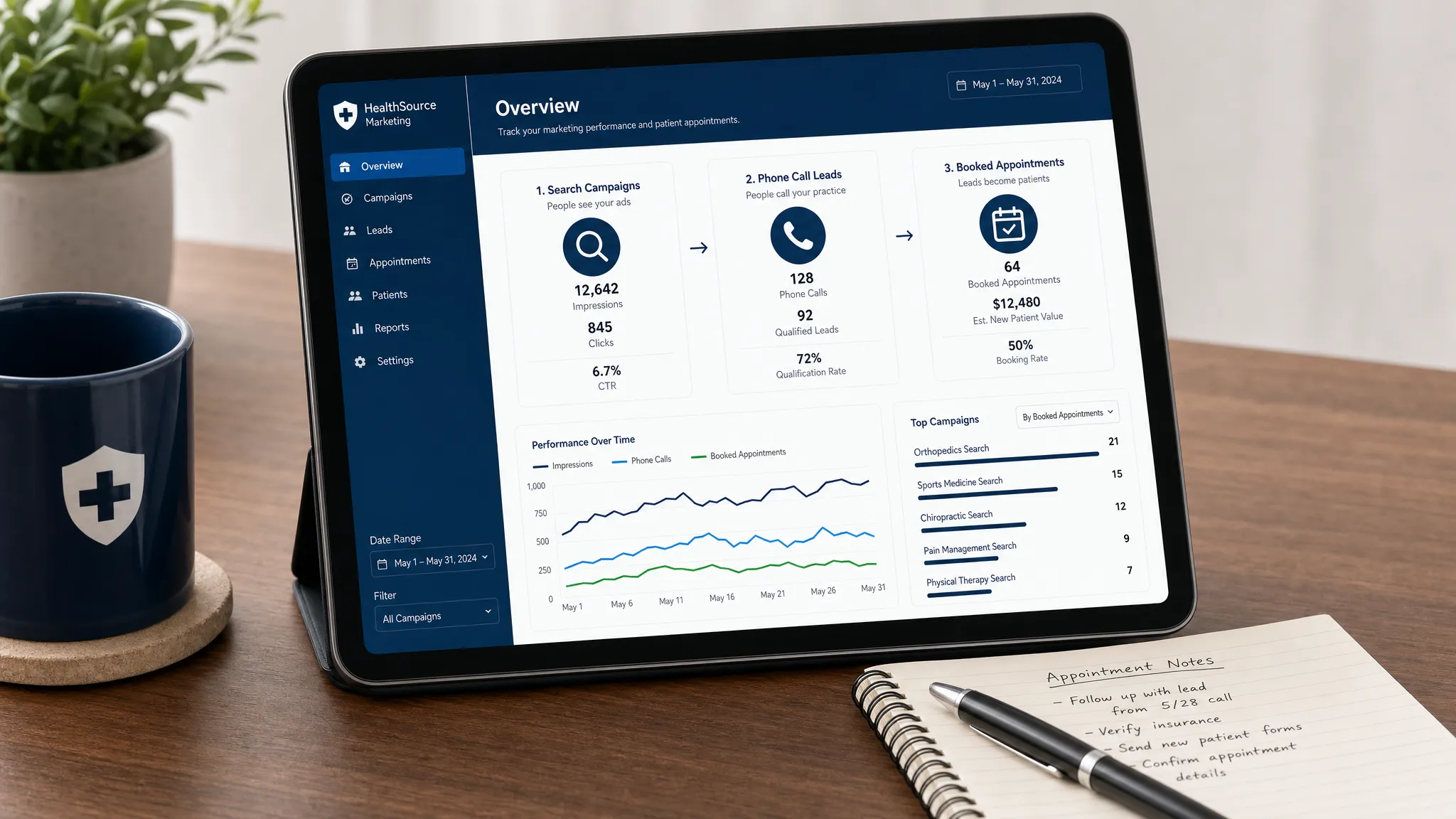
Follow-up speed is another overlooked performance lever. If a patient submits a form and waits hours for a response, they may contact another provider. If a call goes unanswered during business hours, the ad budget did its job, but the acquisition system failed. High-intent traffic needs high-intent operations.
Reduce Waste Without Starving Growth
Lowering wasted spend is not the same as cutting budget. A practice with a modest budget can spend less efficiently than another practice investing much more. The difference is usually targeting, tracking, and optimization discipline.
Search term reviews are one of the most practical ways to improve quality. If an optometry campaign starts matching searches for jobs, school programs, free services, or unrelated symptoms, negative keywords can protect the budget. If a dental implant campaign attracts searches for cheap DIY solutions, the campaign may need tighter match types, better negatives, or different ad copy.
Location targeting also needs attention. A clinic may technically serve a large metro area, but patient willingness to travel varies by specialty. A patient may drive farther for oral surgery, LASIK, or interventional pain care than for routine dental cleanings or basic chiropractic care. Your campaign radius should reflect real patient behavior, not just the largest area Google allows you to target.
Ad schedules should reflect when the practice can respond. If calls after 6 p.m. go to voicemail and rarely convert, the account may need a different after-hours strategy. If Saturday calls are valuable for urgent dental or chiropractic needs, budget may need to be protected for those windows.
For additional ways to improve efficiency, see our guide on lowering cost per lead without sacrificing lead quality.
High-Intent Examples by Healthcare Specialty
Every specialty has its own version of high-intent demand. The key is to identify searches that indicate a patient is looking for a provider, not just general information.
| Specialty | High-intent search themes | Landing page focus |
|---|---|---|
| General dentistry | Emergency dentist, dentist accepting new patients, tooth pain | Fast scheduling, location, patient comfort, services offered |
| Orthodontics | Invisalign provider, braces consultation, orthodontist near me | Treatment options, consultation process, age groups treated |
| Optometry | Eye exam near me, dry eye clinic, contact lens exam | Appointment availability, insurance guidance, specialty services |
| Ophthalmology | Cataract surgeon, LASIK consultation, glaucoma specialist | Provider expertise, evaluation process, patient education |
| Chiropractic | Chiropractor for back pain, same-day chiropractor, neck pain treatment | Conditions treated, visit expectations, easy calling |
| Pain management | Sciatica doctor, pain clinic near me, joint injections | Referral process, treatment pathways, qualification details |
| Physical therapy | Physical therapy near me, sports injury rehab, post-surgery PT | Recovery goals, accepted cases, scheduling process |
These examples are not meant to be copied blindly. The best keyword strategy depends on your market, competitive landscape, patient mix, payer mix, and available capacity. But the principle is consistent: match the campaign to the patient’s problem and stage of decision-making.
Where AI Search Fits With Google Advertising
AI-driven search is changing how patients discover providers, compare options, and summarize local choices. That does not make Google advertising less important. It makes the entire visibility system more connected.
Paid search captures immediate demand. Local SEO, reviews, website content, and answer-ready service pages support trust before and after the click.
For example, a strong Google Ads campaign for dental implants should be supported by a page that explains candidacy, consultation steps, recovery basics, financing conversations, and why the practice is qualified. A dry eye campaign should be supported by useful content about symptoms, evaluation, and treatment options. The ad gets attention, but the broader digital presence helps the patient feel confident enough to schedule.
What to Review Every Week
Google advertising improves through consistent review, not set-it-and-forget-it management. Weekly optimization does not need to mean constant major changes. In fact, too many changes can make learning harder. The goal is to identify waste, protect what works, and connect performance to real appointment outcomes.
A practical weekly review should include search terms, cost per qualified lead, call quality, form quality, conversion rate by landing page, budget pacing, impression share for priority services, and appointment outcomes. Over time, patterns become clear. Certain keywords may generate more serious patients. Certain zip codes may convert better. Certain ad messages may produce more calls but lower booking rates. Certain landing pages may need stronger trust signals or clearer scheduling options.
The most important shift is cultural: do not let clicks become the scoreboard. A campaign with fewer clicks but better appointment quality is often more valuable than a campaign that produces high traffic and low patient fit.
Frequently Asked Questions
Is Google advertising worth it for healthcare practices? Yes, when campaigns are built around patient intent, strong landing pages, and booked appointment tracking. It is less effective when the goal is only traffic or low-cost clicks.
What types of healthcare practices benefit most from Google Ads? Dental, orthodontic, optometry, ophthalmology, chiropractic, pain management, physical therapy, and specialty practices can benefit when patients are actively searching for their services locally.
How fast can Google Ads bring in patient leads? Search campaigns can begin generating calls and form submissions soon after launch, but quality usually improves as search terms, negatives, landing pages, and follow-up processes are optimized.
Should healthcare practices send ads to the homepage? Usually not for service-specific campaigns. A dedicated landing page that matches the patient’s search intent typically creates a clearer path to scheduling.
What is the biggest mistake practices make with Google advertising? The biggest mistake is measuring success by clicks or form fills without confirming whether those leads became qualified appointments and actual patients.
Turn Search Demand Into Scheduled Care
High-intent patients are already searching. The question is whether your practice appears at the right moment with the right message, earns enough trust, and makes scheduling easy.
Louisville Web Lab helps healthcare practices connect Google Ads, local SEO, websites, and automation into patient acquisition systems built around measurable growth. If your practice wants more qualified calls, better-fit leads, and a clearer path from search visibility to booked appointments, book a diagnostic strategy call with Louisville Web Lab.