
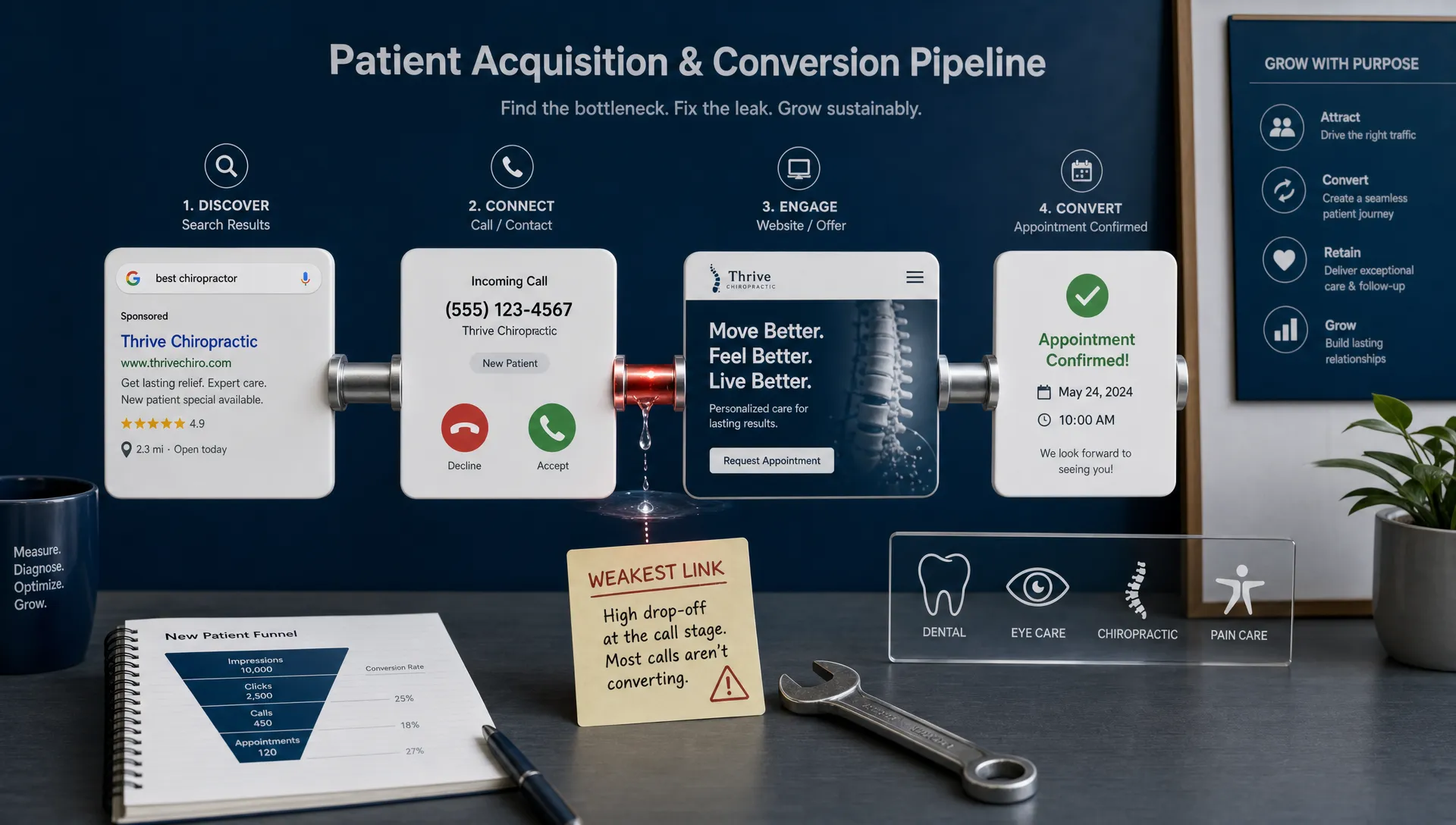
When a practice hires a marketing partner, the temptation is to ask for more of everything: more ads, more posts, more SEO pages, more email campaigns, more social content. But a good Louisville digital marketing agency should not start by piling on activity. It should start by finding the leak that is costing you the most booked appointments.
For healthcare practices, that leak is rarely one single tactic. A dental implant page may rank but fail to convert. A chiropractic office may get calls from Google Business Profile but miss them during lunch. An optometry clinic may spend on Google Ads without knowing which keywords produce scheduled exams. A pain management group may have strong physician referrals but weak local search visibility for self-referred patients.
The first fix should be the highest impact bottleneck between search visibility and a confirmed appointment. Once that is repaired, every dollar and every channel works harder.
Start with the patient acquisition pipeline
Healthcare marketing is not just exposure. It is a sequence of patient decisions and practice handoffs. Someone has to find you, trust you, take action, reach the right person, schedule, show up, and ideally leave a review or refer someone else.
That means the best first move depends on where the breakdown occurs. A practice with no visibility needs a different plan than a practice with traffic but no calls. A practice with plenty of calls but few booked visits does not have a marketing problem first. It has a conversion and follow-up problem.
A practical audit should map the pipeline like this:
| Symptom | Likely bottleneck | What to fix first |
|---|---|---|
| Low search impressions and few map views | Local visibility | Google Business Profile, location pages, citations, reviews |
| Traffic but few calls or forms | Website conversion | Calls to action, page copy, mobile usability, trust signals |
| Calls and forms but low scheduled appointments | Front-desk process | Speed to lead, call handling, reminders, tracking |
| Google Ads spend with unclear return | Measurement | Conversion tracking, call tracking, keyword and landing page reporting |
| Good rankings but weak patient trust | Reputation | Review generation, review response process, proof elements |
| Multiple services but only one generic website | Message mismatch | Service-specific pages and specialty-specific offers |
This is why the first question should not be, “Which channel should we add?” It should be, “Where are patients falling out of the system?”
Fix measurement before you fix spend
If a practice cannot tell which sources produce scheduled appointments, the first fix is tracking. Without it, marketing decisions turn into guesswork. You might pause the channel that brings high value patients or keep funding a campaign that only produces unqualified calls.
At minimum, a healthcare marketing audit should answer several basic questions: Which search queries generate calls? Which pages lead to appointment requests? Which Google Ads campaigns drive new patient calls rather than existing patient calls? Which locations, providers, or services are converting? Which leads become scheduled appointments?
This does not mean a practice needs an overly complicated dashboard on day one. It means the essentials should be clean. Forms should be tracked. Phone calls should be attributed. Google Business Profile links should use tracking parameters when appropriate. Ad campaigns should measure meaningful conversions, not vanity metrics.
Healthcare practices also need to be careful about privacy. Marketing teams should avoid collecting unnecessary protected health information in analytics tools, ad platforms, and form fields. The U.S. Department of Health and Human Services provides guidance on HIPAA rules related to marketing, and practices should work with qualified legal or compliance advisors when sensitive data is involved.
The key principle is simple: measure the patient journey without exposing private health information. A serious agency will understand that healthcare marketing performance and compliance have to coexist.
Fix local visibility if patients cannot find you
For dentists, orthodontists, optometrists, and many specialty practices, local search is often the foundation. Patients search with immediate intent: “dentist near me,” “dry eye doctor Louisville,” “chiropractor open today,” “orthodontist for teens,” or “pain management clinic near St. Matthews.”
If your practice is not visible in the map pack and localized organic results, other improvements may not matter yet. A beautiful website cannot convert patients who never see it.
The first local SEO fixes usually include Google Business Profile accuracy, primary and secondary category selection, service listings, photos, review velocity, name, address, and phone consistency, and location-specific pages. Practices with multiple offices need special attention because each location may compete in a different local search environment.
Google explains that local results are shaped by relevance, distance, and prominence. In practical terms, that means your practice has to clearly match what the patient searched, be geographically relevant, and show enough credibility to earn visibility. Weak profiles, thin location pages, inconsistent citations, and stale reviews can all reduce that credibility.
This is especially important in Louisville because neighborhoods and nearby communities can change intent. A patient in Middletown may not respond to the same search result as a patient downtown, in Jeffersontown, in St. Matthews, or across the river in Southern Indiana. Local relevance needs to be specific enough to match how real patients search.
If you suspect visibility is the issue, review the common local SEO warning signs before assuming you need more ad spend.
Fix the website if visitors are not becoming patients
Once people find you, the website has one primary job: help the right patient take the next step. Too many healthcare websites bury the most important information behind generic branding, stock photography, and vague copy.
A high converting healthcare page should quickly answer who you help, where you are located, what service you provide, why patients should trust you, and how to schedule. For many practices, the above-the-fold section on mobile is the most important real estate. It should not make patients hunt for a phone number, appointment request button, accepted insurance information, or location details.
The first website fix is often clarity. A cosmetic dentist should not rely on a general “services” page to win veneer consultations. An optometrist promoting dry eye care needs a dedicated dry eye page with symptoms, treatment options, trust signals, and a clear booking path. A chiropractor should not send all ad traffic to the homepage if the campaign is about lower back pain, auto injuries, or sports injury care.
Speed and mobile usability matter too. Patients often search between tasks, from a phone, with limited patience. If the site loads slowly, buttons are hard to tap, or the form feels too long, you lose opportunities before a staff member ever speaks to the patient.
For a deeper look at common conversion failures, Louisville Web Lab has covered why many local companies are not getting leads online. For healthcare practices, the same principle applies with higher stakes: every friction point can mean a patient books somewhere else.

Fix follow-up before adding more leads
One of the fastest ways to improve marketing return is to respond to existing leads better. If phone calls go unanswered, forms sit in an inbox, voicemails are returned hours later, or staff cannot identify which calls are new patient opportunities, increasing lead volume may only increase waste.
This is where marketing becomes operational. The handoff from click to call to scheduled appointment has to be dependable. Healthcare practices need the same no-dropoff mindset for patient inquiries: every handoff should have ownership, timing, and accountability.
A Louisville digital marketing agency should look beyond campaigns and ask practical questions. How quickly are forms answered? Are missed calls tracked? Are new patient calls routed differently from existing patient calls? Are appointment requests followed up by phone, text, or email when appropriate? Are staff trained to explain next steps for high value services like implants, orthodontics, LASIK consultations, dry eye treatment, regenerative medicine, or pain procedures?
The fix may be as simple as call tracking, better routing, a shorter form, automated confirmations, or a defined response standard. A practice that replies within minutes often has a major advantage over a competitor that replies the next day.
Fix the message by specialty, not just by channel
Healthcare marketing fails when it treats every patient like the same generic lead. Patients searching for emergency dental care, pediatric orthodontics, cataract surgery, chronic back pain relief, or physical therapy after surgery have different concerns and different levels of urgency.
The first messaging fix is to align content with the patient’s intent. A general dentistry homepage can introduce the practice, but it should not be expected to convert every implant, Invisalign, emergency, and cosmetic query. A pain practice may need separate pages for conditions, treatments, referral pathways, and patient education. An optometry clinic may need content for routine eye exams, medical eye care, dry eye, myopia management, and eyewear.
Good specialty messaging usually includes plain language explanations, realistic expectations, provider credibility, local relevance, and a clear next step. It should avoid exaggerated claims and should never pressure patients with misleading medical promises.
This is also where AI search optimization starts to matter. Search engines and AI answer experiences need clear entities, consistent service information, trustworthy pages, and structured content. If your practice information is scattered or vague, it is harder for search systems to understand when you are the right answer.
Fix reputation if trust is the missing piece
Patients compare healthcare providers quickly. Reviews, star ratings, response quality, before-and-after policies, provider bios, credentials, and patient testimonials all influence whether someone calls.
If your competitors have stronger review profiles, the first fix may be reputation building. This does not mean chasing reviews in a way that violates platform rules or patient privacy. It means creating a consistent, ethical process to ask satisfied patients for feedback, monitor review platforms, and respond professionally.
For many practices, reputation is not only a brand asset. It also supports local SEO. A strong review profile can improve click-through rates, reinforce trust, and help patients choose between similar practices in the same area.
The agency should also look for trust gaps on the website. Do provider pages show real clinicians? Are credentials easy to find? Are locations, hours, and phone numbers accurate? Are service pages written like helpful patient education or like generic marketing copy? Trust is built from many small signals.
Fix paid search economics before scaling Google Ads
Google Ads can be powerful for healthcare practices, especially when patients are actively searching for care. But paid search becomes expensive when tracking is weak, landing pages are generic, or staff cannot convert calls.
Before scaling ads, a Louisville agency should confirm that campaigns are separated by service intent, location targeting is realistic, negative keywords are maintained, calls are tracked, and landing pages match the searcher’s need. A dental implant campaign should not behave like a teeth cleaning campaign. A LASIK consultation campaign should not be measured the same way as routine eye exam traffic. A pain management campaign may need careful filtering for patient fit, insurance, referral requirements, and service availability.
The goal is not just a lower cost per click. The goal is a reasonable cost per qualified appointment. That requires clean data and close coordination between marketing and the practice team.
What should be fixed first in the first 30 days?
A strong first 30 days should feel like triage, not chaos. The agency should identify the biggest constraint, repair it, and build a plan around measurable outcomes.
For a new client, the first priority usually falls into one of four categories. If there is no reliable data, fix tracking. If there is poor local visibility, fix Google Business Profile and local pages. If there is traffic but few leads, fix conversion. If there are leads but few appointments, fix follow-up.
The agency should also be willing to say “not yet.” Not every practice needs TikTok, a new brand campaign, or a larger ad budget immediately. Sometimes the most profitable marketing decision is to stop sending traffic to a weak page. Sometimes it is to answer missed calls. Sometimes it is to rebuild the local foundation before launching broader campaigns.
How to judge whether the first fix is working
The right metrics depend on the bottleneck. If the first fix is tracking, success means you can now see which channels and pages produce calls, forms, and scheduled appointments. If the first fix is local SEO, early indicators may include improved map visibility, profile interactions, calls, direction requests, and localized rankings. If the first fix is conversion, watch call volume, form submissions, appointment requests, and landing page conversion rate. If the first fix is follow-up, measure contact rate, booking rate, missed calls, and speed to response.
Avoid judging everything by traffic alone. A healthcare practice can grow with less traffic if that traffic is better matched to patient intent and handled more effectively. Likewise, a traffic increase without more appointments is a warning sign, not a win.
If you are comparing agencies, look for a partner that can explain the first fix clearly. The plan should connect activity to booked appointments, not just impressions and clicks.
Frequently Asked Questions
What should a Louisville digital marketing agency fix first? The first fix should be the biggest bottleneck between visibility and booked appointments. For one practice, that may be local SEO. For another, it may be tracking, website conversion, review generation, or front-desk follow-up.
Should my healthcare practice start with SEO or Google Ads? It depends on your current position. If you need immediate demand and have strong tracking and landing pages, Google Ads may help. If your local visibility is weak, SEO and Google Business Profile improvements may create a stronger foundation.
Why is local SEO so important for healthcare practices? Most patients choose providers close to home, work, or school. Local SEO helps your practice appear when patients search for nearby care, compare providers, read reviews, and decide who to contact.
How long does it take to see results from the first fixes? Conversion and follow-up fixes can show improvement quickly, sometimes within weeks. Local SEO and organic content usually take longer, often several months, because visibility and authority build over time.
What should I ask an agency before hiring them? Ask how they will identify the first bottleneck, what they will measure, how they handle healthcare privacy concerns, and how they connect campaigns to scheduled appointments rather than surface-level metrics.
Turn the first fix into growth
If your practice is investing in marketing but still unsure where patients are falling out of the journey, start with diagnosis before expansion. Louisville Web Lab helps healthcare practices evaluate SEO, ads, websites, automation, and patient acquisition systems so the first fix is tied to measurable growth.
Schedule a diagnostic call with Louisville Web Lab to identify the highest impact repair in your marketing system and build from there.