
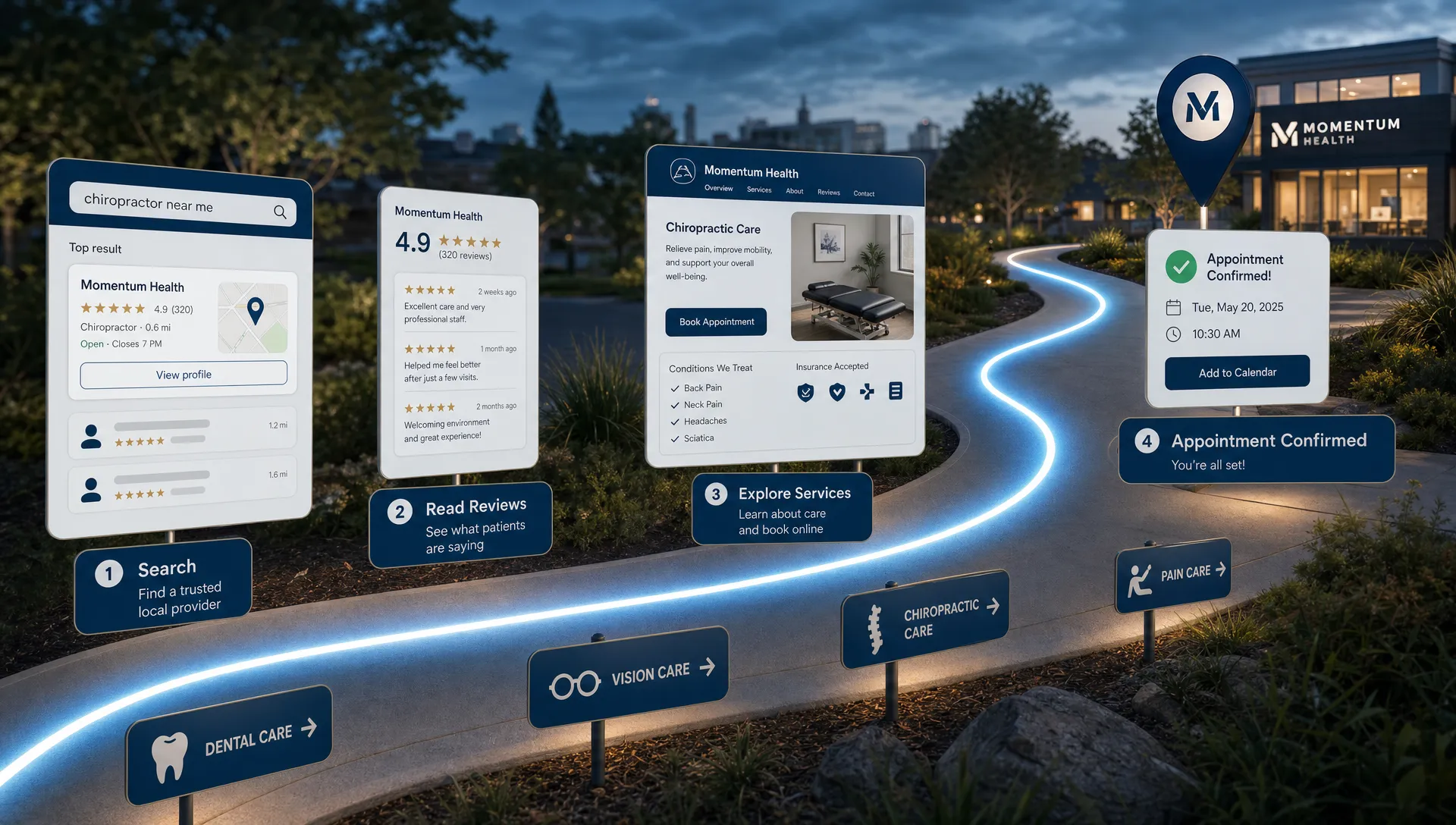
Demand is not the same as traffic. A healthcare practice can have more website visitors, more ad clicks, and more social media activity without seeing a meaningful lift in booked appointments. Real demand shows up when more qualified local patients search for your services, trust your practice enough to contact you, and follow through to schedule care.
That is where a Louisville healthcare marketing agency should be different from a general marketing vendor. Healthcare demand is local, personal, time-sensitive, and trust-heavy. A patient choosing a dentist, orthodontist, optometrist, chiropractor, pain physician, or physical therapist is not just buying a product. They are deciding who to trust with their health, time, money, and family.
A strong agency grows demand by building a connected system: visibility in search, a website that earns confidence, reviews that reduce hesitation, paid campaigns that capture urgent intent, and follow-up that prevents leads from disappearing. When those pieces work together, marketing becomes less about activity and more about measurable patient growth.
What demand means for a healthcare practice
For a healthcare practice, demand is the number of people in your market who are both aware of your services and motivated enough to take the next step. That next step might be a phone call, form submission, online booking request, consultation, or referral.
Demand is not limited to people already searching for your exact practice name. It includes patients searching by symptom, service, insurance question, location, urgency, or outcome. Someone might look for an emergency dentist in the Highlands, Invisalign near St. Matthews, dry eye treatment in Louisville, a chiropractor after an auto accident, or pain management options after physical therapy did not resolve the issue.
A Louisville healthcare marketing agency grows demand across three layers:
- Capture existing demand: Help your practice show up when patients are already searching for the services you provide.
- Influence comparison demand: Build trust when patients compare multiple providers, reviews, websites, and locations.
- Create future demand: Educate patients before they are ready to book, so your practice becomes the obvious choice when timing changes.
The best growth usually comes from improving all three layers, not overinvesting in one channel and hoping it fixes everything.
Why Louisville healthcare demand is local and competitive
Healthcare searches are heavily shaped by proximity. Most patients prefer a provider who is close to home, work, school, or a daily commute route. That creates a different competitive environment in Louisville than a national e-commerce market. Your true competitors may be within a few miles, especially for dentistry, optometry, chiropractic, physical therapy, and other recurring-care services.
Google states that local results are influenced by relevance, distance, and prominence in its Business Profile guidance. In plain English, Google wants to understand what your practice offers, where you are located, and whether you are a trusted option compared with similar practices nearby.
That means demand growth is not only about ranking for broad terms. It also depends on neighborhood relevance, service clarity, review quality, website authority, and whether your online presence matches the way patients actually search.
For example, an orthodontic practice may need visibility for both parent-driven searches and adult clear aligner searches. A pain management clinic may need to distinguish between chronic back pain, joint pain, regenerative medicine, and interventional procedures. An optometry clinic may need separate demand paths for routine eye exams, pediatric eye care, dry eye, specialty contact lenses, and urgent vision concerns.
The demand growth system: from search to scheduled appointment
A healthy marketing system does not treat SEO, ads, website design, reviews, and automation as separate projects. Each piece should support the same outcome: more of the right patients taking action.
| Demand lever | What it improves | Leading indicators | Practice outcome |
|---|---|---|---|
| Local SEO and Google Business Profile | Visibility in nearby searches | Map views, calls, direction requests, local rankings | More organic patient inquiries |
| Service-line content | Relevance for specific patient needs | Non-branded search impressions, page engagement | Better-qualified leads |
| Conversion-focused website | Trust and ease of booking | Form starts, calls, click-to-call actions | Higher appointment conversion |
| Google Ads | High-intent demand capture | Cost per qualified lead, call quality, landing page conversion | Faster new patient volume |
| Reviews and reputation | Confidence during comparison | Review velocity, rating trends, sentiment | More patients choosing your practice |
| Follow-up automation | Lead recovery and speed to contact | Response time, missed-call recovery, booking rate | Fewer lost opportunities |
The table matters because it shows why demand growth is not a single tactic. If search visibility is strong but the website is weak, patients may leave. If ads generate calls but no one answers quickly, budget is wasted. If reviews are thin or outdated, patients may choose a competitor even if your clinical care is excellent.
Start with service lines that can actually grow
The first step is deciding which services should drive demand. Not every appointment type has the same value, urgency, capacity, or profitability. A general dentist might want more hygiene patients, but the growth plan may also need to support implants, cosmetic dentistry, emergency visits, or clear aligners. An optometry practice might focus on eye exams, but demand growth may be stronger when dry eye, myopia management, or specialty lenses are clearly positioned.
This is where healthcare-specific marketing strategy matters. The goal is not to promote every service equally. The goal is to match marketing investment to the services that support the practice’s growth goals, clinical capacity, and patient needs.
A good agency will ask practical questions before building campaigns. Which appointment types are available soon? Which services have the highest strategic value? Which patient segments are underrepresented? Which locations need more demand? Which services already rank well, and which need authority built over time?
Without that diagnosis, a practice can end up paying for attention that does not translate into the kind of patients it actually wants.
Build visibility where patients search first
Search is often the front door to healthcare demand. Patients may ask Google, Maps, voice assistants, AI search tools, or review platforms for help finding a provider. If your practice does not appear where those searches happen, demand flows to competitors.
Local SEO helps a practice become more visible for service and location searches. That includes optimizing the Google Business Profile, building strong service pages, improving internal linking, earning relevant local citations, adding helpful content, and making sure the website clearly connects services to Louisville-area patient needs.
For healthcare practices that want a deeper look at this channel, Louisville Web Lab explains how SEO in Louisville helps practices win more local patients through Search, Maps, and emerging AI-driven results.
The key is specificity. A single generic services page usually cannot support demand for every procedure, specialty, symptom, or location. Patients need pages that answer their actual questions. Search engines need clear signals about what the practice offers. Staff need leads who understand the service before they call.
Turn the website into a trust and conversion engine
Visibility creates the opportunity, but the website often determines whether that opportunity becomes a patient. A healthcare website must do more than look modern. It has to reduce uncertainty.
Patients want to know whether the provider treats their problem, accepts their situation, offers convenient scheduling, has credible experience, and feels trustworthy. They may be comparing multiple tabs at once. They may be anxious, busy, or unsure whether their issue is serious enough to schedule.
Strong healthcare websites usually make these elements easy to find: service explanations, provider bios, location details, accepted insurance or payment guidance when appropriate, reviews, patient expectations, clear calls to action, and simple contact options. For higher-consideration services such as implants, orthodontics, LASIK, pain procedures, or regenerative medicine, the website may also need deeper education and conversion-focused landing pages.
This is why Louisville website design still drives patient growth, even as AI search and paid media evolve. The website is still where many patients decide whether to trust the practice enough to book.
Use paid search to capture urgent demand while organic visibility compounds
SEO builds durable demand, but it takes time. Google Ads can help capture patients who are ready to act now, especially for urgent, competitive, or high-value services. That could include dental emergencies, orthodontic consultations, cataract evaluations, dry eye treatment, physical therapy near a specific area, or pain management consultations.
Paid search works best when campaigns are tightly aligned with patient intent. Broad campaigns can spend quickly without producing quality inquiries. Healthcare advertising also requires careful messaging, compliant claims, and landing pages that match the searcher’s need.
A practice should not judge paid media only by clicks. The better question is whether the campaigns are producing qualified calls, booked appointments, and patients who fit the practice. Louisville Web Lab covers this in more detail in its guide on how a Google Ads marketing agency grows patient volume.
Paid search is especially powerful when paired with local SEO. Ads can fill short-term demand gaps while organic content and map visibility build over months. Search data from ads can also reveal which services, phrases, and objections should influence SEO and website improvements.
Strengthen reputation so patients choose you during comparison
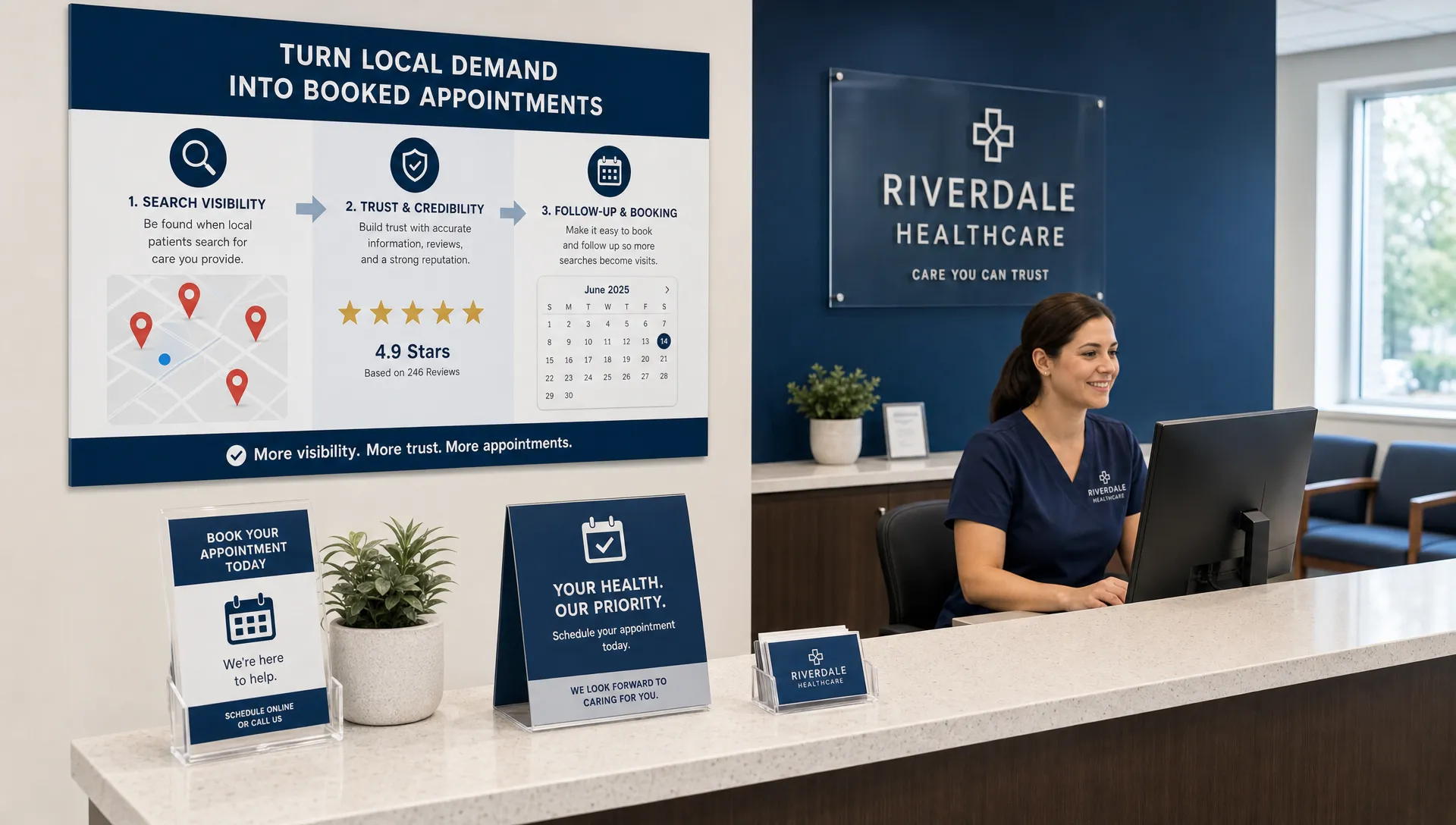
Most patients do not contact the first practice they see. They compare. Reviews, star ratings, recent feedback, provider reputation, photos, and the tone of your website all shape whether your practice feels like the safest choice.
Research from BrightLocal’s Local Consumer Review Survey has consistently shown that online reviews play a major role in how consumers evaluate local businesses. Healthcare decisions can be even more trust-sensitive because the perceived risk is higher.
Reputation growth should be ethical and consistent. Practices need a process for asking satisfied patients for feedback, responding professionally, and identifying recurring themes. If reviews mention friendly staff, short wait times, clear explanations, or successful outcomes, those themes can reinforce your positioning. If reviews reveal friction, such as scheduling issues or communication gaps, marketing should not hide the problem. The practice should fix it.
A demand-focused agency treats reputation as part of conversion, not as a vanity metric. More positive reviews can improve confidence, but the real value is helping patients feel comfortable enough to schedule.
Close the follow-up gap after the lead comes in
Many practices lose demand after marketing has already done its job. A patient calls after hours, submits a form on a weekend, leaves a voicemail, or asks a question but never gets a timely response. In competitive local markets, that patient may contact another practice within minutes.
Marketing automation can help reduce that leakage. Common examples include instant form confirmations, missed-call text responses, appointment request routing, review request workflows, and reactivation campaigns for patients who have not visited in a while. The purpose is not to replace the front desk. It is to support the team so fewer opportunities fall through the cracks.
Healthcare practices also need to be careful with privacy. The U.S. Department of Health and Human Services provides guidance on HIPAA and marketing, and practices should avoid using protected health information in ways that create compliance risk. A specialized agency should understand that healthcare growth must be pursued responsibly.
How demand growth changes by specialty
The core system is similar across healthcare, but the strategy changes by specialty. A pediatric dental practice, cataract surgeon, chiropractic office, and pain management clinic should not use identical messaging or conversion paths.
| Practice type | Common demand trigger | Marketing focus | Conversion priority |
|---|---|---|---|
| Dental and orthodontics | Pain, appearance, family convenience, long-term treatment planning | Local SEO, reviews, emergency or cosmetic service pages, consult campaigns | Fast booking and trust-building |
| Vision and eye care | Routine exams, symptoms, specialty care, surgery consideration | Service education, local visibility, condition-specific pages | Clear next steps and provider credibility |
| Chiropractic, pain, and physical therapy | Pain, injury, mobility limits, failed self-care | Symptom-driven content, Google Ads, landing pages | Urgency, clarity, and follow-up speed |
| Specialty and surgical practices | Diagnosis, referral, second opinion, procedure research | Authority content, reputation, consultation funnels | Education and confidence before scheduling |
This is one reason general marketing playbooks often underperform in healthcare. The patient journey is not one-size-fits-all. Demand growth depends on matching the channel, message, and booking process to the patient’s level of urgency and trust.
Measure demand by appointments, not impressions
A practice cannot improve what it does not measure. Still, the wrong metrics can create false confidence. Impressions, clicks, and rankings are useful leading indicators, but they do not prove growth by themselves.
A demand-focused reporting model should connect marketing activity to business outcomes whenever possible. That usually includes qualified calls, form submissions, booked appointments, cost per booked appointment, service-line performance, new patient trends, and conversion rates by channel.
Call tracking, form tracking, CRM notes, and scheduling data can help reveal which campaigns actually produce patients. The goal is not perfect attribution. Healthcare decision-making can involve multiple searches, phone calls, referrals, and family conversations. The goal is enough clarity to invest more in what works and fix what blocks growth.
When a practice starts tracking demand properly, surprising insights often appear. A page with modest traffic may generate high-value consultations. An ad campaign with lower click volume may produce better patients. A service page may rank well but fail to convert because the call to action is unclear. These are the insights that turn marketing from guesswork into a growth system.
What the first 180 days often look like
Every practice starts from a different place, so no agency should promise an identical timeline. Competition, website condition, review profile, service mix, location, and budget all affect speed. Still, demand growth often follows a practical progression.
During the first 30 days, the focus should be diagnosis and foundation. That means reviewing analytics, search visibility, Google Business Profile performance, website conversion paths, service priorities, tracking, and lead handling. If tracking is broken, fixing it comes before scaling spend.
From days 31 to 90, the agency can begin improving the highest-impact bottlenecks. That may include launching priority service pages, restructuring Google Ads, improving landing pages, strengthening calls to action, cleaning up local SEO issues, and creating a review generation process.
From days 90 to 180, the system should start compounding. SEO content gains traction, ads become more efficient, reputation improves, and conversion data informs the next round of decisions. The practice should have a clearer view of which services are creating demand and which operational gaps still need attention.
The best agencies keep refining. Demand is not built once and left alone. It changes with competition, seasonality, patient behavior, insurance dynamics, staff capacity, and the practice’s growth goals.
Signs your marketing is actually growing demand
A practice does not have to wait a full year to know whether the system is moving in the right direction. Early signals can show whether demand is becoming stronger and more measurable.
Look for patterns such as more non-branded searches for priority services, rising Google Business Profile calls and direction requests, stronger conversion rates on service pages, more qualified appointment requests, better call quality, more reviews mentioning target services, and fewer leads lost to slow follow-up.
The strongest sign is simple: your schedule starts filling with more of the patients you were trying to attract. Not just more inquiries, but more appropriate appointments, better consult quality, and clearer revenue impact.
Frequently Asked Questions
What does a Louisville healthcare marketing agency do? A Louisville healthcare marketing agency helps local practices attract, convert, and retain patients through channels such as local SEO, Google Ads, website design, reputation management, and patient follow-up systems.
How is healthcare marketing different from general local marketing? Healthcare marketing requires more trust-building, clearer patient education, privacy awareness, and service-specific strategy. Patients are often anxious, comparing providers carefully, and looking for credible guidance before booking.
How long does it take to grow patient demand? Paid search can create faster visibility, while SEO and reputation gains usually compound over several months. The timeline depends on competition, website quality, review strength, tracking, budget, and how quickly the practice can respond to leads.
Should a healthcare practice focus on SEO or Google Ads first? It depends on the bottleneck. If the practice needs immediate lead flow, Google Ads may help while SEO builds. If the practice has weak local visibility or poor service pages, SEO and website improvements may be the better foundation.
What metrics matter most for healthcare demand growth? The most useful metrics are qualified calls, appointment requests, booked appointments, conversion rates, cost per booked patient, service-line performance, and new patient volume. Clicks and impressions matter only when they help explain those outcomes.
Build a demand system around your practice goals
Growing demand is not about doing more random marketing. It is about building a patient acquisition system that helps the right people find your practice, trust your expertise, and schedule care with less friction.
If your Louisville-area healthcare practice wants clearer visibility, better-qualified leads, and marketing tied to booked appointments, Louisville Web Lab can help you identify the biggest growth bottlenecks and map the next steps through a diagnostic strategy call.