
All articles

    Learning Center

    Google Ads Cost Per Click in Healthcare: What Changes It

    Healthcare CPC is not just about bids. Learn why patient intent, specialty, location, ad quality, landing pages, and tracking change what your practice pays for every Google Ads click.

    Google Ads Cost Per Click in Healthcare: What Changes It

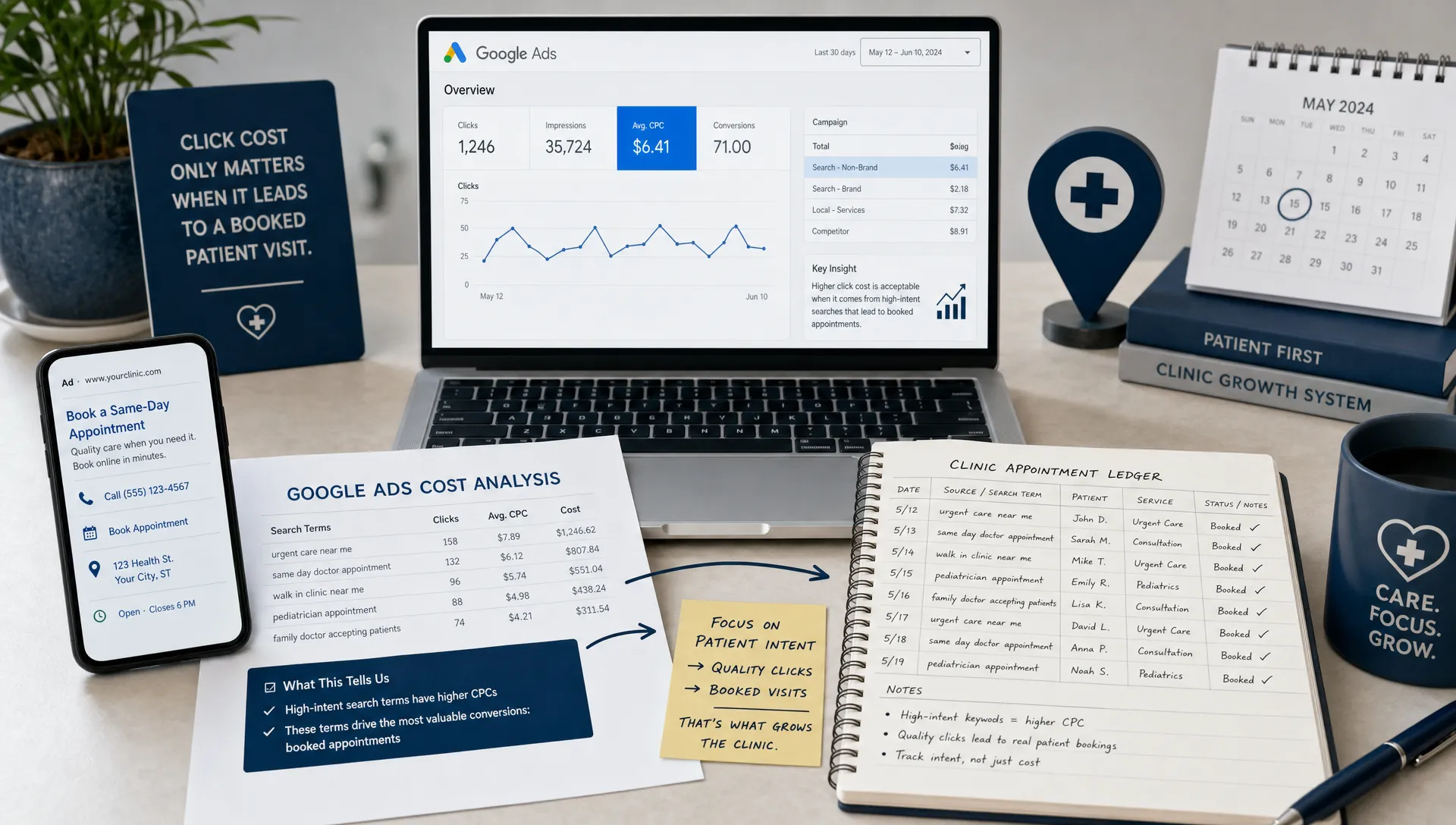
    A high Google Ads cost per click is not automatically bad, and a low CPC is not automatically efficient. In healthcare, the real question is whether each click is coming from a patient with the right intent, in the right location, for a service your practice actually wants to grow.

    That is why two clinics in the same city can see very different Google Ads cost per click numbers. A dental implant campaign may compete in a more expensive auction than a hygiene campaign. A LASIK consultation ad may cost more than a routine eye exam ad. A pain management clinic targeting “back pain doctor near me” will usually face different economics than a physical therapy practice promoting post-surgical rehab.

    CPC changes because Google Ads is an auction, but it is not just a “highest bidder wins” auction. Your bid, competition, ad relevance, landing page experience, location, timing, and patient intent all affect what you pay. Understanding those variables helps healthcare practices stop obsessing over average CPC and start making better decisions about patient acquisition.

    What Google Ads Cost Per Click Really Means

    Cost per click, or CPC, is the amount you pay when someone clicks your ad. Average CPC is calculated by dividing total click cost by total clicks.

    For example, if a campaign spends $1,200 and receives 100 clicks, the average CPC is $12.

    But CPC does not tell the whole story. A $12 click that becomes a booked implant consultation can be far more valuable than a $4 click from someone outside your service area, looking for insurance information, or researching symptoms with no intent to schedule.

    Google explains that ad position and auction outcomes are influenced by Ad Rank, which includes factors such as bid, ad quality, expected impact of assets, auction competitiveness, and the context of the search. In other words, your CPC is shaped by both market demand and campaign quality, not just your daily budget.

    If you want a broader budgeting view by specialty and campaign type, Louisville Web Lab’s guide to Google Ads cost for healthcare practices in 2026 is a helpful companion. This article focuses more narrowly on what causes CPC to move up or down.

    The Biggest Factors That Change CPC in Healthcare

    Healthcare search ads sit at the intersection of urgency, trust, location, and lifetime patient value. That makes CPC especially sensitive to campaign setup and local market conditions.

    CPC factor Why it changes the auction Healthcare example
    Patient intent Higher-intent searches are more valuable and more competitive “Emergency dentist near me” usually costs more than “toothache causes”
    Specialty and service value Higher-revenue services attract more advertisers Dental implants, LASIK, pain procedures, orthodontics
    Local competition More practices bidding in the same area can raise CPC Dense metro areas often cost more than smaller towns
    Keyword match type Broad targeting can enter more auctions, including weaker ones “Dentist” may be less precise than “dental implants consultation”
    Ad relevance Better alignment can improve efficiency Ad copy that matches “Invisalign consultation” to an orthodontic landing page
    Landing page experience Strong pages can support better Quality Score and conversion rates A dedicated dry eye page usually beats a generic homepage
    Device and time of day Patient behavior changes by device and schedule Mobile clicks after hours may perform differently than weekday desktop clicks
    Tracking accuracy Poor tracking can push optimization toward the wrong clicks Counting all calls equally instead of booked appointments

    Patient Intent Has the Largest Impact

    The closer a search is to an appointment decision, the more valuable that click becomes. In healthcare, bottom-of-funnel keywords often carry higher CPC because they indicate immediate need or strong buying intent.

    A search like “best dentist near me” is competitive because multiple practices want that patient. A search like “what causes bleeding gums” may be cheaper, but it is also earlier in the decision process. Both can have value, but they should not be judged the same way.

    Common high-intent healthcare searches include:

    • “emergency dentist near me”
    • “Invisalign provider near me”
    • “LASIK consultation”
    • “chiropractor for sciatica”
    • “pain management doctor near me”
    • “physical therapy near me after knee surgery”
    • “cataract surgeon near me”

    The mistake many practices make is blending high-intent and low-intent keywords into the same campaign. That makes CPC harder to interpret. A campaign may look affordable on average, while the best patient searches are being underfunded or drowned out by broad, lower-quality traffic.

    Specialty and Procedure Value Influence Competition

    Advertisers tend to bid more aggressively when the service has higher revenue potential, stronger lifetime value, or urgent patient demand. That is why CPC often varies widely between service lines inside the same practice.

    A general dentistry campaign for routine cleanings may behave differently from a campaign for dental implants or cosmetic dentistry. An optometry campaign for annual exams may differ from LASIK or cataract surgery. A chiropractic campaign for general wellness may not compete the same way as a pain-focused campaign targeting sciatica or disc-related searches.

    This does not mean high-CPC services are a problem. In many cases, higher CPC is normal when the patient value is higher. The key is to compare CPC against cost per qualified lead, consultation rate, treatment acceptance, and revenue per case.

    For example, a cosmetic or implant dentistry campaign should not be judged like a basic checkup campaign. A dental clinic homepage such as Teeth On Ferry’s smile consultation and dental services experience illustrates how high-value services need clear positioning, visible treatment categories, and an obvious consultation path after the click.

    Location Can Raise or Lower CPC Dramatically

    Google Ads for healthcare is local by nature. Most patients want a provider nearby, and most practices can only serve patients within a realistic drive radius. That makes geography one of the strongest CPC variables.

    In a competitive city, you may have dozens of dentists, orthodontists, optometrists, chiropractors, and specialty clinics bidding for similar terms. In a suburban or rural market, fewer advertisers may reduce auction pressure, but search volume may also be lower.

    Location targeting details matter too. A campaign targeting an entire metro area may pay for clicks from people who are unlikely to drive to the practice. A campaign targeting only a tight radius may improve lead quality but increase average CPC if that area is highly competitive.

    Practices should look beyond city-level performance. ZIP code, neighborhood, and distance-from-office data can reveal where clicks are expensive but unproductive. Sometimes the best move is not lowering bids everywhere. It is excluding poor-fit areas and increasing visibility where patients actually book.

    Ad Relevance and Landing Page Quality Affect What You Pay

    Google does not only reward the highest bid. It also evaluates whether your ad is relevant to the search and whether the landing page provides a useful experience. That matters for healthcare practices because patients are often making trust-based decisions quickly.

    If someone searches “pediatric dentist near me” and lands on a generic dental homepage with no pediatric content, the experience is weak. If someone searches “dry eye treatment” and lands on an optometry page focused mainly on glasses, the message is mismatched. Those disconnects can hurt both CPC efficiency and conversion rate.

    A strong healthcare landing page usually includes clear service relevance, location cues, provider credibility, patient-friendly language, call and form options, insurance or financing information when appropriate, and a visible appointment request.

    A healthcare marketer reviews a Google Ads performance dashboard with campaign metrics for calls, forms, cost per click, and booked appointments, while a clinic landing page wireframe sits beside the data in a clean office setting.

    Even if two practices pay the same CPC, the practice with the better landing page can win more patients from the same spend. That is why cost per click should never be analyzed without conversion rate.

    Here is a simple example:

    Scenario Average CPC Landing page conversion rate Cost per lead
    Campaign A $18 10% $180
    Campaign B $9 2% $450

    Campaign B has the cheaper click, but Campaign A has the better business outcome. In healthcare PPC, the cheapest traffic is often not the most profitable traffic.

    Keyword Match Types and Negative Keywords Change CPC Quality

    Keyword match types determine how closely a patient’s search must match your keyword before your ad can appear. Broad match can generate more volume, but it can also pull in searches that are too general, informational, or irrelevant. Phrase and exact match can improve control, though they may limit volume if used too narrowly.

    Negative keywords are equally important. Without them, a healthcare practice can pay for clicks related to jobs, school programs, free services, at-home remedies, insurance-only questions, competitor research, or conditions the practice does not treat.

    For example, a dental implant specialist may want to exclude searches related to “cheap dentures” if they do not offer that service. A physical therapy practice may want to exclude “physical therapy assistant salary.” An optometrist may want to exclude “eye doctor school” or “free eye exam” depending on the campaign goal.

    Better query control may not always lower average CPC immediately, but it often improves the value of each click. For more tactical ways to improve efficiency after campaigns are live, see these Google Search campaign tips to lower cost per lead.

    Timing, Devices, and Patient Behavior Matter

    Healthcare searches do not perform the same all day. Some urgent searches happen after hours. Some high-value consult requests happen during lunch breaks or evenings. Some clicks convert better on mobile because patients want to call immediately, while others convert better on desktop because the decision requires more research.

    A chiropractic clinic may see strong mobile call activity in the morning when patients wake up in pain. A LASIK practice may see more form submissions in the evening when people have time to compare providers. An orthodontic practice may see parent-driven searches outside traditional work hours.

    If a campaign treats every hour and device equally, CPC data can become misleading. You may be paying the same for clicks that have very different appointment potential.

    Useful segments to review include:

    • Hour of day
    • Day of week
    • Mobile vs desktop
    • New vs returning visitors
    • Call clicks vs form submissions
    • Distance from practice location

    These segments help you understand whether CPC is expensive because the auction is competitive or because the campaign is spending in low-conversion windows.

    Tracking Accuracy Can Change How Google Optimizes

    Modern Google Ads campaigns rely heavily on conversion data. If tracking is wrong, Google may optimize toward the wrong behavior.

    For healthcare practices, this is a common problem. A campaign may count every call as a conversion, even if many calls are spam, billing questions, existing patient calls, or wrong-number inquiries. A form submission may be counted as a lead even if the person is outside the service area or wants a service the practice does not offer.

    Better tracking separates surface-level actions from meaningful outcomes. At a minimum, practices should distinguish between calls, forms, appointment requests, and booked appointments when possible. Call duration filters can also help, although duration alone does not prove quality.

    This is especially important in healthcare because compliance and privacy considerations limit some of the tracking tactics used in other industries. Campaigns need enough conversion data to optimize, but they must also avoid mishandling sensitive patient information.

    If your practice is still building the foundation, Louisville Web Lab’s guide on setting up Google Ads for better healthcare leads covers campaign structure, targeting, landing pages, and conversion tracking in more detail.

    Why CPC Often Rises Over Time

    Many practice owners notice that Google Ads cost per click rises year over year. This can happen for several reasons.

    More competitors may enter the auction. Existing competitors may increase budgets. Google may expand automation features that change auction participation. Seasonal demand may increase for certain services. A practice may also move into more competitive keywords as it tries to grow higher-value procedures.

    Rising CPC is not always avoidable. The goal is to make sure revenue per click rises too. Better landing pages, stronger follow-up, improved scheduling, faster call response, and more precise targeting can protect profitability even when clicks get more expensive.

    For healthcare practices, the biggest opportunity is often not shaving a few dollars off every click. It is converting more of the right clicks into booked appointments.

    How to Lower CPC Without Attracting Worse Patients

    Lowering CPC is only useful if patient quality stays strong. Cutting bids too aggressively can push your ads out of the best auctions and leave you with lower-intent traffic.

    A healthier approach is to improve efficiency at the campaign level:

    • Separate high-value services into their own campaigns or ad groups.
    • Align keywords, ad copy, and landing pages around one clear patient need.
    • Use negative keywords to reduce irrelevant searches.
    • Review search terms regularly instead of relying only on keyword lists.
    • Tighten location targeting around areas that actually produce appointments.
    • Improve landing page speed, clarity, and appointment calls to action.
    • Track qualified leads and booked appointments, not just clicks.

    The best CPC reduction strategies usually come from relevance, not restriction. When Google sees that your ad and landing page match the search, and patients respond well, your campaign has a better chance of competing efficiently.

    The Better Metric: Cost Per Booked Patient

    CPC is useful, but it is not the final scorecard. A healthcare practice should monitor the full path from search to appointment.

    That path usually looks like this: search impression, click, landing page visit, call or form, lead qualification, scheduled appointment, completed appointment, treatment plan, revenue.

    If you only measure CPC, you may optimize for cheap clicks that never become patients. If you measure booked appointments and revenue, you can decide when a higher CPC is acceptable.

    For example, a $25 click may be profitable for dental implants, orthodontics, cataract surgery, pain procedures, or regenerative medicine if the campaign produces qualified consultations. A $5 click may be too expensive if it brings unqualified traffic, no-shows, or patients seeking services you do not provide.

    In healthcare marketing, the right question is not “How do we get the lowest CPC?” It is “How do we pay the right amount for the patients we actually want?”

    Frequently Asked Questions

    What is a good Google Ads cost per click for healthcare? A good CPC depends on specialty, market, service value, and conversion rate. A high-intent dental implant, LASIK, or pain management click may cost more than a routine care click, but it can still be profitable if it turns into a qualified appointment.

    Why is my healthcare CPC higher than a competitor’s? Your CPC may be higher because of your target location, keyword intent, service mix, bidding strategy, ad relevance, landing page experience, or competition. It may also look higher if you are targeting more valuable procedures than your competitor.

    Does lowering bids always reduce cost per click? Lowering bids can reduce CPC, but it can also reduce impression share and push your ads out of high-quality auctions. It is often better to improve relevance, refine keywords, add negatives, and strengthen landing pages before making aggressive bid cuts.

    Should healthcare practices focus on CPC or cost per lead? CPC is an important diagnostic metric, but cost per qualified lead and cost per booked patient are more meaningful. A lower CPC does not help if the clicks do not become appointments.

    Can better landing pages reduce Google Ads costs? Better landing pages can improve conversion rate and may support stronger ad quality. Even when CPC does not drop, a stronger landing page can lower cost per lead by turning more clicks into patient inquiries.

    Turn CPC Data Into Better Patient Acquisition

    Google Ads cost per click in healthcare changes because patient intent, competition, geography, ad quality, landing pages, and tracking all change the auction. The practices that win are not always the ones paying the least per click. They are the ones that know which clicks are worth paying for.

    Louisville Web Lab helps healthcare practices connect Google Ads strategy to measurable growth, including SEO, paid search, websites, automation, reviews, and patient acquisition systems. If your practice wants to understand where ad spend is going and how to turn more searches into booked appointments, a diagnostic strategy call is a smart next step.

    Next Step

    Ready to put this into action?

    Book a diagnostic call and we will build a custom growth plan for your practice.

    The Louisville Practice Growth Brief

    One short email a month: what is working in patient acquisition for private practices. No pitch, unsubscribe anytime.

    Email is required.