
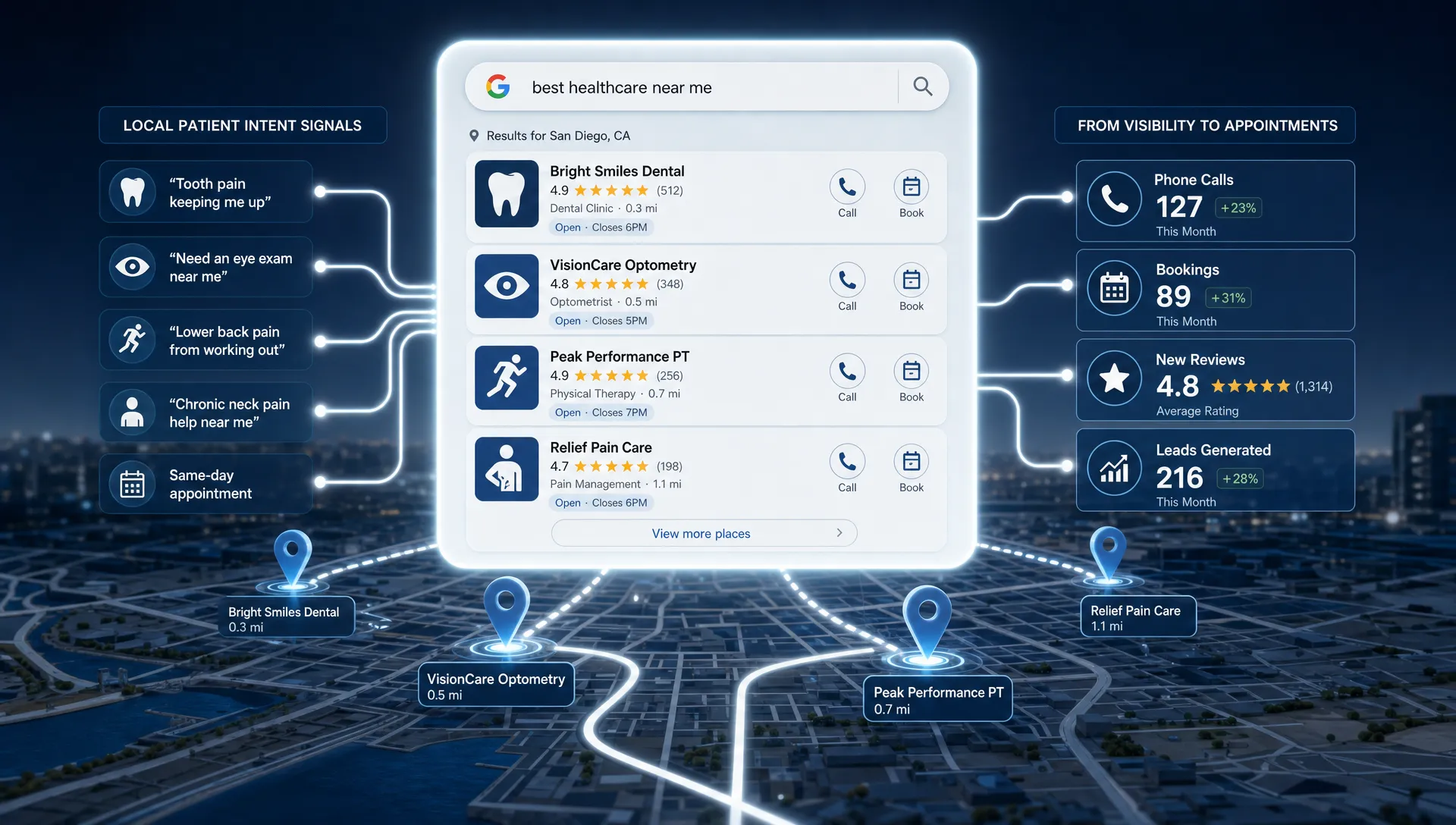
For a healthcare practice, Google Business advertising should do more than make the phone ring. It should make the right phone ring, from the right patient, for the right service, at a time when your team can turn that inquiry into an appointment.
That distinction matters. A dental implant practice, pediatric dentist, optometrist, physical therapy clinic, pain management group, or orthodontic office can all buy Google visibility. But visibility alone is not the goal. The goal is a predictable patient acquisition system that connects local search intent to booked appointments and measurable revenue opportunities.
In practice, “Google Business advertising” usually refers to the combined use of a Google Business Profile, Google Ads, Maps visibility, local landing pages, call tracking, reviews, and conversion follow-up. It is not one button you turn on. It is a system that should help your practice show up when patients are actively searching, earn enough trust for them to contact you, and give your front desk the information needed to convert that contact into care.
It should capture patients who are already looking for care
The strongest Google campaigns start with intent. A patient searching “emergency dentist near me,” “orthodontist consultation,” “dry eye clinic,” “sciatica doctor,” or “sports physical therapy near me” is not browsing casually. They have a problem, a location preference, and often a short decision window.
Google Business advertising should help your practice appear in these high-intent moments across the places patients actually look, including Google Search, Google Maps, and your Google Business Profile. According to Google Business Profile Help, a Business Profile helps businesses manage how they appear on Search and Maps. For healthcare practices, that profile is often the first impression before a patient ever visits your website.
The job of advertising is to strengthen that first impression, not bypass it. If your ad appears but your profile has incomplete hours, weak photos, outdated services, poor reviews, or inconsistent contact information, you may pay for attention that does not become appointments.
If your practice is still building that foundation, this guide on how to create a Google Business Profile for your practice explains the setup elements that influence local trust and visibility.
It should turn local visibility into qualified patient actions
A good campaign is not measured only by impressions, clicks, or profile views. Those numbers can be useful, but they do not prove that advertising is helping the practice grow.
For healthcare practices, the more important outcomes are patient actions:
- Calls from people looking for a specific service
- Appointment requests from your target geography
- Form submissions with enough context for follow-up
- Online booking starts or completed bookings
- Direction requests from nearby patients
- New patient inquiries that match your clinical priorities
A cosmetic dentist may value veneer consultations more than general cleaning calls. A pain physician may prioritize interventional pain consultations over broad “back pain” traffic. An optometry office may need more annual eye exams, while an ophthalmology group may want cataract surgery evaluations. Google Business advertising should be structured around those differences.
That means service lines should not all be treated the same. Campaigns, ads, landing pages, and tracking should reflect which services have capacity, which are profitable, which require education, and which convert best from search.
It should connect the ad, profile, website, and front desk
Many practices think of Google advertising as a media buy. In reality, it is a patient journey.
A patient may first see your ad, glance at your reviews, open your Google Business Profile, compare your hours, click to your website, read a service page, call your office, and ask whether you accept their insurance or offer a consultation. If any part of that journey is weak, ad performance suffers.
That is why strong Google Business advertising should align four assets:
| Asset | What it should do | Practice growth metric |
|---|---|---|
| Google Business Profile | Build local trust with accurate information, services, photos, reviews, and contact options | Calls, direction requests, profile interactions |
| Google Ads | Put your practice in front of high-intent local searches | Qualified clicks, calls, lead volume, cost per lead |
| Landing pages | Explain the service clearly and make the next step easy | Form submissions, calls, booking actions |
| Follow-up process | Help staff convert inquiries into scheduled visits | Appointment rate, show rate, new patient count |
This is where many campaigns fail. The ads might be technically active, but the website is slow, the phone is missed, the landing page is too generic, or the practice never reviews which leads became patients.
Google Business advertising should reduce that friction. It should make the path from search to appointment feel simple and trustworthy.
It should prioritize fit, not just volume
More leads are not always better. A practice can receive plenty of calls and still be frustrated if those calls are outside the service area, about services the practice does not provide, or from patients who are not a good fit for the schedule, provider, or case type.
For example, an orthodontic practice running broad ads for “braces” may attract price shoppers who are not ready for a consultation. A chiropractor advertising “pain relief” too broadly may get calls for conditions outside the clinic’s scope. A dental implant specialist may waste budget if ads attract patients looking for low-cost extractions rather than implant consultations.
Better Google Business advertising should filter as well as attract. It can do this through location targeting, service-specific keywords, negative keywords, ad copy, landing page language, and conversion tracking that identifies lead quality.
This is also why campaigns should be reviewed based on actual search terms, not only the keywords selected at launch. Patient language changes by market. A clinic in Louisville may see different search patterns than a practice in a larger metro or suburban community. The campaign should adapt to that reality.

It should help the practice understand what patients care about
One of the underrated benefits of Google advertising is market feedback. Search behavior reveals what patients are trying to solve, how they describe symptoms, what services they compare, and which concerns create hesitation.
A physical therapy clinic may learn that patients search more often for “sports injury physical therapy” than for a clinical service name. A dry eye clinic may discover that “burning eyes treatment” brings better early-stage inquiries than a branded procedure term. A dental office may find that “same day crown” or “dentist open Friday” performs differently than expected.
This information should not stay locked inside the ad account. It can improve website copy, Google Business Profile services, FAQ content, intake scripts, reputation strategy, and even how the practice presents consultations.
When done well, advertising becomes more than a traffic source. It becomes a listening tool.
It should protect patient trust and healthcare compliance
Healthcare advertising is not like advertising a restaurant or home service company. Patients are making sensitive decisions. They may be in pain, worried about cost, embarrassed about symptoms, or concerned about privacy.
Google Business advertising should reflect that sensitivity. Ad copy should be accurate, clear, and professional. Landing pages should avoid exaggerated promises, fear-based claims, or language that implies guaranteed outcomes. Practices should also be careful with tracking and remarketing, especially when the service could reveal protected health information or sensitive medical interests.
Google maintains specific healthcare and medicines advertising policies, and U.S. healthcare organizations must also consider HIPAA obligations. The U.S. Department of Health and Human Services has issued guidance on online tracking technologies and HIPAA, which is especially relevant when practices use analytics, pixels, forms, and advertising platforms.
A responsible campaign should balance performance with trust. It should generate leads without creating unnecessary compliance exposure or damaging the credibility of the practice.
It should report on appointments, not vanity metrics
Clicks are easy to report. Appointments are harder, but they matter more.
A practice should know which campaigns are producing real opportunities. That does not mean every report must be complicated. It does mean the practice should be able to answer basic business questions:
- Which services generated the most qualified inquiries?
- Which campaigns produced calls that became appointments?
- Which locations or zip codes performed best?
- Which keywords created wasted spend?
- Which landing pages converted at a higher rate?
- What was the approximate cost per booked appointment?
The final question is often the most important. A campaign with a higher cost per click can still be profitable if it attracts patients for valuable services. A campaign with cheap clicks can be a waste if the inquiries never schedule.
If your practice is evaluating performance, it is worth looking beyond platform metrics. Louisville Web Lab’s article on Google ad services for practices focused on ROI goes deeper into how practices can judge advertising by business outcomes instead of clicks alone.
It should support both immediate demand and long-term growth
Google Ads can create faster visibility, especially for competitive services or new locations. But it should not operate in isolation. The best results often come when paid advertising, local SEO, reputation building, and website conversion work together.
For example, ads can help a new orthodontic location get early consultation requests while local SEO gains traction. A Google Business Profile with strong reviews can improve trust when paid traffic checks your listing. A high-converting service page can help both organic visitors and ad visitors take action.
This creates a compounding effect. Paid search helps capture today’s demand. Local SEO and reputation help lower dependency on paid traffic over time. Conversion improvements make every channel more efficient.
If your practice is comparing which advertising options belong in the mix, this breakdown of Google advertising services every practice should compare can help clarify the role of Search Ads, Local Services Ads, landing pages, and related tools.
It should match your capacity and business goals
Advertising should not create demand your practice cannot handle. If your hygiene schedule is booked out for months, pushing general dental cleanings may frustrate patients and staff. If a provider has room for new pain consultations on certain days, campaigns can prioritize that service line. If a physical therapy clinic wants more post-surgical rehab cases, the campaign should not spend most of the budget on unrelated searches.
Before launching or expanding Google Business advertising, a practice should clarify:
- Which services need more patients right now
- Which providers or locations have availability
- Which appointment types are most valuable
- Which insurance, payment, or referral factors affect conversion
- Which calls the front desk is prepared to handle
This is where strategy matters. A campaign should reflect the practice’s actual growth plan, not just a generic list of keywords.
Signs your Google Business advertising is not doing enough
If your practice is already running ads, the problem may not be that Google “doesn’t work.” The problem may be that the campaign is not built to produce healthcare-specific outcomes.
Common warning signs include:
- Reports focus heavily on clicks and impressions, with little mention of booked appointments
- All services are grouped into one campaign or one landing page
- Ads send traffic to the homepage with no clear next step
- Calls are counted as conversions even when they are spam, vendors, or wrong-number inquiries
- The Google Business Profile has incomplete service details or outdated information
- The campaign spends on broad terms that do not match your ideal patient
- There is no feedback loop between the front desk and the marketing team
A mature system should improve over time. If the same problems repeat every month, the campaign may be active, but it is not learning.
What good Google Business advertising should ultimately produce
At its best, Google Business advertising gives a healthcare practice more control over growth. It helps the practice appear when patients are ready, communicate why the practice is a strong choice, and measure whether marketing dollars are turning into real appointments.
The end result should be a clearer answer to a simple question: “If we invest in Google, what happens for the practice?”
A strong answer sounds like this: more qualified local visibility, more relevant patient inquiries, better conversion from search to scheduled visits, and better insight into which services are driving growth.
That is what Google Business advertising should do. Not just traffic. Not just calls. Not just a busy dashboard. It should help the practice acquire the right patients in a way that is measurable, ethical, and aligned with capacity.
Frequently Asked Questions
What is Google Business advertising for a healthcare practice? Google Business advertising is the strategic use of Google visibility tools, such as Google Business Profile, Google Ads, Maps placement, landing pages, and conversion tracking, to generate qualified patient inquiries and appointments.
Is a Google Business Profile enough without paid ads? Sometimes it can be, especially in less competitive markets or for well-established practices. In competitive healthcare categories, paid ads can help capture high-intent searches while your profile, reviews, and local SEO build longer-term visibility.
What should a practice measure from Google advertising? Practices should measure qualified calls, appointment requests, booked visits, cost per qualified lead, cost per booked appointment, service-line performance, and lead quality. Clicks and impressions are useful, but they are not enough by themselves.
Should every healthcare service have its own campaign? Not always, but high-priority services often need separate structure, messaging, landing pages, and tracking. A dental implant campaign should not be evaluated the same way as general dentistry, and a cataract surgery campaign should not be treated like routine eye exams.
How soon should a practice expect results from Google advertising? Paid ads can generate visibility quickly, but meaningful optimization takes time. The practice needs enough data to see which searches, ads, locations, and landing pages produce qualified inquiries and booked appointments.
Turn Google visibility into booked patient appointments
If your practice is investing in Google but still cannot clearly connect visibility to patient growth, it may be time to look at the whole system. Ads, your Google Business Profile, landing pages, tracking, reviews, and front-desk follow-up all influence whether search traffic becomes scheduled care.
Louisville Web Lab helps healthcare practices use SEO, Google Ads, websites, and automation to turn search visibility into measurable patient acquisition. If you want a clearer plan for what Google Business advertising should do for your practice, book a diagnostic strategy call with Louisville Web Lab.